SYNOPSIS: In “Jay Kelly,” a new comedy-drama in theatres now before moving to Netflix on December 5, George Clooney plays a coddled movie star whose growing discomfort with his comfortable existence causes major changes in his life and the lives of those around him. “Are you running to something or from something,” asks Jay Kelly’s manager Ron (Adam Sandler). “Yes,” says Kelly (Clooney).
CAST: George Clooney, Adam Sandler, Laura Dern, Billy Crudup, Emily Mortimer. Directed by Noah Baumbach.
REVIEW: A showcase for George Clooney and Adam Sandler, “Jay Kelly” is a comedy about the cost of fame, tinged with regret.
When we first meet Jay Kelly (George Clooney) he’s a major movie star—think George Clooney—wrapping up one project before starting another in the next week. He’s an on-the-go-guy, surrounded by an entourage, including longtime manager Ron Sukenick (Adam Sandler), publicist Liz (Laura Dern) and hairdresser Candy (Emily Mortimer), who fawn over him, catering to his every whim.
When his mentor passes away, at the funeral he reconnects with Timothy (Billy Crudup), an old friend from acting school who forces Jay to reassess his fame, his work, his entire life. “Is there a person in there?” Timothy asks. “Maybe you don’t actually exist.”
Rocked by the experience, he drops out of his next film and embarks on a journey of self-discovery to Europe, alongside Ron and the staff who have helped erect the wall between him and the real world.
“Jay Kelly” is a sharply written show business satire, but don’t expect “Sunset Boulevard,” “Tropic Thunder” or “Network.” The script, by Emily Mortimer and Noah Baumbach, does poke gentle fun at the usual Tinsel Town excesses, but this is more a cautionary tale of the price of success. “All my memories are movies,” Jay says ruefully, reflecting on his isolation from friends and family.
He’s loved by millions, but isn’t close with his daughters, Daisy (Grace Edwards) and Jessica (Riley Keough), and his friends are mostly staff. He has a movie star smile, but behind the nice guy façade, he can be cruelly dismissive of those who work with him. “You’re my friend who takes 15% of my salary,” he says to Ron, his long serving manager.
“We are not to him what he is to us,” says Liz, his publicist of thirty years.
Clooney nails the sorrow of a man who has it all, except for the things that really matter. Sauve, yet sad, he chose work and his career over all else and now searches for meaning in the relationships that sustained him for decades, even though he always put himself and ambitions first. Does Jay’s world mean anything when the price was not being able to spend meaningful time with his friends and family?
It’s not a Hollywood noir; it’s a Hollywood Melancholy.
Sandler displays his dramatic chops as the eager, puppy dog manager Ron. After thirty years of having his life upended by Jay’s every fancy, it finally dawns on his that the relationship is more one sided than he imagined. Sandler is by times in control, by times vulnerable, but he’s the glue that not only keeps Jay’s like together, but the movie as well.
“Jay Kelly” is slightly overlong, but in its exploration of what is important in life, and not just the life of a movie star, but all lives, it expertly rides the line between funny and heartbreak.
SYNOPSIS: In “Paddington in Peru,” the marmalade loving bear, voiced by Ben Whishaw, searches for his cherished Aunt Lucy who has gone missing in the Peruvian jungle. Helping Paddington on his dangerous quest are Oscar winner Olivia Colman as a cheery singing nun, a brave boat captain played by Antonio Banderas and his adopted parents Henry (Hugh Bonneville) and Mary (Emily Mortimer, replacing Sally Hawkins).
CAST: Hugh Bonneville, Emily Mortimer, Julie Walters, Jim Broadbent, Carla Tous, Olivia Colman, Antonio Banderas and Ben Whishaw. Directed by Dougal Wilson.
REVIEW: If the world worked the way it is supposed to there would be a picture of Paddington the Bear next to the word ‘adorable’ in your dogeared copy of Funk and Wagnalls.
Since 1958, when the marmalade loving, spectacled bear first appeared in print, he has been an avatar for mischievous fun, kindness and overall, unescapable lovability.
Eight years after two perfectly perfect instalments of the bear’s adventures with his adopted English family comes “Paddington in Peru,” a new adventure that is sure to please family audiences, but the ambitious story doesn’t have the magic of the first two films.
The impossibly cute Paddington, voiced by Ben Wishaw, is still the kindhearted agent of mild chaos he has always been, but this time around his adopted family, the Browns, play a larger role. Emily Watson and Hugh Bonneville are up to the task, expertly riding the line between silly and sentimental, but the film Itself feels less whimsical than its predecessors.
Having said that, Olivia Coleman, as the singing nun at The Home for Retired Bears, brings a big dollop of fun in the “Sound of Music” inspired musical number “Let’s Prepare for Paddington.”
Paul King, director of the first two instalments, brought an eccentric charm to Paddington’s world that was undeniably wondrous. That world is still evident, but this time around director Dougal Wilson opts for action and adventure, most of which is very compelling, and character driven, but it doesn’t lift off the screen the way the first two films did.
Nonetheless, “Paddington in Peru” is a thoroughly enjoyable family film, one with timely subtext about immigration (Paddington gets his British passport in the film’s early minutes), identity and loyalty, and, of course, is laced with the bear’s good-natured way of seeing the best in everyone, even those who done him wrong.
Every one of us processes grief differently. Most people know the five stages of grief—denial, anger, bargaining, depression and acceptance—but “In Dust,” a dark comedy starring Matthew Broderick and Géza Röhrig, suggests there are a few phases missing from that list.Röhrig, the Hungarian actor best known as star of the Best Foreign Language Film Oscar winner “Son of Saul,” stars as Shmuel, an upstate New York Hasidic cantor distraught by the sudden passing of his wife Rivkah. Tormented by the thought that her ruach (soul) will not rest until she is turned to dust he becomes obsessed by the rate of her decomposition.
As I said, we all grieve differently.
His anguish pushes him to break religious law and seek guidance outside of his community. A casket salesman (Joseph Siprut), once he realizes Shmuel isn’t in the market to buy a casket, offers no help. “We don’t check their progress,” he says. In desperation he approaches bumbling community college biology professor Albert (Broderick).
The odd couple perform some decidedly non-kosher experiments—most notably with a stolen pig named Harold—to establish a timeline for Rivkah’s decay and put Shmuel’s mind to rest.
“Who doesn’t like bacon?” asks Albert, placing foot firmly in mouth.
First time feature director Shawn Snyder has crafted an offbeat but appealing comedy that offers up laughs as well as bittersweet sensitivity. In what is essentially a two hander, Snyder amps up the absurdity by allowing his actors to be both unlikeable and yet strangely compelling. Röhrig and Broderick are a perfectly matched, if morbid, odd couple.
Röhrig plays Shmuel as a sympathetic character but one who pushes the boundaries of behaviour as he follows through in his tormented obsession. He finds the tragedy and the humour in the situation, equal parts comic exasperation, stubbornness and heartache.
Broderick, often decked out in his ex-wife’s lacy housecoat, is a delight. His Albert has let life pass him by. Hapless and hopeless, he seizes on this experience as a way to reawaken his love of science and life. Broderick is deadpan perfection.
“To Dust” is a one-joke movie but it is a good joke brought to life by two actors who make their extreme characters relatable and recognizable.
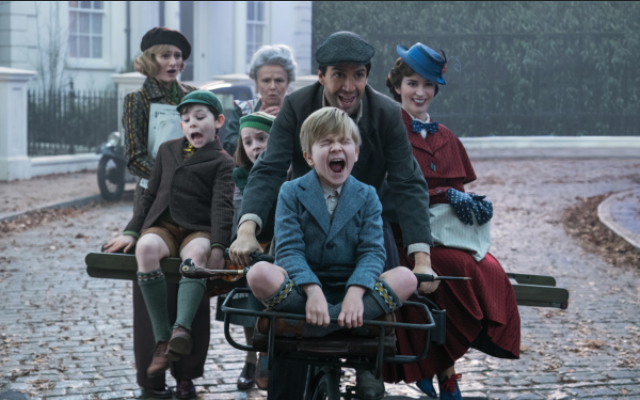
Fifty-four years after Julie Andrews made her debut as “the practically perfect in every way” nanny, who flew in (courtesy of her parrot-handled umbrella) and introduced magic to the lives of the dysfunctional Banks family, the beloved Mary Poppins character is back in “Mary Poppins Returns.” The new Disney musical-fantasy picks up 25 years after the events of the classic, with Poppins, played by Emily Blunt, returning to help the Banks children after misfortune befalls the family.
Set in 1930s London during the Great Slump, a city of gaslights and chimney sweeps, “Mary Poppins Returns” sees the kids from the original Michael and Jane Banks all grown up and played by Ben Whishaw and Emily Mortimer. Michael’s wife passed away the year before and now he, his kids (Pixie Davies, Nathanael Saleh, and Joel Dawson) and housekeeper Ellen (Julie Walters) live in the Banks’s family home on Cherry Tree Lane, the house made famous by P. L. Travers.
When the bank calls in the loan Michael took against the house the family risks losing everything. “Pay back entire loan on the house or it will be repossessed in five days,” cackles the lawyer who delivers the notice. On that very day Mary Poppins (Emily Blunt), the nanny who helped Michael and Jane as kids, and her magic bag come to the rescue. “Good thing you arrived when you did Mary Poppins,” says Jack (Lin-Manuel Miranda), former apprentice of Bert from the original film. Mary “I suspect that I am never incorrect” Poppins, helps the Banks family regain the joy and wonder that made their childhood years magical.
From the first song, “(Underneath the) Lovely London Sky”—“Count your blessings,” sings Jack. “You’re a lucky guy.”—the movie establishes its uplifting tone. It’s a frothy, satisfying concoction of nostalgia, music, fanciful visuals, elegance and optimism; a spoonful of sugar in bitter times.
Director Rob Marshall has made a full-on musical that mixes the best of old and new Disney. This thoroughly modern movie feels old-fashioned in the sense that it takes its time with the music, allowing the songs to breathe and the lyrics to sink in. But it isn’t simply an exercise in recollection. The smart new songs (written by Marc Shaiman with lyrics by Scott Wittman) refresh a familiar story, mixing seamlessly with snippets of songs from the original film blended into the score.
There are huge musical numbers, including a wild underwater spectacular, but the songs that work best are the more modest tunes like “A Conversation,” Michael’s requiem for his late wide. “These rooms were always filled with magic but that vanished since you’ve gone away.” It is heartfelt and heartbreaking. Ditto Mary Poppins’s “The Place Where Lost Things Go.”
Still, this is a movie that brims with joy. When the spunky Banks kids tell Mary Poppins (no one ever calls her Mary or Miss Poppins, its always first and last names) that they have “grown up a great deal in the last year.” She replies, “Yes. We’ll have to see what we can do about that.”
Like “Christopher Robin” from earlier this year, “Mary Poppins Returns” is ultimately about the importance of staying young at heart. The film essays Michael’s sense of loss and longing, his frustration at not knowing how to go on without his wife but it’s the upbeat attitude that gives it depth. “Everything is possible, even the impossible,” is a cliché but in context it is a call to believe, to have faith. If Michael believes in himself everything will be OK. That’s a potent message, delivered with a spoonful of sugar or not.
The cast impresses, delivering the film’s message with charm and verve. Emily Blunt brings a mix of strictness—“Sit up straight you’re not a flower bag,” she scolds.—and mischievousness to her character, effortlessly slipping into some very big shoes. Miranda provides a dose of musical theatre. Meryl Streep, as Mary’s eccentric cousin Topsy, offers a fun and funny lesson in perspective and Dick Van Dyke’s cameo as Mr. Dawes Jr. connects the old and new.
“Mary Poppins Returns” feels modern without sacrificing its nostalgic charm. There’s no “Supercallifragilisticexpialidocious” but, like the first film, there is plenty of heart.
Richard speaks to Emily Mortimer in the pages of the December issue of WestJet Magazine.
“Emily Mortimer says inspirational people—both fictional and real—surrounded her while filming Mary Poppins Returns. “There were so many days on the movie where you wanted to pinch yourself,” says the English actress. “You couldn’t believe what was happening…” Read the whole thing HERE!
At the end of the chamber dramedy “The Party,” you’ll be glad you were able to be a voyeur and not actually attend the get-together in person. It’s “Who’s Afraid of Virginia Woolf?” with more characters and twice the vitriol.
Kristin Scott Thomas is Janet, the newly appointed U.K. Health Minister and host of the party. When we first see her she’s holding a gun on a guest. It’s that kind of party.
Cue the flashback.
Gathered together are Janet’s nearest and dearest. There’s sharp-tongued best friend April (Patricia Clarkson), her almost ex and professional life coach Gottfried (Bruno Ganz), Martha (Cherry Jones) and her pregnant partner Jinny (Emily Mortimer), jumpy financial whiz Tom (Cillian Murphy), whose cocaine and aforementioned gun add some spice to an already edgy situation. On the periphery, for a time anyway, is Bill (Timothy Spall), a ticking time bomb with a glass of champagne.
Director Sally Potter wastes no time in presenting her sophisticated but sour soiree. The verbal—and text—fireworks begin almost immediately. Sparkling dialogue drips from the mouths of these actors like liquid gold. When Jinny announces she’s have more than baby Martha says, “Triplets. People. Small people.” It doesn’t sound like much on paper, but the magic is in the delivery. The best lines are reserved for Clarkson, whose blunt, plainspoken words add fuel to the already hot state of affairs. “Although it may have a deleterious effect on your career I think you could consider murder,” she purrs at one point.
Canapés smoulder, truths are revealed—there will be no spoilers here—and lives are shattered, all in just 71 minutes. “The Party” is a delightfully nasty piece of work, artfully realized by Potter and delivered with just the right amount of venom by a dedicated cast.
“Our life is not our life,” says Tony Webster (Jim Broadbent), “it’s just a story we’ve told to others.” Such is the theme of “The Sense of An Ending,” a gentle retelling of Julian Barnes’ Man Booker Prize-winning 2011 novel about human nature and the vagaries of memory.
Webster’s life is uneventful. An alarm wakes him at the same time every day. After a light breakfast he heads to his camera repair shop, puts in his hours and returns home. Occasionally he attends a birthing class with his pregnant-soon-to-be-single-mom daughter (Michelle Dockery) or enjoys a quick phone call with his cagey ex-wife Margaret (Harriet Walter).
A solicitor’s letter disrupts his quiet semi-retirement. Out of the blue he discovers the mother of his long ago ex-girlfriend Veronica (Freya Mavor) has died and left him something in the will. It is the diary of Adrian (Joe Alwyn) an old friend and classmate at Cambridge. Trouble is, Veronica (played in later life by Charlotte Rampling) doesn’t want to hand it over. Obsessed with getting what is rightfully his, Tony launches an investigation into Veronica and, ultimately, his own unsettled past.
Flip flopping between the present day and 1960s England, “The Sense of An Ending,” is an engaging look at what happens when the debris of a life lived enters into Tony’s well-ordered old age. The story is compelling—although the “as told to” nature of the flashbacks, complete with Margaret’s “so what happened nexts” seem a bit contrived—but the performances are bang on.
Broadbent is a careful mix of curmudgeon and charmer, a self-effacing man forced to confront and rediscover what is important to him. It’s subtle, effortless work and draws us deep into Tony’s tale.
He is supported by strong work from the women in Tony’s life, Walter, Dockery and Rampling. Each are key to the story and each help Tony on his journey of self discovery while never losing themselves or being relegated to stereotypical roles. Also worth a mention is a short but storing performance from Emily Mortimer as Veronica’s mother.
“The Sense of An Ending” is occasionally light and breezy when it should hunker down and dig a little deeper, but Broadbent and Co ensure it is never less than involving.
Harry Brown is a common name, like John Smith or Greg Jones. It’s the kind of name that doesn’t draw attention to itself, but in the hands of Michael Caine, who plays the lead character in the revenge thriller “Harry Brown,” the name, the character and the movie become memorable.
“Harry Brown” is a gritty “Gran Torino” with British accents and a dash of “Death Wish.” Caine plays Brown as High Noon’s Gary Cooper, but instead of being set on the wide open plain, the action in this Teabag Western takes place in the urban terrain of the Elephant and Castle section of London.
Caine plays a widowed man who strikes back after a gang of feral yobs kill his best mate and confidant Len (David Bradley). D.I. Alice Frampton, (Emily Mortimer), a persistent but ineffectual detective with the thankless job of policing the council estate, suspects Harry is a part time vigilante but can’t prove it, and even if she could her partner is ambivalent to the pensioner’s gun slinging ways. “As far as I’m concerned, Harry Brown is doing us a favor,” says D.S. Terry Hicock (Charlie Creed-Miles).
“Harry Brown” is a lurid picture of a crime ridden society. Its bleak worldview effectively illustrates the flip side of the Swingin’ London Caine came to personify in the 1960s. It’s a dark and menacing world where Len admits, “I’m scared all the time, Harry.” But all the atmosphere in the world wouldn’t be worth a hill of bangers and mash if you didn’t believe that an 80 year old man with an inhaler could effectively turn vigilante, take the law into his own hands and go all Dirty Harry on kids a fraction his age.
In a film ripe with nice performances—Mortimer is marvelous and Jack O’Connell is frightening as a young thug—Michael Caine shines, giving us a well rounded portrait of a man who is a trained killer—he was a marine—with a “certain set of skills” and as a defeated old man who has seen too much death and strife in his life.
He’s at his best when he plays the extremes—the heartbroken pensioner on one hand; the lethal killer who tosses off Tarantino-esque one liners like, “You failed to maintain your weapon, Son,” to a drug dealer whose gun jammed at the wrong moment, on the other—and it is his performance that humanizes the film’s often passionate pontificating on “Broken Britain.”
The title is a bit of a misnomer because the brother in question isn’t exactly an idiot. He’s more a trusting soul who naïve ways get him, and those around him, in trouble.
Paul Rudd plays Ned, a Mr. Nice Guy unsuited for life outside of his organic farm. Imagine R. Crumb’s Mr. Natural and you’ll get the picture. When he innocently sells marijuana to a uniformed policeman he is arrested and thrown in jail. His good nature stands him well in jail, where he earns an early release—he won Most Cooperative four months running. Unfortunately in his absence his hippie girlfriend found a new boyfriend and has decided that Willie Nelson, Ned’s beloved dog, is better off with her than with him. His three sisters (Elizabeth Banks, Zooey Dechanel and Emily Mortimer) take turns putting a roof over his head, but in each case his willingness to believe the best in people causes chaos.
“Our Idiot Brother” is a low key indie comedy with a much different feel from the movies that made Rudd famous. His Apatow years have been spent doing broad comedy in movies like Anchorman: The Legend of Ron Burgundy, The 40 Year Old Virgin and Knocked Up but this is more character based—and less funny.
There are laughs here, but instead of going for the jokes Rudd is concentrating on playing he character and allowing the humor to flow naturally from him and the situations. The result is a character driven comedy with a lot of compassion and some very good supporting performances from the women playing his sisters.
Banks, Dechanel and Mortimer each bring a different flavor to their roles. Banks is a driven writer with sketchy ethics, Dechanel a free-ish spirit with commitment issues while Mortimer plays a mousy mom. They all stand in stark contrast to the innocence of their brother but their presence buoys, and gives heart to, the film’s family first message.
“Our Idiot Brother” is a likeable comedy elevated by a strong cast who bring empathy to characters who, in less experienced hands, might not have had any.