Baby Driver: Although it contains more music than most tuneful of movies “Baby Driver,” the new film from director Edgar Wright, isn’t a musical in the “West Side Story,” “Sound of Music” sense. Wallpapered with 35 rock ‘n roll songs on the soundtrack it’s a hard driving heist flick that can best be called an action musical.
The Big Sick: Even when “The Big Sick” is making jokes about terrorism and the “X-Files” it is all heart, a crowd-pleaser that still feels personal and intimate.
Call Me By Your Name: This is a movie of small details that speak to larger truths. Director Luca Guadagnino keeps the story simple relying on the minutiae to add depth and beauty to the story. The idyllic countryside, the quaint town, the music of the Psychedelic Furs and the languid pace of a long Italian summer combine to create the sensual backdrop against which the romance between the two blossoms. Guadagnino’s camera captures it all, avoiding the pitfalls of melodrama to present a story that is pure emotion. It feels real and raw, haunted by the ghosts of loves gone by.
Darkest Hour: This is a historical drama with all the trappings of “Masterpiece Theatre.” You can expect photography, costumes and period details are sumptuous. What you may not expect is the light-hearted tone of much of the goings on. While this isn’t “Carry On Churchill,” it has a lighter touch that might be expected. Gary Oldman, not an actor known for his comedic flourishes, embraces the sly humour. When Churchill becomes Prime Minister his wife, Clementine (Kristin Scott Thomas) makes an impassioned speech about the importance of the work he is about to take on. He raises a glass and, cutting through the emotion of the moment, says, “Here’s to not buggering it up!” It shows a side of Churchill not often revealed in wartime biopics.
The Disaster Artist: The key to pulling off “The Disaster Artist” is not recreating “The Room” beat for beat, although they do that, it’s actually about treating Wiseau as a person and not an object of fun. He’s an outrageous character and Franco commits to it 100%. From the marble-mouthed speech pattern that’s part Valley Girl and part Beaker from The Muppets to the wild clothes and stringy hair, he’s equal parts creepy and lovable but underneath his bravado are real human frailties. Depending on your point of view he’s either delusional or aspirational but in Franco’s hands he’s never also never less than memorable. It’s a broad, strange performance but it may also be one of the actor’s best.
Dunkirk: This is an intense movie but it is not an overly emotional one. The cumulative effect of the vivid images and sounds will stir the soul but despite great performances the movie doesn’t necessarily make you feel for one character or another. Instead its strength is in how it displays the overwhelming sense of scope of the Dunkirk mission. With 400,000 men on the ground with more in the air and at sea, the sheer scope of the operation overpowers individuality, turning the focus on the collective. Director Christopher Nolan’s sweeping camera takes it all in, epic and intimate moments alike.
The Florida Project: This is, hands down, one of the best films of the year. Low-budget and naturalistic, it packs more punch than any superhero. Director Sean Baker defies expectations. He’s made a film about kids for adults that finds joy in rocky places. What could have been a bleak experience or an earnest message movie is brought to vivid life by characters that feel real. It’s a story about poverty that neither celebrates or condemns its characters. Mooney’s exploits are entertaining and yet an air of jeopardy hangs heavy over every minute of the movie. Baker knows that Halley and Moonie’s well being hangs by a thread but he also understands they exist in the real world and never allows their story to fall into cliché.
Get Out: This is the weirdest and most original mainstream psychodrama to come along since “The Babadook.” The basic premise harkens back to the Sidney Poitier’s classic “Guess Who’s Coming to Dinner.” In that film parents, played by Spencer Tracy and Katharine Hepburn, have their attitudes challenged when their daughter introduces them to her African American fiancé. The uncomfortable situation of meeting in-laws for the first time is universal. It’s the added layers of paranoia and skewered white liberalism that propels the main character’s (Daniel Kaluuya) situation into full-fledged horror. In this setting he is the other, the stranger and as his anxiety grows the social commentary regarding attitudes about race in America grows sharper and more focussed.
Lady Bird: Greta Gerwig’s skilful handling of the story of Lady Bird’s busy senior year works not just because it’s unvarnished and honest in its look at becoming an adult but also, in a large degree, to Saoirse Ronan’s performance. I have long called her ‘Lil Meryl. She’s an actor of unusual depth, a young person (born in 1994) with an old soul. Lady Bird is almost crushed by the weight of uncertainty that greets her with every turn—will her parents divorce, will there be money for school, will Kyle be the boy of her dreams, will she ever make enough cash to repay her parents for her upbringing?—but Ronan keeps her nimble, sidestepping teen ennui with a complicated mix of snappy one liners, hard earned wisdom and a well of emotion. It’s tremendous, Academy Award worthy work.
The Post: Steven Spielberg film is a fist-pump-in-the-air look at the integrity and importance of a free press. It’s a little heavy-handed but these are heavy-handed times. Director Spielberg and stars Tom Hanks and Meryl Streep are entertainers first and foremost, and they do entertain here, but they also shine a light on a historical era whose reverberations are being felt today stronger than ever.
The Shape of Water: A dreamy slice of pure cinema. Director Guillermo del Toro uses the stark Cold War as a canvas to draw warm and vivid portraits of his characters. It’s a beautiful creature feature ripe with romance, thrills and, above all, empathy for everyone. This is the kind of movie that reminds us of why we fell in love with movies in the first place.
Three Billboards Outside Ebbing, Missouri: The story of a mother’s unconventional war with the world is simple enough, it’s the complexity of the characters that elevates the it to the level of great art.
Wonder Woman: Equal parts Amazon sword and sandal epic, mad scientist flick, war movie and rom com, it’s a crowd pleaser that places the popular character front and centre. As played by Gal Gadot, Diana is charismatic and kick ass, a superhero who is both truly super and heroic. Like Superman she is firmly on the side of good, not a tortured soul à la Batman. Naïve to the ways of the world, she runs headfirst into trouble. Whether she’s throwing a German tank across a battlefield, defying gravity to leap to the top of a bell tower, tolerating Trevor’s occasional mansplaining or deflecting bullets with her indestructible Bracelets of Submission, she proves in scene after scene to be both a formidable warrior and a genuine, profoundly empathic character.
The Disaster Artist details a filmmaker whose artistic ambitions outweigh his talent. Tommy Wiseau, the writer, director, producer and star of The Room, is the title character, a man who miraculously and unwittingly turns disaster into triumph.
The key to telling the story of the making of the worst film ever is not recreating The Room beat for beat — it’s actually about treating Wiseau as a person and not an object of fun. He’s an outrageous character and James Franco commits to it 100 per cent. From the marble-mouthed speech pattern that’s part Valley Girl and part Beaker from The Muppets, to the wild clothes and stringy hair, he’s equal parts creepy and lovable. But underneath his bravado are real human frailties. Depending on your point of view, he’s either delusional or aspirational, but in Franco’s hands he’s also never less than memorable.
Wiseau is undeniably a terrible filmmaker and actor. The Room is an incomprehensible mess, a movie so misguided it starts off bad, gets worse and keeps going, through sheer force of will to become enjoyable. It’s a film so awful audiences can’t take their eyes off it, like a car crash.
In that sense Wiseau reminds me of Ed D. Wood Jr., another filmmaker whose name has been synonymous with failure and ridicule. The 1980 book The Golden Turkey Awards singled out Wood’s movie Plan 9 from Outer Space in the Worst Movie Ever Made category while also hanging the title of Worst Director around his neck.
To be sure Mr. Wood was no Cecil B. DeMille, but he doesn’t deserve the critical sneers levelled at his work. Certainly movies like Glen or Glenda and Jail Bait were restricted by their über-low budgets and appear hopelessly amateurish, littered by ridiculous special effects and melodramatic acting, but they are entertaining and isn’t that what it’s all about? Many directors have spent a lot more money and not come close to delivering the same kind of giddy fun that The Sinister Urge pulsates with.
Take Michael Bay for instance. His movies make loads of money at the box office, but never fail to put me to sleep. Visually his films are spectacular feasts for the eyes. The former commercial director has a knack for making everything look shiny but having great taste doesn’t make a great film director any more than great taste makes a Snickers bar a gourmet meal.
To my mind the difference between awful auteurs Wiseau and Wood and Hollywood hit-maker Bay is simple. Wiseau and Wood’s films are inexpertly but lovingly made by someone desperate to share their vision. Bay’s big glitzy movies feel like cynical money grabs more concerned with the bottom line than personal expression. I’m quite sure that if Bay had to undergo the trials and tribulations Wood had to suffer to get his movies made he would run to the hills, or maybe just back to his big house in the Hollywood Hills.
The Disaster Artist is a love letter to the movies and how they are the stuff dreams are made of. As for the success of Wiseau’s dream? It’s like what Adam Scott says about The Room in one of the film’s celebrity testimonials, “Who watches the best picture from a decade ago? But people are still watching The Room.”
“The Disaster Artist” details a filmmaker whose artistic ambitions outweighed his talent. The true story of Tommy Wiseau, the writer, director, producer and star of “The Room” is the title character, a man who miraculously and unwittingly turned disaster into triumph.
The story of the making of the worst film ever begins in 1998 at an acting class. Greg Sestero’s (Dave Franco) excerpt from “Waiting for Godot” has severely underwhelmed the teacher. Uptight and timid he’s as stiff as a board onstage. In other words he’s the complete opposite of Wiseau (James Franco), a loose-limbed performer with a wardrobe that looks nicked from Madonna’s closet circa 1986, who is as uninhibited as Greg is clenched.
Tommy is mysterious figure. He claims to be in his twenties, despite clearly being a child of the 1960s. He says his unusual Eastern European accent hails from New Orleans and insists on not being asked personal questions. The there is the question of why his bank account is, apparently, bottomless.
As the odd couple get friendly Tommy becomes Greg’s mentor. “You have to be the best, Greg,” he says, and never give up.” They hang out, watch “Rebel Without a Cause”— “You could be like James Dean,” Tommy says.—and hatch a plan to move to Los Angeles to make their mark in show biz. “I don’t want a career,” Tommy says. “I want my own planet.”
Setting up shop in Tommy’s LA pad, they audition and work but an impromptu audition is an epiphany for Wiseau. Spotting a high rolling producer (Judd Apatow) at a fancy restaurant Tommy recites Shakespeare for the bewildered man. Before being thrown out the producer gives him some advice. “Just because you want it doesn’t mean it’s going to happen. Even with the talent of Brando it’s one in a million and you don’t have it. It’s not going to happen for you.”
In the face of rejection Tommy decides to take matters into his own hands. “Hollywood rejects us,” he says. “We do it on our own.” He writes “The Room,” a self proclaimed masterpiece that he will produce, direct and appear in. Of course there is a juicy role in there for Mark as well.
Much of the rest of the movie is spent chronicling the bizarro-land production of the film-within-the-film. Bankrolled by Tommy, the $6 million production was plagued not only by a nonsensical script but Wiseau’s strange behaviour. When Greg moves in with his girlfriend (Alison Brie) Tommy feels betrayed and takes it out on the cast and crew.
The final product is the stuff of legend. “The Room” is an incomprehensible mess, a movie so misguided it starts off bad, gets worse and keeps going, through sheer force of will to become enjoyable. It’s a film so awful audiences can’t take their eyes off it, like a car crash. “Is it still going?” asks Lisa (Ari Graynor), one of the stars of the film through tears and giggles.
The key to pulling off “The Disaster Artist” is not recreating “The Room” beat for beat, although they do that, it’s actually about treating Wiseau as a person and not an object of fun. He’s an outrageous character and Franco commits to it 100%. From the marble-mouthed speech pattern that’s part Valley Girl and part Beaker from The Muppets to the wild clothes and stringy hair, he’s equal parts creepy and lovable but underneath his bravado are real human frailties. Depending on your point of view he’s either delusional or aspirational but in Franco’s hands he’s never also never less than memorable. It’s a broad, strange performance but it may also be one of the actor’s best.
“The Disaster Artist” is a character study about the power of dreams. Even if it isn’t in the way Tommy intended, audiences have fun at “The Room” screenings. “How often do you think Hitchcock got a response like this?” asks Greg as the crowd roars with laughter.
The new film is a love letter to the movies and how they are the stuff dreams are made of. As for the success of Tommy’s dream? It’s like what Adam Scott says about “The Room” in one of the film’s celebrity testimonials, “Who watches the best picture from a decade ago? But people are still watching ‘The Room.’”
If you thought Pokémon Go, with reports of people being ambushed and robbed while searching for those elusive Digletts and Rhyhorns, was risky along comes a new movie with an even deadlier game. “Nerve,” a new thriller starring Emma Roberts, Dave Franco and Juliette Lewis, introduces an on-line truth or dare game… minus the truth.
Roberts stars as Venus Delmonico—Vee for short—a Staten island high school senior who rarely strays outside her comfort zone. “Life is passing you by,” her friend Sydney (Emily Meade) says. “You need to take a few risks every once and a while. You’re playing Nerve.”
The on-line game is fairly simple, or so it seems. Players are given a series of stunts to perform—like hanging moons, getting a tattoo, eating gross stuff or singing in public. Basically it takes advantage of its player’s poor impulse control and bad decision-making. “Watchers pay to watch, players play to win. Cash or glory? Are you a watcher or a player?” The game that uses your personal online info to tailor dares that play on your fears and deposit cash in your account for every challenge completed. The wilder the stunt the bigger the payday.
Vee becomes a player and when dared to kiss a stranger for five seconds she lip locks with Ian (Dave Franco), a random guy at a diner. The game partners them–“Apparently the watchers like us together,” he says.—and soon Vee is on a wild adventure across New York Bay in the Big Apple. What began as a simple kiss quickly escalates. It’s all fun and games until Vee begins to realize the game controls her life. She’s not playing to win, she’s playing to survive.
“Nerve” is a stylishly made teen flick with an interesting premise and likeable characters and actors. It follows the age-old adolescent formula—there’s unrequited crushes, underage drinking and two-faced BFFs—with one major change. It used to be teen movies always had an athletic character who could be counted on for muscle when the going got tough. Now it’s a hacker, which comes in very handy for Vee as the story takes a dangerous turn. A dangerous turn for Vee and the viewer. What begins as an appealingly made juvenile thriller—complete with comments on how much importance millennials place not on social standing but on social media standing and how the anonymity of the Internet allows people to use cyberspace to do things they never consider in real life—dissolves into typical teen fare by the time the end credits roll. What could have been an edgy analysis on the responsibility of social media is, instead, reduced to an actioner with an upbeat ending.
“Nerve” is almost really good. Too bad co-directors Henry Joost and Ariel Schulman didn’t have the nerve to continue with the dark tone all the way to the end credits.
Three years ago “Now You See Me” played like “Ocean’s Eleven” reimagined by Penn and Teller. A magical heist movie, it introduced a prestidigitation collective known as The Four Horsemen—Jesse Eisenberg, Isla Fisher (replaced by Lizzy Caplan in this sequel), Woody Harrelson and Dave Franco—who outsmarted the FBI and Interpol with some highly focused hocus pocus. The tricksters stole from the rich to give to the poor—the poor people who paid premium prices to see their shows.
When asked how any of this could have happened Interpol agent Alma Vargas (Mélanie Laurent) says, “Some things are best left unexplained.”
Also left unexplained is how a star-studded but modest hit like “Now You See Me” spawned a sequel three years after it briefly played in theatres.
The new film, “Now You See Me 2,” begins one year after the last one ended with the Four Horsemen staging a comeback. This time, however, the trick backfires and the magicians are forced to escape, fleeing from one side of the world to the other via a giant chute.
New York to China in under a minute. “This makes no sense,” says J. Daniel Atlas (Eisenberg) upon arrival in China. Damn right. It’s that kind of movie. Buy into that and the rest of the movie’s twists and turns will seem… if not quite believable than a little less preposterous. The world’s greatest magicians have just become the object of someone else’s magic trick.
In Macau, the Vegas of China, the mysterious tech genius Walter Mabry (Daniel Radcliffe)—imagine Harry Potter with a James Bond villain vibe—forces them to use their skills to pull off a seemingly impossible heist, the theft of “the stick,” a device able to hack any computer on earth. Using misdirection, hypnotism, showmanship and sleight-of-hand—coupled with some good old-fashioned CGI movie magic—the Horsemen must pull off their greatest trick—exposing Mabry.
“Now You See Me 2” has a serious case of the sillies but luckily it embraces its silliness. Revels in it, even. For instance Caplan’s character Lula is best known for a previously unheard of magic trick, pulling a hat out of a rabbit. Make sense? Nope, but in “Now You See Me 2’s” world it doesn’t have to.
It all makes sense in a Harry Houdini misdirected kind of way, but don’t worry if the labyrinthine plot loses you here and there. Every few minutes one of the characters explains what’s just happened, or what is about to happen. Even though magicians aren’t supposed to tell their secrets the Horsemen can’t seem to stop giving away the movie’s riddles. There’s way too much exposition but by and large the mix of action, intrigue and magic is a fun diversion.
When we last saw thirty-something new parents Mac (Seth Rogen) and Kelly (Rose Byrne) they had just called a truce in a Hatfield and McCoy’s style feud with their unruly Delta Psi frat boy neighbours led by Teddy (Zac Efron) and Pete (Dave Franco).
Time has moved on.
Mac and Kelly have happily figured out how to balance fun and parenthood but Teddy is struggling to find his place. The final straw? He realizes he is the oldest Abercrombie & Fitch employee by six years. He finds purpose when he joins forces with party animal and grrrl power advocate Shelby (Chloë Grace Moretz) who brings him back to the scene of his greatest work—right next door to Mac and Kelly—to liven things up at her newly formed Kappa Nu sorority. “I have finally found something I am good at,” says Teddy.
The more things change, the more they stay the same. Or so the old saying goes. In the case of “Neighbors 2: Sorority Rising” the title and party animal gender has changed but everything else is pretty much identical to the first movie. There are sex toy jokes, loud parties, elaborate plans to put an end to the partying and even an air bag gag or two. The familiar elements raise a laugh or two and even made me slap my knee a couple of times, but the thing that makes “Neighbors 2” worth a look isn’t Efron’s abs, which are on ample display, but the relationships between the main cast.
Rogen and Byrne have the easy, kooky camaraderie of a long time couple. Individually they are funny, but together they radiate humour and warmth, even when they’re talking about being horrible parents to their two-year-old child.
That likeability trickles down to the supporting cast. Selby, Teddy, Ike (Ike Barinholtz) and Paula (Carla Gallo) may do ill-advised things—Selby comes just this side of kidnapping and Ike gets REALLY high at a party—but they aren’t terrible people. Just folks placed in extraordinary situations. When it comes right down to it they all do more or less the right thing. That kind-and-gentle approach is a change from Rogen’s earlier shock-and-awe films but doesn’t diminish the laughs.
“Neighbors 2: Sorority Rising” isn’t quite as funny as the first time, but it’s genial just as good neighbours should be.
“Unfinished Business” is a good title for a movie that feels fragmentary. It has a beginning, middle and end, so it technically qualifies as a story, but its reliance on mawkish sentimentality and non-sequiturs to forward the plot and an overload of narration to tie the loose ends together leave it feeling unfinished, unsatisfying and worst of all, unfunny.
Vince Vaughn plays Dan Trunkman a consultant who impulsively left a high powered job rather than take a pay cut. Now in business for himself—“I only have two employees,” he says, “one’s too old and one’s too young.”—he’s on the cusp of the biggest contract of his career. The oddball trio—Trunkman, Timothy McWinters (Tom Wilkenson) and the unlikely named Mike Pancake (Dave Franco)—travel to Portland, Maine in what should be a routine trip to close the deal.
But because this is a Vince Vaughn screwball comedy there is nothing routine about the trip.
Upon arrival he finds himself in a Davey and Goliath situation as his former boss, Chuck Portnoy (Sienna Miller), is pulling out all the stops to snag the business for the multinational company Dynamic Progressive Systems. Out gunned and on the verge of bankruptcy, Trunkman pulls out all the stops by flying to Berlin to meet with the top brass and show them a good time in hopes of winning their goodwill and the business. Instead they end up in a tiresome tour of Germany’s fetish bars, rave scene and unisex saunas.
“Unfinished Business” in its current unfinished-feeling state will make you wonder what could have happened if someone like Judd Apatow had been allowed to have a crack at the same material. Apatow is a master at finding the balance between heartfelt social commentary and socially inappropriate fratboy jokes. It’s the tone director Ken Scott, in his sophomore effort with Vaughn after last year’s charming-but-slight “Delivery Man,” seems to be going for but falls short on. Way short.
The gags mostly involve poking fun at Pancake’s reduced intellect, gay panic and tone-deaf sex jokes. It is occasionally amusing to see the usually oh-so-serious actor Tom Wilkinson let it rip as a randy old man and Nick Frost make the best of a bad situation, but for the most part the laughs feel like leftovers from a rejected “Hangover” script.
As a look at modern life it hits on some hot button topics, like bullying and providing for a family in a world where full time employment can be elusive, but even the serious stuff, meant to give the movie some heart, veers to the saccharine side and is about as insightful as a philosophical debate on twitter.
Ultimately the failure of “Unfinished Business” falls on Vaughn’s desk. He’s the boss at the center of the story but not even his natural charisma can salvage this very bad day at the office.
There’s an old saying that goes, “You can choose your friends, but you can’t choose your family.” True enough, but as Hollywood has taught us, you should add neighbors to the “cannot choose” list.
Seth Rogen and Rose Byrne star in “Neighbors” as Mac and Kelly, aging hipsters and parents to newborn Stella. “Just because we have a house and a baby doesn’t mean we’re old people,” says Mac.
Their quiet suburban life is uprooted when unruly frat boys led by Teddy (Zac Efron) and Pete (Dave Franco) move in next door. The frat has a storied history, laying claim to originating Toga Parties, Beer Pong and something called Boot and Rally.
“Make sure that if we’re too noisy, call me,” says Teddy on the eve of a big blowout. “Don’t call the cops.”
When a house party spirals out of control the couple has to call the police, thereby violating the fragile “circle of trust” between the two households. With their bond broken, petty resentments trigger a Hatfield and McCoy’s style feud between Teddy and Company and Mac and Kelly.
“Neighbors” could have simply been “Animal House” for a new generation but mixed in with the laughs—and there are a lot of laughs—is a character study of two people suffering from arrested development. Rogen and Byrne have great chemistry, and are a natural match, like a frat boys and bongs. Their story doesn’t hinge on the war with the neighbors, however, as much as it does the way they battle against growing up. Their need to be thought of as young and cool while being responsible adults, is very funny and adds a nice subtext to what could have been simply a very silly comedy.
But make no mistake. This is as raunchy and batty a farce as we’ll see this year, but the reason we laugh so hard at the inane stuff is because there is something deeper at work. The frustration, irritation and exhaustion that goes along with being a new parent is amplified, giving the outrageous comedic characters some grounding. Characters like this are frequent in reel life but Bryne and Rogen bring them into real life.
“Neighbors” is not so much a story as it is an idea played out in a series of wild gags, but good performances—watching Rose Byrne, in her natural Aussie accent, out cursing and out doing Rogen with razor sharp comic timing is one of the film’s big pleasures—and some unexpected heart make it a cut above the usual frat boy fare.
There’s an old saying that goes, “You can choose your friends, but you can’t choose your family.” True enough, but as Hollywood has taught us, you can add neighbors to the “cannot choose” list.
This weekend in Neighbors Seth Rogen and Rose Byrne star as parents of a new baby whose quiet suburban life is uprooted when unruly frat boys led by Zac Efron and Dave Franco move in next door. “Make sure that if we’re too noisy, call me,” says Zac. “Don’t call the cops.”
When a house party spirals out of control the couple has to call the cops, thereby violating “the circle of trust” and triggering a Hatfield and McCoy’s style feud between the households.
Terrible neighbors are nothing new in Hollywood films.
In his final role John Belushi starred as earl Keese in the 1981 movie Neighbors. He plays a cranky man whose regimented residential life is turned upside down by toxic neighbors, played by his Blues Brothers cohort Dan Aykroyd and Cathy Moriarty. “We don’t want any bad blood,” says Aykroyd, “especially since we’ll be living next door to you for a long, long time.”
The situation spirals out of control, but what begins as domestic warfare between the tow households soon takes a turn when Earl realizes his new neighbors are way more fun than the button–down life he led before.
The dark comedy didn’t satisfy critics or fans of Blues Brothers era Belushi and Aykroyd, but Roger Ebert liked it, calling it, “an offbeat experiment in hallucinatory black humor,” and giving it four out of five stars
Roman Polanski’s study of nasty neighbors, Rosemary’s Baby was a much bigger hit. After moving into the beautifully gothic Bramford apartment building (exterior shots were taken at John Lennon’s old home, the Dakota Building on New York City’s Upper West Side) Rosemary Woodhouse (Mia Farrow) and husband Guy (John Cassavettes) soon discover that the folks next door Minnie and Roman Castevet (Ruth Gordon and Sidney Blackmer) have a satanic interest in their unborn child.
“Awful things happen in every apartment house,” says Rosemary.
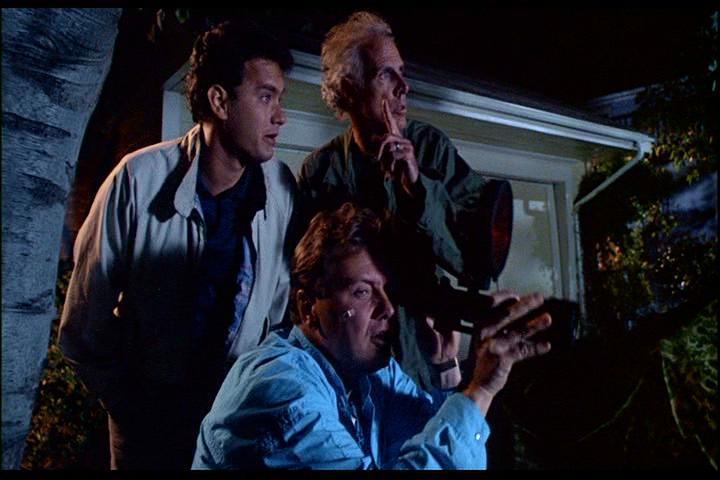
The ‘Burbs may have the ultimate nosy neighbors. The action in the 1989 Tom Hanks movie really begins when one of the locals finds as femur bone in the backyard. “Our neighbors are murdering people,” he says. “They’re chopping them up. They’re burying them in their backyard.”
Rumours of a suburban cannibalistic cult spread through town, putting everyone on edge.
“Green sky at morning,” say Ricky Butler (Corey Feldman), “neighbor take warning.”