“The Big Short” is an infuriating movie. Not because it’s poorly made but because it is so well made. It takes years of banking bafflegab and distils it down to the essence in what may be the funniest, smartest and most maddening look at why America’s housing market crashed in 2008.
The films opens with a famous Mark Twain quote, “I’t ain’t what you don’t know that gets you into trouble. It’s what you know for sure that just ain’t so.” The quote is a bit of a Mobius strip but so is the story “The Big Short” is trying to tell.
Based on Michael Lewis‘ nonfiction best-seller of the same name, the film presents a cavalcade of facts and information formed into a story about how four investment-bankers—played by Christian Bale, Steve Carell, Finn Wittrock, John Magaro—saw the financial meltdown coming when no one else did. Taking on the arrogance of Wall Street’s old boy network, they bet against the American economy and, in the process, expose an unprecedented level of financial criminality.
“The Big Short” is a lighthearted look at a dire situation. Call it a dramedy. Director Adam McKay is best known for making movies like “Anchorman 2: The Legend Continues,” “The Other Guys,” “Step Brothers,” so he knows how to milk a laugh out of a scene. He also knows that the level of understanding the viewer needs to get why the housing bubble burst is above the level of most MBAs.
The movie explains that Wall Street likes to use confusing terms to make you think only they can understand what they do. “It’s like 2+2 = fish,” says one banker, expressing disbelief at the financial manipulations used by the big banks. To make the financial mumbo-jumbo sexy the McKay uses a variety of tricks, including cutting to Margot Robbie in a bubble bath explaining subprime loans in plain language. It’s a spoonful of sugar to help the expositional medicine go down. From the simple—one loan officer calls his clients “Ninjas, no income, no job.”—to the incredibly complex world of CDOs (collateralized debt obligations) “The Big Short” doesn’t shy away from tackling complex financial transactions but it never feels dry or forced. McKay is a showman, and layers the film with fourth-wall-breaking celebrity cameos and concise social commentary woven into the drama.
A great scene of Goldman Sachs executives laughing at Dr. Michael Burry’s (Christian Bale) $100 million investment is cut into a rap video celebrating excess. In one wordless scene McKay illustrates the arrogance of the bankers in the days before the rug was pulled out from underneath them.
Subtle it’s not, but the director’s use of pop culture images and music to set the scene goes a long way to establish a time, place and tone.
“The Big Short” features strong performances—Bale stretches in ways we haven’t seen from him before—but it is the film’s unflinching depiction of unbridled greed that will resonate.
Adam McKay is best known for directing broad comedies with Will Ferrell like Anchorman and Step Brothers. But his new film, The Big Short, is a different beast.
It’s the story of how four investment-bankers — played by Christian Bale, Steve Carell, Finn Wittrock and John Magaro — saw the devastating financial meltdown of 2007–10 coming when no one else did. It’s a lighthearted look at a dire situation. Call it a dramedy.
“When I read this book it did everything I wanted to see in a movie,” he says. “It was funny, it was tragic, and the characters were amazing. I think it was a case of running into one of the great books of the last 20 years that shows what is really going on in our modern world.”
McKay knows how to milk a laugh out of a scene but he also knows that the level of understanding the viewer needs to get why the housing bubble burst is above the level of most MBAs.
“It’s like 2 + 2 = fish,” says one banker, expressing disbelief at the financial manipulations used by the big banks. In the film he takes pains to explain how Wall Street likes to use confusing terms to make you think only they can understand what they do.
“We wanted to be the first Wall Street movie that took you behind the curtain, that really said, All these confusing terms you hear, all the ways the banks make you feel stupid or bored … it’s actually not that hard. If the guy who did Step Brothers can understand it you can too.
“We were trying to show that this thing that half of Wall Street doesn’t understand, these derivatives, mortgage backed securities, they’re actually pretty easy. They bundled a bunch of mortgages, they sold them, made a ton of money. Then they ran out of good mortgages so they put crappy mortgages in and coerced the ratings agencies to give them AAA. That’s it. That’s the whole story.”
McKay has an a-list cast but he didn’t want to make the movie all about the stars.
“It would have been very easy to just do this character story and just show these guys being affected by it but I wanted this thing to bridge a gap. I think there is too much stuff in our society where people just think, ‘Ahhh banking! It’s boring. Politics! Who cares?’ The truth is, this stuff is exciting, It’s the language of power. Once you get hooked on it, it gets addictive.”
The Big Short is a look at our recent past, but McKay warns this is not a historical drama or cautionary tale, rather it’s very much a going concern.
“All the effects of this collapse are still completely in play. All the same questions are still in play and they fixed a few things but they didn’t fix the main, weight bearing beam beams that caused this problem. So this is an active story right this second. That is one of the main reasons we made this movie, we want people to understand that. This isn’t over.”
In the Heart of the Sea features less of Chris Hemsworth than we’ve seen on screen before. He’s in virtually every scene, but for much of the film the usually bulked up Thor star is set adrift in a raft, starving and physically much less imposing than usual.
The movie is an old-fashioned whale of a tale. Literally.
Based on the true story said to have inspired Moby Dick, it’s about whalers battling not only repeated assaults from the one whale who fought back, but also malnourishment and dehydration.
At sea for three months in tiny whaleboats the men are pushed to the edge of sanity, taking drastic steps to survive.
To convincingly play a starving sailor Hemsworth trimmed 33 pounds off his already toned 6’2 3/4” frame.
“My crazy diet would make you pass out from exhaustion,” he said. At certain points he was eating just 500 or 600 calories — that’s less than a combo lunch meal at most fast-food places — in the form of a boiled egg, two crackers and a celery stick a day.
Hemsworth and his underfed cast mates passed away the time with conversations “about our favourite foods and what we would eat when we finished the film.”
The actor says losing that amount of weight isn’t something he’d like to do again, but adds, “by those final sequences when we were supposed to be exhausted and emotional. We were feeling that way off screen too, so it helped.”
Dramatic weight loss isn’t new — actors have been yo-yo dieting for roles for years — but doctors say rapid body mass reduction can lead to malnutrition, maladies like gallstones and worse. In other words, as Christian Bale who dumped 60 pounds for his role in The Machinist says, “It ain’t great for your health.”
Still, actors take on dramatic diets to aid in their dramatic work. Anne Hathaway dropped 25 pounds by food deprivation and exercise to make Les Miserables while Matthew McConaughey survived eating only Diet Coke, egg whites and a piece of chicken a day to play AIDS patient Ron Woodroof in Dallas Buyers Club. According to The Playlist he stopped dieting when “people stopped asking if he was all right and started suggesting he seek help.”
Just as common are actors who gain weight. Russell Crowe gained 63 pounds to play a CIA bigwig in Body of Lies, George Clooney gained 35 pounds for Syriana and Renee Zellweger gained 30 pounds for Bridget Jones’s Diary, lost it, only to regain it for the sequel.
Jared Leto who lost 40 pounds to play Rayon in Dallas Buyer’s Club, gained 67 pounds for the film Chapter 27 by drinking melted pints of chocolate Haagen Dazs ice cream mixed with olive oil and soy sauce “to get me bloated even more.”
Why do actors alter their bodies? Some call it dedication while cynics suggest it’s an easy Oscar. Physical transformations (plus acting talent) brought Robert DeNiro, Charlize Theron and McConaughey to the winner’s circle.
But some actors have sworn off manipulating their weight. Jim Carrey turned down a role in the Three Stooges biopic that would have required him to gain 40 to 50 pounds and Tom Hanks blames gaining and losing weight for roles with him developing Type 2 diabetes.
“I’ve talked to a number of actors who have gained weight for roles and — just out of the sheer physical toll on one’s knees and shoulders — no-one wants to do it again,” he told the BBC.
As fans of Charlton Heston are well aware, Moses (Christian Bale) was a one-time Prince of Egypt raised as a brother to Pharaoh Ramses (Joel Edgerton) and exiled to the desert when his Jewish heritage was revealed. He should have perished but instead found a new life, with a wife, a son and a flock of goats.
It’s during this rather uneventful time that God speaks to Moses, commanding him to liberate his people, the Hebrew slaves, from under the tyranny of Ramses’s rule. “He has lost his mind,” says the Pharaoh. “He has found a god. His god. Not one of ours.” Moses supposes that the slaves are Egyptians and should be treated as such, with fare pay and the rights of any other citizen.
Cue the burning bush, plagues and the (almost) parting of the Red Sea.
Director Ridley Scott is the anti-Cecil B. DeMille. Like “The Ten Commandments,” “Exodus: Gods and Kings” is a huge movie with thousands of extras, two very important tablets and plagues galore. The stories are basically the same (although Scott takes liberties, making God appear as a young, tart-tongued boy) but the approaches are very different.
Scott’s film eschews all the Hollywood glam of DeMille’s biblical epic. It’s humanistic and so gritty you’ll feel like taking a bath afterwards, but not in the Nile, which is turned a lurid blood red as one of the ten plagues. Scott also makes good use of 3D, staging big screen dioramas with amazing detail, depth and even the odd spear that shoots off the screen.
The director pulls out all the stops in the large-scale action scenes and when the movie is raging it works. When he slows the pace in the more introspective scenes it flattens. Character development is one thing. Bad dialogue is another.
The eager cast is up for almost anything, but it’s unlikely that many actors, when asked, “Do you know where we are?” could keep a straight face when replying, “Yes. We are somewhere at a point on earth where there is a sea in front of us and an army behind.” Bale gives it his best, and does a noble job, but the script stymies even this fine actor from time to time.
The film’s climax—and this is NOT a spoiler—is the parting of the Red Sea sequence. Like the plague scenes—wild crocodile attacks, locusts, frogs, pustules etc—the parting is quite stunning visually, but ultimately feels a bit less than miraculous. For one thing it’s more of a wave than an actual parting, and while that may be splitting hairs, it is one of the best-known parts of the story and Scott turns it into an Irwin Allen moment.
“Exodus: Gods and Kings” does share one main thing with “The Ten Commandments” in that there is a noticeable lack of Middle Eastern faces among the cast. The days where Heston and Edward G. Robinson could pass for Egyptian slaves and Pharaohs is apparently not too far in the rearview mirror.
The phrase “Fun for the whole family” takes on a new meaning around Christmas time. The kids are on winter break, grandma and grandpa have come to visit and Cousin Ethyl still has last year’s gravy stains on her Christmas sweater. How do you keep everyone entertained once the gifts are opened, the eggnog is all gone and everyone is sick of turkey leftovers?
You go to the movies. Grandma might not enjoy the drug-fuelled excesses of Joaquin Phoenix’s latest, Inherent Vice and at 142 minutes Exodus: Gods and Kings is probably too long for young attention spans, but there are a couple of films opening in theatres the whole clan can enjoy.
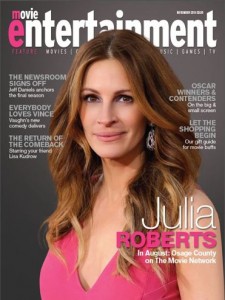
Produced by Jay-Z and Will Smith the new version of Annie is “a modern re-imagining of a beloved musical…” Read the whole thing in the December issue of Movie Entertainment magazine on stands now!
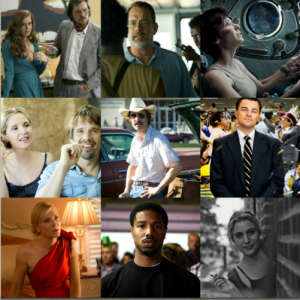
TOP THIRTEEN HITS (click on the title to see trailer)
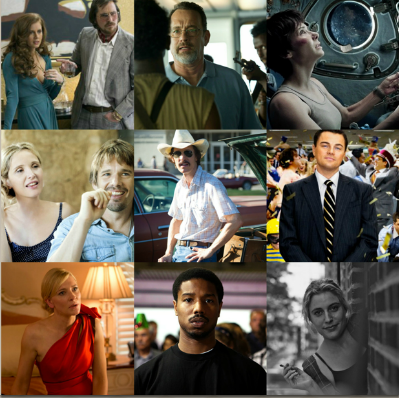
1. 12 Years a Slave. There’s a key line near the beginning of “12 Years a Slave, “ the new drama from “Shame” director Steve McQueen. Shortly after being shanghaied from his comfortable life as a freeman into a life of slavery Solomon Northup (Chiwetel Ejiofor) declares, “I don’t want to survive. I want to live.” Based on Northup’s 1853 memoir the movie is an uncompromising story about will, suffering and injustice.
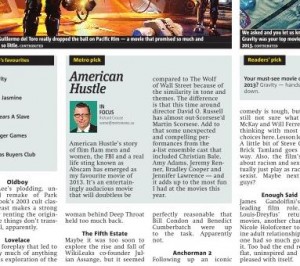
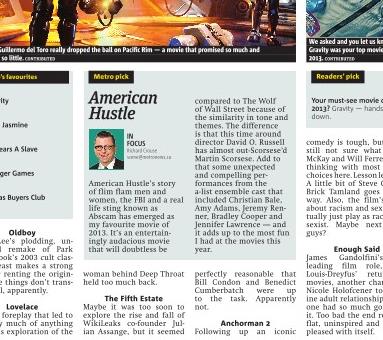
2. American Hustle. “American Hustle” is one of the year’s best. It’s an entertainingly audacious movie that will doubtless be compared to “The Wolf of Wall Street” because of the similarity in tone and themes, but this time around David O. Russell has almost out-Scorsese’d Scorsese.
3. Before Midnight. “Before Midnight” is beautifully real stuff that fully explores the doubts and regrets that characterize Jesse and Celine’s (Ethan Hawke and Julie Delpy) love affair. Done with humor, heart and pathos, often in the same scene, it is a poignant farewell to two characters who grew up in front of us.
4. Blue Jasmine. Darker than most of Woody Allen’s recent output, “Blue Jasmine” doesn’t go for laughs—very often anyway—but is an astutely crafted psychological character study. Jasmine is a modern day Blanche Du Bois, a faded bright light now forced to depend on the kindness of strangers. Getting in her way are delusions of grandeur and a continued sense of denial—likely the same sense that kept her guilt free during the years the illegal cash was flowing—that eventually conspire to fracture her psyche. “There’s only so many traumas one can take,” she says, “ before you end up in the street, screaming.”
5. Captain Phillips. I don’t think it’s fair to charge audiences full price for screenings of “Captain Phillips.” While watching this exciting new Tom Hanks thriller I was reminded of the old Monster Trucks ads that bellowed, “You Pay for the Whole Seat but You’ll Only Need the Edge!”It a film about piracy and I don’t mean the sleazy guys who bootleg movies but the real pirates who were responsible for the first hijacking of an American cargo ship in two hundred years.
6. Dallas Buyer’s Club. In “Dallas Buyer’s Club” Canadian director Jean-Marc Vallée has made an emotional drama that never stoops to melodrama. Instead it’s an inspirational film about standing up for what you believe in.
7. Frances Ha. The seventh film from “Greenberg” director Noah Baumbach isn’t so much a traditional narrative as it is a character study of Frances (Greta Gerwig), an underemployed dancer struggling to find herself in New York City. It plays like a cleaned up black-and-white version of “Girls”; an emotionally rich and funny portrait of twenty-something ennui. “Frances Ha” is a collection of details. There is an engaging story, but it’s not exactly laid out in three acts. It feels more intimate and raw than the usual twenty-ish crisis flick and with each detail we get another piece of the puzzle that makes up Frances’ life.
8. Fruitvale Station. It’s important to remember that “Fruitvale Station” isn’t a documentary. Director Ryan Coogler has shaped the movie for maximum heartrending effect, and by the time the devastating last half hour plays out it’s hard to imagine any other movie this year packing such a emotional wallop.
9. Gravity. “Gravity” isn’t an epic like “2001: A Space Odyssey” or an outright horror film like “Alien.” There are no monsters or face hugging ETs. It’s not even a movie about life or death. Instead it is a life-affirming movie about the will to survive.
10. Her. “Her” is an oddball story, but it’s not an oddball film. It is ripe with real human emotion and commentary on a generation’s reliance on technology at the cost of social interaction.
11. Inside Llewyn Davis. “Inside Llewyn Davis” is a fictional look at the vibrant Greenwich Village folk scene. Imagine the cover of “The Freewheelin’ Bob Dylan” come to life. Sharp-eyed folkies will note not-so-coincidental similarities between the people Llewyn meets and real-life types like Tom Paxton, Alert Grossman and Mary Travers, but this isn’t a history, it’s a feel. It gives us an under-the-covers look at struggles and naked ambition it takes to get noticed.
12. Nebraska. The humour doesn’t come in the set-up-punch-line format but arises out of the situations. A scene of Woody’s gathered family—his elderly brothers and grown sons—watching a football game redefines the word taciturn but the subject of the sparse conversation, a 1974 Buick, is bang on, hilarious and will likely sound familiar to anyone with a large family.
13. Wolf of Wall Street. “Wolf of Wall Street” makes for entertaining viewing, mostly because DiCaprio and Jonah Hill are able to ride the line between the outrageous comedy on display and the human drama that takes over the movie’s final minutes. Both are terrific, buoyed by the throbbing pulse of Scorsese’s camera. With its fourth wall breaking narration, scandalous set pieces and absurd antics “The Wolf of Wall Street” is an experience. At three hours it’s almost as excessive as Balfort’s $26,000 dinners. It feels a bit long, but like the spoiled brats it portrays, it will not, and cannot, be ignored.
TOP FIVE MISSES
TREND: Big stars don’t guarantee box office!
1. The Fifth Estate – Budget: $28 million, Global box office: $6 million, Return: 21% Late into “The Fifth Estate” Guardian investigative journalist Nick Davies (David Thewlis) says, “most good stories start at the beginning.” I argue that he’s right– about 99% of the time. Unfortunately this look at WikiLeaks and hacker-turned-whistleblower Julian Assange falls into the 1%.
2. Bullet to the Head – Budget: $25 million, Global box office: $9 million, Return: 36% With a name like Bullet to the Head you know the new Sylvester Stallone movie isn’t a romantic comedy. Although he paraphrases the most famous rom com line of all time, “You had be at BLEEP BLEEP!” the movie is nothing but an ode to testosterone.
3. Getaway – Budget: R180-million, Global box office: R105-million, Return: 58 percent. On a scale of zero to stupid, ”Getaway” ranks an eleven. It is what we call in the film criticism business a S.D.M. (Silly Damn Movie). OK, I made that last part up, but I couldn’t really think of any other category to place this movie under. Maybe E.S.D.M. (Extremely Silly Damn Movie).
“American Hustle, ” the new film from “Silver Linings Playbook” director David O. Russell, bristles with energy.
Imagine the love child of “The Sting” and “Ocean’s Eleven” infused with the verve of the frenetic last thirty minutes of “Goodfellas” and you get the idea.
Branded with the disclaimer, “Some of this actually happened,” “American Hustle” is a fictionalized retelling of the Abscam scandal, an elaborate FBI takedown of corrupt government officials.
Christian Bale plays Irv Rosenfeld, a low level con man with a paunch and Trump-esque comb over. He makes a comfortable living, enough to support his wife Rosalyn (Jennifer Lawrence), their son and his mistress and partner-in-crime Sydney (Amy Adams).
His life goes sideways when Richie DiMaso (Bradley Cooper), an ambitious FBI agent, threatens them with arrest unless they help him run a complicated corruption investigation involving New Jersey mayor Carmen Polito (Jeremy Renner) and other high ranking officials.
There’s a zany tone to “American Hustle.” It plays like a heightened version of real life. Perhaps it is the outrageous 1970s styles—all big hair, wide collars and flared pants—or the edgy, slightly larger-than-life performances from the top-notch cast, but the film feels one step removed from reality. Settle into “American Hustle’s” world and the darkly humorous ride is an enjoyable journey.
Bale leads the cast, but it is very much an ensemble. As the dumpy Irving he is a mass of contradictions. He’s a confidence man with a conscience; a man who feels it’s wrong to entrap politicians so soon after the public cynicism about elected officials after Watergate and Vietnam. Trapped in a loveless marriage, he’s a philanderer who is reluctant to leave Rosalyn because he wants to do the right thing for his son. He genuinely likes Carmine even though he’s about to set him up to do some real jail time.
Bale brings some real complexity to a character who could easily have been a stunt. Some actors might have relied on the weight gain and the bad hair to do the work, but Bale brings him to life and even makes you feel sorry for him.
The standout, in a smaller role, is Lawrence. Realistically she may be too young for the part, but as “the Picasso of passive-aggressive karate,” she’s perfectly cast. With a thick Long Island and perfectly lacquered lips, she plays Rosalyn as a creature of pure emotion, passionate one second, needy the next, driven by jealousy and dysfunction and one too many self-help books.
Adams, Renner and Cooper also distinguish themselves playing preposterous characters with one thing in common—they aspire to be something they are not. Everyone on display is on the hustle, looking to reinvent themselves, and that desperation is what gives the movie its dynamism.
As a backdrop Russell hits all the right period notes, particularly with the music. He uses archival music from the likes of Elton John, Electric Light Orchestra and The Bee Gees to set the mood, but instead of acting as a greatest hits collection of the Me Decade through clever editing it sounds like a soundtrack.
“American Hustle” is one of the year’s best. It’s an entertainingly audacious movie that will doubtless be compared to “The Wolf of Wall Street” because of the similarity in tone and themes, but this time around David O. Russell has almost out-Scorsese’d Scorsese.