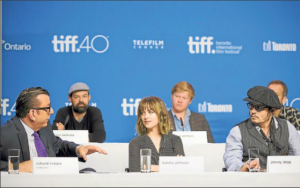
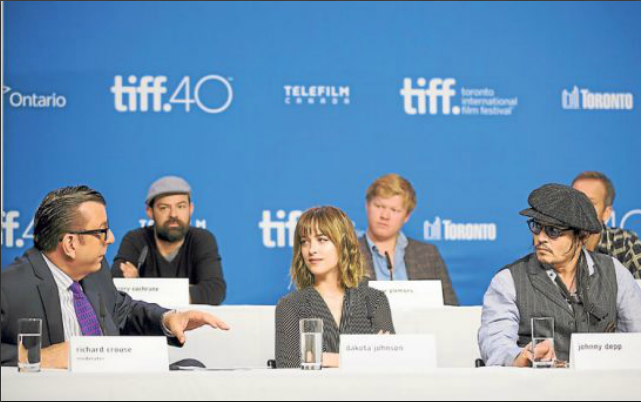
Black Mass sees Johnny Depp playing Jimmy ‘Whitey’ Bulger, a crime lord-turned-FBI-informant who ruled South Boston and was also the inspiration for Jack Nicholson’s character in The Departed.
Bulger was a community minded cold-blooded killer. He loved his neighbourhood, kids, cats and choking people to death with his bare hands.
Depp says “a responsibility to history and truth to some degree” was very important to him going into the project.
“When you’re playing someone who exists or existed,” he says, “there’s a tremendous kind of amount of responsibility, at least for me, no matter whether they’re deemed good or bad or whatever. You have a responsibility to that person.”
The fifty-two year old actor’s performance is already earning early Oscar buzz for the chilling authenticity he brings to a man described in the film as “ripened psychopath.”
Director Scott Cooper says, “I don’t think people come to narrative features for the facts, or for truth. I think you go to documentaries for that. What you do come to narrative features for is psychological truth, emotion and deep humanity. I did not want to make a film strictly about criminals who happened to be humans. I wanted to make a film about humans who happened to be criminals.”
Like many underworld figures, Bulger created his own mythology based on his exploits, making it difficult for co-screenwriter Mark Mallouk and Cooper to discern what was true and what wasn’t.
“Jimmy Bulger had his version of the truth which was different from (accomplice) Stephen Flemmi’s,” said the director, “that was different from (henchman) Kevin Weeks and (hitman) John Martorano. I had to determine what was the story I was going to tell… and tell it as accurately as I could from a very emotional place.”
It’s a hard-edged tale to be sure, fuelled by Bulger’s violent and grim behaviour, but Depp found it best not to judge the character.
“I don’t think any of us wake up in the morning and say, ‘I’m so evil. I’m so horrible,’” Depp said. “I approached James Bulger as a human being, who’s multi-faceted and did have a side to him that was human and loving.”
Depp’s performance and the work of his co-stars Dakota Johnson and Joel Edgerton among others, ensure that Black Mass is a complex study of human behaviour, but hopefully, according to Mallouk, not a glamorous one.
“None of wanted anyone walking out of the theatre to go, ‘I want to be Whitey Bulger,’” said Mallouk. “You feel that way after Scarface or Goodfellas or after The Godfather, and I love those movies, but there is a responsibility to not do that here. It feels more like Donnie Brasco. We did not want to create more fuel for the Whitey Bulger myth.”
Cooper says his responsibility as a filmmaker and storyteller was with “the victim’s families because Jimmy Bulger and the men we chronicle in this film left a deep emotional scar on the city of Boston that is still very fresh and widely felt.
“I care what they think about the film and I hope I didn’t trivialize these events.”
In real life Bulger, now eighty-six years old and serving two life terms plus five years at a penitentiary in Florida, was convicted of racketeering, money laundering, extortion, weapons charges and was found to have been involved in 11 murders.
“You talk about six degrees of Kevin Bacon,” says Cooper. “In South Boston or Boston in general it’s two degrees of Whitey Bulger. Everybody had a story and everybody knew him.”
In the 1950s, author Robert Schnakenberg’s father was the letter carrier who delivered jazz legend Louis Armstrong’s mail. “Louis would say, ‘Hi Mr. Mailman’ and sometimes Louis and his wife would invite my dad in for coffee. That is sort of my claim to fame.”
It also began a career Schnakenberg says involves “lurking around the edges of famous people.” The author of more than a dozen books, including The Encyclopedia Shatnerica and Christopher Walken A-to-Z, Schnakenberg’s latest is The Big Bad Book of Bill Murray, a weighty tome analyzing the life and career of everybody’s favourite Ghostbuster.
“They’re more history books than puff pieces about celebrities,” he says on the line from his Brooklyn home. “I wanted to approach them from a quasi or mock academic perspective and treat them as if they were historic artifacts rather than just pop culture icons.”
Murray was a perfect subject for the pop historian. “I had done two previous A-to-Zs and was looking around for a third person to round out the trilogy. I had visions of a three volume slip case edition in my head.”
Murray fit the criteria. “Who has a long career? Who has left a paper trail of interviews and profiles? Who has an off-camera persona that is just as interesting as what they do onscreen? It just clicked last year. He reached a point of saturation with all these viral videos going around that (the publisher) said, ‘Let’s do the book now.’”
The volume provides an overview of Murray’s long and varied time in the public eye. From critical appreciations of his films, to interesting trivia, The Big Bad Book of Bill Murray spans decades of fascinating behaviour.
“His career provides a lot of entry points for people who want to get into him,” says Schnakenberg. “If you came of age in the ’70s, the way that I did, you remember the Saturday Night Live version of Bill Murray. If you were 13 in 1984 you probably think of him as Ghostbusters Bill Murray. If you were a proto-hipster in the ’90s your image is probably the guy in all the Wes Anderson movies. Now people know him as the dishevelled guy who crashes people’s parties.”
The point is, for almost forty years Bill Murray has been a constant in our lives. “Bill Murray never had to come back because he never went away,” says the author. “He was always cool; just cool in different forms over the years.”
The backstage room at the TIFF Bell Lightbox’s press conference area is a beehive of activity.
“Is George here yet?”
“Is that Johnny vaping in the corner?”
It’s a place where no last names are necessary and the star wattage is blinding. Actors, directors, publicists and gofers mingle while air kisses, handshakes and Hollywood hugs are exchanged.
This year the Toronto International Film Festival is mounting 11 press conferences featuring everyone from Matt Damon and Sandra Bullock to George Clooney and Keith Richards.
I’m hosting four of them — Demolition, The Martian, Our Brand is Crisis and Black Mass — with, as MGM used to brag, “More stars than are in the heavens.”
Despite the buzzy nature of the events, backstage is a casually chaotic place where actors get caught up with one another before taking the stage.
Matt Damon made the rounds, glad-handing with his The Martian cast mates, many of whom he hadn’t met because he spent 90 per cent of his of screen time alone, stranded on Mars.
The business of the press conferences happens on stage. Moderating these things provides a fascinating glimpse into both sides of the publicity machine.
Ideally the press conferences are a reciprocal event: Reporters ask questions to actors and filmmakers they might not otherwise have access to, and in return the stars get publicity for their films. It’s a pretty simple but often unpredictable transaction.
Gone are the days of the legendary “journalist” who asked all her questions in rhyme, but for every sensible inquiry about the movie, there is inevitably another off-the-wall query that leaves panel lists either annoyed or scratching their heads.
At the Our Brand is Crisis conference someone asked Bullock about her character’s grown-out roots. The Oscar winner replied as best she could and when she finished, Clooney chimed in, “Aren’t you glad you asked that question?”
Later she shut down a silly query regarding how she keeps her bum as toned as it is in the film. “It’s so sad that you just want to talk about the butt,” she said, before tersely adding that leg lifts are the secret to posterior pertness.
Not that the attendees are the only ones to pull a gaffe or two. During the Demolition conference, I asked Chris Cooper a long, rambling question about his character. He seemed genuinely perplexed, and you know what? I was, too. Sometimes you can overthink these things.
Later at The Martian presser, there were 13 people on the stage, everyone from Michael Pena to Damon, Scott, Chiwetel Ejiofor and Jessica Chastain, and in the shuffle I made the horrifying mistake of forgetting to ask the great Sean Bean a question and didn’t realize it until we were out of time.
Who doesn’t acknowledge Lord Eddard Stark?
Me, idiotically. Next year I promise to go to him first and frequently.
Like millions of people I remember exactly what I was doing the morning of Tuesday, Sept. 11, 2001.
When the first plane hit the World Trade Center I was walking down Bloor Street in Toronto, on my way to the InterContinental hotel to do a day of Toronto International Film Festival coverage.
I didn’t register anything unusual in the air until I got to the hotel. People on the street may have been walking and talking a bit faster, acting a bit more animated than usual, but not so that I noticed.
Entering the hotel was a different story. The halls were eerily silent.
What was usually a cheery beehive of activity with camera crews, stressed publicists and actors roaming around, was now quiet, still.
At 9 a.m. I walked into our makeshift interview suite on the third floor just as the second plane hit. My crew were sitting around the television. Sobs from the rooms next to ours broke the stunned silence.
What the hell was going on?
What was going on was a change in all our lives; a new era where the unthinkable became possible.
It was a confusing day. With no details we, like many others, pressed on with the business at hand.
David Lynch came and went, smoking American Spirits and chatting about his film Mulholland Drive.
A handful of others walked the halls, unsure of what else to do, keeping previously scheduled interview slots.
When I mentioned to New York actress Adrienne Shelly that I couldn’t reach my girlfriend, who was living in Manhattan, she loaned me her cellphone.
“For some reason it seems to get through,” she said.
It did, and after a quick call to make sure she was safe, the full impact of what had just happened sunk in. Sometimes the small stuff, the personal things — like the anxious voice at the other end of the line — help you understand the magnitude of a grim situation.
We cancelled the rest of the day but I stayed put, talking to my hotel neighbours, most of whom were Americans, many from New York.
There were hugs, tears and bafflement in equal measure. TIFF elected to cancel many of the day’s events and tone down the glitz for the rest of the festival.
But the show would go on and in that moment art won over terror.
What we began to hear were stories from New York filmmakers who, with all flights cancelled to and from the city, were loading cans of film into their cars and driving to the festival.
It wasn’t about vanity and it wasn’t about ego.
It was about filmmakers, the storytellers of our times, the people who document our lives, not being silenced.
The rest of the festival was a sombre affair but there was a steeliness uncommon at the usually glitzy event. We gathered, watched films, communicated and healed, sending a message that the uncertainty of the times would not prevent us from expressing ourselves, from sharing stories.
Fourteen years later I think back to those days and realize that terror didn’t win on 9/11.
As long as we don’t allow ourselves to go silent, as long as we breathe life into our stories and experiences on film and elsewhere, we won’t and can’t live in fear.
The summer movie season began amid doom and gloom. I don’t mean George Miller’s filling screens with his dystopian vision of the future in Mad Max: Fury Road or the career ending fallout from the Sony hack. No, I mean the sky-is-falling predictions that circulated about the movie business.
Box office is down! No one goes to the movies anymore! And best of all: Movies are dead!
To paraphrase Mark Twain, I’m happy to say the reports of the death of cinema have been greatly exaggerated. The summer box office of 2015 will go down in the record books as the second-biggest in history with almost seven billion dollars generated by Minions, Ant-Man, Mad Max, dinosaurs and a sad little girl named Riley.
Superheroes helped put bums in seats, but 2015 won’t be remembered as the Year of Ultron. Now that the summer silly season is over, a definite trend toward female-driven movies like Trainwreck, Pitch Perfect 2 and Spy showed that, as Amy Schumer told me, Hollywood has finally realized “our money works, too. Our banks also accept the female dollar.”
But it wasn’t just women going to the movies. With Jurassic World pulling in 1.6 billion samolians worldwide, it seems everyone put down the remote and went to the cinema.
We didn’t rush out to everything — cash grabs like Ted 2 and Terminator: Genisys flopped — but the naysayers, the folks who, in January, were declaring movies to be a thing of the past, an old outmoded form of entertainment in the digital age, missed the point.
People flocked to the movies in huge numbers this summer, filling seats and studio bank accounts, not simply to sit in air conditioning for a few hours as relief from the summer heat or to dine out on popcorn and Twizzlers, but to engage in an age-old ritual.
Of course, you can watch movies at home or on your phone. New technology has made it easier than ever to enjoy a film from the comfort of your coach on a 60-inch screen with surround sound and healthy, homemade snacks, but no matter what set-up you may have in your living room, the thing missing is the ancient practice of sharing entertainment with a large group of strangers. It’s a primal thing, hard-wired into our DNA, that dates back to when tribes of cave dwellers would sit around fires and tell stories through to the Globe Theatre, vaudeville, the talkies and right up to today’s IMAX and AUX screenings.
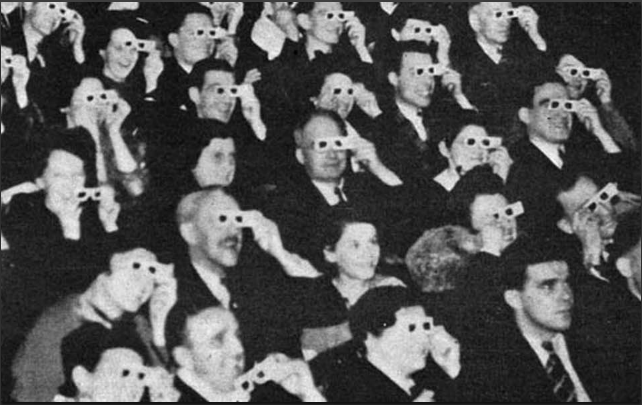
People have gathered to be entertained since there were tales to be told because there is no better way to enjoy the storytelling experience than surrounded by strangers who are laughing, crying, gasping— whatever — in response to a shared event.
No matter how large your TV or comfortable your sofa, home viewing misses the magical element of community. In the theatre you’re getting the sound and the picture the director intended, but more than that the experience brings people together, inspires conversation, respect and triggers actual physical interaction with others. Try that as you stream a movie on your iPhone.
Of course, as in any other community there are a few troublemakers — texters, seat kickers — but I spend more time in theatres than most and find the pros far outweigh any negatives.
In the era of home entertainment the idea of going to the movies may sound old fashioned or quaint but I like the way English novelist Angela Carter described watching a film in a theatre. She called it “dreaming the same dream in unison” and that, for me will never go out of style.
“I love Canada,” says Mountain Men star Chace Crawford. “I’m from Texas so I get along with Canadians really well. There is some weird kindred spirit there.”Crawford is best known as the star of Gossip Girl — he played Upper East Side heartthrob Nate Archibald on over 100 episodes of the hit show — but he got his big break working in Canada.
“I worked in Montreal on my first film ever back in 2005,” he says. “It was a Screen Gems movie called The Covenant, which was like The Craft meets the Backstreet Boys. I had the best time of my life on that. I love Montreal but I know Montreal is a lot different than Toronto or Vancouver and definitely Revelstoke.”
Revelstoke is, indeed, a long hike from Montreal. The beautiful southeastern British Columbia community has provided a backdrop for films dating back to the 1930s — a 1937 Lilli Palmer about the building of the Canadian Pacific Railway was partially shot there — and gave Mountain Men its picturesque setting.
The film is the story of estranged brothers Cooper (Crawford) and Toph (Tyler Labine, real life brother of the film’s writer and director Cameron Labine). When Cooper returns home to attend their mother’s wedding, Toph tricks him into taking a trip into the Rocky Mountains. When everything goes wrong they must bond or die.
The scenery is suitably rustic, but Crawford says the location wasn’t as rough as it looks in the film.
“We really pulled it off,” he says. “To be honest we got there in April and had this house up in the middle of nowhere. There was a couple feet of snow everywhere but by the end it was gorgeous springtime. The snow just slowly melted. We had to keep going higher and higher up the mountain to make it look more treacherous. It was nice out almost. It was more wet than anything.”
When he wasn’t shooting on the mountain he was getting to know his co-star.
“Tyler and me shared a big house,” he says. “He has a family and a wife and kids and he’s a great dad, but he got to be away from that for a moment and kind of lock in. We’d go out and have a few drinks and get to know one another. There was nothing negative about it. We didn’t get tired of one another or angry. It was more a bonding experience and by the end of it we were brothers from another mother.”
In Cop Car, a b-movie thriller about two kids who steal a police vehicle for a joyride, Kevin Bacon plays Sherriff Kretzer, a bad cop short on dialogue but long on menace. It’s an intense role but one that once upon a time the Footloose star would have turned down.
“When I first started becoming an actor I would judge a role by how many lines I had,” he says. “Then, later on, by, ‘Where’s my big scene?’ As time has gone on I’ve really loved the idea of trying to use everything cinema has to offer in terms of helping you unfold the mystery of who somebody is. Sherriff Kretzer is one of those guys who, somehow, even though there is very little being said, I had an image for who he would be. Sometimes it just comes to me.”
Now into an almost four decade long career—his first professional acting gig came in 1978 on the soap opera Search for Tomorrow—he’s come to understand why less is often more on screen.
“Look at something like Diner,” he says. “I didn’t want that part because the guy didn’t say much. I didn’t know or trust that who he was would come through [in the scene where] I was just sitting there watching the college bowl. People talk about that as being the moment where they totally got the guy, but on the page I didn’t get that. I was too naïve to understand that. In the course of my career I have started to realize that the camera sees so much more than we see in real life. It’s not that it just shoots real life, it’s that it goes deeper. You shoot somebody’s eyes, do a close up on somebody’s eyes, and you see things that the human eye can’t see. It actually reaches down into that person’s soul so you’re exposed to something that is deeper and more beautiful.”
Bacon says he and director Jon Watts give audiences everything they need to “metaphorically jump in the car and come along” without over explaining the characters.
The result is a violent film that transcends its b-movie roots to become a story about loss of childhood innocence. “I think it is a surprisingly moving and emotional film,” he says. “I know my wife [actress Kyra Sedgwick] feels that way.”
Ben Kingsley is an Academy Award winner and one of the most recognizable faces in movies. He is an actor, and a very good one but he prefers to be called something else.
“I’m sure I am a storyteller,” he says. “I’m sure that is the right place for my DNA to be.”
Whether he is playing Darwan in this weekend’s Learning to Drive or Mohandas Gandhi, Itzhak Stern in Schindler’s List or Sexy Beasts’ Don Logan, he strives to tell stories that get under the audience’s skin.
“Something happened to me and it stayed with me forever,” he says. “I had the privilege of playing Hamlet for the Royal Shakespeare Company and I was walking and it was always in my head. It is a very all-consuming role.
“I was in Snitterfield, an open field just outside Stratford Upon Avon. A lovely young woman was on the opposite side of the field and seemed to be walking towards me, so I decided to tack to my right to avoid her feeling that I was intruding on her space. She tacked to her left. In other words, she mirrored me. Then I went the other way and she mirrored me. She was determined to meet me in the middle of this field. Then face-to-face, she said, ‘I saw Hamlet last night. How did you know about me?’
Something (I did) must have gone right in there (he points to his heart), straight through the sternum and said, ‘I know.’ That’s the connection.”
In his new film Kingsley makes a connection with co-star Patricia Clarkson. She plays Wendy, a divorcee who hires Darwan to teach her how to drive so she can travel to upstate New York to visit her daughter. As she learns to navigate Manhattan’s mean streets, they form a bond, teaching one another about life and love.
“I think in a really beautifully fashioned play or screenplay you have a feeling that the gods look down and say, ‘I’m going to bring you two together.’ I love that idea in mythology that the gods look down and send somebody to somebody. It is only through very unfortunate, heartbreaking circumstances that she finds herself in a taxi.
Heartbroken. I am driving a heartbroken woman. And I loved in the way, as in all great stories, the little coincidences are the gods guiding and bringing people together for some purpose. Here it is not for a great romance, it is to heal.”
Zac Efron became a teen heartthrob with the success of the High School Musical movies and then did everything possible to decimate and alienate the core audience that made him a star.
He rightly realized that the shelf life of a young Disney star was limited and turned his attention to making serious but little seen films like Parkland, At Any Price and The Paperboy, an art house film better known for a scene utilizing an age-old cure for a jellyfish sting you don’t normally see administered by an Oscar winner like Nicole Kidman.
His latest movie, We Are Your Friends, the first major-studio film set in the world of electronic dance music, is a mix of music and romance that sees Efron play an aspiring DJ who falls in love with his mentor’s girlfriend.
It’s a role that should appeal to his original fanbase, the kids who have aged out of High School Musical and now listen to EDM, where his other screen choices seem to have left them behind. Occasionally he’s thrown them a bone, with popcorn movies like New Year’s Eve, or Neighbors, where he plays the prerequisite 20-something good-looking Hollywood hunk.
Take That Awkward Moment for instance. He played an avowed hook-up artist, a young guy who would rather hang out with his best friends Daniel (Miles Teller) and Mikey (Michael B. Jordan) than have a meaningful relationship with a girl. In time-honoured rom-com fashion, it’s a movie that takes advantage of its leading man’s blue eyes and sculpted abs. Efron’s hair is practically a character in the film.
Perhaps while making The Lucky One, a Nicolas Sparks romance co-starring Taylor Schilling, it occurred to him that simply watching good-looking people fall in love does not a movie make.
I couldn’t help but think that Efron, when he says to Schilling’s character Beth, “I know you deserve better than this,” was actually speaking to the audience.
Luckily his other films are less about his looks and more about his ability. The Paperboy is an odd film. It’s an art house thriller — meaning that there aren’t many thrills — in which each of its stars do some fairly intense envelope pushing in a story about a reporter returning to his native Florida to investigate a murder.
Paired with risk-taking actors like Nicole Kidman, David Oyelowo, John Cusack and Matthew McConaughey, Efron works hard to shake off the early teen idol gloss that made him famous. He mostly succeeds, although director Lee Daniels’s camera still caresses the actor, taking full advantage of his effortless appeal.
In Me and Orson Welles, Efron is overshadowed by an actor playing a man who died many years before the core audience of this movie was even born. Christian McKay plays Orson Welles with such panache that Efron becomes a supporting player in his own movie but still makes a strong impression as a teenager with dreams of being on stage in this handsomely mounted period piece.
Other films like At Any Price, a 2012 powerful tale of fathers and sons and the pressure to succeed, have shown not only his depth but his willingness to stretch as an actor.
So why does Efron, who could have a movie franchise career in a heartbeat, look past the obvious career path?
Efron told the Hollywood Reporter that his often eclectic acting choices are always artistic in nature and never about money.
“I’m constantly searching for characters that are about betterment of self and betterment of others,” he says. “And I’m searching for those parts because those are the ones that make me happy. They’re the ones that fulfil me personally.”