Richard Crouse: CTV Canada AM, Metro News and NewsTalk 1010
James Stewart stars in one of the movies that always puts me in the mood for Christmas, but its not the one you think. Sure, It’s A Wonderful Life is a classic and yuletastic, but I also enjoy The Shop Around The Corner. It’s a Christmassy romance that sees shop co-workers Stewart and Margaret Sullivan at one another’s throats at work, unaware that they are also anonymously courting one another as pen pals. All becomes clear on Christmas Eve and they unwrap a big ol’ gift basket of love. It’s almost as heartwarming as a giant mug of hot chocolate.
On the other end of the scale is Black Christmas. Many years ago, on the first Christmas the PMC — my Preferred Movie Companion — and I spent together, I screened the movie for her, which almost stopped the relationship before it had a chance to really get going. I love the slaying slasher story. Her, not so much. I quickly rebounded with National Lampoon’s Christmas Vacation, which made the yuletide bright once again. Thanks, Chevy Chase, for saving Christmas and my relationship!
Read entries from Peter Howell, Johanna Schneller, Linda Barnard, Eli Glasner and Brian D. Johnson HERE!
Unless the movie is called “Planet of the Apes” its faint praise to say the monkey is the best thing about a picture. Such is the case with “Night at the Museum: Secret of the Tomb,” the third outing in the popular Ben Stiller kid’s franchise. Crystal the Monkey as Dexter a Capuchin monkey, gets the most laughs and is the only member of the top-of-the-line cast who doesn’t feel like they’re only in it for the big holiday movie paycheque.
On the third visit to the New York Natural History Museum we discover the Tablet of Ahkmenrah, the magical Egyptian plaque that gives its life force to the museum’s statues, allowing them to come to life after the sun goes down, is losing its power. Soon the tablet will die and so will animated exhibits Theodore Roosevelt (Robin Williams in one of his last movies), miniature men Jedediah and Octavius (Owen Wilson and Steve Coogan), and a Neanderthal named Laa (Ben Stiller). To save them night guard Larry Daley (Ben Stiller again) travels to the British Museum to find the secret to restoring the artifact’s power.
“Night at the Museum: Secret of the Tomb” beats the original premise into submission, blowing up the idea of a secret nightlife at the museum into the best example this year of how franchise filmmaking can go horribly wrong. Like the dimming tablet that slows down the wax exhibits, this movie sucks the life out of once interesting characters, placing them in a plot that is essentially an excuse to showcase more characters (like Dan Stevens as Sir Lancelot and a surprising and rather charming cameo from a very big star) and bigger special effects than in parts one and two.
There’s plenty of kid friendly slapstick and computer generated effects but a short action scene inside M. C. Escher’s topsy turvy staircase painting shows more imagination than the rest of the movie’s big set pieces put together.
It all feels old hat and despite the nostalgic rush of seeing the late Mickey Rooney and Robin Williams on the big screen, it’s less exciting to see Sir Ben Kingsley as Ahkmenrah’s father delivering bad double entendres like, “I am a pharaoh. Kiss my staff.” Andrea Martin has a fun blink-and-you’ll-miss-it cameo and the above mentioned cameo will raise a laugh, but as I left the theatre I couldn’t help but think my feelings about the film were best summed up by a line Octavius speaks just after a monkey urinates on him. “We must never speak of what happened here.”
Quvenzhané Wallis, the eleven-year-old Academy Award nominee, kicks the old “Annie” to the curb in the opening minutes of the reimagined story of a spunky little orphan and her foster father.
The movie begins with a curly haired red head making a presentation in class. With a flourish, she finishes her show-and-tell with a few snappy tap dance moves. Next up is Annie (Wallis) who erases the old image of the Broadway waif with a spirited “Stomp” style opening number.
It doesn’t all work, but the update does make the old “Annie” seem as au courant as “Downton Abbey.”
Set in modern day New York City, “Annie” drops the “orphan” in favor of “foster child.” Abandoned by her parents, her only connection to them is a note scribbled on the back of a restaurant bill. That scrap of paper and her scrappy attitude sustain her as she lives with a group of plucky kids at failed singer Miss Hannigan’s (Cameron Diaz) Dickensian Harlem apartment.
Her ticket out of Hannigan’s hell hole comes in the form of a viral video shot by a citizen journalist. Chasing a stray dog down the street Annie is rescued by the city’s richest citizen and mayoral candidate Will Stacks (Jamie Foxx). Unscrupulous campaign manager Guy (Bobby Cannavale) sees an opportunity to humanize his candidate and asks Annie over for a photo op.
“It’s good PR for my campaign to be seen with you,” Stacks explains to the little girl.
“If I came to live with you, you could become president,” she shoots back.
And thus Annie is invited to live in Stacks’s deluxe apartment in the sky. They form a bond and… blah, blah, blah. You can guess the rest.
Aside from a handful of songs, an overload of cute and shards of a storyline, the new “Annie” has little in common with the original musical. Director and co-screenwriter Will Gluck takes pains to make an “Annie” for a new generation but loses the spirit that made Broadway “Annie” so iconic.
“People love musicals,” he has Miss Hannigan say at one point. “Bursting into song for no apparent reason.” Except in good musicals there is always a reason for characters to burst into song. Annie doesn’t miss any opportunity to sing and dance—it even manages to turn taking out the recycling into a percussive event—but Gluck handles the transitions from dialogue to verse awkwardly. “Are you going to sing to me?” Hannigan asks Guy. “Is this happening?”
Worse, the music isn’t particularly memorable and bland, beat-heavy new school arrangements obscure the lyrics. The music is big, but the voices aren’t. Wallis has a much more natural singing style than he Broadway trained predecessors and gets lost in the mix. Ethel Merman she ain’t. The show was filled with showstoppers—“It’s the Hard-Knock Life” and “Tomorrow” among others—that are reduced in the film to aural wallpaper with choreography that could charitably be described as curious.
Wallis does plucky very well, but is rather one note, not just musically but personality wise as well. Foxx can sing but is saddled with the film’s second worst number, “I Don’t Need Anything But You,” (the “winner” is Diaz’s “Little Girls”) and Cannavale appears to be acting in a Christmas pantomime nobody told the rest of the cast about.
“Annie” is an attempt to recreate an icon for a new age but falls flatter than Miss Hannigan’s high notes.
On January 25th at 7 pm Richard and Geoff Pevere will host a special screening of Don’t Look Back, 1967 documentary film by D. A. Pennebaker of Bob Dylan’s 1965 concert tour in the UK at the Revue Cinema (400 Roncesvalles Avenue,(416) 531-9950) in Toronto.
Geoff Pevere is one of Canada’s leading pop culture commentators and movie critics. Geoff was a former host of CBC Radio’s Prime Time program, a movie critic with the Toronto Star for ten years, a TV host and a lecturer on film and media and is currently a movie columnist with the Globe and Mail. He is the co-author of the national bestseller Mondo Canuck: A Canadian Pop Culture Odyssey, his books include Toronto on Film and Donald Shebib’s Goin’ Down the Road, his latest book is Gods of the Hammer – The Teenage Head Story. Geoff will be signing copies of Gods of the Hammer! If you don’t have your own copy you can pick one up at the Revue before and after the screening.
Richard Crouse is the regular film critic for CTV’s Canada AM, the 24 hour news source CTV’s News Channel and CP24. He is a frequent guest on many national Canadian radio and television shows. His syndicated Saturday afternoon radio show, The Richard Crouse Show, originates on News Talk 1010 in Toronto. He is the author of six books on pop culture and writes a weekly column for Metro newspaper.
Join us on January 25th at 7 pm when Geoff and Richard long-time friends and television co-hosts discuss music and film before screening Geoff’s all-time favourite music film Don’t Look Back.
The release of The Hobbit: The Battle of the Five Armies brings Peter Jackson’s trilogy to a close, and marks the end of a life immersed in Middle Earth for the actors. For several of the cast it was a years-long journey, and like any trip it’s nice to pick up a souvenir as a keepsake.
According to director Peter Jackson the actor who played the exiled dwarf king Thorin stole “the most boring thing in the world to steal,” from the set of the penultimate film, The Desolation of Smaug, socks.
“I did steal every single pair of costume socks,” said Richard Armitage, “because we were given a brand new pair every day.”
As production on The Battle of the Five Armies wrapped Armitage was gifted with some more interesting props including the deadly goblin cleaver Orcrist, which he keeps in an umbrella stand, “cause I want to be able to pick it up.”
Martin Freeman, who plays head Hobbit Bilbo Baggins, says he doesn’t miss making the films—“I’m really proud to have done it,” he says, “and I’m really glad to have done it, but I rarely miss jobs.”—but kept his sword and prosthetic ears as mementos.
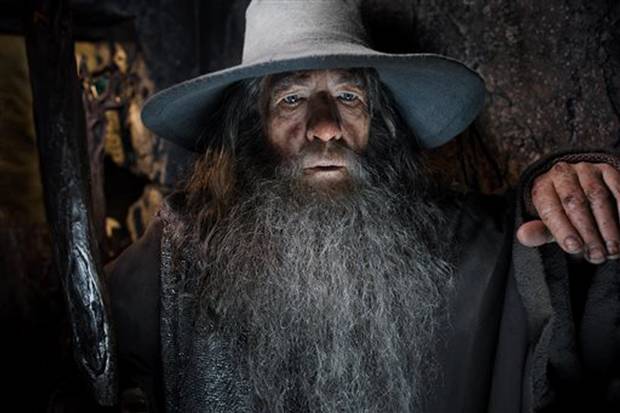
Unlike Freeman, Sir Ian McKellen does get sentimental when he reflects on making the movies because, “a lot of the audience seeing The Hobbit part three wouldn’t have been born when we started filming it.” After spending thirteen years playing wise wizard Gandalf the Grey he took two priceless props from the set, “Gandalf’s staff, which I keep with umbrellas and walking sticks, and Gandalf’s hat, which I keep in the basement.”
Many actors have pilfered props from their movies. Keira Knightley walked off with Elizabeth Bennet’s striped socks from Pride & Prejudice. Elijah Wood has the One Ring from Lord of the Rings and Daniel Radcliffe liberated two pairs of Harry Potter’s famous round glasses, even though there was a strict policy about taking props from the set.
‘The ones from the first film are absolutely tiny now,” he says, “but they are very sweet.”
Kristen Stewart kept the engagement ring Edward Cullen gave her at the end of Twilight: Eclipse and Zachary Quinto took the ears he wore as Spock in Star Trek: Into Darkness but the strangest cinematic souvenir may belong to Mark Wahlberg.
The Academy Award nominee kept the prosthetic penis he wore as Dirk Diggler in Boogie Nights. “I used to keep it in my desk drawer,” he said, “and I’d take it out and slap my friends in the face with it. I don’t keep many things from my movies, but that just seemed to have personal significance.”
“The Hobbit: The Battle of the Five Armies” is the end of an era, and the beginning of one of the biggest movie franchises in history. As the third part of the Hobbit trilogy, it brings to an end the Peter Jackson movies inspired by J.R.R. Tolkien’s books. In the chronology, however, it is midway, the film that sets up the “Lord of the Rings” movies.
The action picks up seconds after the Dwarves evicted greedy dragon Smaug (Benedict Cumberbatch) from the gold filled Lonely Mountain in “The Desolation of Smaug.” With the wicked worm gone exiled Dwarf king Thorin Oakenshield (Richard Armitage) has now reclaimed his homeland and all the gold and power but wearing the crown has made him paranoid. He trusts no one, not even his loyal warriors and won’t listen to Bilbo Baggins’s (Martin Freeman) attempts to make him see reason. His irrational behavior leads to the epic showdown mentioned in the title. Legions of bloodthirsty Orcs (complete with their giant, hard-headed War Beasts) face off with Dwarves, Elves of the Woodland Realm, King Dain II Ironfoot of the Iron Hills and the Men of Laketown. The fate of Middle Earth hangs in the balance as alliances are made and skulls are cracked.
At least I think that’s what happens. There is so much going on, so many characters struggling for power and survival it’s sometimes hard to keep track. Jackson wraps up the series with a movie that tries to close every door it has opened which leads to a cluttered film short on story but long on characters and action scenes.
Big themes abound—greed, power, love, loyalty, family, all cloaked in a story about dragons, halflings, wizards, ill tempered Orcs and a struggle for a mountain filled with gold but the one thing, by and large, missing from the story is a strong presence from the title character. That’s right, “The Hobbit: The Battle of the Five Armies” treats Hobbit Bilbo Baggins (Martin Freeman) like a supporting character.
Baggins bookends the action and appears sporadically throughout, but the spotlight is fixed firmly on the other characters, rendering the “Hobbit” part of the title a tad superfluous.
The “Battle” part, however, is bang on. The movie is essentially a series of combat scenes stitched together and within those bruised and bloody sequences are some of the film’s highlights. Legolas (Orlando Bloom) running atop bricks, Mario Brothers style, as they fall through the air from a disintegrating bridge is a striking visual image and a scene where Gandalf (Ian McKellen), Saruman (Christopher Lee) and Galadriel (Cate Blanchett) thrash away at evil spirits will entertain the eyes.
Jackson’s grey palette infuses “The Battle of the Five Armies” with an ominous air as the dozens of characters breath life into the fight scenes. Heroes and villains abound, and while there isn’t quite enough actual story to justify the two-hour-and twenty-minute running time, the battle between good and evil is so primal, so elemental you can’t help but let it get your blood racing.
Thirteen years, six movies and more than 1,000 minutes of film later, Peter Jackson is ready for a break.
“You can’t believe how much we don’t want anything to do,” he says.
With the release of The Hobbit: The Battle of the Five Armies, the journey that began with 2001’s The Fellowship of the Ring has come to an end for the director and his wife, producer and screenwriter Fran Walsh.
“We haven’t had a day when we’ve woken up and there hasn’t been a deadline,” he says of the last 13 years.
“Even if you go on vacation and they say, ‘You finished the first Hobbit movie and you can have three weeks off over Christmas,’ but we have to come back and start work on the next one on January 6, so it has always been this sort of looming thing.
“Now we get to wake up and it is done, finished, nothing left to do. We deliberately haven’t taken on any other work because Fran and I wanted so badly, for once in our professional lives of 30-odd years, to not have anything to do. That doesn’t mean that six weeks into our holiday we’ll not be so bloody bored that we’ll immediately start another project. That would be fine. At least we’ll do it for the right reasons.”
The new film is the end of an era, and the beginning of one of the biggest movie franchises in history. As the third part of the Hobbit trilogy, it brings to an end Jackson’s J.R.R. Tolkien’s adaptations. In the chronology, however, it is midway, the film that sets up the Lord of the Rings pictures.
“To me it has significance because it is the moment in time where a six-film series finally comes into focus,” he says.
“We are only four or five years away from a generation arriving who will have no memory or knowledge of how these films were released when they came out. All they’ll have is a six-part box set and hopefully they’ll start at the beginning and go through to the end. To me, until this movie actually existed there were these parts that were floating out there that can now be together.”
He may be done with the Lord of the Rings and Hobbit movies — “I have other things I want to make. I think it would be a terrible sad thing to spend the rest of my life going back over these films and trying to make them better” — but he’s not done with the cast he built over the years.
“We’ve just got such a wonderful collection of actors of all different types, and we’re friends now,” he says.
“I would be a happy man if I could make movies for the rest of my life using the cast we’ve used to date. I love it when directors have relationships with the same actors in film after film. It’s a fantastic thing.”