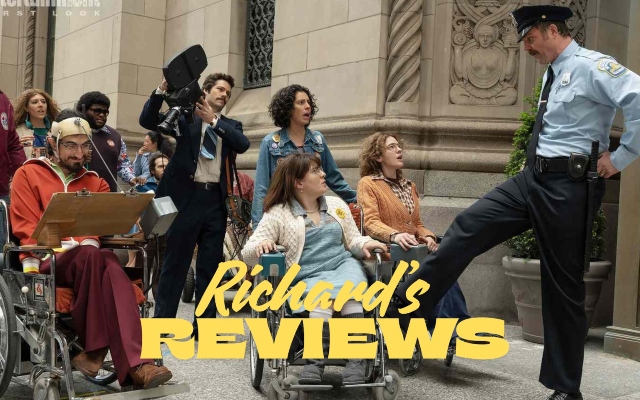
I join “CTV News Toronto at Five” with guest anchor Sean Leathong to talk about the the biopic “Being Heumann,” the dark comedy “Wild Horse Nine” and the epic “Godzilla Miinus Zero.”
I join CP24 Breakfast anchor Nick Dixon toi talk about the biopic “Being Heumann,” the dark comedy “Wild Horse Nine,” the historical Crave soap opera “The Gilded Age” and the Appple TV series “Knife Edge: Chasing Michelin Stars.”
I sit in on the CFRA Ottawa morning show with host Bill Carroll to talk about the biopic “Being Heumann,” the dark comedy “Wild Horse Nine” and the epic “Godzilla Minus Zero.”
Fast reviews for busy people! Watch as I review three movies in less time than it takes to wind your watch. Have a look as I race against the clock to tell you about the biopic “Being Heumann,” the dark comedy “Wild Horse Nine” and the epic “Godzilla Minus Zero.”
SYNOPSIS: “Being Heumann,” a new biopic now playing in theatres before moving to Apple TV on November 13, tells the undeniably important story of a disabled activist named Judy Heumann, and how she spearheaded the 1977 Section 504 sit-in, which resulted in the federal government of the United States giving more rights and privileges to disabled people.
CAST: Ruth Madeley, Mark Ruffalo, Dylan O’Brien, Rob Delaney, Ray Fisher. Directed by Sian Heder.
REVIEW: “Being Heumann” could have used a bit more grit and a little less made-for-television style, but the story is undeniably affecting.
Based on adaptation of Judy Heumann’s memoir “Being Heumann: An Unrepentant Memoir of a Disability Rights Activist,” the Sian Heder film tells the story of a women left paralyzed by polio at eighteen months, who devoted her life to civil rights for disabled people.
Instead of a cradle to grave look at Heumann’s (Ruth Madeley) eventful life Heder plants most of the action in 1977. Heumann initiated the nationwide Section 504 Sit-In, a cry for the government to implement disability protections which saw hundreds of people with disabilities occupied federal Department of Health, Education, and Welfare buildings across the United States. “We are not leaving this building until these regulations are signed,” she says.
It became the longest occupation of a federal building in U.S. history, ultimately resulting—after much back and forth—in the implementation of the Americans with Disabilities Act. “They’re not asking for a place on a bus,” says the United States Secretary of Health, Education and Welfare Joseph Califano (Mark Ruffalo), “they’re asking for a whole new bus!”
The portrait of Judy Heumann that emerges is one of a tenacious advocate, a blunt person who would not take no for an answer. “I’m not an asshole,” she says. “I’m just from Brooklyn.” Madeley plays her like a real person, not simply an inspirational avatar. Heumann’s work motivates those around her, but it is her take-charge attitude, tinged by both anger and humor that drives Madeley ‘s performance.
Like Madeley, who is an ambulatory wheelchair user, much of the cast are disabled actors. Their presence lends a stirring authenticity to the proceedings, emphasizing the urgency of Heumann’s push for inclusion, representation, and equality. “They see you in front of the stairs,” she said, “and they think that you’re the problem. The stairs are the problem!”
“Being Heumann” is Sian Heder’s crowd-pleasing follow-up to his movie “CODA.” Like that Oscar winner, “Being Heumann” is a story of empathy, resilience and community that engages the audience despite a formulaic presentation.
SYNOPSIS: A story of legacy and spirituality, in “The Piano Lesson,” starring Samuel L. Jackson, John David Washington and Danielle Deadwyler, and now playing in theatres, a treasured heirloom reveals a family’s past and possibly its future.
CAST: August Wilson, Samuel L. Jackson, John David Washington, Ray Fisher, Michael Potts, Erykah Badu, Skylar Aleece Smith, Danielle Deadwyler, and Corey Hawkins. Directed by Malcolm Washington.
REVIEW: “The Piano Lesson,” based on the 1987 stage play by August Wilson, isn’t about practicing scales or learning to read music. It’s a story about honoring ancestors, generational trauma, self-determination and facing the ghosts that haunt.
The story begins in 1911 Mississippi with the Charles Brothers and the theft of an ornate upright piano from the home of former slave owners, the Sutter family. Decorated with carvings on the front and sides, we later learn that the piano’s art is a history of the Charles family, carved by an enslaved relative.
Cut to 1936 Pittsburgh. The piano now rests in the front room of the home of Doaker Charles (Samuel L. Jackson), his niece Berniece (Danielle Deadwyler), her young daughter Maretha (Skylar Aleece Smith), and a ghost Berniece is convinced lives upstairs.
The relative calm of their lives is upended when Berniece ‘s brother Boy Willie (John David Washington) arrives from Mississippi with Lymon (Ray Fisher) with a plan to make money to buy the land where his family had once been enslaved. Trouble is, his plan involves selling the piano and Berniece will not hear of it.
The story is layered, and crisply complex, a tangle of emotion, the paranormal and family dynamics. In his directorial debut Malcolm Washington opens up the story with some brief flashbacks to Mississippi and some outside scenes, but the action here mostly takes place in the Charles house. It lends a stage bound feel to the film, and yet, the topflight performances and dialogue never allow “The Piano Lesson” to become overly theatrical in its claustrophobic setting.
It’s about the words, the ideas, and characters so carefully written each and every one of them could be the star of their own story. As it is, it’s an ensemble, that spreads the wealth, allowing each actor to shine. As the easy-going Lymon, Fisher has a playful moment when he buys a suit and some ill-fitting shoes from Wining Boy (a great Michael Potts). Washington is all kinetic energy and dreams for the future, but it is Deadwyler whose presence captivates. As a grieving widow and single mother, her character is the film’s beating heart and has the widest arc, leading up to an intense crescendo in the film’s final moments.
“The Piano Lesson” is a period piece, but the topics raised by Wilson’s script remain powerful and timely.
Richard’s interview with “Justice League” star Ray Fisher.
What’s it like playing Cyborg in Justice League? Ray Fisher compares his excitement to Charlie and the Chocolate Factory.
“It’s like someone handing you the keys to the chocolate factory and saying, ‘Go ahead, it’s yours now,’” says the 30-year-old actor… Read the whole thing HERE!
What’s it like playing Cyborg, the technologically enhanced human superhero of Justice League? Ray Fisher compares his excitement to Charlie and the Chocolate Factory.
“It’s like someone handing you the keys to the chocolate factory and saying, ‘Go ahead, it’s yours now,’” says the 30-year-old actor.
Before he was a superhero, Cyborg was Victor Stone, a sports-obsessed young man who was cybernetically reconstructed by his scientist father after a nearly fatal car accident. Cobbled together with technology that allows him to weaponize his arms and mind, he becomes a reluctant superhero.
Fisher first played Cyborg in a cameo appearance in Batman v Superman: Dawn of Justice and audiences took notice.
“Fans have reached out,” he says. “There have been some who are amputees. There have been kids who have implants. For Cyborg to be able to represent the underrepresented in that way is a very special thing. I didn’t know the full scope of what he would represent when I took on the mantle.”
Fisher says he’s inspired by the fact that his character gives voice and power to those who feel marginalized.
“Cyborg represents not just people who are differently abled, he is also a representation of the Black community and people of colour within the Justice League. Being able to don both those mantles with the integrity which that character would need to be portrayed and was adhered to was something that was very important. I never felt that I was in too much danger of becoming a stereotype. I never felt like I was in danger of offending anyone with that particular portrayal because it could go wrong in so many ways.”
Growing up, he thought Cyborg was a “funny character but he didn’t resonate with me.” Live action heroes did, however. “I remember watching Wesley Snipes as Blade,” he says. “I watched Michael Jai White as Spawn. I even watch Shaquille O’Neal as Steel. I felt like seeing a physical representation, a non-cartoon representation affected me in a much different way.”
Although he didn’t read comic books growing up in the 1990s and 2000s, Fisher says he was a huge fan of the animated series and movies.
“It wasn’t until I booked the role of Cyborg that I was sent literally everything Cyborg-related from DC comics. I was able to fall in love with the original iteration of Cyborg from the Teen Titans. For me to be able to bring the character into the same sphere as the shows and the animated series I loved as a kid is coming full circle.”
Fisher, who made a name for himself playing Muhammad Ali in the Off-Broadway production of Fetch Clay, Make Man says he hopes his take on the character will make an impression on DC fans.
“Hopefully it resonates with people in a positive way,” he says. “I think there is definitely a message behind Cyborg that is needed for people to hear and what he represents and the resilience of the human spirit. I hope it means as much to people watching it as it meant to me to do it.”
Let’s face it, without the batsuit Bruce Wayne is just another billionaire playboy with some cool toys. With it, he’s the Caped Crusader, keeping Gotham and the world safe. The clothes make the man, or in this case, the superhero.
To play the Dark Knight in the new Justice League movie, Ben Affleck wore a variation on his Batman v Superman costume which was a variation on every batsuit that came before it.
Designed to conceal his identity and frighten criminals, the basic batsuit is usually blue-black or dark grey, emblazoned with the chest-mounted Batsymbol. Add to that a flowing cape, finned gloves and a utility belt with a variety of crime fighting gadgets. All batsuits are topped off with a cowl with ears that mimic a bat’s head.
Costume designer Michael Wilkinson says Affleck’s new look is, “a little more aggressive.” To pump up the suit’s armour, Wilkinson drew on Bruce Wayne’s history of studying martial arts in Japan, creating new gloves based on samurai designs. Inspired by the Wayne Tech esthetic, he also revamped the cowl, adding in new ways for Batman to communicate with his trusty manservant Alfred.
Like Rick Blaine’s fedora or Annie Hall’s wide trousers, long white shirts, vests and men’s ties, the suit is crucial to Batman’s brand but it’s not always a comfortable fit.
“The first time I ever put on the (suit) myself I thought, ‘Oh, Chris (Nolan) has to re-do the cast,’” says Christian Bale, who played the Caped Crusader in three movies, “because the claustrophobia was just unbelievable.”
The Batman Begins actor says he discovered a meditative process that eased the anxiety of feeling trapped inside the hulking suit and estimates that he spent a total of 21 months encased in Batman’s armour.
He claims the discomfort actually helped him play the brooding character because he was always in a foul mood when he had to don the suit.
“Batman, he’s this very, very dark, messed-up character,” said Bale. “I found when I put on the suit I went, ‘I just feel like a bloody idiot if I don’t use this as a means to (show) his true, monstrous self that he allows to come out in that moment.’”
When Affleck took over the role from Bale he says the Welsh actor gave him one important bit of advice. “He told me to make sure I got a zipper in the suit,” Affleck laughs, “which was valuable, practical advice as it turned out.”
Perhaps the most beloved actor to wear the batsuit was the late Adam West. For 120 episodes from 1966 to 1968, West was Batman on the most popular show on television. He called putting on the suit one of his most memorable moments on the show.
“One defining moment was when I first put on the costume for real and was about to leave my trailer on the stage and walk out in front of the crew and the press, and into the light,” he told me in a 2010 interview.
“I thought, ‘Oh Lord! Are they going to laugh? What’s going to happen here?’ Well, I walked across the stage as dignified as I could and there wasn’t a sound. People stood there in awe and I thought, ‘Yes, this will work.’”