“You Were Never Really Here” is about a man with a special set of skills who rescues young women and yet it couldn’t be any more different from “Taken” and other recent guardian angel action movies.
Joaquin Phoenix stars as Joe, a bulky, bearded veteran who lives with his mother. When he isn’t rescuing young girls from human traffickers he’s doing household chores, helping his mom clean the silver wear or, when memories of his violent past overtake him, trying to kill himself.
Driven by vengeance and haunted by memories of childhood abuse he metes out punishment to human traffickers, violently beating them with fists and hammers. “Can you be brutal?” asks a client. “I can,” he replies calmly.
When a job retrieving Nina (Ekaterina Samsonov), the eleven-year-old daughter of a high-ranking New York politician (Alex Manette), from a pedophile ring goes sideways, Joe is forced to delve deeper than ever before.
There is violence in “You Were Never Really Here” but don’t expect a Liam Neeson style action flick. First of all Joe’s special set of skills mainly include surveillance and ball peen hammer assault. Secondly Joe doesn’t have any catchphrases. He’s a secretive man of action, plagued by PTSD and driven by a sense of righteous justice. Think Travis Bickle, not former Green Beret and CIA operative Bryan Mills.
Phoenix delivers a deceptively simple performance. A man of few words Joe expresses himself in other ways and Phoneix finds way to do much while doing very little. The pain in his eyes, amplified by random flashbacks to his troubled youth, reveals both his personal torture and why he works exclusively with mistreated children. More importantly are the traces of humanity that slip through Joe’s blank façade. The way he dotes on his mother or holds a dying man’s hand, singing along with a syrupy pop song, as life slips away. In another scene he instructs his pre-teen rescue to close her eyes, trying to protect what little innocence she has left, before he bludgeons one of her captors to death. It’s in these moments that Joe becomes a fully rounded character and not simply a killing machine.
Scottish director Lynne Ramsay never gives away the game, doling out the details only as necessary. The flashbacks are jagged, poking into the story like a shard of glass slashing through silk. Those elements, bolstered by an anxiety inducing score—loud, abrasive yet beautiful—from Radiohead’s Jonny Greenwood, combine to present an intriguing, elliptical portrait of a tortured soul.
Steve Martin, who studied philosophy at California State University once joked, “If you’re studying Geology, which is all facts, as soon as you get out of school you forget it all, but Philosophy you remember just enough to screw you up for the rest of your life.”
Such is the case with Abe (Joaquin Phoenix) the eponymous “Irrational Man” of Woody Allen’s fiftieth movie. A university professor about to start a new job at a new university, he’s brilliant but has fallen into the kind of existential funk that can only come from a lifetime spent studying philosophy. He’s the kind of guy who uses “As Simone de Beauvoir pointed out…” as a conversation starter and drinks single malt scotch from a flask in public.
He’s lost his zest for life, but not his appeal to women. Within days of the beginning of the semester he’s sleeping with the age appropriate but married Rita (Parker Posey) and is fighting off the advances of a student, Jill (Emma Stone). “He’s a sufferer,” she says with stars in her eyes, “and very conservative in a liberal sort of way.”
When he and Jill overhear a conversation regarding a crooked judge, suddenly his life has meaning. He decides to “make the world a better place” by getting rid of the judge. Planning the perfect murder, a crime he feels will benefit humanity, brings zest back into his life and puts a spring in his step.
From here “Irrational Man” becomes part character study and part romance and while it’s not exactly a whodunnit—more of a whydunnit—there is a procedural element to the last quarter of the film.
Subject wise Allen is in his element here, giving a raft of characters a chance to talk philosophy and the meaning of life but while the story should have forward momentum the farce ever escalates. Instead Allen relies too heavily on narration slowing down the action to a crawl.
Despite appealing performances from all, the story feels like a talky celebration of Abe’s dysfunction—the poor tortured genius—than a true study of a person pushed to extremes in search of happiness. Allen makes a movie a year, and while he often hits pay dirt there are years when it feels like he should have taken some time off, maybe vacationed in the South of France and recharged. This is one of those years.
Early on in “Irrational Man” Abe says, “Much of philosophy is verbal masturbation.” I said the same thing about the movie as the closing credits rolled.
The term “inherent vice” can be found on property insurance policies eliminating coverage for loss “caused by a quality in property that causes it to damage or destroy itself.” In other words, if the chocolate you’re shipping melts, you’re out of luck.
The new film from director Paul Thomas Anderson not only borrows the term as a title, but also the spirit. A complex stoner detective story, the movie’s characters are a doomed lot, debasing themselves with their own behavior. The result is a story of damaged personalities that requires a roadmap to navigate.
Joaquin Phoenix, is Larry “Doc” Sportello, a shaggy haired hippie detective in 1970 Los Angeles. Perpetually stoned he sees the world through a fog, and writes things like, “Paranoia Alert!” and “Not hallucinating” in his red detective’s notebook. When his ex-girlfriend Shasta (Katherine Waterston) asks him to investigate a plot to have her wealthy, married lover committed to a mental health facility, Doc is sucked into a complicated web of deceit involving a neurotic LA cop named Bigfoot (josh Brolin), a snitch (Owen Wilson), a drug crazed dentist (Martin Short), a drug syndicated called the Golden Fang and a man with a swastika tattooed on his face (Keith Jardine).
“Inherent Vice” plays like a brainier Cheech and Chong movie. The rambling story, that makes the work of Alaskan Native storytelling seem linear, sometimes gets lost in a cloud of pot smoke, and is occasionally almost incomprehensible, but never less than compelling. The actors, doing very high-level work, cut through the confusing murk of the plot, putting a human face on the twists and turns of the tale.
It’s been suggested that the mutton-chopped Phoenix based his performance on Leslie Nielsen’s work with the Zucker Brothers. That means playing it straight, or as straight as a stoner can be played. His hard-boiled lingo and natural PI ability are not played for laughs, but every now and again a measure of slapstick works its way into the performance; an unexpected yelp or an eager lunge at a table full of white powder. It’s an audacious performance that rides the line between serious and ridiculous without ever swaying too far one way or the other.
Your appreciation of Phoenix’s work, or at least the essence of the work, will relate directly to your enjoyment of “Inherent Vice.” The wonky tone, spread throughout the movie’s 148 minute running time, feels like an extended joke the audience isn’t always in on. When it works, it hums along, like a strange but enjoyable dream. When it doesn’t, it’s nightmarishly incoherent.
The phrase “Fun for the whole family” takes on a new meaning around Christmas time. The kids are on winter break, grandma and grandpa have come to visit and Cousin Ethyl still has last year’s gravy stains on her Christmas sweater. How do you keep everyone entertained once the gifts are opened, the eggnog is all gone and everyone is sick of turkey leftovers?
You go to the movies. Grandma might not enjoy the drug-fuelled excesses of Joaquin Phoenix’s latest, Inherent Vice and at 142 minutes Exodus: Gods and Kings is probably too long for young attention spans, but there are a couple of films opening in theatres the whole clan can enjoy.
Produced by Jay-Z and Will Smith the new version of Annie is “a modern re-imagining of a beloved musical…” Read the whole thing in the December issue of Movie Entertainment magazine on stands now!
In our busy lives it’s very possible we spend more quality time with machines, our ever-present technology, than with our loved ones.
We certainly spend more intimate time with our earbuds than with our significant others, ask Siri questions all day and lovingly stroke our keyboards as if they were the silky-smooth hands of our intendeds.
So the premise of “Her,” a new (slightly) futuristic romance from director Spike Jonez about a man who falls in love with the operating system of his computer, doesn’t feel that far fetched. Or does it?
Set in the near future “Her” begins with Theodore (Joaquin Phoenix), an unhappy, soon-to-be-divorced writer, buying a new computer with an advanced operating system designed to meet his every need. It sorts e-mail, keeps track of his appointments and helps him navigate through the in formation age.
It also speaks with a raspy, flirty voice that sounds suspiciously like Scarlett Johansson. Named Samantha, she helps organize his life but soon their back-and-forth takes on a tone more in line with old school 976 phone calls than high tech banter.
“I’m becoming much more than they programmed,” she says, as a romantic relationship blooms and Theodore falls in love with OS-amantha. “She’s not just a computer,” he says, “she’s her own person.”
Their connection might be unconventional, but the film’s approach to the subject isn’t. It’s a romantic movie that explores the essence of relationships. The gimmick is the idea of marrying technology to romance, but the core is a primal love story.
Phoenix’s delicate performance embodies the way that technology both isolates and bonds us all. He’s a melancholy presence, alienated from friends and co-workers, but longing for a connection with someone or something. In this quiet, intimate performance he makes us believe in and accept the story’s eccentric premise.
As good as Phoenix is, and he’s very good, the performance that will stay with you is Johansson’s vocal work. We never see her, but her raspy, expressive voice is a near constant presence, and she creates a character with words, not actions.
“Her” is an oddball story, but it’s not an oddball film. It is ripe with real human emotion and commentary on a generation’s reliance on technology at the cost of social interaction.
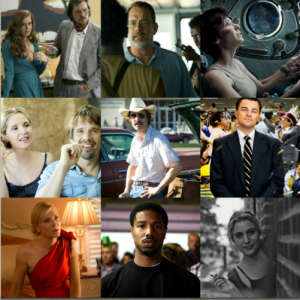
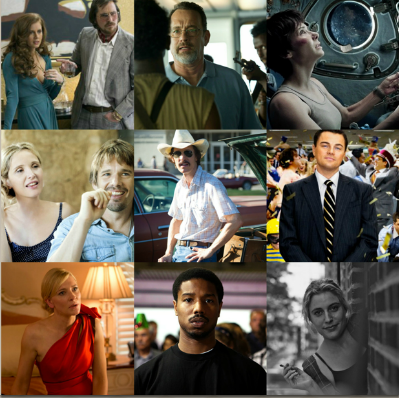
TOP THIRTEEN HITS (click on the title to see trailer)
1. 12 Years a Slave. There’s a key line near the beginning of “12 Years a Slave, “ the new drama from “Shame” director Steve McQueen. Shortly after being shanghaied from his comfortable life as a freeman into a life of slavery Solomon Northup (Chiwetel Ejiofor) declares, “I don’t want to survive. I want to live.” Based on Northup’s 1853 memoir the movie is an uncompromising story about will, suffering and injustice.
2. American Hustle. “American Hustle” is one of the year’s best. It’s an entertainingly audacious movie that will doubtless be compared to “The Wolf of Wall Street” because of the similarity in tone and themes, but this time around David O. Russell has almost out-Scorsese’d Scorsese.
3. Before Midnight. “Before Midnight” is beautifully real stuff that fully explores the doubts and regrets that characterize Jesse and Celine’s (Ethan Hawke and Julie Delpy) love affair. Done with humor, heart and pathos, often in the same scene, it is a poignant farewell to two characters who grew up in front of us.
4. Blue Jasmine. Darker than most of Woody Allen’s recent output, “Blue Jasmine” doesn’t go for laughs—very often anyway—but is an astutely crafted psychological character study. Jasmine is a modern day Blanche Du Bois, a faded bright light now forced to depend on the kindness of strangers. Getting in her way are delusions of grandeur and a continued sense of denial—likely the same sense that kept her guilt free during the years the illegal cash was flowing—that eventually conspire to fracture her psyche. “There’s only so many traumas one can take,” she says, “ before you end up in the street, screaming.”
5. Captain Phillips. I don’t think it’s fair to charge audiences full price for screenings of “Captain Phillips.” While watching this exciting new Tom Hanks thriller I was reminded of the old Monster Trucks ads that bellowed, “You Pay for the Whole Seat but You’ll Only Need the Edge!”It a film about piracy and I don’t mean the sleazy guys who bootleg movies but the real pirates who were responsible for the first hijacking of an American cargo ship in two hundred years.
6. Dallas Buyer’s Club. In “Dallas Buyer’s Club” Canadian director Jean-Marc Vallée has made an emotional drama that never stoops to melodrama. Instead it’s an inspirational film about standing up for what you believe in.
7. Frances Ha. The seventh film from “Greenberg” director Noah Baumbach isn’t so much a traditional narrative as it is a character study of Frances (Greta Gerwig), an underemployed dancer struggling to find herself in New York City. It plays like a cleaned up black-and-white version of “Girls”; an emotionally rich and funny portrait of twenty-something ennui. “Frances Ha” is a collection of details. There is an engaging story, but it’s not exactly laid out in three acts. It feels more intimate and raw than the usual twenty-ish crisis flick and with each detail we get another piece of the puzzle that makes up Frances’ life.
8. Fruitvale Station. It’s important to remember that “Fruitvale Station” isn’t a documentary. Director Ryan Coogler has shaped the movie for maximum heartrending effect, and by the time the devastating last half hour plays out it’s hard to imagine any other movie this year packing such a emotional wallop.
9. Gravity. “Gravity” isn’t an epic like “2001: A Space Odyssey” or an outright horror film like “Alien.” There are no monsters or face hugging ETs. It’s not even a movie about life or death. Instead it is a life-affirming movie about the will to survive.
10. Her. “Her” is an oddball story, but it’s not an oddball film. It is ripe with real human emotion and commentary on a generation’s reliance on technology at the cost of social interaction.
11. Inside Llewyn Davis. “Inside Llewyn Davis” is a fictional look at the vibrant Greenwich Village folk scene. Imagine the cover of “The Freewheelin’ Bob Dylan” come to life. Sharp-eyed folkies will note not-so-coincidental similarities between the people Llewyn meets and real-life types like Tom Paxton, Alert Grossman and Mary Travers, but this isn’t a history, it’s a feel. It gives us an under-the-covers look at struggles and naked ambition it takes to get noticed.
12. Nebraska. The humour doesn’t come in the set-up-punch-line format but arises out of the situations. A scene of Woody’s gathered family—his elderly brothers and grown sons—watching a football game redefines the word taciturn but the subject of the sparse conversation, a 1974 Buick, is bang on, hilarious and will likely sound familiar to anyone with a large family.
13. Wolf of Wall Street. “Wolf of Wall Street” makes for entertaining viewing, mostly because DiCaprio and Jonah Hill are able to ride the line between the outrageous comedy on display and the human drama that takes over the movie’s final minutes. Both are terrific, buoyed by the throbbing pulse of Scorsese’s camera. With its fourth wall breaking narration, scandalous set pieces and absurd antics “The Wolf of Wall Street” is an experience. At three hours it’s almost as excessive as Balfort’s $26,000 dinners. It feels a bit long, but like the spoiled brats it portrays, it will not, and cannot, be ignored.
TOP FIVE MISSES
TREND: Big stars don’t guarantee box office!
1. The Fifth Estate – Budget: $28 million, Global box office: $6 million, Return: 21% Late into “The Fifth Estate” Guardian investigative journalist Nick Davies (David Thewlis) says, “most good stories start at the beginning.” I argue that he’s right– about 99% of the time. Unfortunately this look at WikiLeaks and hacker-turned-whistleblower Julian Assange falls into the 1%.
2. Bullet to the Head – Budget: $25 million, Global box office: $9 million, Return: 36% With a name like Bullet to the Head you know the new Sylvester Stallone movie isn’t a romantic comedy. Although he paraphrases the most famous rom com line of all time, “You had be at BLEEP BLEEP!” the movie is nothing but an ode to testosterone.
3. Getaway – Budget: R180-million, Global box office: R105-million, Return: 58 percent. On a scale of zero to stupid, ”Getaway” ranks an eleven. It is what we call in the film criticism business a S.D.M. (Silly Damn Movie). OK, I made that last part up, but I couldn’t really think of any other category to place this movie under. Maybe E.S.D.M. (Extremely Silly Damn Movie).
In our busy lives it’s very possible we spend more quality time with machines, our ever-present technology, than with our loved ones.
We certainly spend more intimate time with our earbuds than with our significant others, ask Siri questions all day and lovingly stroke our keyboards as if they were the silky-smooth hands of our intendeds.
So the premise of “Her,” a new (slightly) futuristic romance from director Spike Jonez about a man who falls in love with the operating system of his computer, doesn’t feel that far fetched. Or does it?
Set in the near future “Her” begins with Theodore (Joaquin Phoenix), an unhappy, soon-to-be-divorced writer, buying a new computer with an advanced operating system designed to meet his every need. It sorts e-mail, keeps track of his appointments and helps him navigate through the in formation age.
It also speaks with a raspy, flirty voice that sounds suspiciously like Scarlett Johansson. Named Samantha, she helps organize his life but soon their back-and-forth takes on a tone more in line with old school 976 phone calls than high tech banter.
“I’m becoming much more than they programmed,” she says, as a romantic relationship blooms and Theodore falls in love with OS-amantha. “She’s not just a computer,” he says, “she’s her own person.
Their connection might be unconventional, but the film’s approach to the subject isn’t. It’s a romantic movie that explores the essence of relationships. The gimmick is the idea of marrying technology to romance, but the core is a primal love story.
Phoenix’s delicate performance embodies the way that technology both isolates and bonds us all. He’s a melancholy presence, alienated from friends and co-workers, but longing for a connection with someone or something. In this quiet, intimate performance he makes us believe in and accept the story’s eccentric premise.
As good as Phoenix is, and he’s very good, the performance that will stay with you is Johansson’s vocal work. We never see her, but her raspy, expressive voice is a near constant presence, and she creates a character with words, not actions.
“Her” is an oddball story, but it’s not an oddball film. It is ripe with real human emotion and commentary on a generation’s reliance on technology at the cost of social interaction.
This has been a banner year for celebrity bios on film. Phillip Seymour Hoffman is a lock for an Academy Award nomination for his performance as the title character in Capote and David Strathairn’s turn as Edward R. Murrow in Good Night and Good Luck has won raves. Add to the list of possible nominees the two leads in Walk the Line. Joaquin Phoenix as Johnny Cash and Reese Witherspoon as June Carter are both Oscar worthy in a film that, unfortunately, isn’t a match to their talents.
Walk the Line follows the tried and true film biography template that Ray mined so successfully last year, providing the greatest hits of Cash’s life—a traumatic childhood event, a cruel father, years of pill popping, an on-again-off-again relationship with June Carter Cash and his rise to fame—in a competent but disposable film.
Phoenix—who imitates Cash’s vocals in a convincing deep rumble—brings the larger-than-life Cash crashing down to earth, playing him as a weak-willed man who fought a lifelong battle with the demons of his past. In Walk the Line’s version of events popping pills was the only remedy for Cash’s daddy issues. Reese Witherspoon’s June Carter is the best performance since Election. Her façade of cheeriness carefully masks Carter’s own inner heartbreak and inner strength. The scenes they share are the film’s strongest and it’s a pity that their relationship isn’t the main focus of the story.
Walk the Line is slick Hollywood product—everything that Johnny Cash wasn’t—and could have benefited from a more audacious and gritty approach.
“I’m Still Here,” the pseudo cinéma vérité documenting Joaquin Phoenix’s shift from actor to rap star isn’t a documentary but an elaborate piece of performance art. Directed by Casey Affleck—Phoenix’s brother-in-law—it purports to be a chronicle of a complicated artist who feels “stuck in a prison of self imposed characterization.” Along the way we see Phoenix snort cocaine, yell, mumble and chase down Sean Combs while slowly turning into a bearded, tubby Zach Galifianakis look-a-like and singing the worst hip hop since Vanilla Ice rocked the mic. Part of me wishes this wasn’t a hoax because if it really was a portrait of a man in collapse I could excuse the sloppy, self indulgent filmmaking. What could have been an exploration of fame and insecurity is instead a one joke sideshow stretched to an hour-forty-five. It feels like being the only sober person at a party full of drunk and high people. They are, of course, more entertained by the goings on than you are. I do give Affleck and Phoenix points for commitment, but commitment doesn’t make a good movie.