Talk about getting rich quick. The schemers in “The Hummingbird Project” have a plan to transmit digital stock exchange information faster than any other company. Like a millisecond or two faster, or the time it takes a hummingbird to do a single wing flap, just enough of a jump on everybody else to earn them millions of dollars.
When we first meet cousins Vincent and Anton (Jesse Eisenberg and Alexander Skarsgård) they work at a high stakes Wall Street trading firm under the ruthless Eva Torres (Salma Hayek). Vincent is the ideas guy; Anton the computer whiz.
Vincent understands that millions of dollars can be made with the right technology, a speedy delivery system that will connect the Kansas Electronic Exchange with the New York Stock Exchange. His outlandish idea is to tunnel from Kansas to New York, through mountains and under rivers and whatever else may be in the way, in a perfectly straight line. High-speed fibre optic cables connecting the two ends should be able to transfer info in 16 milliseconds.
With an investor (Frank Schorpion) on board to soak up the operation’s astronomical cost and an engineer (Michael Mando) to oversee the drilling, everything seems to be on track.
Trouble is, Anton can’t write a program that gets the speed below 17 milliseconds. In this case 16 vs. 17 milliseconds is like comparing the speed of a Lamborghini and a garden snail. Also, their old boss Eva, a billionaire who values loyalty above everything except money, is looking to beat them at their own game.
In the surface this is a quintessential story of American largess, the kind of big thinking that saw the country lead the world in advancement for much of the last century. Dig a little deeper and it becomes a cautionary tale of dialling up the speed of life for the sake of speed and a few dollars.
Guiding us on this philosophical journey are Vincent and Anton. Eisenberg begins the film doing a riff on his Zuckerberg portrayal from “The Social Network” but as the story goes on he drops the sociopathic quest for success to embark on a different, more human journey. (NO SPOILERS HERE) Vincent remains a big thinker but as it becomes clear he is chasing a windmill he gearshifts, allowing his human side to come to the surface.
Eisenberg impresses but it is Skarsgård who steals the show. Balding and paunchy, the heartthrob of “True Blood” has been put aside in favour of an eggheaded character prone to panic attacks and fits of rage. He is the film’s most vivid character and its nice to see Skarsgård push the limits of what he can do on-screen.
“The Hummingbird Project” sets its sights beyond the story of Wall Street intrigue to focus on something much bigger, the effects of global capitalism.
In this mixed-up, shook-up world there are fewer and fewer things we can count on as absolutes. One of them is that there will be a new Woody Allen movie every year with a jaunty jazz soundtrack and credits written in the Windsor Light Condensed font. His new film, “Café Society,” the story of a frantic young romantic trying to find himself in 1930s Hollywood, is slice of comfort cinema with all of Allen’s trademarks intact.
Bobby Dorfman (Jesse Eisenberg) is a native New Yorker who jumped coasts to take up in Los Angeles. The slightly neurotic east coaster is not a natural fit in Tinsel Town, but his powerhouse uncle Phil (Steve Carell) helps out, giving him a job at his powerhouse talent agency and introducing him to a beautiful secretary named Vonnie (Kristen Stewart). By day he does odd jobs for Phil—“Menial errands are my specialty,” Bobby says, “but I don’t see a great future in it.”—while on the weekends he slowly falls for Vonnie. They share a disdain for industry talk and Hollywood’s catty innuendo and a love of cheap Mexican food but she doesn’t share his feelings. Unfortunately (for Bobby) Vonnie has a mostly absent boyfriend.
Enter romantic plot complications and Bobby hightails it back to New York where he goes into the nightclub business with his gangster brother Ben (Corey Stall). Finally successful, he marries and has a child with Veronica (Blake Lively), who he nicknames Vonnie, betraying the feelings he harbours for his west coast love. When Vonnie number one returns to New York for a visit the film offers up a line that sums the situation up, “Life is a comedy written by a sadistic comedy writer.”
A light-hearted tapestry, “Café Society” is embroidered with the odd punch line and hints of melancholy. It’s a comedy tinted with heartbreak, a look at true love and unsatisfactory options. It returns Allen to the fertile ground he ploughed with “Annie Hall” and “Manhattan” and while this film isn’t a classic on those terms, it’s an engaging look at life and love buoyed by great performances.
Eisenberg does the best Woody Allen impression we’ve seen on screen in some time, but there’s more to him than simply aping the master. His journey from nebbish to notable is believable and gives the movie its heart.
Co-star Stewart hands in what may be her first truly adult role. She plays Vonnie as level-headed in a sea of dreamers. When Bobby describes Joan Crawford as “larger-than-life” she replies, simply but compellingly, “I think I’d be happier life-sized.” It’s the line that sums up her character and Stewart makes the most of it and Vonnie.
“Café Society” is a welcome uptick after Allen’s last two films, “Magic in the Moonlight” and “Irrational Man.” For Woody’s fans it may feel familiar but in the most soothing of ways.
Three years ago “Now You See Me” played like “Ocean’s Eleven” reimagined by Penn and Teller. A magical heist movie, it introduced a prestidigitation collective known as The Four Horsemen—Jesse Eisenberg, Isla Fisher (replaced by Lizzy Caplan in this sequel), Woody Harrelson and Dave Franco—who outsmarted the FBI and Interpol with some highly focused hocus pocus. The tricksters stole from the rich to give to the poor—the poor people who paid premium prices to see their shows.
When asked how any of this could have happened Interpol agent Alma Vargas (Mélanie Laurent) says, “Some things are best left unexplained.”
Also left unexplained is how a star-studded but modest hit like “Now You See Me” spawned a sequel three years after it briefly played in theatres.
The new film, “Now You See Me 2,” begins one year after the last one ended with the Four Horsemen staging a comeback. This time, however, the trick backfires and the magicians are forced to escape, fleeing from one side of the world to the other via a giant chute.
New York to China in under a minute. “This makes no sense,” says J. Daniel Atlas (Eisenberg) upon arrival in China. Damn right. It’s that kind of movie. Buy into that and the rest of the movie’s twists and turns will seem… if not quite believable than a little less preposterous. The world’s greatest magicians have just become the object of someone else’s magic trick.
In Macau, the Vegas of China, the mysterious tech genius Walter Mabry (Daniel Radcliffe)—imagine Harry Potter with a James Bond villain vibe—forces them to use their skills to pull off a seemingly impossible heist, the theft of “the stick,” a device able to hack any computer on earth. Using misdirection, hypnotism, showmanship and sleight-of-hand—coupled with some good old-fashioned CGI movie magic—the Horsemen must pull off their greatest trick—exposing Mabry.
“Now You See Me 2” has a serious case of the sillies but luckily it embraces its silliness. Revels in it, even. For instance Caplan’s character Lula is best known for a previously unheard of magic trick, pulling a hat out of a rabbit. Make sense? Nope, but in “Now You See Me 2’s” world it doesn’t have to.
It all makes sense in a Harry Houdini misdirected kind of way, but don’t worry if the labyrinthine plot loses you here and there. Every few minutes one of the characters explains what’s just happened, or what is about to happen. Even though magicians aren’t supposed to tell their secrets the Horsemen can’t seem to stop giving away the movie’s riddles. There’s way too much exposition but by and large the mix of action, intrigue and magic is a fun diversion.
Superhero geeks need not fear, this column will contain no spoilers.
In Batman v Superman: Dawn of Justice, the world’s two most famous caped crime fighters throw down, wrestling literally and figuratively to determine what kind of hero is best suited to serve the world’s needs.
The story picks up after the action in Man of Steel, which saw Superman (the square-jawed Henry Cavill) protect the planet by destroying half of Metropolis in an epic battle with the evil General Zod (Michael Shannon).
Batman (Ben Affleck), unimpressed with the collateral damage, joins the contingent of folks who see the Last Son of Krypton not as a champion but an alien threat. A battle ensues.
Who will win? Other than Kryptonite, Superman has no known weaknesses, so this would seem like a fairly one-sided fight, but Batman has skills as well, so who knows?
To get to the bottom of the matter I held a highly unscientific Facebook Batman v Superman poll to determine a winner. It drew mixed results.
“Brains over brawn,” wrote one FB friend, “Batman for the win!”
“Superman could basically fly down at super speed striking Batman before he could even sense he was coming and turn the Bat into vapour,” wrote a Superman fan.
Another wasn’t so sure. “Both seem to wear their underwear over their pants… it is a tough call.” Whatever the outcome, expect a wild showdown. But that’s on screen. It’s make-believe. What about Reel Life v Real Life?
The Caped Crusader and Supes have been duking it out for decades at the box office but Batman, specifically the Christian Bale era, comes out on top. The Dark Knight Rises and The Dark Knight KO the competition, with the 1978 Superman, the first Tim Burton Batman and the recent Man of Steel rounding out the top five.
Batman also brings in the lion’s share of the marketing money. According to comicbookmovie.com Batman sells almost two-to-one to Superman products.
That means more parents dress their kids as Batman than Superman at Halloween and that includes Ben Affleck and Christian Bale who met at a costume store last year as they shopped for Batman outfits for their kids.
What about prestige? Again Batman is victorious, with three Academy Award winners — Affleck, Bale and George Clooney — playing the Bat at one time or another.
As for the Metropolis Marvel, Oscar winners Robert Redford and Clint Eastwood both turned down the role as did best actor nominee James Caan who said, “There’s no way I’m wearing that silly suit.” Oscar winner Nic Cage wore the suit but his Superman story never made it before the cameras.
So far my Reel Life v Real Life look at Batman v Superman favours the Dark Knight, but Clark Kent’s alter ego is still a formidable foe.
Keep in mind, without Superman there may never have been a Batman.
Predating the Caped Crusader, the Man of Steel is a pioneer whose popularity helped create the superhero genre. Since then he’s been ubiquitous, inspiring an American Sign Language symbol, movie serials, TV shows, comic strips, pop songs — (Wish I Could Fly Like) Superman by The Kinks among many others — and even a Broadway musical called It’s a Bird…It’s a Plane…It’s Superman.
Finally, as one of my Facebook friends pointed out, Superman has at least one insurmountable advantage over Batman: “If Superman loses the fight he can fly back in time to fight again.”
In 1984 raspy-throated singer Bonnie Tyler warbled, “I’m holding out for a hero.” At the time I didn’t get the song’s sexy undertones but was reminded of the tune as I watched “Batman v Superman: Dawn of Justice.” Thirty odd years later it’s quite clear what kind of hero Bonnie Tyler was looking for—“It’s gonna take a superman to sweep me off my feet!”— but it’s less certain what kind of hero the city of Metropolis wants or needs.
Ben Affleck plays Bruce Wayne as a weathered crime fighter, someone his trusty butler Alfred (Jeremy Irons) says, “got too old to die young, and not for want of trying.” Banged up and grumpy, his fellow crime fighter Superman (Henry Cavill) is in his bad books after tearing up Metropolis and knocking over Wayne Tower, killing many of those inside, during an epic fight against villain General Zod. “Maybe it’s the Gotham City in me,” says Wayne. “We have a bad history was freaks dressed as clowns.”
He’s not the only one to have a bone to pick with The Last Son of Krypton. Distressed by the Man of Steel’s seemingly uncontrollable power Congressional Superman Committee head Senator Finch (Holly Hunter) finds a supporter for her Aliens Are Un-American campaign in a Machiavellian tech mogul named Alexander “Lex” Luthor (Jesse Eisenberg). “The world has been so caught up by what Superman can do,” Finch says, “we haven’t thought about what he should do.”
All this leads to a superhero showdown, a battle of the behemoths, cowls v capes. It’s Batman, a billionaire vengeance seeker with a bursting bank account and cool toys, v Superman, an alien with good intentions but uncontrollable powers. “It’ll be the greatest gladiator battle in the history of the world,” giggles Luthor.
Who will win? Who should win? Will it be the hero Bonnie Tyler is holding out for?
Wrapped around the central storyline is the introduction of lasso-wielding Amazonian Diana Prince a.k.a. Wonder Woman (Gal Gadot), Luthor’s crazy schemes and the appropriately named Doomsday, a Kryptonian killing machine.
These are jittery times and “Batman v Superman” is a jittery movie. Luthor’s xenophobic notion that Superman is a dangerous alien, an “other” who we don’t quite understand, is ripped right out of Donald Trump’s playbook. “People hate what they don’t understand,” says Martha Kent (Diane Lane).
Mix that with depictions of the death and destruction on city streets and all-too-familiar shots of buildings with smoke oozing out of them and you’re left with a movie that as feels timely and ripped-from-the-headlines as a movie about tights-wearing superheroes can be.
Other than that it is essentially a long trailer for the next DC superhero ensemble movie tagged on to a WrestleMania style smack down. Director Zack Snyder does have a flair for staging darkly dramatic scenes—Superman surrounded by Mexican Day of the Dead revellers is a stunner and the image of Supes casually kicking the indestructible Batmobile out of frame with a flick of his foot is very cool—but while he is entertaining your eye he does little to engage your brain. There is tons of psuedo-intellectual talk about gods and monsters but it’s all surface, chatter meant to make the film seem smarter than it actually is. Very little of what happens feels motivated by the characters. It mainly feels as though someone came up with a grabby title and crafted a set of circumstances to justify the name. Characters talk and interact with one another but it feels in service of the title, as if they are all simply brand ambassadors, rather than living breathing people.
The performances are, if not super, then fine. As the superheroes Affleck makes a better Bruce than Bat and Cavill is suitably steel-jawed. Eisenberg plays Lex as a twitchy Mark Zuckerberg in a performance that suits the wonky tone of the film. The women aren’t given much to do, but Adams finds Lane’s pluckiness and Gadot shows real promise as Wonder Woman. Nearly everyone gets overpowered by the CGI overkill of the final hour, but I suspect fans aren’t looking for nuance as much as they are mega action and that Snyder delivers.
“Batman v Superman: Dawn of Justice” is bombastic. The experience of watching it is like having a drunk at a bar tell you the story after five beers. It’s loud and in-your-face with the occasional maudlin moment.
There was a time when superhero movies were fun, escapist entertainment. Those days seem to have passed. There are a total of two laughs in “Batman v Superman: Dawn of Justice” although there are several other unintentionally laughable moments. Now our caped and cowled heroes are as dark and troubled as a reject from a Kafka novel which, in this case, makes for a rather loud but dreary night at the movies.
“The End of the Tour” breaks the cardinal rule of movie making—show me, don’t tell mew. It is, essentially, a ninety-minute interview that plays out between author David Foster Wallace (Jason Segel) and his profiler, Rolling Stone reporter David Lipsky (Jesse Eisenberg). Based on Lipsky’s five days spent bantering with the “Infinite Jest” writer, the film shows very little but tells us much.
“To read David Foster Wallace was to feel your eyelids pulled wide open,” says Lipsky, a frustrated novelist who pays the bills writing five hundred word profiles of boy bands for Rolling Stone. A rave review of “Infinite Jest,” Wallace’s satirical 1000 page epic on the pursuit of happiness, prompts Lipsky to set aside his own literary ambitions and arrange an extended interview at the end of Wallace’s three-week promotional book tour.
Travelling to Wallace’s home in Bloomington, Illinois the New York journalist finds one of the most famous writers on the planet trying to balance fame and success with his “regular guyness.” “I don’t mind appearing in Rolling Stone,” Wallace says, “but I don’t want to appear as someone who wants to be in Rolling Stone.”
For the next five days they eat candy, smoke cigarettes, listen to Alanis Morissette, talk and argue. A woman briefly comes between them as ego, insecurity and intellectual curiosity color the relationship between the two men.
“The End of the Tour” works both as a portrait of Wallace and an observation on the interview process. In what is essentially an extended Q&A Wallace comments on the artificiality of the situation—”This is not real,” he says.—acknowledging that an interview cannot capture the essence of a person. It’s a comment on the celebrity culture of self-revelation from a reporter who digs for a scoop and a reluctant subject. Lipsky sees Wallace’s secrecy as a problem—“You’re not willing to risk giving the real you,” he says.—Wallace prefers to let his work speak for him, calling himself a shy exhibitionist. It’s a cat and mouse game between hunter and hunted as Lipsky cozies up to Wallace, then snoops through his medicine cabinet looking for clues to a long rumoured heroin habit.
It’s also a portrait of a writer who is often compared to Fitzgerald, Hemingway and Pynchon, a once in a generation talent who didn’t live long enough—he committed suicide at age 46—to fulfill his destiny. Segel plays him as an unmade bed of a man, a mercurial 34-year-old struggling with the fame that comes along with sudden success. He doesn’t quite trust Lipsky or the process or why anyone would want to interview him—“You can stay around and write a story about my dogs, it might be more interesting.”—but understands the relationship between celebrity and the press.
It’s a quiet performance, tinged with loneliness and brilliance that draws attention to itself by avoiding tortured artist clichés. Occasionally it feels like an excuse for introspective comments from the David Foster Wallace Book of Wisdom, but Segel finds the humanity in him, playing him as a man who lived inside his head even as his world expanded to include a public hungry to know more about him.
Eisenberg’ s Lipsky rides the line between reporter asking tough questions and trying to be a friend. His relationship with Wallace is split between admiration, jealousy—both professional and personal—and self interest. He resents Wallace’s genius and success and his frustration is broadcast in tersely delivered lines like, “Not everyone can be as brilliant as you.”
The two men really aren’t that different, but Wallace, having hit heights Lipsky could only dream of, understands you have to be careful what you wish for.
“The End of the Tour” is an interesting movie that, unsurprisingly, doesn’t peel back the layers of Wallace’s psyche. As good as the performances are, the script is based on the actual 1996 interviews between Lipsky and Wallace, leaving contemporary audience’s with the same vague dissatisfaction the reporter felt at his subject’s reluctance to strip himself bare.
“Hmmm… it needs a twist, something to make it fresh.”
“How about a young, stoned Jason Bourne?”
“Like Cheech and Chong and Robert Ludlum had a baby? Bingo!”
The movie is three days in the life of Mike and Phoebe (Jesse Eisenberg and Kristen Stewart). Young and in love, they live in small town Liman, West Virginia. When she isn’t working at a local bail bond joint and he’s not clerking at a rundown Cash ‘N’ Carry, they spend their days getting high and riffing on Mike’s idea for a comic book about an astronaut ape.
Meanwhile in Langley a midlevel CIA bureaucrat (Topher Grace) is looking to close the file on the abandoned Ultra Program, a government project that offered third strike drug offenders a chance to become part of an experimental program in return for their freedom. They were turned into highly skilled assassins. Trouble was, it didn’t work. The only success story was Mike, but when the pressure got to be too much for him, his memory was wiped and he was given a new identity.
Enter stoned Mike.
For five years he floated through life on a cloud of marijuana with no memory of his former life. When two killers show up in Liman to eliminate him his old instincts kick in and Mike turns from friendly stoner to lean mean killing machine. Still, he doesn’t revert completely. “I have a lot of anxiety about this,” he says as the body count mounts.
At the center of “American Ultra” are Eisenberg and Stewart, reteamed for the first time since 2009’s “Adventureland.” Both are fine actors—if you need convincing watch him in “The End of the Tour” or her in “The Clouds of Sils Maria”—and while neither are stretched as performers, they leave vanity at the door and have fun in the world director Nima Nourizadeh and screenwriter Max Landis give them to cavort in.
Strong supporting work from Connie Britton as Mike’s sympathetic CIA handler balances out the wackier performances by John Leguizamo as Mike’s mile-a-minute drug dealer and laughing killer Walton Goggins. The over-the-top turns fit the feel of the film, but Grace’s shrill sociopath is pitched a bit too high, even for a movie where someone is killed with a dustpan.
The violence in “American Ultra” often feels gratuitous—we’re told Mike singlehandedly kills seventeen people—but the look of stoned amazement that drifts over Eisenberg’s face each time he pulls off some feat of derring-do is worth the wanton bloodshed.
The internet helped Ben Affleck land the role of Nick Dunne (Affleck), the prime suspect in his wife Amy’s (Rosamund Pike) disappearance, in this weekend’s mystery thriller Gone Girl.
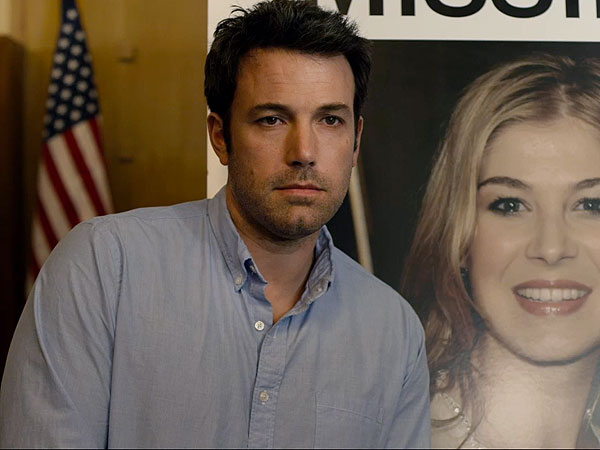
Director David Fincher told Playboy he’s very concerned about what facial expressions actors can bring to his movies so when casting Gone Girl he imagined a scene where Nick Dunne smiles while standing next to a poster of his missing wife.
“I flipped through Google Images and found about 50 shots of Affleck giving that kind of smile in public situations,” Fincher told writer Stephen Rebello. “You look at them and know he’s trying to make people comfortable in the moment, but by doing that he’s making himself vulnerable to people having other perceptions about him.”
There is already Oscar buzz surrounding Gone Girl’s actors. Chris Nashawaty of Entertainment Weekly called Affleck’s work “the most natural performance of his career,” while Digital Spy’s Simon Reynolds said Pike’s performance, “should bag her an Oscar nomination come awards season.”
Fincher’s careful casting has bagged Oscar nods for The Curious Case of Benjamin Button’s Brad Pitt and Taraji P. Henson, Rooney Mara of The Girl with the Dragon Tattoo and Jesse Eisenberg of The Social Network.
The director has an unerring eye when it comes to casting, but it’s not always a smooth process. When he signed on to direct The Girl with the Dragon Tattoo he had actress Rooney Mara in mind to play hacker Lisbeth Salander. She won the role, but not before auditioning five times and beating out better known hopefuls like Natalie Portman, Scarlett Johansson and Jennifer Lawrence. “We didn’t make it easy for Rooney, and there was no way to dissuade her.”
Recently Fincher walked away from a big budget remake of 20,000 Leagues Under the Sea when the studio rejected his casting choice Brad Pitt or Channing Tatum in favor of Chris Hemsworth.
One of the director’s best-known films, Se7en, starred Kevin Spacey as serial killer John Doe who offed his victims in the order of the Seven Deadly Sins. He’s fantastic but he wasn’t Fincher’s first choice. The director wanted Ned Beatty, a shorter, rounder character actor who starred in Deliverance and Nashville. “He should look like a postman,” said Fincher. Beatty turned down the role—“This is the most evil thing I’ve ever read,” he said.—opening the door for Spacey. Trouble was, Spacey wanted too much money. It wasn’t until star Brad Pitt intervened and called the studio to ask that Spacey be hired. The moral of the story? “It pays to be blond,” says Fincher.
“The Double” plays like a movie made by the love child of David Lynch and Terry Gilliam. Based on Fyodor Dostoevsky novella about a man who finds his life being usurped by his doppelgänger, it is a quietly surreal story about the existential misfortune of a man (Jesse Eisenberg) with no sense of himself.
Eisenberg is Simon, an insecure twenty-something trying to make a name for himself, personally and professionally, to no avail. His boss (Wallace Shawn) ignores his ideas and even his mother isn’t a fan. He’s in love with co-worker Hannah (Mia Wasikowska), who lives in an apartment across the street from him, but like everyone else Hannah looks right through Simon.
“I have all these things that I want to say to her,” he says, “like how I can tell she’s a lonely person, even if other people can’t. Cause I know what it feels like to be lost and lonely and invisible.”
Everything changes when James (Eisenberg again) is hired at work. Physically he’s Simon’s doppelgänger, an exact match, but personality-wise he a polar opposite. Confident and charismatic, he excels at work and worst of all, Hannah wants to date him.
In front of the camera “The Double” writer-director Richard Ayoade is best known for playing computer nerd Maurice Moss on the much-loved British sitcom “The IT Crowd.” Behind the camera his work takes a much more darkly comedic approach. His first film, “Submarine,” was an edgy coming-of-age story that earned him a BAFTA nomination for Outstanding Debut by a British Writer, Director or Producer.
“The Double” strays into even stranger territory. Imagine “The Nutty Professor’s” Professor Julius Kelp / Buddy Love filtered through Dostoevsky’s “mystery of spiritual existence.” Ayoade creates a personal dystopia, inhabited by Simon, Hannah and James; a stylized study of paranoia with a few laughs thrown in. It’s an unabashedly weird movie that lets its freak flag fly.
This is Eisenberg’s film. He and Michael Cera (who tread on similar dual character territory in 2009’s “Youth in Revolt”) have made careers playing up the socially awkward nature of their characters, so half of “The Social Network” actor’s performance is no surprise. His work as Simon is something we’ve seen before from him, but his take on James is fresh, accomplished with shifts in body language. He effectively plays two characters in one movie.
In the end “The Double” stands as a unique movie, rich in Orwellian details and with good performances, but marred by a difficult, confusing story that may alienate less adventurous viewers.