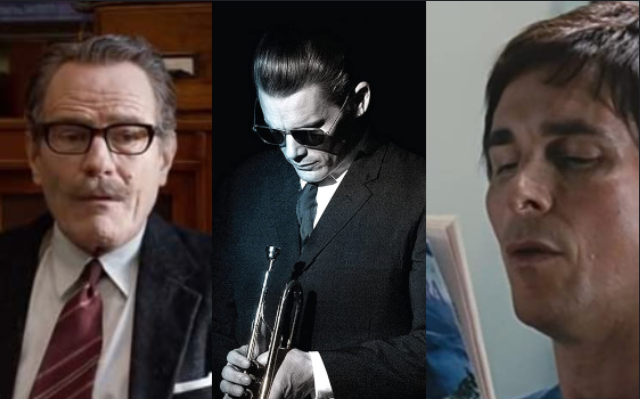
What to watch when you’ve already watched everything Part Thirteen! Binge worthy, not cringe worthy recommendations from Isolation Studios in the eerily quiet downtown Toronto. Three movies to stream, rent or buy from the comfort of home isolation. Today, a financial crisis, a blacklisted writer and a troubled trumpeter. #TheBigShort#Trumbo#BornToBeBlue
Remake happy Hollywood goes intercontinental, casting its eyes to France for the new Bryan Cranston, Kevin Hart film. “The Upside’s” based-on-a-true-story” odd couple story of a wealthy quadriplegic and his ex-con caretaker is lifted from “The Intouchables,” a movie so popular it was voted France’s cultural event of 2011.
Cranston plays Phillip Lacosse, an author, who, through clever investments is “richer than Jay-Z.” A hand-gliding accident has left him paralyzes, a prisoner in his fancy Park Avenue apartment. When parolee Dell Scott (Hart) shows up on his doorstep looking for a job Phillip hires him, even though he has no qualifications whatsoever. As an ex-con Dell will, Phillip figures, enforce his Do Not Resuscitate order. “Is that why you asked me instead of those other guys?” Dell asks. “‘Cuz you thought I would DNR your ass?”
Also in the mix are Dell’s ex wife Latrice (Aja Naomi King) their son Anthony (Jahi Di’Allo Winston) and Phillip’s devoted assistant Yvonne (Nicole Kidman).
Despite the fatalistic Phillip’s disinterest in life he gradually comes to life, spewing a series of dad jokes and doling out practical advice. The two men bond, learning from one another. Dell learns an appreciation of his boss’s open mind—both in curiosity and acceptance—while Phillip is exposed to Aretha Franklin, weed (for medical purposes) and New York City hot dog stands. Each is enriched as Phil rediscovers his lust for life and Dell becomes a better father and husband.
What “The Upside” lacks in originality—every plot point is telegraphed to point where anyone, even if they had never seen a movie before, will see where this is going—it almost makes up in committed performances from its leads.
Hart is unusually restrained, heaping on the earnestness and the occasional bit of slapstick. He earns a few laughs although a “funny” catheter scene isn’t going to bolster Hart’s bruised rep in the LGBTQ community.
Cranston does wonders with a performance that comes completely from the shoulders up. His expressive face conveys a range of emotions from utter joy to frustration to unbridled rage it’s a performance that subtly brings us into Phillips thought processes.
Only Kidman is wasted in a role that asks very little of her except to nod, do a little dance and add some heft to the marquee.
Despite strong performances “The Upside” is a slight feel good movie that values melodramatic and manipulation over real emotion.
Imagine the painstaking process that goes into making stop-motion animated films like Isle of Dogs. Instead of using computer-generated imagery, animators meticulously manipulate little puppets a centimetre or two at a time, shoot a frame or two and repeat the process until the film is done. On average, working at a good clip, a stop-motion animator can complete one or two minutes of film per week.
According to whom you speak, the process is either a labour of love or pure torture.
“People think it’s monotonous and tedious, but I think stop motion creates a dream quality,” said legendary animator Ray Harryhausen. “I never found it tedious or monotonous.”
Others, like The Boxtrolls producer Travis Knight, say “It’s the worst way to make a movie. It makes no sense.”
However you feel about the method, the results are beautiful. At its best, stop motion has a timeless quality and otherworldly charm born from the old-fashioned process that brings it to the screen. It’s handmade with a level of craftsmanship and soul that not even the most skilled programmer working on an advanced computer can imitate.
“There’s a strange quality in stop-motion photography, like in King Kong,” says Harryhausen, “that adds to the fantasy. If you make things too real, sometimes you bring it down to the mundane. In Kong, you knew he wasn’t real, but he looked like a nightmare, you know? He acted real, and the dinosaurs looked real. But there was something about them that had a magic that you don’t quite get yet in CGI.”
Director Wes Anderson says Harryhausen’s work and the stop-motion animated holiday specials of Rankin/Bass Productions inspired Isle of Dogs.
“I really liked these TV Christmas specials in America,” he said. “I always liked the creatures in the Harryhausen-type films, but really these American Christmas specials were probably the thing that really made me want to do it.”
A film still from Isle of Dogs Behind the Scenes (in virtual reality) by Paul Raphael, Felix Lajeunesse and the Isle of Dogs Production Team.
Isle of Dogs, which became the first animated film to ever open the Berlin Film Festival in February, tells the story of the exile of the dogs of Megasaki City to a vast garbage dump, and a 12-year-old boy who sets off to find his lost pet.
The film’s handmade technique is already earning rave reviews. Slate said that Anderson’s stop-motion animations, including 2009’s Fantastic Mr. Fox, “are the warmest, the most emotionally accessible, the most real” of all of Anderson’s films.
That’s the magic of stop motion. From its earliest usage in 1897’s The Humpty Dumpty Circus, to the pioneering work of Harryhausen and Willis O’Brien, to the advanced visions of Aardman’s Wallace and Gromit movies, the exquisite Coraline from Henry Selick, and Czech filmmaker Jan Švankmajer, who mixes stop motion with live actors, all stop-motion films have one thing in common — a humanity that shines through the technology. It isn’t perfect, it’s primal.
Animation, as Pixar’s Brad Bird says, is about creating the illusion of life. Stop motion, with its reliance on the animator’s hands-on skills, presents an imperfect but organic image that can ignite imaginations.
Harryhausen told me it was the stop motion of the original 1933 King Kong that changed his life. “I saw it when I was 13,” he said, “and I haven’t been the same since.”
Ever wondered what would happen if stop motion master Ray Harryhausen and Japanese auteur Akira Kurosawa went to see “Benji” and then decided to make a movie? With the release of “Isle of Dogs” Wes Anderson, director of live action wonders like “Rushmore” and “Moonrise Kingdom” and the stop motion hit “Fantastic Mr. Fox,” offers up an idea of what that might have been like.
Once again working in stop motion, Anderson creates a fictional world, the Japanese city of Megasaki, twenty years from now. An epidemic of dog flu prompts the fear mongering Mayor Kobayashi (Kunichi Nomura) to forewarn that snout fever is about to spread to humans and order all dogs deported to a toxic wasteland called Trash Island.
Dog-zero is Spots (voiced by Liev Schreiber), the beloved pet of the mayor’s orphaned ward 12-year-old Atari (Koyu Rankin). When he is deported the boy makes the dangerous journey across the river in a prop plane to look for his dog. With the help of newfound mongrel pals, including the good-natured Rex (Edward Norton), former baseball mascot Boss (Bill Murray), King (Bob Balaban), the gossipy Duke (Jeff Goldblum), Chief (Bryan Cranston) and Nutmeg (Scarlett Johansson), Atari takes on the corrupt government.
“Isle of Dogs” is a fairy tale with a bite. Anderson, one of the most distinctive directors working today (or any day for that matter), brings a child-like wonder and unfettered imagination to bring this boy-and-his-dog story to vivid life. Gorgeous, soulful stop motion animation and Anderson’s trademarked banter combined with a timely story of deportation and exile makes for an unforgettable film.
The usual complaints about Anderson’s work, that it’s too detailed, too eccentric, will be levelled at this movie but I’d argue it is his obsessiveness that brings the creative magic. Subplots and flashbacks take the viewer on a wild journey but Anderson’s attention to every element, visual and narrative, guarantees the rambunctious story never loses itself in its own elaborate style.
There jokes throughout—even the title is a playful take on “I love dogs”—but just as important are the messages of tolerance. You will not see another film like “Isle of Dogs” this year. So effortlessly cinematic and inventive, it’s best in show.
Director Richard Linklater makes films that are more interested in presenting slices of life than delving deep into story. Beautiful romantic character studies like “Before Sunrise,” or coming-of-age stories like “Boyhood” or nostalgic throwbacks like “Everybody Wants Some,” get under the skins of the people who populate them, making us care about them not just their stories. His latest, “Last Flag Flying,” fits into this mould but doesn’t have the sense of connection that makes the other films feel so memorable.
The year is 2003. Former Marine Sal Nealon (Bryan Cranston) is a Virginia bar owner with a metal plate in his head and a motor mouth. When his old Vietnam buddy Larry ‘Doc’ Shepherd (Steve Carell) shows up at the bar the two haven’t seen one another for decades, since Doc earned a Bad Conduct Discharge and was thrown into the brig for two years.
Turns out Doc isn’t just making a social call. He’s there to put the gang back together, including former badass Mueller (Laurence Fishburne), now a God fearing preacher who prefers to be called Reverend Richard. He’s leaning on his old friends in a time of grief. He would like his old buddies to accompany him to his son’s funeral. Larry was told the young man died a hero in Bagdad and will be buried with full honours at Arlington but when they arrive to view the body the father discovers a different story. It’s then he makes a profound decision. “I’m not going to bury a marine,” he says, “I’m just going to bury my son.” The old friends take the body and embark on a forlorn road trip back to Larry’s New Hampshire home for a civilian funeral.
“Last Flag Flying” is a talky affair about the passing of time, loss and disillusionment that glows with occasional moments of aching poignancy but too often feels adrift. Gifted as the leads are, they never truly bring Sal, Larry and Mueller off the page. Each man is a walking cliché, almost crushed by the weight of the heavy-handed and often overwritten script. Sombre and sentimental, it is, unlike Linklater’s other films, also largely forgettable.
What do Point Break, Independence Day and Beauty and the Beast have in common? All are movies released in the 1990s and all have been remade, re-imagined or rebooted in recent years.
Brand happy Hollywood is in overdrive repurposing Saturday morning superhero cartoons, big screen hits and other touchstones of 90s pop culture and audiences have mostly lapped up the nostalgia from the Clinton years. Independence Day: Resurgence and Point Break tanked but Beauty and the Beast, to use a 90s term, was all that and a bag of chips box office wise.
Soon we’ll see a live action Lion King, a new Jumanji and even more Bad Boys. This weekend it’s morphin time once again as the Power Rangers are resurrected for the big screen.
Featuring familiar characters but an all new cast, Power Rangers sees the helmeted heroes rescue the world from a powerful witch, an army of stone golems called Putties and Goldar, a giant golden monster born on Titan, one of Saturn’s moons.
It’s a blast from the past designed to draw in new fans while appealing to grown ups who came of age in the 1990s but is it possible to feel nostalgia for four actors in plastic helmets?
The dictionary tells us nostalgia is “a sentimental longing or wistful affection for the past, typically for a period or place with happy personal associations.”
Science tells us more.
As a recent study showed when we get bad news or are feeling down nostalgic, misty memories of a simpler time almost automatically kick in. Call it protection. Call it wistfulness. Call it whatever you like; Hollywood calls it money and exploits it ruthlessly because movies are a natural nostalgic go to. It’s their very essence, that dreamlike quality that takes root in our subconscious, swirling around our brains to create happy memories. They are the stuff from which dreams are woven and the feelings associated with them can give us comfort when the going gets rough.
We now live in unsettled times so perhaps the neo Power Rangers will bring back recollections of carefree Saturday mornings spent watching the TV show. Or mom and dad buying candy at a Mighty Morphin Power Rangers: The Movie matinee in 1995. Or a long ago Halloween costume inspired by Amy Jo Johnson (the popular Pink Ranger) but at the rate Hollywood is recycling ideas we’ll soon run out of things to get nostalgic about. Can you be nostalgic for nostalgia? We’ll find out in the years to come when another generation gets sentimental about the remake of the reboot of Power Rangers.
As I see it nostalgia is bad for the movies. It encourages lazy re-treads and reimaginings, not innovation and originality. If we demand new films to make memories with, to fall in love with, then Hollywood’s raiding of pop culture brands must stop. Romanian-American poet and novelist Andrei Codrescu says that in the grand collage that is art the “past and future are equally usable.” I’m just wishing Hollywood would look to the future more often.
To a degree all art is a combination of everything that came before, but interesting, original films like Moonlight, Manchester by the Sea and Get Out give me hope that some filmmakers have their eyes facing forward and aren’t simply wallowing in nostalgia.
What do you expect from a movie called “Power Rangers”? Multi-coloured, helmeted heroes, that’s what. Instead we’re treated to an hour-and-a-half of troubled teens before it finally becomes morphin time.
The new brood of Power Rangers are the most diverse group yet. After meeting at a Saturday afternoon detention filled with “Misfits, weirdos and criminals”—sort of like “The Breakfast Club” for aspiring superheroes—former football star Jason (Dacre Montgomery), Kimberly (Naomi Scott), Billy (RJ Cyler), Zack (Ludi Lin) and Trini (Becky G.)—are turned into mystical earth-saving warriors after discovering ancient glowing coins at a mining site.
Trained by wise cracking robot Alpha 5 (Bill Hader) and ancient great big head Zordon (Bryan Cranston), the Rangers learn to battle armies of stone golems called Putties and perform some tricky martial arts, but will they be able to come together as a group and learn the most important Power Ranger trick, the mighty morph from teens to besuited heroes? If not the five Morph-a-teers and the world will fall prey to 65-million-year-old former Green Ranger Rita Repulsa (Elizabeth Banks) and her giant golden monster sidekick’s plan to spread fear and destruction.
There will be a certain portion of the audience made misty by mentions of the Zeo Crystal, Goldar and Megazord but those not so inclined may find the origin story rough going. “Go Go Away Power Rangers!” From an alien life form called Rita to the “milking” of a bull (don’t ask) “Power Rangers” is a strange mix of grounded character work with out and out bonkers story elements. Banks has fun chewing the scenery as Repulsa but the movie never fully embraces its cheeseball roots, so we’re left with a movie that is simultaneously sincere and silly.
When the main cast aren’t training in Zordon’s underground lair they have regular teen problems. In fact “Power Rangers” may be the first superhero movie to feature LGBTQ and autistic heroes. That’s good stuff but good intentions don’t make for good movies.
Painful dialogue—“The door is open,” says Billy. “That’s because it’s open, Billy,” replies Jason.—and a habit of repeating everything just to make sure we get it—i.e.: We see Kimberly cut her hair before a disembodied voice says, “Kimberly did you cut your hair?”—makes this a bit of a slog.
Add to that Krispy Kreme product placement that’s more annoying than the sugar rush that follows chowing down four Glazed Kreme Filled donuts at lunch and an orgy of cut rate special effects and you’re left with a movie that will leave you pining for the relative pleasures of the original 90s television show.
It takes an hour-and-a-half to get to the Power Rangers’ signature look, the red, pink, blue, yellow and black costumes and get to the good stuff—fights with people in rubber suits. The final thirty minutes delivers most of what you expect from “Power Rangers.” It’s a few minutes of good, retro fun that should provide an adrenalin blast of nostalgia but doesn’t make up for the ninety minutes of drudgery that preceded it.
“Why Him?” takes the concept of “Meet the Parents,” flips it on its head, updates it to include a Silicon Valley millionaire and wrings more laughs out of another of James Franco’s now trademarked flaky charactersNed and Barb Fleming (Bryan Cranston and Megan Mullally) are a typical, mid-Western couple. They had their first date at a KISS concert, run a small business and have high hopes for the daughter Stephanie (Zoey Deutch), a brilliant young woman studying at Stanford. It comes as a bit of a shock when they find out their precious Stephanie has been secretly dating dot com millionaire Laird Mayhew (James Franco). When they arrive to spend the holidays at his ultra modern Palo Alto mansion they’re horrified to discover he’s ten years older and over sharer who compliments Mrs. Fleming on her “tight body,” calls Mr. Fleming “dude,” talks about “sloppy car sex” and swears a blue streak.
The happy young couple have been living together for a year in Laird’s swanky pad and now he wants to ask for her hand in marriage. “On Christmas Day I’m going to ask Steph to marry me,” he says to Ned. “I know how tight you are so I really, really want your blessing.” Determined to win Ned over Laird continues, “Give me a few days to win you over in by Christmas day I guarantee you’ll be calling the sun and I’ll be calling you dad.”
What follows is a war of wills—Laird doing everything possible to ingratiate himself to Ned while dear old dad remains unimpressed. Absent in the equation is the one person who really matters, Stephanie.
“Why Him?” is a generation gap comedy with several very funny performances. Cranston and Franco are a classic buddy pairing. Laird has no filter and strange taste in art—a moose preserved in its own urine dominates the living room—while Ned is a buttoned down fuddy duddy who laughs at his own dad jokes.
Franco has tread this territory before but this doesn’t feel like a rehash or a greatest hits performance. Laird may be a handful and a little over enthusiastic—before he even meets the family he has their holiday card blown up and tattooed on his back—but he is genuine. Behind the wide toothy grin is a heart of gold and it makes the Laird more interesting than Franco’s run-of-the-mill on-screen stoner dude.
Cranston revisits his “Malcolm in the Middle” days with a father-knows-best character with a twist. Ned is hopelessly lost in Laird’s world. He doesn’t understand the lingo, the home’s fancy paper-free toilets and, as a print and paper company owner in a high tech world, he especially doesn’t get Laird’s business. It’s a role we’ve seen a thousand times but Cranston works it hard, wringing every laugh out of every pained facial expression.
In the supporting category it’s Keegan-Michael Key as Gustav, Laird’s right-hand-man, who almost steals the show. He’s the Cato to Laird’s Inspector Clouseau, a faithful handler who runs the house and randomly attacks his boss to train him for potential threats. It’s funny stuff, the kind of thing he perfected on his sketch show “Key & Peele” and while he’s a character who would seem most at home in a short skit he never outstays his welcome here.
“Why Him?” balances raunchy humour—an awkward electronic toilet sequence rivals anything from the Adam Sandler canon—with actual heartfelt storytelling resulting in an enjoyably bawdy holiday pastime.
Imagine if “Donnie Brasco” and “Narcos” had a baby. Now imagine that the baby grew up to be the dull kid who thought he was smarter than everyone else. That baby is “The Infiltrator,” a new drug movie starring Bryan Cranston.
Set in 1985 South Florida, the War on Drugs is in full swing. Colombian drug kingpin Pablo Escobar is flooding the streets with $400 million of cocaine per week while remaining out of reach to law enforcement. Enter Robert Mazur (Cranston), an accountant-turned-federal-undercover-drug-agent. He’s wounded and eligible for retirement with a full pension, but takes in one last job that turns out to be the biggest and most dangerous of his career. Working with fellow narcs Kathy Ertz (Diane Kruger) and Emir Abreu (John Leguizamo), he goes deep as Bob Musella, money launderer to the cartels. Dodging bullets and unwanted sexual advances, Musella gains the trust of the Medellín Cartel but must balance his friendship with drug lord Roberto Alcaino (Benjamin Bratt) with the responsibilities of his job.
Part of all of us wants Bryan Cranston back in the drug trade. Years of “Breaking Bad” primed us for his brand of Heisenbergian ruthlessness and in the wake of the show’s conclusion, left us wanting more. Too bad that his return to the underworld is such a milquetoast affair. What could have been an engaging look into the inner workings of a business so huge they had to spend a thousand bucks a week on rubber bands to hold stacks of bills together, is instead a mishmash of clichés, tough-talk and 80s-style excess. Not content to let the story do the talking director Brad Furman errs on the side of the obvious throughout. For instance, instead of letting the implied threat of Cartel violence stand on its own, characters remind us that if things go wrong there will be grave consequences for everyone involved.
Better is the portrayal of Mazur’s complicated relationship with Alcaino and his wife. The agent and Escobar’s suave-but-deadly US representative become friends of a sort and when the sting goes down there are poignant moments that add some real drama to a film that desperately needs them.
“The Infiltrator” is held together by Cranston whose fine work is the most compelling thing in the movie. Leguizamo has the more interesting character in the street wise Abreu but isn’t given enough to do. Ditto Amy Smart as Mazur’s commanding officer. She does what she can but the character still seems to have walked straight of Central Casting Handbook and on to the screen.
 What to watch when you’ve already watched everything Part Thirteen! Binge worthy, not cringe worthy recommendations from Isolation Studios in the eerily quiet downtown Toronto. Three movies to stream, rent or buy from the comfort of home isolation. Today, a financial crisis, a blacklisted writer and a troubled trumpeter. #TheBigShort #Trumbo #BornToBeBlue