The action in “The Hangover Part 2” starts as so many bad benders do, with the simple words, “Come and have a drink with me and the guys” and ends after as debauched ride through the streets of Bangkok as has ever been committed to film. The first time around, in 2009, the day after the night before adventures of the Wolfpack—Bradley Cooper, Zach Galifianakis and Ed Helms—was fresh, even charming in an alcoholic haze kind of way. This time out the guys have all the charm of stale beer breath.
The set up is similar to the first film. This time around Phil (Cooper) and Alan (Galifianakis) are groomsmen at their buddy Stu (Helms) Thailand wedding. One thing leads to another and they wake up in a grotty Bangkok hotel room, minus one of the wedding party, Teddy (Mason Lee), Stu’s bride-to-be’s brother. To find him they must re-enact the first movie… er… turn Bangkok upside down.
“The Hangover Part 2” has a severe case of sequelitis. It tries to please the core “Hangover” audience by presenting a familiar—some would say photocopied—plot, but also introduces new, darker humor in an attempt to keep things fresh. Neither is really successful. The recycled plot points borrowed from the original—Stu writes a song about their adventures, there’s the Tyson tattoo, hookers and the mystery of a missing friend—don’t work as well the second time through and the movie’s dark tone dampens many of the laughs.
Ed Helms spends much of the movie screaming, “I can’t believe this is happening again,” and frankly, by the end of the first hour, neither can the audience.
Galifianakis brings most of the laughs to the movie, but his unbalanced brand of humour is hit and miss and the character Alan is better in small doses, not as the main fount of funny.
There is nothing as hilarious here as the first movie’s tiger in the bedroom or the closing credit’s Polaroids. If these guys decide to go for a third binge, perhaps they should call Dr. Drew first.
Almost everyone has done it once; woken up with cotton mouth, a headache, a mystery bruise or two and only a vague recollection of what happened the night before. Some call these symptoms the “wrath of the grapes” others call them by their real name—the hangover. Hangovers are always unpleasant, unless of course you’re not the one with the splitting headache. If I learned anything in my twenties it was that’s it always fun to laugh at someone who is desperately hungover, which is exactly what Old School director Todd Phillips is counting on with his new film about three groomsmen who lose their about-to-be-wed friend after a night of drunken debauchery.
The trailer sets up the movie nicely. It’s the aftermath of a wild Vegas bachelor party. There’s a tiger in the bathroom, a chicken in the living room, a baby in the closet and three very hungover groomsmen (Bradley Cooper, Ed Helms and Zach Galifianakis). What’s missing is the front tooth of one of the guys and the groom. Nobody knows what happened to either of them. The hazy-headed trio have just a few hours to retrace their staggered steps from the night before, find their friend Doug (Justin Bartha) and, for God’s sake, get him to the church on time.
The Hangover is an extreme “what happens in Vegas, stays in Vegas” movie. A boy’s weekend version of Fear and Loathing in Las Vegas, it’s the ultimate nightmare for anyone waiting at home for the guys to come home from a bachelor party. These three take part in every vice The Entertainment Capital of the World has to offer from drinking to drugs to marrying the proto stripper with a heart of gold to hanging out with Carrot Top. It’s packed to bursting with every Vegas cliché, a hybrid of all the Sin City movies that preceded it. Call it Leaving Viva Las Vegas Honeymoon.
It’s also the funniest thing to come out of Vegas since the Rat Pack ruled the Sands. Not that it’s for everyone. There are jokes here that would make Hollywood’s current king of crude, Judd Apatow, squirm in his seat. If 911 jokes (Too soon? Apparently not!), holocaust references and a scene with a baby being made to do something the Divinyls once sang about (look it up, it was top twenty in 1991) sound too outrageous, then this movie is not for you. If, however, you don’t mind muttering “That’s not right” while laughing out loud, there is much here to enjoy.
The big surprise is Bradley Cooper in a role that not only establishes him as a leading man after a long run as the good looking second banana in movies like Failure to Launch and Wedding Crashers, but also proves that he can be funny. Really funny. He’s a reactive comedian and doesn’t get many punch lines, but his response to finding a tiger in his hotel room bathroom is priceless.
The Hangover is a wild brain-dead movie about men behaving badly that breaks so many taboos it makes raunchy comedies like Knocked Up seem tame.
He’s Just Not That Into You, a new romantic comedy with an all star cast, is being described as Love Actually meets Sex and the City. Not surprising since the book it was based on was inspired by a line from the latter. The book’s authors Greg Behrendt and Liz Tuccillo’s eureka moment came when they saw the episode Pick-A-Little, Talk-A-Little. On the show Miranda (if you don’t know who that is, stop reading now) was telling Carrie’s boyfriend Berger about a date who declined her invitation to come up to her apartment. “I have an early meeting,” he said by way of an excuse. Berger analyzes the situation and concludes that “he’s just not that into you,” adding that “when a guy’s really into you, he’s coming upstairs, meeting or no meeting.” That one exchange inspired a self help book which became a bestseller and now a two hour movie starring Drew Barrymore and Jennifer Aniston.
The multi-pronged plot involves a seemingly unconnected group of Baltimore men and women who by the time the movie is over have swapped spit, broken up, gotten back together, dated, stalked and generally dabbled in all forms of human interaction. The unifying theme is that one person in each relationship is more “into” the other person than vice versa. According to director Ken Kwapis the relationship tango goes like this: “Character A is going out with character B, character B is really into Character A, but Character A is really into Character C who’s dating Character D…”
The first thing you’ll notice about He’s Just Not That Into You is that every good looking actor or actress in Hollywood is in this movie. It’s a panoply of blue eyes, shiny coiffed hair and jaw lines so sharp you could use them to cut granite and, of course they all live in beautifully designed homes and have cool jobs. So go see the movie for the clothes, the apartments, the general beauty of the cast, but don’t expect anything useful in terms of relationship advice.
Despite the movie’s source material and general self-help premise this is one of the most toxic looks at male – female relations since the Brittney Spears, Kevin Federline wedding video. The women are either portrayed as a.) incomplete without a man in their lives, b.) home wreckers, or c.) pathetically man crazy.
The men don’t fare much better. The guys are needy, cheaters, slobs or downright smarmy. One man, played by Bradley Cooper, has a slip of the tongue where he says “funeral” when the word he should have said was “wedding.” That’s about the extent of the character development on display here. (In case you don’t get it, he’s wondering if he ruined his life by marrying too young.) All in all despite their obvious genetic gifts it’s no wonder these characters are terminally single.
He’s Just Not That Into You makes the point that dating is hard and relationships are difficult and confusing. Well, thanks for the info. I get it. I got it after the first hour. By the end of the second hour of watching these hapless characters flop around from one warm body to the next I could only think of one sure fire way to test for a prospective mate. Make them watch He’s Just Not That Into You. If they want to leave midway through you may have found someone worth hanging out with.
“Limitless” is a drug movie with Bradley Cooper as a chemically enhanced knowledge junkie. Imagine Keith Richards with a four digit IQ and you get the idea.
Cooper plays a slacker writer with a crappy apartment, an ex-wife and soon-to-be ex-girlfriend. Like the rest of us he’s only using 20% of his brain, and often, not even that. His life changes when he begins taking a drug that allows him to access the other 80%. Suddenly he can learn languages in hours and can retrieve everything he has ever read, seen or thought about. His intellectual ability is, as the title says, limitless. Also limitless are the people who will do almost anything to lay their hands on the drug.
“Limitless” begins with a premise that would make Timothy Leary proud—drugs open up the mind, man—then becomes a Nancy Reagan “Just Say No” drama before winding down to an ambiguous ending. I wasn’t exactly expecting “Reefer Madness,” but I would have liked a clearer point of view.
This is, after all a drug movie. It’s a drug movie with a twist mind you, but at its heart it’s a movie about addiction and the effects of drug use. In this Charlie Sheen world there’s enough images of drug abuse out there for this one to be so noncommittal.
But that’s a quibble when the movie is as entertaining as “Limitless.” Despite the limits of the story it’s a whole lot of fun. The drug haze scenes are effective and the 18 hour blackout sequence is a tour de force, complete with Bruce Lee flashbacks. Neil Burger only oversteps when he tries to illustrate Cooper’s newfound intelligence. Letters falling from the ceiling while he is furiously writing. Really?
No matter, the movie is so adrenaline paced, the gimmicky scenes are over before they have much a chance to register. The movie is as jittery as the drug addicted lead character.
Cooper is in virtually every scene here and proves that he’s leading man enough to carry a movie, charming enough to keep us interested and has the chops to pull off the drama. I’m not sure I could have accepted him in a gritty drug movie like “Last Train to Brooklyn,” but as the upwardly mobile brainiac with an edge he’s perfectly cast.
“Limitless” will be a good gap filler for Cooper fans who are anxiously awaiting the release of “The Hangover 2” scheduled for this May.
“The Place Beyond the Pines” is actually three stories bonded by blood and blood shed.
In the opening story Ryan Gosling plays Luke, a carnival sideshow motorcycle daredevil, who discovers he has a son from a one-night stand. He wants to take responsibility but the child’s mother Romina (Eva Mendes) has moved on. In a desperate attempt to make money Luke teams with Robin (Ben Mendelsohn) to stage a daring series of bank robberies. “Not since Hall and Oates has there been such a team,” Luke jokes.
He’s desperate and desperate people do unpredictable things which puts him in the way of (star of story number two) rookie cop Avery Cross (Bradley Cooper), setting up a situation that will change both their lives and see the sins of the fathers affect their children’s lives as well (that’s story three).
“The Place Beyond the Pines” is a sprawling movie. At almost two-and-a-half hours it takes its time laying out the multi-generational tale. Director and co-writer Derek (“Blue Valentine”) Cianfrance has created a character study disguised as a crime drama in which two flawed men—Luke and Avery—act as mirror images of one another. One allows himself to be brought into corruption, another fights against it. In the end both pay a price for their actions.
Ripe with slow-paced tension the movie carefully details how one chance encounter can send ripples throughout a person’s life, with reverberations felt by all those around. Each character’s existence is interconnected to a degree, and while the set-up is a predictable crossing of the paths, the movie doesn’t paint by numbers.
There are surprises along the way—I’ve tried to be careful in my synopsis not to give away any spoilers—but it is the performances that sell the material.
Gosling is in full-blown brooding mode—like Marlon Brando and Steve McQueen had a baby—but brings enough charm to Luke to engender sympathy from the audience even as he is seduced by the dark side of life.
Bradley Cooper takes another few baby steps away from the role that made him famous, Phil the philandering dentist of the “Hangover” movies. He hands in a performance that becomes richer as the story becomes darker and more complex.
The strongest performances, however, belong to two supporting characters. As Robin, the mechanic who leads Luke down the wrong path, Ben Mendelsohn is memorable. Delivering lines like, “I never liked guns, they’re vulgar,” in a soft country twang he makes the most of his few scenes.
We meet Dane DeHaan’s character Jason in the final third of the film and his portrayal of a teenager searching for some way to full the void in his life—it would be too much of a spoiler to explain why—is heartfelt and heartbreaking.
“The Place Behind the Pines” is thematically rich with good performances and any movie that showcases Ray Liotta in corrupt cop mode is OK by me.
Bradley Cooper’s continued push to distance himself form his most famous character, the slime-ball Phil of “The Hangover” fame, continues with “Silver Linings Playbook,” a David O. Russell film that pioneers the genre of mental illness rom com.
Cooper is Pat Solitano a separated substitute teacher, jailed for beating his wife’s boyfriend half to death. Now his wedding song, “My Cherie Amour,” sends him into rages and he has severe control issues. After eight months being institutionalized he’s released into the reluctant care of his parents (Robert De Niro and Jacki Weaver). His recovery is slowed by a fixation on his ex-wife, but helped along by a kindred spirit, Tiffany (Jennifer Lawrence) a troubled widow who needs Pat’s help to win a dance competition.
Cooper stretches here, displaying his well-honed comedic skills but tempering the jokes with some serious dramatic chops. He desperate to rebuild his life and Cooper shows us how he slowly gets the building blocks in order to achieve his goal. It’s nice work that turns on a dime from manic to awkward to disheartened, often in the same scene.
Director David O Russell (“The Fighter,” “Three Kings”) visually echoes Pat’s various states, using the camera and zooms and fast cuts to give us an idea of the mental state of the main character.
Vying for attention are Lawrence and De Niro. Lawrence brings considerable charm and chops to Tiffany. Her understanding, but slightly icy stare as Pat meets her for the first time with the greeting, “You look nice. How’d Tom die?” is skilled, subtle and effective.
Ditto De Niro, except for the subtle part. He hands in a broad performance as a father who couldn’t ever relate to his son. Their relationship is based on a mutual love for the Eagles football team and dad’s belief that Pat provides some sort of mojo for the team during the playoffs.
So, good performances all round, but the last half is marred by too much repetitious dialogue—arguments that go nowhere—and football superstition that leads the story far afield from where it began.
Mental illness is a complicated subject that the film doesn’t exactly treat lightly. Instead “Silver Linings Playbook” uses it as a plot device
The structure of “The Words” is mind-bending. It’s the story of a reading of “The Words,” a novel about a young writer who commits a great literary sin, which makes up the narrative thrust of the movie, until a second narrator shows up and takes over the story from the first one. Like that M.C. Escher painting of one hand drawing another it’s hard to tell where this story wrapped-in-a-story wrapped-in-a-moral dilemma begins or ends.
Dennis Quaid plays Clay Hammond, a best selling author speaking in front of a black tie crowd. Reading from his book “The Words” he spins a tale about struggling author Rory (Bradley Cooper), so desperate for success he submits a manuscript he didn’t write to a top agent. He found the yellowed typed pages tucked inside an antique briefcase he bought while on honeymoon in Paris.
The book is a work of genius, gets published and soon he is being treated like the next big thing.
Here’s where things get confusing and a bit mind-bending. As told by Clay, Rory meets the old man (Jeremy Irons) who wrote the book after the war while he was married to a French national. Then, in a terrible accent (the movie excuses his lapses by suggesting his Pennsylvania twang is coloured by his English birth), Irons tells the tale of how the book came to be written. It’s a story within a story that was already being told through the framework of the film’s narrative. Before dropping a major plot point the old man says, “Wait! This is where things get interesting.”
If only he were right.
The film continues with yet another subplot about a young woman named Danielle (Olivia Wilde) who tries to seduce Clay at the intermission of his book reading and more flashbacks (which have all the charm of documentary reenactments) and even more of Rory’s moral dilemma.
As for the rest of the story, well, words fail me. Or should I say, “The Words” failed me.
As might be appropriate for a film called “The Words” the script is wordy. Trouble is, very few of the words are terribly interesting. We are supposed to believe that Hammond is a great writer, capable of filling a theatre with people who will be transported by his ingenious turns of phrase and mastery of story. Too bad there’s no evidence of that in the film. There’s no artfulness on display in the considerable amount of narration Clay vocalizes. Mostly he sounds like he’s reading a police report. “And on a Friday afternoon, they were married at City Hall. They honeymooned in Paris.”
Clay isn’t the only character saddled with trite words. The old man, apparently a genius wordsmith can only seem to offer up platitudes like “You can’t escape the past.” Or bad writing, as it turns out.
At the center of most of the action is Rory, who, although he disappears for twenty minutes in the middle of the movie, is the protagonist that keeps the story chugging along. Perhaps Cooper is trying to distance himself from his most famous character, the smarmy Phil of “The Hangover” fame, but I found myself wishing the masturbating monkey from those films would show up here to liven things up.
“The Words” is too earnest by half. It’s set in a world where people weep after reading the book, where the romantic myth of the troubled, drunken writer banging out his masterpiece on an old Underwood typewriter is a reality and where we’re told that great artists must choose between life and fiction. “They’re very close,” Clay intones seriously, “but they’re two different things.” Thanks for clearing that up.
This bizarrely plotted, ponderous movie yearns to be an important take on the creative lives of artists, but is, instead, simply pretentious and dull.
It should come as no surprise that there are dozens, if not hundreds of movies about writers. After all, who is coming up with the ideas for these movies? Writers! The very people who put pen to paper, or fingers to keyboards, and come up with the ideas that are the building blocks of film.
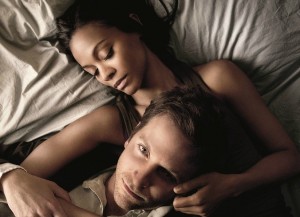
This weekend The Words, starring Bradley Cooper, Denis Quaid and Zoe Saldana, is the latest movie to explore the process of putting words in the right order.
Woody Allen has featured writers in many of his movies—Meryl Streep plays a writer in Manhattan, in Midnight in Paris Owen Wilson portrays a screenwriter visiting Paris–but Deconstructing Harry features his most vivid portrayal of a tormented author. Woody plays a novelist with writer’s block whose characters come back to haunt him. “I’m a guy who can’t function well in life but can in art,” he says.
Allen also played a writer in The Front, a movie about a talentless hack who “fronted” for blacklisted writers. Allen’s performance, however, is overshadowed by Zero Mostel as an out-of-work comic in this savage indictment of the McCarthy witch-hunt.
David Cronenberg’s Naked Lunch is probably the most hallucinatory look at the writing process ever put on film. How strange is it? Typewriters turn into bugs, that’s how weird it is.
To get into the character of Hunter S. Thompson for Where the Buffalo Roam, Bill Murray hung out with the Gonzo journalist. In preparation for Fear and Loathing in Las Vegas Johnny Depp did the same thing, which led to a friendship that lasted until the writer’s death. “He knew I worshiped him,” said Depp, “and I know that he loved me, so he may have been part father figure, part mentor, but I’d say the closest thing is brothers. We were like brothers.”
Mrs. Parker and the Vicious Circle showcased the alcohol-fuelled work of satirist, poet and all round bon vivant Dorothy Parker. Jennifer Jason Leigh, plays the writer from her heyday at the legendary Algonquin Round Table to her time as a Hollywood screenwriter. Of her Tinsel Town work she said, “I write doodads because it’s a doodad kind of town.”
Finally, 2002 was a particularly good year for writers on film. Nicole Kidman won and Oscar playing author Virginia Wolfe in The Hours and Adaptation featured Nicolas Cage, the star of the film, also playing the film’s writer!
Hollywood loves a drunk. Not the self destructive drink-themselves-to-death kind, although Nicholas Cage won an Oscar for playing one of those in Leaving Las Vegas, but the playfully befuddled drinker whose behavior provides the set up for some intoxicating comedy. W.C. Fields, who once said, “I drink therefore I am,” made a career of playing silly souses and this weekend Bradley Cooper, Ed Helms and Zach Galifianakis are under the influence again in The Hangover Part II.
From John Belushi as Animal House’s boozy beast Blutarsky, who downs an entire bottle of Jack Daniels in one megagulp to Karen Allen, who drinks her way out of a sticky situation in Raiders of the Lost Ark, the movie’s best boozers have been a varied group.
There’s the happy drunk, a smashed stereotype best personified by Dudley Moore in Arthur. Rarely sober, the character stumbles through life with the aid of his loyal butler and bottles of champagne. When his fiancée Susan (Jill Eikenberry) tells him that “a real woman could stop you from drinking,” he replies, “It’d have to be a real BIG woman.”
If Moore was most loveable, then Billy Bob Thornton’s Bad Santa con man in is the least likeable. As a mall Santa who only takes the job to rob the place on Christmas Eve, he drinks, destroys a holiday display and scars an entire crowd of children. Drunk movie moments abound although the sight of a wobbly Santa Claus in a back alley swigging from a flask is the most indelible. Billy Bob Thornton says he was genuinely loaded during the filming.
Jeff Bridges has played a variety of drunks in his day, most recently in True Grit and Crazy Hearty, but his best known drinker is Jeffrey “The Dude” Lebowski who singlehandedly re-popularized the White Russian. As laid-back party monster he drinks nine White Russians during the course of the movie.
Of course Hollywood occasionally uncorks a serious look at drinkers. Ray Milland showed the destructive side of boozing in The Lost Weekend, ditto Barfly’s Mickey Rourke but few have brought as much boozy beauty to a role than Elizabeth Taylor as the cantankerous Martha in Who’s Afraid of Virginia Woolf.
And finally, not all drunks are as dysfunctional as Martha. In Tombstone Val Kilmer’s Doc Holliday could still shoot even though he was seeing double. His technique? Use two guns, “one for each of you.”