The world was shocked when Chadwick Boseman passed away in 2020 at the tender age of forty-four, just two years after finding superstardom as King T’Challa in “Black Panther.” His passing left the future of the “Black Panther” franchise in flux. Would it be possible to make a “Black Panther” movie without the Black Panther?
The second film in the series, “Black Panther: Wakanda Forever,” answers the question. The new film has all the action you expect from a blockbuster Marvel movie, but also acts as a eulogy of a sort to the late actor and his most famous character.
“Wakanda Forever” begins on a sombre note, acknowledging the passing of T’Challa. “Your brother is with the ancestors,” Queen Ramonda (Angela Bassett) tells daughter Shuri (Letitia Wright). After a grand funeral fit for a king, director Ryan Coogler moves the action forward by one year.
Queen Ramonda, still healing from the wound left by T’Challa’s passing, is forced to defend her kingdom from international poachers intent on stealing their most valuable resource, a rare metallic ore with energy-manipulating properties called Vibranium. “We mourn the loss of our king,” she informs the United Nations, “but don’t think for a moment that Wakanda has lost its ability to protect her resources.”
Meanwhile, the U.S. military discovers a cache of Vibranium, previously thought to only exist in Wakanda, at the bottom of the ocean. But before you can say “Wakanda Forever,” the expedition is attacked by sea people, led by Namor (Tenoch Huerta), “feathered serpent god” of an ancient race of teal-skinned underwater people who look like they could have been extras in James Cameron’s “Avatar.”
Namor’s kingdom of Talokan also has Vibranium, and now that Wakanda has made the ore’s awesome power public knowledge, his nation is under threat from people who want what they have. That puts Wakanda at odds with an enemy unlike any they’ve fought before, an army outfitted with Vibranium weapons.
With a 2-hour-and-41-minute runtime, “Black Panther: Wakanda Forever” takes on a lot. It’s a study in loss and grief mixed with big time Marvel action set pieces. In addition, Coogler and co-screenwriter Joe Robert Cole have woven an indictment of colonialism into both the history of Wakanda and the Mayan-influenced backstory of Talokan. It makes for rich subtext in the storytelling, even if the movie occasionally has a rough time balancing all its elements.
If those missteps can be forgiven, its simply because “Wakanda Forever” isn’t a typical Marvel film. It exists outside Marvel Cinematic Universe. That means there is no connection to the other Avengers films, and it is better for it. Instead of feeling as if it is a puzzle piece of a larger picture, it is its own thing, a movie able to walk a different path and get away from the increasingly rigid structures of the late period MCU movies. The mix of the intimate and epic is what makes this movie work, both as a tribute to Boseman and as blockbuster entertainment.
The ensemble cast is very strong, but it is Bassett who leaves a mark. As Queen and T’Challa’s mother, she is majestic and melancholy, a woman attempting to balance duty with grief. “I am Queen of the most powerful nation in the world,” she says in anguish, “and my entire family is gone. Have I not given everything?” It’s a powerful moment and a poignant exploration of the weight that comes with loss coupled with obligation.
“Black Panther: Wakanda Forever” has a few draggy moments, but its determination to be its own thing makes for compelling viewing.
Crouse moderates the show’s lively panel discussions – set in the POP LIFE bar – featuring actors, journalists, and entertainment personalities debating hot topics in pop culture and the arts.
“My first radio boss told me something I’ve never forgotten,” said Crouse. “People want to hear about people. It’s simple and true and that’s what we’ve brought to POP LIFE, the chance for some of the most interesting people from pop culture – actors, musicians, newsmakers and authors – to share their personal stories and opinions. We keep it conversational and you never know what people will say. I can’t wait to share this season with our viewers.”
Tune in Saturday nights, 8:30 pm (ET) on the CTV NewsChannel and again at midnight on CTV or watch the whole thing HERE!
Film critic and pop culture historian Richard Crouse shares a toast with celebrity guests and entertainment pundits every week on CTV News Channel’s talk show POP LIFE.
Featuring in-depth discussion and debate on pop culture and modern life, POP LIFE features sit-down interviews with celebrities from across the entertainment world, including rock legends Sting and Meat Loaf, musicians Josh Groban and Sarah Brightman, comedian Ken Jeong, writer Fran Lebowitz, superstar jazz musician Diana Krall, stand-up comedian and CNN host W. Kamau Bell, actors Danny DeVito and Jay Baruchel, celebrity chefs Bobby Flay and Nigella Lawson, and many more.
The words “most-anticipated movie of the year” get tossed around a few times every season, usually describing a beloved fan sequel or an Oscar hopeful riding a wave of good press.
After “Avengers: Endgame” we can retire those words until January 2020. Before it played on one public screen the follow-up to 2018’s “Avengers: Endgame” smashed records. Demand for tickets crashed AMC Theatres’ website and app, it became Fandango’s top-selling pre-sale title and in China, advance sales topped a record one million tickets in a matter of hours. Someone in the United States paid a staggering $15,000 on-line for a pair of tickets (I hope that includes popcorn) and box office prognosticators predict forecast a domestic debut in the $260 million range.
Most-anticipated indeed but the question remains, Does “Avengers: Endgame” deserve all the hype?
In the spirit of #DontSpoilTheEndgame I’m cribbing the synopsis of the movie from IMBD.com: “After the devastating events of Avengers: Infinity War (2018), the universe is in ruins. With the help of remaining allies, the Avengers assemble once more in order to undo Thanos’ actions and restore order to the universe.”
“Endgame” is, first and foremost, a fan service movie. From the sheer number of returning Marvel faves—characters number in the dozens, if not the low hundreds—too deep character backstory—superheroes have mommy and daddy issues too!—to the crew’s biggest world-saving mission to date, it indulges every aficionado’s story hopes and desires. It may leave the casual superhero fans feeling overwhelmed by the sheer weight of the film but people willing to line up for hours to see the movie on opening weekend will be rewarded for their patience.
It is epic in the terms of length—it’s three hours so get a snack—location—infinity and beyond!—but it feels like “a lot“ rather than epic.
The story begins on a minor chord, spending much time with the characters grappling with the loss of friends and family before finding a way to right the world-destroying wrongs of Thanos. There is humor, some action but mostly character work. Hulk is in a form we haven’t seen before, Rudd and Downey still have a way with the line and it’s a whole new Thor than any other movie. As the story hopscotches through time and space directors Anthony and Joe Russo keep the focus on the characters fans have come to love.
It’s in the third hour the movie loses its human touch, becoming a noisy CGI orgy that must’ve required the power of 1 million networked computers working overtime to render the frenetic images we see on screen.
As for who lives and who dies? (SPOILER ALERT WITH ABSOLUTELY NO REVEAL) You’ll get no hint here. Suffice to say one of the characters says, “part of the journey is the end,” and I can tell you there will be unsigned contracts and actors suddenly free to do other movies that do not require the wearing of spandex.
“Endgame” feels like the end of the old cycle, the beginning of a reset. Old favourites gone, passing the mantle to others before they go. We even see a poster that reads, “Where do we go, now that they’re all gone?” I’m sure the next several Avengers movies will point the way but it is worth noting there are no hints in the post-credit scene because there is no post-credit scene (at least at the screening I saw).
The film has a sense of self-importance that fans will love, giving the characters the respect that franchises owe characters who have made them billions of dollars.
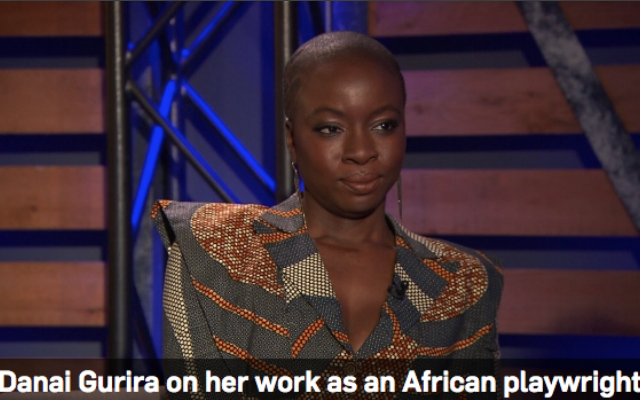
Episode Five of the “Pop Life Podcast” sees “Black Panther” star Danai Gurira and “Workin’ Moms” creator and star Catherine Reitman stop by the Pop Life Bar to discuss diversity in art.
For those who complain that the recent spate of superhero movies aren’t about anything other than bombast and reaching into your wallet, I give you Black Panther. Directed by Ryan Coogler and starring Chadwick Boseman in the title role, it’s a movie that delivers wham-bam action but serves it up with compelling sides of mythology and social awareness.
“Part of my frustration that led me to write,” says playwright of the Tony Award-winning play Eclipsed and Black Panther star Danai Gurira, “was that I didn’t see stories that allowed truths to be told about the continent and about our potential and our power and our dimensionality and our perspective and our personality and our languages. What was really exciting to me was to see all of that embodied in what Wakanda and the Black Panther narrative bring with the African perspective. It is completely unprecedented.”
The film starts with a quick origin story, detailing the introduction of vibranium to the small (fictional) African nation of Wakanda. This mysterious metal is a wonder. Near indestructible, it can absorb kinetic energy and has imbued a Wakandan flower called the Heart-Shaped Herb with a supercharge that gives superpowers when ingested.
Cut to modern day. After his father’s death T’Challa (Boseman) is crowned king but just as he is ordained a rare Wakandan artifact made of vibranium is lifted from a London museum by two very bad men, Ulysses Klaue (Andy Serkis) and Erik “Killmonger” Stevens (Michael B. Jordan).
To retrieve the precious metal, T’Challa, a.k.a. Black Panther, along with spy Nakia (Lupita Nyong’o) and warrior Okoye (Gurira), travel to Korea where the artefact is about to be sold to CIA agent Everett K. Ross (Martin Freeman).
A wild battle leads to a power struggle that may not only compromise the throne of Wakanda but also threaten the safety of the world.
“I loved the idea of being able to enact a nation that was never colonized,” says Gurira, who also plays the katana-wielding Michonne on The Walking Dead. “I grew up in post-colonial Africa. There is a lot of work that goes into reclaiming who you are, how you define your place in the world and what your power potential truly is when you have been colonized.
“One thing that colonized people don’t have is that part of their history that tells them who they would have been had they never been colonized. The beauty of Wakanda is that is shows us something. It’s a celebration. So many things are pulled from actual stories and narratives. The costumes, the language are actually African. It is a celebration of a place that often gets distorted or misrepresented or presented as something deficient, which we all know, Africa is so not.”
Black Panther takes place in a couple of time frames (NO SPOILERS HERE!) but at its heart it is a timely story about social responsibility — a wealthy nation state must confront its role in the world — that pulsates with smart commentary about race and revolution. It takes a well-known comic book character, the first Black standalone superhero in the Marvel Universe, and delivers a movie ripe with subtext. Black Panther is not only capable of fighting the bad guys but is also a vessel for the film’s study of legacy and identity.
For those who complain that the recent spate of superhero movies aren’t about anything other than bombast and reaching into your wallet, I give you “Black Panther.” Directed by Ryan Coogler and starring Chadwick Boseman in the title role, it’s a movie that delivers wham-bam action but serves it up with compelling sides of mythology and social awareness.
The film starts with a quick origin story, detailing the introduction of vibranium to the small (fictional) African nation of Wakanda. This mysterious metal is a wonder. Near indestructible, it can absorb kinetic energy and has imbued a Wakandan flower called the Heart-Shaped Herb with a supercharge that gives superpowers when ingested.
Cut to modern day. After his father’s death T’Challa (Boseman) is crowned King but just as he is ordained a rare Wakandan artefact made of vibranium is lifted from a London museum by two very bad men, Ulysses Klaue (Andy Serkis) and Erik “Killmonger” Stevens (Michael B. Jordan).
To retrieve the precious metal T’Challa, a.k.a. Black Panther, along with spy Nakia (Lupita Nyong’o) and warrior Okoye (Danai Gurira), travel to Korea where the artefact is about to be sold to CIA agent Everett K. Ross (Martin Freeman).
A wild battle ensues to a power struggle that may not only compromise the throne of Wakanda but also threaten the safety of the world.
“Black Panther” takes place in a couple of time frames—NO SPOILERS HERE!—but at its heart it is a timely story about social responsibility—a wealthy nation state confronting its role in the world—that pulsates with smart commentary about race and revolution.
“The world is going to start over,” Killmonger declares, “and this time we are on top!” It’s the kind of thing movie bad guys have been saying for years but this time around the villain is so multi-layered and interesting it packs an extra punch. Jordan isn’t just evil—although he is pretty bad; covered in scars for every person he’s ever killed—he’s a villain with a purpose. His motivations are personal—AGAIN: NO SPOILERS HERE!—but when he suggests arming the, “two billion people who look like me all over the world,” with vibranium he’s not just speaking as a revolutionary but as someone hungry for representation and recognition. It’s a powerful message and Jordan brings it home in a performance that is both intense and very emotional.
Letitia Wright plays T’Challa’s sixteen-year old sister Shuri and steals most every scene she appears in. Imagine James Bond’s Q with a snappier wit and more brains than Tony Stark. She has some of the movie’s best lines and is destined to become a featured player in future instalments.
Boseman has made a career of playing iconic characters on screen. As sports legend Jackie Robinson in “42” or James Brown, the Godfather of Soul, in “Get on Up,” or Thurgood Marshall, the first African-American Supreme Court Justice in “Marshall,”: he has breathed new life into characters we thought we already knew. Here he takes a well-known comic book character, the first black standalone superhero in the Marvel Universe, and delivers a performance ripe with subtext. His Black Panther is not only capable of fighting the bad guys but is also a vessel for the film’s study of the importance of legacy and identity.
“Black Panther” pushes the Marvel Universe past the typical Avengers style bombast fests like “Age of Ultron.” This is a breath of fresh air, a warm breeze along the lines of “Ant-Man” or “Doctor Strange,” films that transcend the superhero genre, pushing the form into new, unexplored territory. It may be a tad too long and slightly uneven in it’s first hour but with its strong female characters—who work together rather than as opponents—an Afrocentric story and social commentary it feels like the perfect movie for right now.
“All Eyez on Me” presents several sides of Tupac Shakur, the iconic rapper whose life came to a violent end at age twenty-five. Coming to theatres on June 16—which would have been the rapper’s 46th birthday—we see Shakur both as a devoted mother’s boy, a poet and gun toting tough guy accused of sexual assault.
Shakur (Demetrius Shipp Jr.) lived several lifetimes in the brief period he was here and the film wastes no time getting us up to speed. Director Benny Boom uses an interview led by a TV reporter (Hill Harper) to skip through the major events of Shakur’s formative years. From being raised by Black Panther leaders and auditioning to be a high school Hamlet to writing poetry and watching his parents arrested by the FBI, the film spends twenty minutes establishing the unsettled background that gave him a lasting urge to expose the underbelly of life on the street.
It’s familiar biopic device that allows filmmakers to quickly cover a lot of ground by creating vignettes based on the interviewer’s questions. Here it feels clunky and while it provides background info it does so in a perfunctory way. We get scene after scene with little real insight into what made Shakur tick.
The film improves when it drops the interview premise and keeps the film in real time. The compelling story of Shakur’s legal and financial problems and his fateful decision to sign on with Suge Knight (Dominic L. Santana) and west coast hip hop label Death Row Records takes up the film’s second half to better results. It is still content to offer up platitudes—“Its amazing Pac,” says manager Atron (Keith Robinson). “You’re on your way.”—but by the time Shakur finds out the hard way that “there’s more to this business then recording records,” the story finally finds it pace.
There is a great movie to be made of Tupac Shakur’s life but “All Eyez on Me” is not it. His short but eventful life is the stuff of legend, his dual nature a fascinating character study but Boom has a rough time condensing the life of such a complex man into two hours.
Shipp Jr. (whose father produced Pac’s “Toss It Up”) bears such an uncanny resemblance to the late rapper he almost legitimises the conspiracy theory that the rapper’s death was faked. In his first acting gig what he lacks in technique Shipp Jr. makes up for in looks.
Structurally the film has problems, but the movie finishes strong with Boom doing a good job of building some tension in the final moments leading up to the fatal Las Vegas drive-by shooting.
“All Eyez on Me” is a near miss. A little depth to the storytelling could have added context to the importance of Shakur as a cultural figure. There is talk about the gap between the civil rights generation and the hip-hop era and rap music’s objectification of women but neither is satisfactorily explored. The most telling line in the film comes early on when the young rapper is negotiating a record deal with Interscope Records. “There are people who want to be entertained,” he says, “and there are people who want to be heard.” It’s too bad the movie doesn’t give voice to the real spirit of the hip hop icon.