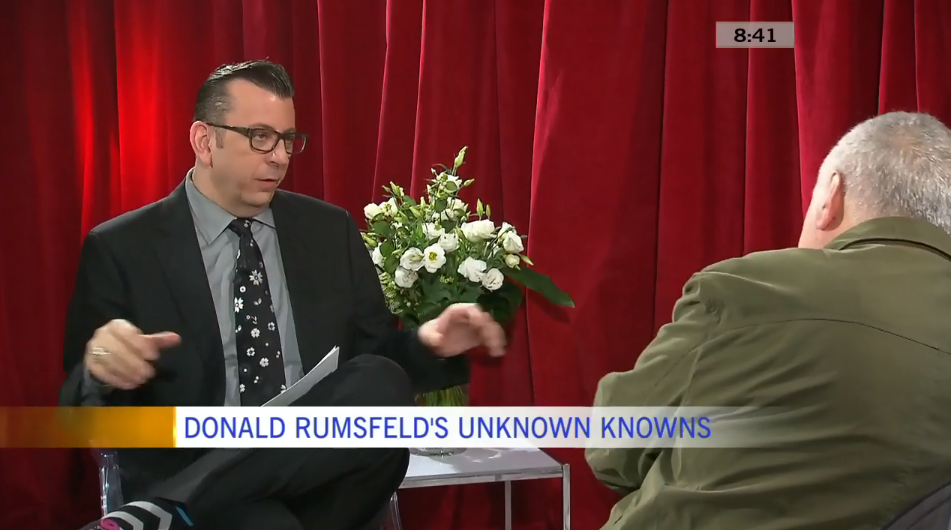
Richard’s “Canada AM” interview with documentary filmmaker Errol Morris on his latest film ‘The Unknown Known’ – an in-depth look at the political career of Donald Rumsfeld.
Trying to prove that someone was possessed by the devil when they did a bad thing is the kind of thing that generally only people in the movies do, and often not very convincingly. But a new film, Oculus, makes a creepy case for demonic interference even though the evidence is slight.
The story begins in present day with Tim (Brenton Thwaites) being released from a twelve-year stretch in a mental institution. The twenty-one-year-old was locked away at age nine after he gunned down his father (Rory Cochrane) who had just murdered his mother (Katee “Starbuck” Sackhoff).
His sister Kaylie (Karen “Dr. Who” Gillan), now a successful antiques dealer, lets him in on a family secret—she claims dear old dad was possessed by a demonic spirit that lives in a mirror. She has the ornate old looking glass and needs Tim’s help to destroy it.
Working in a tried and true supernatural genre—devil possession movies are a dime a dozen—director Mike Flanagan manages to find a new way to inject some life into the story of a haunted piece of furniture. Weaving together Tim and Kaylie’s past and present into one seamless whole, he flip flops through time, telling the story from the perspectives of the characters at different ages. It adds intensity to a tale that isn’t too far off from the terrible Amityville 4: The Evil Escapes (the story of a ghostly lamp).
The horror elements work because this is a character driven story and while there are blood and guts aplenty it is the intensity of the story and the performances that will stay with you.
Actor Mark Rendall prepared for his new film by not preparing. At least not in the traditional sense.
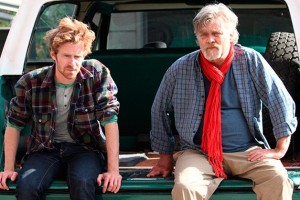
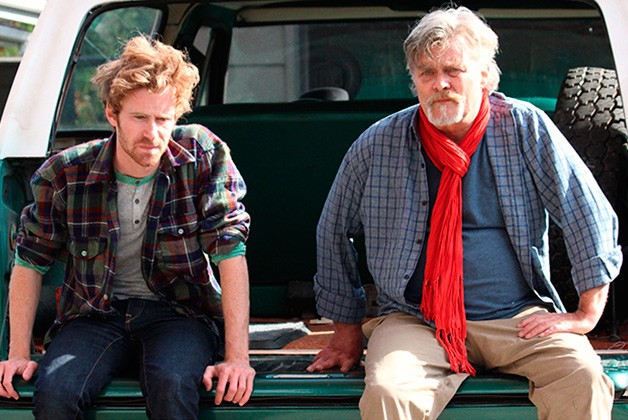
He co-stars in Algonquin with Nicholas Campbell—who Rendall calls, “a legend.”—in a story about estranged fathers, new found brothers and a young man who discovers what makes family truly important.
Rendall, who has been acting in films like Childstar and TV shows such as Hannibal since the age of ten, calls the new movie “the first dramatic lead I have done at a more mature point in my life.”
More mature physically, but also in life experience.
“I took two years off from acting to go to school and find out what I really wanted,” says the twenty-five year old. “I wanted to explore other things because I had been acting for so long. Algonquin is the first performance I did coming back onto it.
“I did so much in those two years that had I continued acting I wouldn’t have experienced. I feel a good actor is someone who has lived and isn’t pretending to emote or show an experience on screen, but is actually feeling it. Someone who has been there. I needed those experiences and time away to grow in ways that I feel acting would have sheltered me from.”
He continued leading a creative life, just one away from the camera.
“When I wasn’t acting I was taking instrument building classes. That is a real passion of mine. I really respect Daniel Day Lewis for learning how to become a cobbler. I think that is beautiful because one thing you miss when acting is working with your hands or doing really organic artistic endeavors that you’re in control of.
“In the end with instrument making I’m the one editing, directing, buying the material and producing the end result. It’s an individual and personal process, more so than acting, I think. Acting is not a one man operation. It’s a team, it’s like being part of a family for a while with lots of people working to make something. There is always a director and a writer and you’re always kind of portraying someone else’s dream, but to actually be in control of your own dream is amazing.”
Hollywood’s two most famous birds must be Donald Duck and Woody Woodpecker. Between them they’ve starred in almost three hundred films.
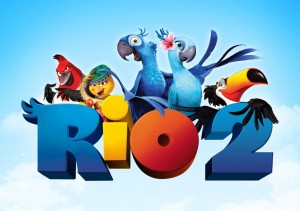
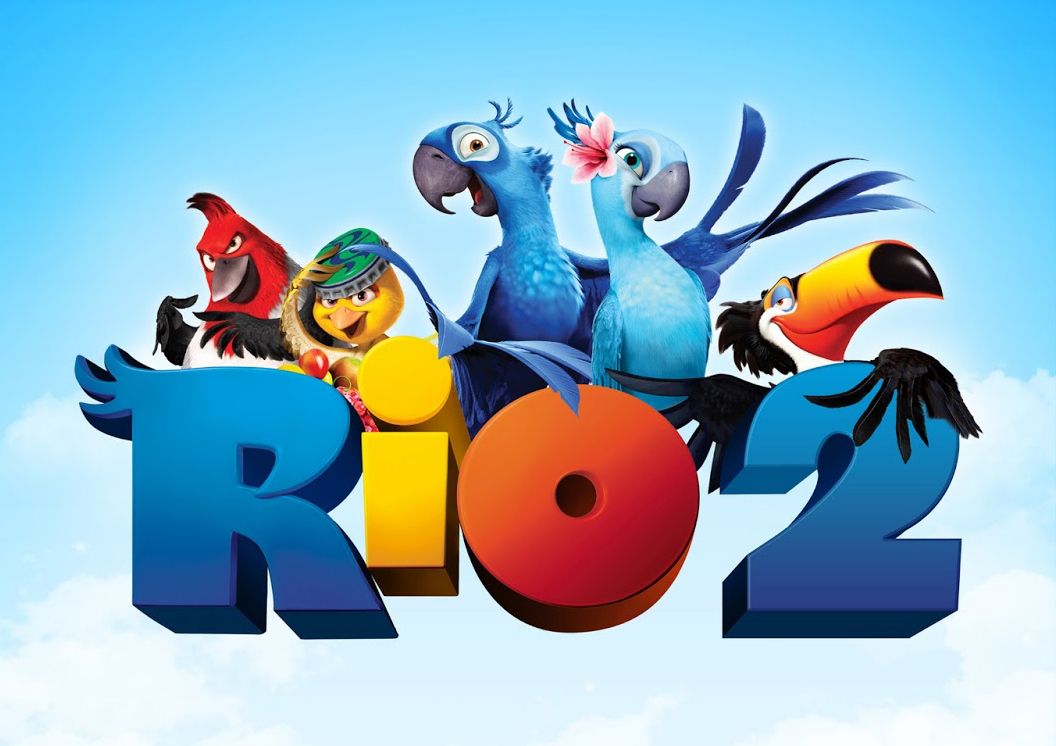
This weekend Donald and Woody are joined by Tyler Blu Gunderson, a rare male Spix’s macaw, voiced by Jesse Eisenberg making his second big screen appearance in Rio 2. He’s joined by a cast of fine feathered friends, including a Yellow Canary (Jamie Foxx), a rapping Red-crested Cardinal (will.i.am) and a sulphur-crested Cockatoo (Jemaine Clement), as they leave their home in Rio de Janeiro for the Amazon rainforest.
The colorful co-stars in Rio 2 are animated which makes them a much more agreeable lot than Tippi Hedren’s cast mates in her most famous movie. In the Alfred Hitchcock film The Birds she plays a wealthy socialite visiting Bodega Bay in Northern California when hundreds of ravens, seagulls and pigeons begin viciously attacking the townsfolk.
Some of the birds were props, but many of them were all too real. Actors with ground meat and anchovies daubed on them to entice the birds escaped with nips and scratches but Hedren took the worst of it during the shooting of the movie’s famous attic scene.
She had been told mechanical birds would be used to in the sequence that sees her trapped in a small room while birds attack her. When she arrived at the shoot she saw a cage built around the set and realized the plan had changed. For a week real birds were thrown at her by stagehands. Pecked and scratched by birds attached to her by elastic bands she screamed and sobbed as one of them gouged her eye. It was such a traumatic sight Cary Grant, who dropped by the set to say hello, said, “You’re one brave lady.
It’s no wonder Hedren chose Marnie, and not The Birds, as her favorite Hitchcock leading role.
As distressing as the shoot for The Birds might have been, the movie is now considered a classic.
That can’t be said for a film inspired by Hitchcock’s avian terror.
Birdemic: Shock and Terror director James Nguyen says the inspiration for his movie dates back to 2006 when he saw a flock of seagulls flying toward him at Half Moon Bay south of San Francisco. The sight reminded him of Hitchcock’s film, but he thought, “What if I make a movie where instead of seagulls and crows, it’s birds of prey? There’s nothing more shocking than eagles and vultures.”
The self-financed film took four years to finish and laid an egg in theatres before it became a cult hit as one of the worst film ever made.
When asked what Hitchcock would have thought of Birdemic Nguyen told Empireonline.com, “I think Mr. Hitchcock would forgive a lot of its imperfections and say, ‘James, you did what you could. Do another one and try to do it better.’”
“Must have freaked you out, coming back after the defrosting.” If that bit of dialogue, spoken by war veteran Sam Wilson (Anthony Mackie) in “Captain America: The Winter Soldier,” makes sense then you already have all the backstory you need to enjoy the movie.
For those who don’t, here’s the scoop. Steve Rogers (Chris Evans) was a ninety-pound über patriot, too scrawny to enlist in World War II. Not to be deterred he allowed himself to be a guinea pig in the top-secret “super-soldier” experiment. Transformed into a ripped, heroic warrior he (and his trusty shield) took on risky missions and kept the world safe from the terrorist organization HYDRA. On one operation he crash landed in the Arctic and spent decades frozen in a block of ice in a state of suspended animation.
Thawed out in modern day, the MIA soldier is pressed into service by the folks at S.H.I.E.L.D. to protect freedom and the American way.
When we meet up with him in the new film he’s still catching up with the modern world. The extremely well preserved 95 year old is making a list of all the things he missed out on in seven decades of suspended animation. He likely won’t have time to get up to date—take in “Rocky” or listen to Marvin Gaye’s “Trouble Man” for instance—before having to deal with the chrome-armed Winter Soldier (Sebastian Stan), a villain from Cap’s long distant past and battle against a threat from deep inside S.H.I.E.L.D., his own spy network.
With his new world collapsing around him the good Captain must determine who can be trusted. Will it be S.H.I.E.L.D. director Nick Fury (Samuel L. Jackson), the flirty but deadly Natasha Romanoff (Scarlett Johansson) or World Security Council bigwig Alexander Pierce (Robert Redford)? The decisions he makes could save his life and the lives of 20 million civilians.
Movie by movie Marvel has created an interconnected universe. Like a giant jigsaw puzzle the comic book company has pieced together something quite unprecedented; a series of films that aren’t sequels to one another but when combined form a loud, brash whole.
Captain America was a latecomer to the party, and while the first film was a solid introduction, it didn’t have the sparkle of say, the first “Iron Man” movie. The character seemed a bit beige; a do-gooder with no rough edges. “The Winter Soldier” addresses those concerns, fleshing out the character and providing some very good action sequences.
Evans has grown into the character. Physically he’s one big rippling muscle, but it is his personality and attitude that make him interesting. This time around he’s still a do-gooder but one who questions his missions. “You’re holding a gun to everyone on Earth and calling it protection,” he says after learning of S.H.I.E.L.D.’s violent plan to bring peace to the world. “This isn’t freedom, this is fear.”
It’s an edgy message from a Greatest Generation type to a world where drones have become common and Edward Snowden rides the line between patriot and traitor. The message permeates the plot, which is ripe with twists and turns and some genuinely thrilling moments.
Adding to the intrigue is some high powered star wattage. Robert Redford, who, if this was 1973 might have played the title role, brings credibility to Pierce. He’s an enigma, a man who turned down the Nobel Peace Prize, but also helped create a world so chaotic that he believes people are willing to give up freedom for peace. He brings some old school gravitas to the part and his very presence in the movie made me want to re-watch “Three Days of the Condor.”
Johansson is mad, bad and dangerous to know as Romanoff, and kicks so high it’s only a matter of time until she gets her own Avenger’s movie.
Of course, this is a comic book movie so for all the high-minded subtext there are still big action scenes every ten minutes or so, each one larger and louder than the last. The biggest and brashest is saved for the climax, which is where “The Winter Soldier” packs the inventiveness of its first two acts away and becomes a standard Marvel action movie. Up until that point, however, it is a funny (pay attention for a good “Pulp Fiction” gag involving Jackson), fast paced movie that is a cut above the usual super hero fare.
“I’m happiest when I’m alone in the forest with the lemurs.”
Those are the words of Dr. Patricia Wright, scientist and trainer of Madagascarian and western lemur lovers. She has dedicated her life to ensuring that the lemurs of the remote country will have a habitat for years to come.
By the end of “Island of Lemurs: Madagascar’s” scant 45 minute running time, you may find yourself also wanting to spend some time with the leapin’ lemurs.
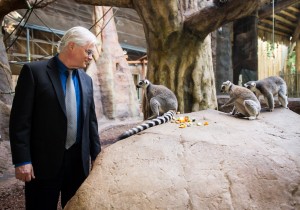
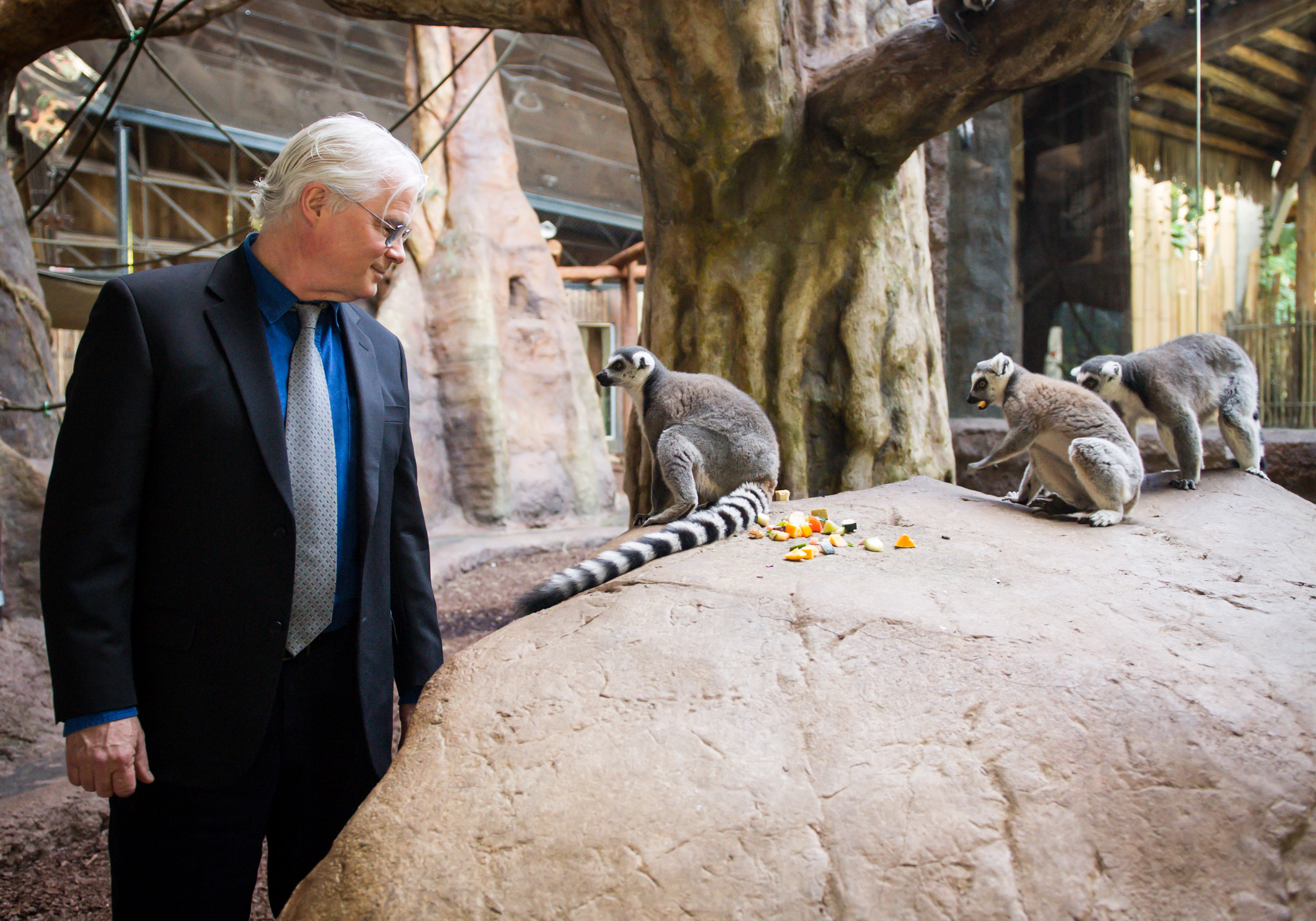
Shot on location with IMAX 3D cameras, and narrated by (who else?) Morgan Freeman, the documentary begins with the story of how castaway lemurs populated the island, evolved into hundreds of species—like the “dancing” Sifaka “I like to move it, move it” lemurs and the more common Ringtails—but are now endangered by the encroachment of humans.
Working out of a jungle compound, Dr. Wright and her team toil to create an environment where the odd bug-eyed creatures can thrive. She even plays lemur yentl with some endangered species, creating a love connection between a male and female that may save a genus.
Like the Disney “World” documentaries, “Island of Lemurs: Madagascar” provides an up close and personal look at its subject. The photography by David Douglas provides a beautiful glimpse of these animals in their natural surroundings.
“Island of Lemurs: Madagascar” is a slight—clocking in at just 45 minutes—but intriguing look at these creatures. For once the 3D is worth the extra ding at the box office and the sheer size of the IMAX screen puts the viewer brings the story and the animals to vivid life.
After mid-1970s success of two “midnight movies” called “El Topo” and “The Holy Mountain,” renegade director Alejandro Jodorowsky was offered the chance to make any movie he wanted. He toyed with a number of stories, including “Don Quixote,” the story of an hidalgo with lofty, but unrealistic ideas.
Instead the Chilean born Jodorowsky chose to make “Dune,” the science fiction epic by Frank Herbert. As it turns out, however, the director may have been better suited to the story of Cervantes’s impractical idealist than the maker of a giant Hollywood film.
To hear Jodorowsky tell it, his version of “Dune,” which never made it past preproduction due to budget and Hollywood’s reluctance to work with the avant-garde director, would have been more of a mystical journey than a film. He collected “spiritual warriors” like Salvador Dali (who demanded to be paid $100,000 an hour to appear as the Emperor of the Known Universe), Orson Welles (who was promised a private chef), special effects wiz Dan O’Bannon and conceptual designers Chris Foss, H.R. Giger and Jean “Moebius” Giraud, to fulfill his vision, creating an amazingly detailed storyboard of the proposed film.
The story is mostly told by the people who in the room, lead by the 84-year-old Jodorowsky. It’s a talking head doc, punctuated by preproduction art and storyboards. For movie geeks it’s an essential glimpse into the mind of a legend. For others—including fans of Frank Herbert who gets a bit of a short shrift here—it may sound like the ramblings of a madman. Which it is, but an endearing madman who values art and spirituality above all else. He was so committed to making this movie, a movie he says might have changed the very fabric of humanity, that he was prepared to die for it.
Of course, that didn’t happen. David Lynch made the movie and one of the pleasures of “Jodorowsky’s Dune” is watching the elderly director describe his delight in realizing that Lynch’s film was a bit of a disaster.
As for whether or not the director’s vision for “Dune” would have been feasible, we’ll never know. Like many lost or never made films, it feels as though the legend of the project might be more entertaining than the film itself could ever have been.
David Douglas, the veteran wildlife filmmaker behind the new IMAX film Madagascar: Island of Lemurs, has dreamed of making a film on the island country in the Indian Ocean for thirty years.
He calls it a “remote and mythic place,” but adds, “in wildlife filmmaking everybody wants to go there and do it but you never can.”
But three things convinced him to take a chance and travel there “to figure out how to make the movie.”
First was the story of primatologist Dr. Patricia Wright. Douglas came across her while doing research for another film, but was taken with her efforts to protect Madagascar’s lemurs, whose numbers are shrinking to alarming levels. Around since the time of the dinosaurs, the big-eyed creatures arrived on the island as castaways from Africa and have now evolved into hundreds of species.
Douglas wanted to shine a light on Wright’s efforts to protect the lemur’s delicate ecosystem and raise awareness of their plight.
The second thing was a technological advancement.
“The normal situation in wildlife filmmaking is you have film stock, this resource that costs money and it runs through the camera in a certain amount of time,” he says. “It can’t be any longer. You have to reload it. So you have to spend a lot of your life trying to put yourself in the position of accurately predicting what an animal is going to do in the future because you want to have your camera running while its happening. That is the foundation of all of your planning and everything you do. That’s why you never see whales coming out of the water (in movies), you always see them falling back in.”
New IMAX equipment developed for this film allowed him to shoot digitally, on cameras with lots of memory. “The camera is always on and all we do is turn it off when we like what we got.”
The third draw was, of course, the lemurs themselves.
“They are spectacular looking. They look like a pile of toys in your kid’s closet because they’re all different, but they’re all sort of similar.”
The first things you notice about them are their prominent eyes. “Their eyes are radically different colors for the different species,” says Douglas. “They have every color of the rainbow of eyes.”
“Then there is the range of physical sizes. The mouse lemurs are the smallest primate on earth and up until humans got the last ones, there were really big lemurs on Madagascar; much bigger than a human being.
“Gosh, they’re fascinating animals,” he says with a hint of wonder in his voice.
 Richard’s “Canada AM” interview with documentary filmmaker Errol Morris on his latest film ‘The Unknown Known’ – an in-depth look at the political career of Donald Rumsfeld.