TOP THIRTEEN HITS (click on the title to see trailer)
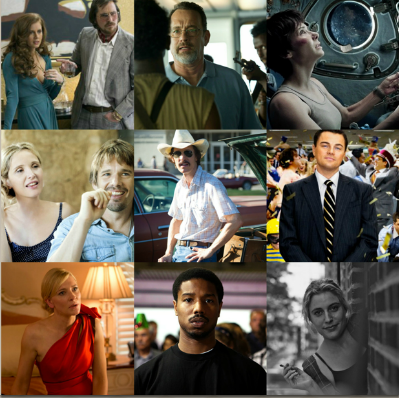
1. 12 Years a Slave. There’s a key line near the beginning of “12 Years a Slave, “ the new drama from “Shame” director Steve McQueen. Shortly after being shanghaied from his comfortable life as a freeman into a life of slavery Solomon Northup (Chiwetel Ejiofor) declares, “I don’t want to survive. I want to live.” Based on Northup’s 1853 memoir the movie is an uncompromising story about will, suffering and injustice.
2. American Hustle. “American Hustle” is one of the year’s best. It’s an entertainingly audacious movie that will doubtless be compared to “The Wolf of Wall Street” because of the similarity in tone and themes, but this time around David O. Russell has almost out-Scorsese’d Scorsese.
3. Before Midnight. “Before Midnight” is beautifully real stuff that fully explores the doubts and regrets that characterize Jesse and Celine’s (Ethan Hawke and Julie Delpy) love affair. Done with humor, heart and pathos, often in the same scene, it is a poignant farewell to two characters who grew up in front of us.
4. Blue Jasmine. Darker than most of Woody Allen’s recent output, “Blue Jasmine” doesn’t go for laughs—very often anyway—but is an astutely crafted psychological character study. Jasmine is a modern day Blanche Du Bois, a faded bright light now forced to depend on the kindness of strangers. Getting in her way are delusions of grandeur and a continued sense of denial—likely the same sense that kept her guilt free during the years the illegal cash was flowing—that eventually conspire to fracture her psyche. “There’s only so many traumas one can take,” she says, “ before you end up in the street, screaming.”
5. Captain Phillips. I don’t think it’s fair to charge audiences full price for screenings of “Captain Phillips.” While watching this exciting new Tom Hanks thriller I was reminded of the old Monster Trucks ads that bellowed, “You Pay for the Whole Seat but You’ll Only Need the Edge!”It a film about piracy and I don’t mean the sleazy guys who bootleg movies but the real pirates who were responsible for the first hijacking of an American cargo ship in two hundred years.
6. Dallas Buyer’s Club. In “Dallas Buyer’s Club” Canadian director Jean-Marc Vallée has made an emotional drama that never stoops to melodrama. Instead it’s an inspirational film about standing up for what you believe in.
7. Frances Ha. The seventh film from “Greenberg” director Noah Baumbach isn’t so much a traditional narrative as it is a character study of Frances (Greta Gerwig), an underemployed dancer struggling to find herself in New York City. It plays like a cleaned up black-and-white version of “Girls”; an emotionally rich and funny portrait of twenty-something ennui. “Frances Ha” is a collection of details. There is an engaging story, but it’s not exactly laid out in three acts. It feels more intimate and raw than the usual twenty-ish crisis flick and with each detail we get another piece of the puzzle that makes up Frances’ life.
8. Fruitvale Station. It’s important to remember that “Fruitvale Station” isn’t a documentary. Director Ryan Coogler has shaped the movie for maximum heartrending effect, and by the time the devastating last half hour plays out it’s hard to imagine any other movie this year packing such a emotional wallop.
9. Gravity. “Gravity” isn’t an epic like “2001: A Space Odyssey” or an outright horror film like “Alien.” There are no monsters or face hugging ETs. It’s not even a movie about life or death. Instead it is a life-affirming movie about the will to survive.
10. Her. “Her” is an oddball story, but it’s not an oddball film. It is ripe with real human emotion and commentary on a generation’s reliance on technology at the cost of social interaction.
11. Inside Llewyn Davis. “Inside Llewyn Davis” is a fictional look at the vibrant Greenwich Village folk scene. Imagine the cover of “The Freewheelin’ Bob Dylan” come to life. Sharp-eyed folkies will note not-so-coincidental similarities between the people Llewyn meets and real-life types like Tom Paxton, Alert Grossman and Mary Travers, but this isn’t a history, it’s a feel. It gives us an under-the-covers look at struggles and naked ambition it takes to get noticed.
12. Nebraska. The humour doesn’t come in the set-up-punch-line format but arises out of the situations. A scene of Woody’s gathered family—his elderly brothers and grown sons—watching a football game redefines the word taciturn but the subject of the sparse conversation, a 1974 Buick, is bang on, hilarious and will likely sound familiar to anyone with a large family.
13. Wolf of Wall Street. “Wolf of Wall Street” makes for entertaining viewing, mostly because DiCaprio and Jonah Hill are able to ride the line between the outrageous comedy on display and the human drama that takes over the movie’s final minutes. Both are terrific, buoyed by the throbbing pulse of Scorsese’s camera. With its fourth wall breaking narration, scandalous set pieces and absurd antics “The Wolf of Wall Street” is an experience. At three hours it’s almost as excessive as Balfort’s $26,000 dinners. It feels a bit long, but like the spoiled brats it portrays, it will not, and cannot, be ignored.
TOP FIVE MISSES
TREND: Big stars don’t guarantee box office!
1. The Fifth Estate – Budget: $28 million, Global box office: $6 million, Return: 21% Late into “The Fifth Estate” Guardian investigative journalist Nick Davies (David Thewlis) says, “most good stories start at the beginning.” I argue that he’s right– about 99% of the time. Unfortunately this look at WikiLeaks and hacker-turned-whistleblower Julian Assange falls into the 1%.
2. Bullet to the Head – Budget: $25 million, Global box office: $9 million, Return: 36% With a name like Bullet to the Head you know the new Sylvester Stallone movie isn’t a romantic comedy. Although he paraphrases the most famous rom com line of all time, “You had be at BLEEP BLEEP!” the movie is nothing but an ode to testosterone.
3. Getaway – Budget: R180-million, Global box office: R105-million, Return: 58 percent. On a scale of zero to stupid, ”Getaway” ranks an eleven. It is what we call in the film criticism business a S.D.M. (Silly Damn Movie). OK, I made that last part up, but I couldn’t really think of any other category to place this movie under. Maybe E.S.D.M. (Extremely Silly Damn Movie).
Hunter S. Thompson, the great gonzo journalist and observer of American life, had nothing to do with “The Wolf of Wall Street,” but he certainly is one of the film’s spiritual fathers.
Directed by Martin Scorsese and based on the life of hard-partying Wall Street tycoon Jordan Belfort, it is a depraved opera about sex, drugs and greed. It’s the kind of epic story of avarice and excess Thompson would have relished, but are audiences ready for a three-hour drug fuelled romp through the wild side of Wall Street?
When we first meet Belfort (Leonardo DiCaprio) he has yet to occupy Wall Street. An ambitious newbie, his first day as a broker is Black Monday, October 19, 1987, the date of the biggest crash since the Depression. Forced to reinvent himself he forms a shady company specializing in penny stocks that do little for his clients, but line his pockets with commissions.
With money rolling in Balfort and company (including Jonah Hill as Quaalude enthusiast Donnie Azoff) dive head first into Wall Street’s cocaine and hookers era, forming a brokerage firm with the upstanding name of Stratton Oakmont. “Stratton Oakmont is America,” says Balfort. “It’s the land of opportunity.”
Equating success with excess, Balfort indulges in every debauchery while making everyone around him rich (and himself richer than everyone else) and fending off attention from the FBI.
By the end of “The Wolf of Wall Street” you’ll feel as though you’ve had testosterone splashed on your face. From the film’s opening scenes of DiCaprio and Co. throwing helmeted little people at a giant Velcro target to a wild soon-to-be-classic Quaalude scene, Scorsese has crafted a film that makes Gordon Gekko look warm and fuzzy. It’s muscular filmmaking that takes no prisoners, highlighting unlikeable mostly male characters in dubious situations.
There are female characters. As Belfort ‘s second wife Naomi Margot Robbie does good work, but the movie is a boy’s club. Or rather, a frat house where the Bro Code relegates women to the bedroom or the barroom but rarely the boardroom.
The sexual politics are definitely slanted in toward the males, but the movie shines as a metaphor for all the venal men whose gluttonous appetites for power and wealth ground the US economy into the dirt over the last few decades. Scorsese captures the unhinged spirit of these men, luxuriating in the decadent details of their lives.
It makes for entertaining viewing, mostly because DiCaprio and Jonah Hill are able to ride the line between the outrageous comedy on display and the human drama that takes over the movie’s final minutes. Both are terrific, buoyed by the throbbing pulse of Scorsese’s camera.
With its fourth wall breaking narration, scandalous set pieces and absurd antics “The Wolf of Wall Street” is an experience. At three hours it’s almost as excessive as Balfort’s $26,000 dinners. It feels a bit long, but like the spoiled brats it portrays, it will not, and cannot, be ignored.
The last time Martin Scorsese went to Boston he had the biggest mainstream hit of his career and won an Oscar as Best Director. “The Departed’s” change of scenery seemed to do him good so it shouldn’t come as a surprise that his latest film is also set in the New England city, this time however, he isn’t telling a tale of gangsters, but a story of the criminally insane—“the bugsies” they call them—on an piece of land in Boston harbor called Shutter Island.
Returning for his fourth outing with Scorsese Leonardo DiCaprio headlines the all star cast, playing Teddy Daniels, a US Marshall assigned to investigate the disappearance of a patient on the isolated Shutter Island asylum. Working with Chuck Aule (Mark Ruffalo), his new partner, he must keep a close grip on his own sanity. Is he insane or is he being driven insane?
I’ve kept the synopsis deliberately vague because there is so much going on in “Shutter Island,” it is such a house of cards that revealing one detail too many could bring the whole thing down and spoil the experience of seeing it through fresh eyes. This will be a no spoiler zone, but that means being light on the details.
“Shutter Island” (adapted from a Dennis Lehane novel) is likely the most enigmatic movie Scorsese has ever made. It’s a bold, risk-taking film, ripe with dramatic music, sweeping photography and unapologetically strange storytelling. It’s a story of paranoia, a deeply psychological thriller that pays homage to Hitchcock films like “Vertigo” and “North By Northwest.” Throw in a dollop of “The Snake Pit” and some Mario Bava you get an idea of the tone of the film.
He uses flashbacks, odd and deliberate lapses in continuity, weird camera tricks—he runs the film backwards in one scene so it looks like smoke is flowing into, rather than out of DiCaprio’s cigarette—to create an atmosphere of creeping dread, one in which the viewer, and perhaps even the characters don’t know what is real and what is not. Where many of his earlier films like “Raging Bull” and “Goodfellas” are about a state of existence, “Shutter Island” is all about a state of mind.
Anchoring the film is a fantastic performance from DiCaprio who by times seems to be channeling Jimmy Stewart. Not the “Philadelphia Story” Stewart but the edgy, post war Stewart of “Rope” and “Vertigo.” His performance seems artificial, as though he has spent too much time watching film noirs, but watch for the subtleties, the way he suggests his character’s hidden depths with interesting line readings and reactions. It’s a brave performance and one that doesn’t reveal itself entirely until the film’s final moments, but it’s one that will hold up to multiple viewings.
The movie, for all its boldness, however, may not. It is perhaps a bit too enigmatic for its own good, its twist ending is unconvincing and a bit of a letdown, (for once I was wishing for a little M. Night Shyamalan influence), but even Scorsese’s missteps have more interesting filmmaking than most other films at the multiplex.
“Shutter Island” is a difficult movie that demands more than most audiences are probably willing to give these days. It’s an art film disguised as a police drama and will probably leave the crowds who loved “The Departed” scratching their heads.
I admired Martin Scorsese’s last two movies, Gangs of New York and The Aviator, but I didn’t love them, and Scorsese is the kind of filmmaker who should inspire fanatical praise. The last two were handsome, big-budget epics but it felt like he was making movies to please Academy voters and not himself. The Departed is a departure from those sleek studio efforts, and places the director firmly back where he belongs, on the mean streets surrounded by gangsters, duplicity and violence.
Based on a Hong Kong film called Mo-gaan-do (titled Infernal Affairs in North America) The Departed, relocates to Boston and stylishly tells the story of two men on opposite sides of the law. Both are cops, one deep undercover in the organization of mob boss Frank Costello (Jack Nicholson), the other an ambitious state trooper who appears to be on the straight and narrow, but is actually an employee of Costello’s. Both men, played by Leonardo DiCaprio and Matt Damon respectively, are tormented by their duplicitous lives, feeling trapped between the truth and lies, but neither has a way out of the situation. DiCaprio is so far undercover that officially he doesn’t exist, and Damon’s character owes a huge dept of gratitude to Costello. Their lives intersect both professionally—as they play cat and mouse with one another—and personally as they unwittingly become involved with the same woman, a beautiful therapist played by newcomer Vera Farmiga.
Scorsese skillfully tells this story about loyalty and men who lead dark, dangerous lives, infusing each frame of the film with excitement. He has created an unpredictable atmosphere, where the threat of trouble hangs over every scene. Not since 1995’s Casino has he so effectively embraced the down-and-dirty world of crime. The film is a study of contradictions, both in character and style—Scorsese mixes fluid camera work with hard-edged editing; his script is both darkly funny and brutally violent.
The movie’s large ensemble cast of Hollywood A-listers do great work. The youngest members of the above-the-title cast, DiCaprio and Damon, each set the bar very high. This may be DiCaprio’s first truly adult role, a man who can’t trust anyone and who battles his jangled nerves to do the right thing. Damon plays off his clean-cut image, expanding on his recent work in Syrianna and the Bourne movies, to present a good-guy façade that is being eroded by paranoia.
The rest of the cast, Ray Winstone, Martin Sheen, Mark Walhberg (as the foul-mouthed Dignan) are stellar, but if there are two performances that look Oscar bound they are Jack Nicholson and Alec Baldwin.
Baldwin plays Ellerby, a task force head out to get Costello with gusto. The character is a mix of steely-eyed determination and goofy comedic relief, and Scorsese keeps him in check, allowing to walk to the edge of the cliff without ever jumping over into overacting. It’s a fine line and Baldwin walks it expertly.
In a film packed with great performances—it’s as if everyone was putting in extra effort for Scorsese—Jack Nicholson still manages to steal the show. Costello is his King Lear, a tyrant on the edge of madness, but with Nicholson’s burning eyes. Closing in on 70 years old he is still vital, still scary and still capable of blowing younger, prettier actors off the screen. There is a reason why some people are legends and in The Departed we are reminded once again why Nicholson is acting royalty.
The Departed finds Scorsese in top form, and is the coolest and best movie so far this year.
The new Martin Scorsese film is the director’s first PG rated film in 18 years. Hugo is a handsome 3D kid’s flick featuring adventure, a broken robot, a toy store owner and one of the mainstays of Central Casting—an orphan.
There are all kinds of on-screen orphans, some lovable—The Jungle Book’s Mowgli, Harry Potter—some not– Hannibal Lecter, Darth Vader—but few have been as memorable as Oliver Twist.
The younster first captured people’s imaginations one-hundred-and-seventy-three years ago as the title character in Charles Dickens’s second book and debuted on film in 1908. Since then there have been at least eleven adaptations of the story of an urchin who famously asked his cruel workhouse foreman for more gruel with the words, “Please sir, I want some more.”
The most famous version of the story has to be Oliver!, a splashy 1968 all-singing-all-dancing edition which film critic Pauline Kael said was one of the few film adaptations of a stage musical superior to the original stage show.
Oliver had it rough. Much rougher than Little Orphan Annie, the perky red-haired waif adopted by the über -wealthy Daddy Warbucks but for the actress who played her in the 1982 movie Annie there were some unpleasant moments.
The curly red wig Aileen Quinn wore was so itchy a specially designed comb had to be created to give her some relief and in order to get Annie’s dog Sandy to realistically kiss her the prop master rubbed Alpo all over her face. Still, Quinn says, “I just remember having the best time.”
Unlike our next orphans Oliver and Annie were decidedly earthbound ragamuffins but the movies have seen lots of alien children abandoned on our planet. In Escape to Witch Mountain Tony and Tia Malone’s psychic abilities made them standouts at the orphanage and the moniker Clark Kent was the name his human adoptive parent’s gave to Kal-El. You know him best as Superman.
Superman wasn’t the only superhero orphan, however. The death of Bruce Wayne’s parents at the hand of the Joker prompted him to become the Caped Crusader. “You made me,” he grumbles to the parent’s killer in Batman.
Finally, Peter Parker’s parents were Richard and Mary, CIA agents killed in the line of duty. Rumor has it they will appear in the 2012 reboot, The Amazing Spider-Man, played by Campbell Scott and Embeth Davidtz.
Last week, the Internet lit up with news that one of the great actor-director teams might reunite to remake one of their classic films.
Rumours (since debunked) had Martin Scorsese and Robert De Niro set to give Taxi Driver the sequel treatment.
It seemed too good to be true — De Niro is busy overseeing the Tribeca Film Festival and Scorsese is occupied with new muse Leonardo DiCaprio — and the rumor turned out to be just that — a rumour.
But for a tantalizing moment it seemed there might be a new film from one of the most dynamic director-actor pairings since Bogart and Huston or Mifune and Kurosawa.
Not that there are any shortage of director-actor teams. Scorsese and DiCaprio’s newest bit of teamwork, Shutter Island, opens this weekend and the latest Pedro Almodóvar-Penélope Cruz film, Broken Embraces, was recently nominated for a Golden Globe.
“I think you find, when you talk about a collaboration between a filmmaker and an actor, that it’s always evolving,” said Shutter Island producer Brad Fischer. “I don’t think it begins and ends with any one movie.”
Diane Keaton cites the evolution of collaboration with Woody Allen — they made seven films together, including the classic Annie Hall, between 1973 and 1993 — with elevating her from a “novice who had lots of feelings but didn’t know how to express herself” to someone who “can be braver and more spontaneous.”
Penélope Cruz is more effusive when discussing her mentor Pedro Almodóvar, who made her an art house darling, international star and claims to have “saved her from Hollywood.”
“He changed the way I looked at the world before I even knew him,” she says.
“There is something that works really well in our relationship that combines both our friendship and the professional side,” says Almodóvar. “We operate like lovers. So while we don’t have the pleasures of sex, we don’t have the complications of sex either. We work really well as a couple who don’t sleep together.”
Sometimes the director- actor relationship extends past the movie set. Four years after shooting The Life Aquatic in Italy, Wes Anderson regular Bill Murray (five films together) asked the director to deliver 10,000 Euros in cash to his former landlord.
“It’s not as weird as it sounds,” said Anderson on paying the rent a little late. “Bill can be a little weird with time.”
 TOP THIRTEEN HITS (click on the title to see trailer)