SYNOPSIS: In “Good Fortune,” a body-swap comedy starring Seth Rogen and Keanu Reeves and now playing in theatres, a bumbling guardian angel attempts to convince a down-on-his-luck guy that money won’t solve all his problems. “”Money in your pocket can’t hide the poverty in your character,” says tech mogul Jeff (Seth Rogen).
CAST: Seth Rogen, Aziz Ansari, Keke Palmer, Sandra Oh, and Keanu Reeves. Directed by Aziz Ansari.
REVIEW: If “Trading Places,” “Nomadland” and “It’s a Wonderful Life” had a baby, it might look something like “Good Fortune.”
In his directorial debut, Aziz Ansari, who also wrote the script, stars as Arj, a down-on-his-luck handyman who, if he didn’t have bad luck, wouldn’t have no luck at all. He does odd jobs for tech bro Jeff (Seth Rogen), a wealthy guy who never met an excess he didn’t embrace. “I did everything right,” Arj says, “but nothing is working out.”
Arj gets a second chance at life when his “budget” Guardian Angel Gabriel (Keanu Reeves)—he usually sticks to saving people from texting and driving—is inspired by the other guardian angels to do something more meaningful with his job.
Wanting to show lost soul Arj how superficial a life of wealth can be the angel offers him a chance to see life through Jeff’s eyes.
Literally.
Gabriel swaps Arj and Jeff, allowing them to live one another’s lives. “Maybe I can show you that [that] life is not all it’s cracked up to be,” Gabriel says to Arj.
Trouble is, Arj’s problems are solved by Jeff’s cash. “I tried to show him that wealth wouldn’t solve all his problems, but it seems to have solved most of his problems.” As punishment for his divine intervention Gabriel loses his wings and is sent to Earth to become Jeff’s roommate. “You have to get Arj to go back,” says head angel Martha (Sandra Oh). “Until then I have to take your wings.”
“Good Fortune” is an American Dream satire with a standout performance from Keanu Reeves who brings humor and heart to the fallen angel Gabriel. All innocence and wide eyes, Reeves plays Gabriel like a baby in a man’s body as he learns about the simple pleasures of street tacos, dancing and laughing. “How will I know when I’m done chewing?” he asks as he tastes food for the first time. It’s a strange, committed performance that provides many of the film’s unexpected laughs.
Rogen and Ansari are solid, playing characters that echo their previous roles, but Reeves is the glue that sticks “Good Fortune’s” simple and sentimental story together.
Hidden underneath the character driven story are incisive and biting commentary on the difficulty of the gig economy—“We have it good” rich guy Jeff tells his board of directors, “because they have it bad.”—being true to yourself and finding hope in life. The presentation of the ideas is earnest, but effective situationally.
“Good Fortune” isn’t a laugh a minute, but the situation overall is amusing and director Ansari milks some laughs out of the circumstances.
SYNOPSIS: Taking place between the events of “John Wick: Chapter 3 – Parabellum” and “John Wick: Chapter 4,” “Ballerina,” sees Ana de Armas as a newly minted Ruska Roma assassin looking to exact revenge for her father’s death. “Your childhood was taken from you,” says her mentor (Anjelica Huston), “It’s that pain that drives you.”
CAST: Ana de Armas, Gabriel Byrne, Catalina Sandino Moreno, Norman Reedus, Anjelica Huston, Lance Reddick, Ian McShane, Keanu Reeves. Directed by Len Wiseman.
REVIEW: A sequel ready spin-off of the “John Wick” movies, it’s a shame that “Ballerina’s” storytelling isn’t quite as agile as its main character.
The origin story of Eve Macarro (Ana de Armas), “Ballerina” begins with childhood trauma. After witnessing the murder of her father at the hands of a killer cult, she follows in the footsteps of John Wick to become a highly trained Ruska Roma assassin.
With vengeance on her mind, and “Lux in tenebris,” a Latin phrase that translates to “light in darkness” tattooed on her back, she vows to hunt down the man responsible for the father-sized void in her life.
The story of rules and consequences—”When you deal in blood there must be rules or nothing matters,” says Ruska Roma Director (Angelica Huston)—borrows the framework of “John Wick” but forgets to bring the fun.
The first Wick film was a masterclass in restrained filmmaking. Well, perhaps that’s not exactly the word, the body count is too high to be considered restrained, but it was economical in its approach. The stripped-down storytelling eliminated any excess. From its set-up to blood-soaked finale, it was uncompromisingly lean and mean.
“Ballerina’s” approach feels overstuffed and yet slack by comparison. Director Len Wiseman allows the story to get tangled up as he interweaves the tale of Eva’s vengeance with Wick’s Wild World of Assassins.
Our introduction to Eva should come with high stakes. If John Wick is willing to reign holy hell down on the men responsible for the death of his dog, imagine what Eva could do to avenge her father. There will be blood, but because we only see the father at the beginning of the film, the stakes don’t seem all that elevated. Instead, “Ballerina” is a series of Wickian set pieces supervised by Chad Stahelski that provide the appropriate amount of gun-fu and face stomping, etc that you would expect, but apart from two standout sequences the action has a sameness that made me agree with Gabriel Byrne’s character when he said near thew end of the movie, “Don’t you think you’ve had enough?”
Two of the action scenes, however, deliver the kind of inventiveness you expect from a Wick movie. A high kicking set piece in a restaurant features a plate smashing scene that is funny, a bit ridiculous and creative and a literal fire fight adds visual pizazz but much of the action looks like generic video game violence.
“Ballerina” delivers on the franchise’s promise of a high body count but suffers from low stakes and a serious case of “off-shoot-itis.” Stuck somewhere between trying to replicate the vibe of the Wick films and forging a new path within that universe, it’s mired in the mushy middle.
SYNOPSIS: When a mysterious and powerful enemy threatens to destroy the planet, Sonic (Ben Schwartz), Knuckles (Idris Elba) and Tails (Colleen O’Shaughnessey) are recruited by the secretive Guardian Units of Nations (G.U.N.) to save the day.
CAST: Jim Carrey, Ben Schwartz, Colleen O’Shaughnessey, Natasha Rothwell, Shemar Moore, James Marsden, Tika Sumpter, Idris Elba Krysten Ritter, Keanu Reeves. Directed by Jeff Fowler.
REVIEW: A combination of live action and animation, “Sonic the Hedgehog 3” starring Jim Carrey and Keanu Reeves and now playing in theatres, sees the lead trio of heroes, Sonic, Tails and Knuckles face-off against “the Ultimate Lifeform.” He’s Shadow the Hedgehog, a powerful villain, recently unleashed after fifty years of captivity, who is determined to destroy Earth. To save the planet the trio teams with an old adversary, Ivo Robotnik. “Let’s do this,” the formerly evil doctor says. “If I can’t rule the world, I might as well save it!”
Usually by the time a franchise gets to the point where they have a “3” in the title the movies are bigger and louder but not better. Of course, there are exceptions to every rule, and “Sonic the Hedgehog 3” is one of them.
90s nostalgia takes the day. A generation who grew up with the Sonic videogames—the first one was released in 1991—are rewarded with a story that packs loads of lore into the fast moving movie.
Sometimes it feels like there’s too much lore.
The plot is all over the place and the film jumps to and fro through time and mythology at breakneck speed, but even though it’s convoluted, it’s a lot of fun for old fans and new.
The bonus for Generation Y’ers is the presence of Jim Carrey in the dual role of Dr. Robotnik and Gerald Robotnik, Ivo’s grandfather and Shadow’s creator. Carrey is in fine comedic form, recalling his up-for-anything performances in 90s favorites like “The Mask” and “Ace Ventura: Pet Detective.” It’s double the fun as Carrey delivers the film’s funniest lines and shows off his mastery of physical humour.
Another 90s superstar, Keanu Reeves, takes a role that could have been a standard issue villain and makes us understand the source of his malevolence. When he talks about the effect of the death of his best friend had on his psyche, it’ll make you feel something for an evil, animated hedgehog.
Not all of it works. James Marsden and Tika Sumpter aren’t given much to do as the adoptive father of Sonic, Tails, and Knuckles, simply adding another story shard to an already crowded movie.
“Sonic the Hedgehog 3” defies the rule of sequel diminishing returns. It builds on the strengths of the first two films in the franchise to deliver a fun family friendly movie just in time of the holidays.
From Cineplex: In celebration of Keanu Reeves’ milestone 60th birthday this September, Cineplex will honour the legendary actor with special screenings of his most timeless films. From his roles as the reluctant hero Neo to the lovable and clueless Ted to the vengeful and intense John Wick, Reeves is one the most beloved Hollywood stars to come out of Canada. Cineplex invites audiences to celebrate his remarkable career by screening six indisputable classics at ‘Keanu-Fest’. Cineplex will commemorate the 35th anniversary of Bill and Ted’s Excellent Adventure, the 25th anniversary of The Matrix, and the 10th anniversary of John Wickby bringing these essential films back to the big screen for a limited time. There will also be VIP one-night-only screenings of his unforgettable supporting roles in Parenthood,Something’s Gotta Give, a fun screening of Point Break with RiffTrax, providing comedic live commentary on this 90’s classic, and a Saturday matinee of his hilarious appearance in the family favourite The Spongebob Movie: Sponge on the Run.
Screening from August 30 throughout September in select theatres nationwide, the special screenings are part of Cineplex’s year-round programming.
Celebrate Keanu’s birthday month and the 25th anniversary of “The Matrix” with a special introduction from Richard Crouse during select showings from Sept. 6 – 19, 2024. Check cineplex.com for more details.
“Why don’t you just die?” screams one of the hundreds of people looking to kill the titular character in “John Wick: Chapter 4,” the wild new Keanu Reeves assassin movie now playing in theatres.
Why doesn’t he just die? Because he’s John Wick, a mix of Anton Chigurgh, Wile E. Coyote and the Energizer Bunny, that’s why.
If you’re a fan of the movies, you already know Wick can take a lickin’ and keep on tickin’. You don’t need the backstory to enjoy the new film, but it might help. Here’s a quick John Wick Wiki to get you up to speed.
The John Wick Universe is a place where an association of twelve crime lords, called the High Table, govern the underworld’s most powerful criminal organizations. They control the Continental, a hotel chain with exclusive branches sprinkled across the globe that serve as homebases for assassins. It is a place run by a strict set of rules, like never do “business” on the premises, by managers like Wick’s friend Winston Scott (Ian McShane) who runs the New York outlet.
Legendary hitman Wick ran afoul of the High Table, and was declared excommunicado. He is persona non grata and they want him dead. Trouble is, he’s hard to kill.
Also, he really loves dogs as much he loves killing people. There. You’re caught up.
At the beginning of the new film, High Table elder and all-round psychopath, Marquis de Gramont (Bill Skarsgård), displeased with Winston’s continuing connection to Wick, decommissions the Continental New York. “He is the face of your failure,” he sneers.
With one of his last allies rendered powerless, Wick must get to the Marquis before the Marquis can get to him.
Cue an amount of mayhem rarely seen this side of Russian car wreck videos on YouTube.
At 2 hours and 49 minutes “John Wick: Chapter 4” is by far the longest film in the franchise. Heck, it’s even longer than “Pulp Fiction,” “A Clockwork Orange” and “Raging Bull,” but director Chad Stahelski maintains interest, staging at least one major action sequence, more like a well-choreographed ballet for the blood thirsty, each hour. People get gone in spectacular ways, Wick defies the laws of physics and medical science to get his revenge and some of the world’s most beautiful locations become the backdrop to Wick style mayhem.
A scene staged in the roundabout circling Arc de Triomphe de l’Étoile is an eyepopper, one of the best big screen action scenes in recent years not directed by George Miller. A shoot out on the 200 steps of Paris’s Sacré-Cœur has an anarchic cartoon vibe that would make the Tasmanian Devil envious. Tom Cruise may be famous for his signature run, but after this, I think, Reeves will be remembered for falling down stairs. It’s a wild, extended ticking-clock sequence that uses slapstick humor to alleviate the tension as Wick violently makes his way to a date with destiny.
Adding to the action sweepstakes are Hong Kong martial arts superstar Donnie Yen as the blind assassin Caine, and legendary Japanese actor and martial artist Hiroyuki Sanada, last seen on screen with Reeves in 2013’s “47 Ronin,” who plays the manager of the Osaka Continental Hotel and an old friend of Wick. Yen is effortlessly cool, with an elegant and humorous fighting style that threatens to steal the show from Wick’s blunt force. Sanada has fighting skills and brings gravitas to the character, a man who values loyalty above all. The personality each bring to their scenes adds much to the effectiveness of the action.
Director Stahelski stages several all-timer action scenes with grace and inventiveness, always remembering to keep the frenetic battles clean and easy to follow.
Of course, the Wick movies are all about the central character, a man whose path to inner peace is littered with the bodies of the people he’s killed. Like a character straight out of a Sergio Leone film, he is a man of few words, and few motivations. In part, that is what makes the character and the movies so enjoyable. He may be the most lethal man on the planet, but, in each movie, his violent tendencies are in service of one objective. There is no muddled middle ground for Wick, no waffling, and that clarity of purpose keeps the movies from becoming cluttered, even at an epic 169-minute run time.
If “John Wick: Chapter 4” is the last film starring Keanu Reeves in the series—it is set-up for spin-offs within the Wickverse—then it goes out with a bang.
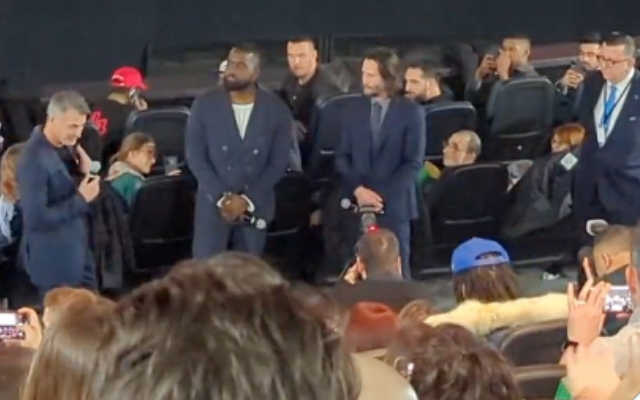
I introed the Canadian premier of “John Wick: Chapter 4” with stars Keanu Reeves and Shamier Anderson and director Chad Stahelski. Instead of the planned Q&A, they did a tribute to Lance Reddick, a co-star in all four Wick movies, who passed away earlier in the day.
We all know that Jor-El and Lara, sent their infant son Kal-El to Earth minutes before their planet Krypton self-destructed. Less known is the story of Kal-El’s Kryptonian Labrador Retriever, the boy’s faithful best friend, who leapt into the Earth-bound spaceship to start a new life on the little blue planet third from the sun. “Look after our son,” Jor-El says as the ship careens out of sight in “DC League of Super Pets,” a new animated movie now playing in theatres.
When we meet them on Earth they are now settled in Metropolis and are known as Clark Kent a.k.a. Superman (John Krasinski) and Bark Kent a.k.a. Krypto (Dwayne Johnson). “I’m his ride or die,” Krypto brags. They live the lives of best friends, sharing an apartment, watching their favorite cooking shows on the Food Network and fighting crime. “My only friend is Superman,” Krypto sings to John Williams’ “Superman” theme. They are inseparable, except for the time Superman spends with his girlfriend, and Daily Planet reporter, Lois Lane (Olivia Wilde).
Sensing that Krypto needs a friend, Superman visits the local animal rescue, just as Ace (Kevin Hart), is making a run for it. In the cage above him is Lulu (Kate McKinnon), a hairless guinea pig who was once a test subject for Superman’s archenemy Lex Luthor (Marc Maron). The supervillain is experimenting with orange kryptonite, a variation of the green kryptonite that saps Superman’s powers.
In a battle of the superheroes and supervillains, Superman and Krypto are hobbled by green kryptonite while the orange kryptonite empowers Ace, Lulu and the other rescue animals. “I figured out something Lex didn’t know,” Lulu gloats. “Orange doesn’t work on people. It only works on pets!”
It is revealed that Lulu is an evil genius who, with the help of her newly recruited injustice squad, plans on reuniting with Luthor and putting an end to the work of the Justice Squad, Wonder Woman (Jameela Jamil), Aquaman (Jemaine Clement), The Flash (John Early), Cyborg (Daveed Diggs), Batman (Keanu Reeves) and Green Lantern (Dascha Polanco).
Now, it’s up to Krypto, with the help of Ace and the other super pets, to rescue Superman and the world savers.
“DC League of Super Pets” tries hard to mold the superhero movie formula into a kid-friendly shape. For much of the movie director Jared Stern succeeds. Supes and Krypto have a good ‘n goofy relationship, punctuated by funny banter and antics. Everyday chores, like dog walking are given a superhero spin as Superman and Krypto’s daily constitutional becomes a supersonic flight around the world, powered by their extranormal abilities.
Kids should also get a kick out of fun characters like McKinnon’s sarcastically sinister Lulu, the Natasha Lyonne-voiced Merton McSnurtle, the turtle with superspeed, and a cat who coughs up hand grenade furballs. Parents should appreciate the good life lessons about team work, sharing, learning by listening and being true to yourself to unlock your true powers, while getting a laugh out of the film’s more self-aware moments. “Every superhero struggles to learn their powers, “ says PB (Vanessa Bayer), a potbellied pig who can change size at will, “until they have their training montage.”
But, and there is a but, the movie eventually goes the way of all superhero movies and devolves into a loud, messy climax that feels as though it doesn’t line up with the kid friendly action that came before it.
“DC League of Super Pets” doesn’t have the same sense of fun as “The Lego Batman Movie,” and sticks too closely to the adult style of storytelling we’ve come to expect from superhero movies—there are even two after credit scenes—but it does deliver some cute characters and a handful of superlaughs.
These days movies are regularly remade, rebooted, reimagined and regurgitated. But none of those terms capture how Warner Bros has brought back one of their most famous and ground breaking franchises.
The new Keanu Reeves movie isn’t simply a return to the Matrix, the simulated reality created by intelligent machines to pacify humans and steal their energy, it’s a resurrection. After eighteen years, Neo has been raised from the dead by Lana Wachowski in “The Matrix: Resurrections,” now playing in theatres.
The last time we saw Neo (Reeves) he made the ultimate sacrifice, giving himself to create peace between machines and mankind. His death would allow people to finally be free of the virtual world of the Matrix.
In “Resurrections” it’s twenty years later. Neo now goes by his real name, Thomas A. Anderson. He is the “greatest videogame designer of his generation,” with an ordinary life, save for the visions that plague him. “I’ve had dreams,” he says, “that weren’t just dreams.” His analyst (Neil Patrick Harris) has him on a steady diet of heavy therapy and blue pills, meant to quell the strange delusions.
Anderson’s regular life is turned upside down when his business partner Smith (Jonathan Groff) announces that their company will be making a sequel to their most popular game, “The Matrix.” As his team works on the new game—“It’s a mindbomb!”—his memories become more intense and soon he has trouble distinguishing fact from fiction.
Or is it all real?
When people from his past, like computer programmer and hacker Trinity (Carrie-Anne Moss) and Morpheus (Yahya Abdul-Mateen II), an alternate reality version of the heroic Matrix hovercraft captain who first believed Neo was “The One,” appear, Thomas fears he is losing his mind.
Things become clearer—Or do they?—when the new Morpheus offers Thomas/Neo a choice of pills. The blue ones will keep Thomas’ state of mind status quo. The red ones, however, will take him down the rabbit hole, into the heart of the Matrix. “Nothing comforts anxiety like a little nostalgia,” says Morpheus.
Pill popped, the simulated world opens up to reveal a dangerous place in need of a hero. Teaming with a group of rebels, Neo battles a new enemy and secrets are revealed. “The Matrix is the same or worse,” says Neo, “and I’m back where I started. It feels like none of it mattered.”
“The Matrix: Resurrections” may be the most self-aware movie of the year. No instalment of “The Matrix” will ever match the whiz bang excitement of the first film, and “Resurrections” knows it. It comments on itself and consistently winks at its legacy.
“This cannot be a retread, reboot or regurgitation,” says one of the “Matrix” videogame designers.
“Why not?” says another. “Reboots sell.”
Like the movie’s story, the film itself attempts to blur the line between the reality of the story and the very act of watching the movie. It is simultaneously self-depreciating and cynical. It’s OK to have a bit of good fun with the story, especially given the oh-so-serious tone of the previous “Matrix” movies, but by the time Thomas meets Trinity at the Simulatte Café, the jokes have worn thin.
The meat of the story, a search for truth, is the engine that keeps the movie motoring along, but the endless exposition, a torrent of words, seems to be the fuel that keeps things running. When a character says, “That’s the thing about stories, they never end,” it’s hard to disagree as the movie gets mired in mythology and world building.
It becomes a slog, without enough of the trademarked Wachowski action scenes to help pick up the pace. When the movie does dip into bullet time and the action that made the original so memorable, it feels like a pale comparison. There is nothing much new—“I still know Kung Fu,” says Neo—just frenetic action and nostalgia for a time when a slow-motion bullet made our eyeballs dance.
“The Matrix: Resurrections” does try to recontextualize the existing mythology. This time around the all-you-need-is-love-story between Neo and Trinity is amped up and there is some timely social commentary about control, whether it’s from the government or a virtual reality machine, but, and there is a big “but,” as much as I wanted to enjoy another trip to the Matrix, I found it too meta, too long and yet, not ambitious enough.
Just because Bill and Ted, the time travelling slackers last seen on screen almost thirty years ago, got bigger and older doesn’t mean they grew up. Alex Winter and Keanu Reeves reunite as William S. “Bill” Preston, Esq and Theodore “Ted” Logan in “Bill and Ted Face the Music,” available now in theatres and on demand, to try, once again, to save the world through music.
The leaders of the Wyld Stallyns are now middle aged with kids of their own, played by Brigette Lundy-Paine and Samara Weaving. At their peak Bill and Ted’s band played at the Grand Canyon but are now reduced to performing at a lodge for a handful of people who were already there for taco night. Still, they persist in their quest to write the perfect song, a tune so powerful it will unite the world.
Not everyone is on board. “It’s been hard to watch you beat your heads against the wall for 25 years,” says Ted’s wife Princess Elizabeth Logan (Erinn Hayes). “Not sure how much more we can take.”
But when their old mentor Rufus (George Carlin in archival footage) send his daughter Kelly (Kristen Schaal) from the future with a mission, Bill and Ted accept. Given 77 minutes and 25 seconds to create a song that will “save reality,“ the duo go on an excellent, time travelling journey to the future to get the song from their future selves. “Let’s go say hello to ourselves and get that song,” says the ever-optimistic Bill.
Cue the famous inner-dimensional phone box.
The new adventure brings with it some grown-up issues, marital problems, matters of life and death, their manipulative future selves, a trip to hell and killer robots.
Meanwhile, as Bill and Ted race into the future with Kelly their daughters are on a mission of their own. Zipping through time they convince some of the greatest musicians the world has ever known—Jimi Hendrix (DazMann Still), Louis Armstrong (Jeremiah Craft), Mozart (Daniel Dorr), drummer Grom (Patty Anne Miller), flautist Ling Lun (Sharon Gee) and rapper Kid Cudi as himself—to bring Bill and Ted’s music to life.
A mix of quantum physics and silly humor, “Bill and Ted Face the Music” is more a blast in nostalgia than laugh out loud funny. The screenplay, by Chris Matheson and Ed Solomon, who also penned “Bill & Ted’s Excellent Adventure” and “Bill & Ted’s Bogus Journey,” haven’t played around with the formula. This isn’t a gritty reimagining of the franchise. Bill and Ted haven’t developed dark sides or become jaded. They are carbon copies of their former screen selves, albeit with a few more miles on their faces. The yuks are derived from Bill and Ted as wide-eyed, Valley-speaking saviors who look for and find the best in everyone they meet in the past, present and future.
Along the way there are some welcome returns, most notably William Sadler as the bass playing Grim Reaper, who can’t understand why Bill and Ted don’t appreciate his 40-minute-long bass solos, and it’s nice to see Carlin again, if only for a second. Lundy-Paine and Weaving, have fun, playing the daughters as two chips off the old blockheads, naively discovering the true secret of world unity.
“Bill and Ted Face the Music” is a blast from the past, a movie that would look great on VHS, that maintains the goofiness and the optimism of the originals.