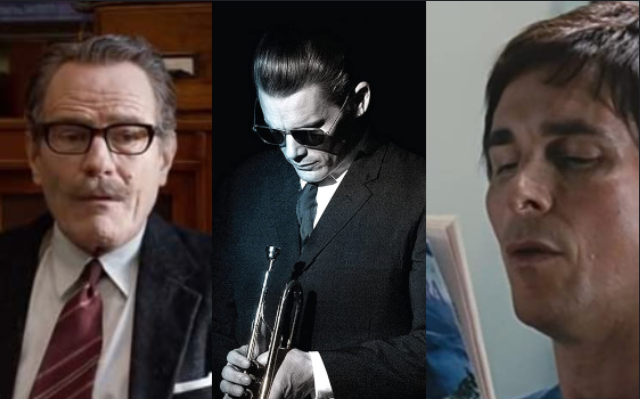
What to watch when you’ve already watched everything Part Thirteen! Binge worthy, not cringe worthy recommendations from Isolation Studios in the eerily quiet downtown Toronto. Three movies to stream, rent or buy from the comfort of home isolation. Today, a financial crisis, a blacklisted writer and a troubled trumpeter. #TheBigShort#Trumbo#BornToBeBlue
We’ve all heard the term Stockholm Syndrome. It refers to a hostage situation in which the captees come to sympathize or even identify with their captors. We’ve seen it in films like “Dog Day Afternoon,” “V for Vendetta” and even “King Kong.” But why is it called Stockholm Syndrome? Director Robert Budreau found out when he stumbled across “The Bank Drama” by Daniel Lang, a 1974 New Yorker article about a 1973 Swedish bank heist and hostage crisis that gave name to the phenomenon.
Ethan Hawke plays Lars Nystrom, a Swedish national raised in America. When he steps inside one of Sweden’s main banks, the Kreditbanken, armed with a machine gun and some bad intentions, he’s disguised, resembling Dennis Hopper circa “Easy Rider.” Gun blazing he orders everyone out of the bank save for tellers Bianca Lind (Noomi Rapace) and Klara Mardh (Bea Santos).
His plan is simple. He will hold the two women hostage until his best friend, legendary bank robber Gunnar Sorensson (Mark Strong), is released from jail, delivered to him and the two friends, with hostages in tow are allowed to leave in a Mustang GT. They’ll drive to a nearby dock, release Bianca and Klara, sail to France and never be seen again. If he doesn’t get what he wants he tells police he will kill the hostages and shoot his way out of the bank.
What the police don’t know is that Lars is all bluster, all talk and no walk. He’s never shot anyone and isn’t about to start now. Bianca, the more valuable of the hostages because she is a wife and a mom, senses Lars’s soft heart and begins to feel for his plight, even though he is the architect of their dire situation.
“Stockholm” has a bit of a damp fuse. The elements are all in place for a terrific thriller but they never gel. Hawke is a hoot as the more nerve than brains instigator and Rapace captures the compassion and desperation necessary for us to believe she could help the man holding her for ransom. The rest of the cast, Strong included, take a backseat, personality and interest wise.
Budreau mixes and matches Bianca’s rational perspective with Lars’s irrationality in a true opposites attract not-quite-love story. They are the spark that keeps “Stockholm” interesting.
Early on in their relationship Blaze Foley’s (Ben Dickey) girlfriend and muse Sybil Rosen (Alia Shawkat) asks, “Are you going to be a big country star, like Roger Miller?” The singer-songwriter replies, “I don’t want to be a star. I want to be a legend.”
Texas singer, songwriter Foley did indeed lead a legendary life. The “Let Me Ride in Your Big Cadillac” singer, who died at in obscurity age 39, wore duct tape on the toes of his boots to mock wannabe cowboys with silver-tipped cowboy boots. Later, the master tapes from his first studio album were confiscated by the DEA. Lucinda Williams dedicated the tune “Drunken Angel” to him and Ethan Hawke was inspired to co-write and direct the movie “Blaze” based on the novel “Living in the Woods in a Tree: Remembering Blaze” by Rosen.
“Blaze” is as non-traditional as its subject. Non-chronological and bold, it’s a study of creativity, relationships and struggle. The backbone of the story is a radio interview with Foley’s friend, musician Townes Van Zandt (Charlie Sexton). Chain-smoking, he details the events of Foley’s life as a musician and companion to Sybil. As mythmaking takes over Van Zandt’s storytelling another friend, Zee (Josh Hamilton), jumps in, bringing the story back to earth. Zee’s influence grounds the story. Far from justifying the usual bad behaviour essayed in music bios, “Blaze” looks to examine why Foley acted out.
Playing Foley in the flashback scenes is newcomer Dickey. The heavyset Dickey captures Foley’s lost soul status in a performance that is equal parts charisma and kindness. Because the singer died in virtual obscurity for most audiences there is no deeply etched idea of who Foley was. That gives Dickey the opportunity to take all the elements that formed Foley—creativity, a vein of self-destruction tempered by sweetness and talent—and bundle them into a portrait that captures what the singer was all about. It’s a lovely, edgy performance that is the soul of the film.
Like the man himself, there is nothing standard about “Blaze,” the story of his life. Hawke takes chances narratively and stylistically, fracturing the timeline of Foley’s life to make a film that proves, once and for all, that music biopics don’t just have to be about famous people.
“First Reformed,” the meditative new film from writer-director Paul Schrader is a movie about hope, specifically, the search for it.
Ethan Hawke is a Father Toller, a former military chaplain at the under attended First Reformed Church. New to the church and still stinging from a troubled past he’s akin to another of Schrader’s creations, “Taxi Driver’s” Travis Bickle. He’s one of God’s lonely men, racked with despair, plagued by stomach problems brought on by drinking and thoughts of ecological failure. “I think we are supposed to look with the eyes of Jesus into everything,” he says. While overseeing the heritage church he creates his own “form of prayer,” a daily journal where he documents his crisis of faith.
His personal issues are amplified when Mary (Amanda Seyfried), a pregnant parishioner, seeks Toller’s council. Her husband Michael (Philip Ettinger), an extreme eco activist, is having second thoughts about bringing a baby into a world he is convinced is dying. His apocalyptic view of the world unsettles Toller, feeding his inner spiritual struggle.
Schrader is most famous for writing “Taxi Driver,” “Raging Bull” and “The Last Temptation of Christ,” all deeply spiritual in their own ways. Here he tackles faith head on in his best film as a director since 2002’s “Auto Focus.”
Questions are asked; answers are left in the ether. It’s a portrait of a man in progress, trying to figure out his place in the world, if there will be a world to be part of. Hawke is subdued, handing in an internal performance that creates tension as Toller waits for God to tell him what to do. It is powerful work complimented by strong performances from Seyfried and Cedric the Entertainer as the condescending mega-church preacher Pastor Jeffers.
Schrader makes some bold choices here—the film is unrelentingly sombre—but most notably with the sudden and ambiguous ending. Toller looks to be finally taking control of his life, although the form of his redemption is left open to interpretation. This is Schrader’s ode to Andrei Tarkovsky and Ingmar Bergman, contemplative filmmakers of the past who essayed questions of theology and spiritual growth without judging their characters. Uncluttered and edited with laser like attention to detail, “First Reformed” is a thought-provoking movie that bears repeated viewing.
CHIPs: It’s a remake, a comedy and an action film and yet it doesn’t quite measure up to any of those descriptors. It’s a remake in the sense that writer-director-star Dax Shepard has lifted the title, character names and general situation from the classic TV show but they are simply pegs to hang his crude jokes on.
The Circle: While it is a pleasure to see Bill Paxton in his last big screen performance, “The Circle” often feels like an Exposition-A-Thon, a message in search of a story.
The Fate of the Furious: Preposterous is not a word most filmmakers would like to have applied to their work but in the case of the “Fast and Furious” franchise I think it is what they are going for. Somewhere along the way the down-‘n’-dirty car chase flicks veered from sublimely silly to simply silly. “The Fate of the Furious” is fast, furious but it’s not much fun. It’s an unholy mash-up of James Bond and the Marvel Universe, a movie bogged down by outrageous stunts and too many characters. Someone really should tell Vin Diesel and Company that more is not always more.
Fifty Shades Darker: Depending on your point of view “Fifty Shades of Grey” either made you want to gag or want to wear a gag. It’s a softcore look at hardcore BDSM (bondage, discipline, sadism and masochism) that spanked the competition on its opening weekend in 2015. Question is, will audiences still care about Grey’s proclivities and Ana’s misgivings or is it time to use our collective safeword? “Fifty Shades Darker” is a cold shower of a movie. “It’s all wrong,” Ana says at one point. “All of this is wrong.” Truer words have never been spoken.
The Mountain Between Us: Mountain survival movies usually end up with someone eating someone else to stay alive. “The Mountain Between Us” features the usual mountain survival tropes—there’s a plane crash, a showdown with a cougar and broken bones—but luckily for fans of stars Idris Elba and Kate Winslet cannibalism is not on the menu. Days pass and then weeks pass and soon they begin their trek to safety. “Where are we going?” she asks. “We’re alive,” he says. “That’s where were going.” There will be no spoilers here but I will say the crash and story of survival changes them in ways that couldn’t imagine… but ways the audience will see coming 100 miles away. It’s all a bit silly—three weeks in and unwashed they still are a fetching couple—but at least there’s no cannibalism and no, they don’t eat the dog.
The Mummy: As a horror film it’s a meh action film. As an action film it’s little more than a formulaic excuse to trot out some brand names in the kind of film Hollywood mistakenly thinks is a crowd pleaser.
The Shack: Bad things in life may be God’s will but I lay the blame for this bad movie directly on the shoulders of director Stuart Hazeldine who infuses this story with all the depth and insight of a “Davey and Goliath” cartoon.
The Snowman: We’ve seen this Nordic Noir before and better. Mix a curious lack of Oslo accents—the real mystery here is why these Norwegians speak as though they just graduated RADA—Val Kilmer in a Razzie worthy performance and you’re left with a movie that left me as cold as the snowman‘s grin.
Valerian and the City of a Thousand Planets: Movies like the high gloss crime thriller “La Femme Nikita,” the assassin mentor flick “Léon: The Professional” and outré sci fi opera “The Fifth Element” have come to define director Luc Besson’s outrageous style. Kinetic blasts of energy, his films are turbo charged fantasies that make eyeballs dance even if they don’t always engage the brain. His latest, “Valerian and the City of a Thousand Planets,” not only has one of the longest titles of the year but is also one of the most over-the-top, retina-frying movies of the year. Your eyes will beg for mercy.
Wonder Wheel: At the beginning of the film Mickey (Justin Timberlake) warns us that what we are about to see will be filtered through his playwright’s point of view. Keeping that promise, writer, director Woody Allen uses every amount of artifice at his disposal—including cinematographer Vittorio Storaro’s admittedly sumptuous photography—to create a film that is not only unreal but also unpleasant. “Oh God,” Ginny (Kate Winslet) cries out at one point. “Spare me the bad drama.” Amen to that.
THE UGLY
Song to Song: I think it’s time Terrence Malick and I called it quits. I used to look forward to his infrequent visits. Sure, sometimes he was a little obtuse and over stayed his welcome, but more often than not he was alluringly enigmatic. Then he started coming around more often and, well, maybe the old saying about familiarity breeding contempt is true. In “Song to Song” there’s a quick shot of a tattoo that sums up my feelings toward my relationship with Malick. Written in flowery script, the words “Empty Promises” fill the screen, reminding us of the promise of the director’s early work and amplifying the disappointment we feel today. This is the straw that broke the camel’s back, the Terrence Malick movie that put me off Terrence Malick movies. I’ll be nice though and say, it’s not him, it’s me.
EXTRA! EXTRRA! MOST COUNFOUNDING
mother!: Your interest in seeing “mother!,” the psychological thriller from “Black Swan” director Darren Aronofsky, may be judged on your keenness to watch American sweetheart Jenifer Lawrence flush a beating heart down a toilet. Aronofsky’s story of uninvited guests disrupting the serene lives of a poet and his wife refuses to cater to audience expectations. “mother!” is an uncomfortable watch, an off-kilter experience that revels in its own madness. As the weight of the weirdness and religious symbolism begins to feel crushing, you may wonder what the hell is going on. Are these people guilty of being the worst houseguests ever or is there something bigger, something biblical going on?
Aronofsky is generous with the biblical allusions—the house is a paradise, the stranger’s sons are clearly echoes of Cain and Abel, and there is a long sequence that can only be described as the Home-style Revelation—and builds toward a crescendo of wild action that has to be seen to be believed, but his characters are ciphers. Charismatic and appealing to a member, they feel like puppets in the director’s apocalyptic roadshow rather than characters we care about. Visually and thematically he doesn’t push button so much as he pokes the audience daring them to take the trip with him, it’s just too bad we didn’t have better company for the journey.
“mother!” is a deliberately opaque movie. Like looking into a self-reflective mirror you will take away whatever you put into it. The only thing sure about it is that it is most confounding studio movie of the year.
To some director/writer/producer Luc Besson is the French equivalent of Steven Spielberg, a big-budget filmmaker with populist appeal. To others he’s a retina-frying, turbo charged fantasist whose films are empty calories for the eyes.
Movies like the high gloss crime thriller La Femme Nikita, the assassin mentor flick Léon: The Professional and outré sci fi opera The Fifth Element have come to define his outrageous style. Kinetic blasts of energy, his films make eyeballs dance even if they don’t always engage the brain.
His work divides critics. The Fifth Element, and its huge, Earth-destroying ball of molten lava, was simultaneously called “an exhilarating, visual feast” and “boring and idiotic.” One critic called Léon: The Professional, “a wonderful character study,” while another said, “The Professional is strictly amateur-hour.” Different strokes for different folks.
His latest, Valerian and the City of a Thousand Planets, is similarly polarizing. According to whom you listen to it’s either as “if someone projected an entire decade’s worth of sci-fi space epics on the same screen, at the same time” or “one of the best films of the year.” Based on a French comic book series and starring Dane DeHaan and Carla Delevingne, the story of special operatives Valerian and Laureline and their quest to save the universe is another wild, idiosyncratic ride from the director.
His movies may divide critics but there is no question his more-is-more style of filmmaking appeals to audiences. His Taken trilogy (he wrote and produced the Liam Neeson thrillers) has grossed near $1 billion worldwide and his Le Grand Bleu, a tale of love and friendship set against a backdrop of professional free diving, was so popular in France the International Herald Tribune called it a “film générationnel,” a defining moment in the culture.
More recently Lucy, a philosophical action movie starring Scarlett Johansson as a woman whose mind expands to ten times the usual capacity, grossed ten times its $40 million budget. It’s pure Besson. Imagine a mix of Limitless, La Femme Nikita, The Matrix and a Philosophy 101 textbook with half the pages torn out and you’ll get an idea of the film’s loopy feel.
Besson is a maestro at high-octane action but falls down somewhat in others genres. A rare comedy, The Family, is a basic fish out of water story with a gangland twist, starring Robert De Niro and Michelle Pfeiffer as a crime family in witness protection trying to fit in. Trouble is, they don’t blend. Besson is heavy handed with the paint-by-numbers story, the humour and the violence. It’s a movie without a genre, neither funny enough to be a comedy or interesting enough to satisfy as thriller.
Despite that movie hitting the box office with a thud, Besson seems to have the Midas Touch with audiences although he claims not to care much about money. He says people request sequels for two of his most popular turns behind the camera, The Fifth Element and Léon: The Professional. “If I was motivated by money I would have done it a long time ago,” he says. “But I don’t feel it.”
Instead, he’d like you to go see Valerian and the City of a Thousand Planets at least twice. “I’m sorry, you can’t watch the film once. It’s impossible,” he said at a recent press day. ”You have to go twice.”
Movies like the high gloss crime thriller “La Femme Nikita,” the assassin mentor flick “Léon: The Professional” and outré sci fi opera “The Fifth Element” have come to define director Luc Besson’s outrageous style. Kinetic blasts of energy, his films are turbo charged fantasies that make eyeballs dance even if they don’t always engage the brain. His latest, “Valerian and the City of a Thousand Planets,” not only has one of the longest titles of the year but is also one of the most over-the-top, retina-frying movies of the year. Your eyes will beg for mercy.
Based on the French comic book “Valérian and Laureline,” a series that ignited the young Besson’s imagination, it stars Dane DeHaan and Cara Delevingne as 28th century dimension-jumping space police and lovers Major Valerian and Sergeant Laureline. When they aren’t cooing over one another the duo preserve law and order in the universe’s human territories.
Their biggest mission ever comes when the Minister of Defense (jazz star Herbie Hancock) dispatches them to save Alpha, an ever-growing space station nicknamed, “the City of a Thousand Planets.” Led by Commander Arün Filitt (Clive Owen) it is one of the most diverse places in the universe, a peaceful melting pot, home to 30 million inhabitants and thousands of species, who live in harmony, content to share culture and knowledge. Trouble is, sinister forces are afoot.
There’s more, like the Besson-ian touch of a wild red light district called Paradise Alley, an exploding planet, a shape-shifting burlesque performer played by Rihanna and a creature that that poops pearls, but the draw here are the eyeball-spinning visuals, not the story.
“Valerian and the City of a Thousand Planets” is undeniably great looking, but Besson is a stylist above all, but it feels as though it is composed of influences from dozens of other better movies. It’s less than the sum of its parts. “Avatar” + “Tron” + “Dune” + “Star Wars” = “Valerian and the City of a Thousand Planets.”
There are characters who look so much like the Na’vi you’ll think James Cameron delivered his long promised “Avatar” sequel years early, plus ectoplasm shooting guns, Lucas look-a-like creatures and Jessica Rabbit even makes an appearance. Laureline also drops one of the most famous space opera lines ever, “I’ve got a bad feeling about this,” without a trace of irony. Cowabunga! The movie brings with it a disconcerting feeling of déjà vu, made doubly strange because you’ve never seen anything quite like it before.
It’s all spectacle and the leads get lost somewhere between the art direction and the artless storytelling. DeHaan plays Valerian as a Han Solo type, cocky and quick with a line but his laid-back, off kilter demeanour—so appealing in films like “The Place Beyond the Pines” and “Life”—gets lost amid the noise.
Delevingne, the Meryl Streep of eye roll acting, delivers a speech about love being more powerful than any army that is destined to become a YouTube camp classic. A psychic jellyfish sequence recalls one of Delevingne’s high fashion modelling jobs come to life, is beautiful but deeply odd.
Both leads look like they reek of Redbull and herbal cigarettes and provide the film’s most interesting juxtaposition between the flamboyant art design and their blasé performances.
“Valerian and the City of a Thousand Planets” has some trippy space-time continuum stuff but otherwise it’s jammed with the hoariest of clichés, like a ticking clock counting down to doom and an ending right out of “Colombo” complete with flashbacks. There is a sense of fun about some of the creatures—and a wild allusion to eating live monkey brains—but oddly the movie isn’t much fun.
In Maudie, a biopic of Nova Scotia folk artist Maud Lewis, Ethan Hawke plays Everett, the artist’s brusque husband. “You walk funny,” he says when he first meets her. “You a cripple? You sick?”
In other words, he’s not exactly a charmer.
“It’s always fun and such and such a great experience to get to play a character that audiences love,” says Hawke. “It feels really good but often to tell a really interesting story you have to play people who are badly behaved. I feel that as gruff and as unacceptable as a lot of Everett’s behaviour is, it is not uncommon at all of men of that time period. I remember my grandmother always accusing my grandfather of not wanting a wife but a maid. He’s somebody that in the course of that relationship learns how to love.”
As romance blossoms between them Maud’s art—handmade postcards, paintings—slowly gains fans, including Vice President Richard Nixon who purchased a landscape by mail. As Maud’s increasing recognition threatens Everett’s simple way of life their union becomes strained.
“I found that story really surprising and the subtle details of their internal power shifts, I thought, were really true to life. All long term relationships have strange power dynamics and the behaviour within the couple is always shifting about who’s in charge and in charge of what, and what that does to their love and how that changes.”
The couple is, as Maud says, “like a pair of odd socks.”
“I thought it was a beautiful journey to go from someone who was abusive to somebody who knew how to love and care for another person. That’s an interesting character to get to play.”
The script caught his eye not only because of the chance to play a complicated character but also because of his affinity for Nova Scotia.
“I bought a place in Nova Scotia probably in the late nineties. I’ve been going up there once or twice a year every since then. I love it up there.
“Through a friend of a friend they thought I might like the script just because I like Nova Scotia so much. They were right. Of course then they tricked me and the shooting ended up being in Newfoundland. I thought I could shoot this movie and live in my house, but I couldn’t.”
Maudie is a movie about small moments, an exchanged look, a caress. Like its real life inspirations the film is unpretentious, occasionally gruff but always honest and truthful.
“Most of us aren’t in giant espionage battles or helicopter chases. Most of us don’t need a superhero,” Hawke says. “For most of us the real events of our lives correspond around love. The losing of it, the gaining of it. How we feel about any given time period of our life has to do with that and I think it is very difficult to make love stories for adults because they’re very complicated.
“Arthur Miller has a great quote about how everybody is interested in stories about falling in love and getting married, or stories that start with a break up but end in somebody finding resolution but what is very difficult to do is show the actual relationship and I love this story for the messiness of the real life in it.”
“Maudie,” the true story of folk artist Maud Lewis, is a romantic movie about a physically challenged woman who found beauty in life’s simplicity.
Born with juvenile rheumatoid arthritis that left her undersized and frail, Maud Dowley (Sally Hawkins) was shunted around to relatives in her youth. Told she couldn’t look after herself she was treated like an outsider by her family and rural Nova Scotian community. “Some people don’t like it if you’re different,” she says. In a bid to get out from under the thumb of her controlling aunt she answers a help wanted ad at the local general store. It leads her to Everett Lewis’ (Ethan Hawke) rundown one-room shack. He’s a man of few words, raised in an orphanage, now a loner who ekes out a living selling fish and chopped wood.
“You walk funny,” he says, unsure she’ll be up to the job. “You a cripple? You sick?”
“I was born funny,” she replies.
The circumstances are rustic in the extreme but for room and board plus $0.25 a week spending money she agrees to try and turn the shack into a home. To pass the time when she isn’t cooking and cleaning, she retreats into her art, painting colourful landscapes on the walls of the house. She paints flowers, birds and a portrait of their prize chicken—now a long ago digested meal—so, “we can remember his happier days.”
As romance blossoms between this odd couple Maud’s art—handmade postcards, paintings—slowly gains fans, including Vice President Richard Nixon who purchased a landscape by mail. As Maud’s increasing recognition threatens Everett’s simple way of life their union becomes strained.
“Maudie” is a quiet movie with nicely wrought moments. The excitement and joy that spreads across Hawkins’ face as she negotiates her first big sale—$5 a painting plus $1 for postage—is infectious and touching. Later, a muted but emotional reconciliation is heartfelt without being showy or obvious. This is a movie about small moments, an exchanged look, a caress. Like its real life inspirations the film is unpretentious, occasionally gruff but always honest and truthful.
Hawkins is remarkable as the determined Maud. Frail but indomitable, she is a classic movie heroine, a woman who succeeds against all odds. Hawke is a solid presence, gruff on the outside and, if not exactly mushy on the inside, then at least open to love. They are, as Maud says, “like a pair of odd socks.”
Director Aisling Walsh is unafraid to tug at the heartstrings. He sometimes errs on the emotional quality of the score, pushing towards the saccharine, but Hawkins and Hawke always rein it in before we get too much of a sugar rush.
 What to watch when you’ve already watched everything Part Thirteen! Binge worthy, not cringe worthy recommendations from Isolation Studios in the eerily quiet downtown Toronto. Three movies to stream, rent or buy from the comfort of home isolation. Today, a financial crisis, a blacklisted writer and a troubled trumpeter. #TheBigShort #Trumbo #BornToBeBlue