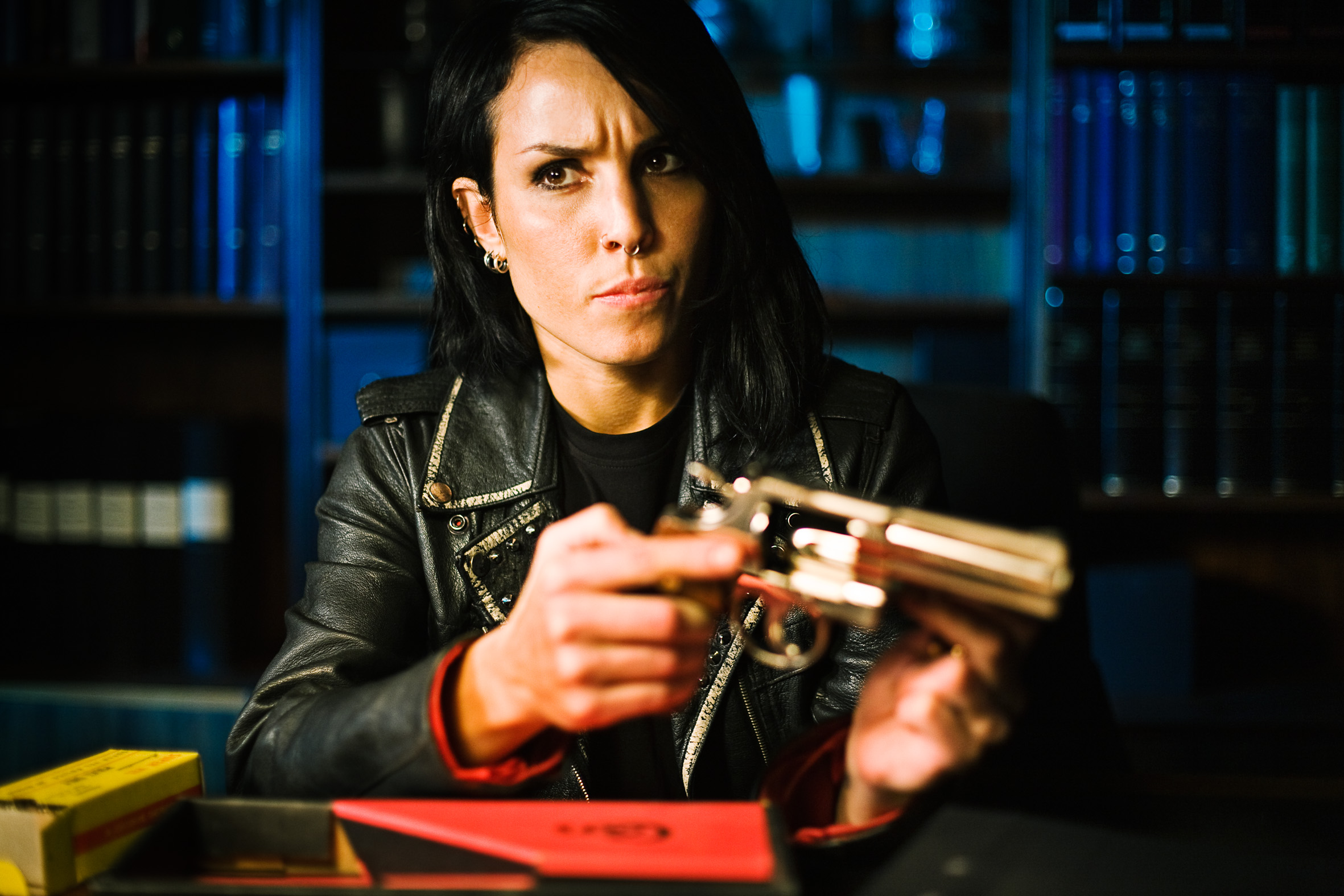
“The Secrets We Keep,” a new revenge thriller starring Noomi Rapace and coming to digital and on-demand, is a riff on the claustrophobic revenge story of “Death and the Maiden.”
Set in 1960, Rapace plays Maja, a Romanian refugee and Holocaust survivor, now living in a small American town with her physician doctor Lewis (Chris Messina) and son Patrick (Jackson Vincent). One day at the park she hears a man whistle for his dog and a flood of memories come back. Following him home she gets a good look and her worst fears are confirmed. He is the SS officer who, near the end of the war, raped her and killed her sister as they fled a concentration camp.
Blinded by anger and horrific memories she kidnaps him, hitting him in the head with a hammer and shoving him in the trunk of her car. When Lewis gets home to find the man, who denies Maja’s charges and claims to be a Swiss citizen named Thomas (Joel Kinnaman, who, in real life went to high school with Rapace), tied up in the basement he is rightfully perplexed. Maja had never shared to the details of her ordeal with her husband but he trusts her and goes along with plan to get a confession, one way or another. “I’m not the man you think I am,” Thomas (or whatever his name is) says, begging to be let go. She is tortured by the memory of what happened and why her sister was shot and she wasn’t. “Help me remember,” she says to him. “It is your only way out of here.”
“The Secrets We Keep” raises questions of trust, survivor’s guilt and the corrosive nature of secrets. It’s a gritty, unsentimental movie that ratches up the tension with ideas, not action. How reliable is Maja’s memory? What amount of scepticism should Lewis bring to this situation? Is vengeance morally correct? Those questions and more hang heavy over the plot, confronting the viewer to assess their own feelings and biases. The story isn’t particularly tricky but it is carefully calibrated to make you wonder who is telling the truth, who is lying and even, who can trust their memories of long-ago events.
Rapace does her best work ever in an English film, bringing some nuance to a character who could have been played with a much harder, vengeful edge. Messina brings the sense of his character’s confusion to life—You said we were going to do things together,” he says supportively, “and you torture him while I’m not here?”—while Kinnaman remains a cypher, a person who may or may not be the man Maja thinks he is. Each performance fits in place, creating a mosaic of truths and lies that is as compelling as it is confounding.
We’ve all heard the term Stockholm Syndrome. It refers to a hostage situation in which the captees come to sympathize or even identify with their captors. We’ve seen it in films like “Dog Day Afternoon,” “V for Vendetta” and even “King Kong.” But why is it called Stockholm Syndrome? Director Robert Budreau found out when he stumbled across “The Bank Drama” by Daniel Lang, a 1974 New Yorker article about a 1973 Swedish bank heist and hostage crisis that gave name to the phenomenon.
Ethan Hawke plays Lars Nystrom, a Swedish national raised in America. When he steps inside one of Sweden’s main banks, the Kreditbanken, armed with a machine gun and some bad intentions, he’s disguised, resembling Dennis Hopper circa “Easy Rider.” Gun blazing he orders everyone out of the bank save for tellers Bianca Lind (Noomi Rapace) and Klara Mardh (Bea Santos).
His plan is simple. He will hold the two women hostage until his best friend, legendary bank robber Gunnar Sorensson (Mark Strong), is released from jail, delivered to him and the two friends, with hostages in tow are allowed to leave in a Mustang GT. They’ll drive to a nearby dock, release Bianca and Klara, sail to France and never be seen again. If he doesn’t get what he wants he tells police he will kill the hostages and shoot his way out of the bank.
What the police don’t know is that Lars is all bluster, all talk and no walk. He’s never shot anyone and isn’t about to start now. Bianca, the more valuable of the hostages because she is a wife and a mom, senses Lars’s soft heart and begins to feel for his plight, even though he is the architect of their dire situation.
“Stockholm” has a bit of a damp fuse. The elements are all in place for a terrific thriller but they never gel. Hawke is a hoot as the more nerve than brains instigator and Rapace captures the compassion and desperation necessary for us to believe she could help the man holding her for ransom. The rest of the cast, Strong included, take a backseat, personality and interest wise.
Budreau mixes and matches Bianca’s rational perspective with Lars’s irrationality in a true opposites attract not-quite-love story. They are the spark that keeps “Stockholm” interesting.
“The Drop,” the new film from the pen of “Mystic River” writer Dennis Lehane, presents itself as a Brooklyn-based crime drama, but is, at its heart, the story of a boy and his dog.
Tom “Man of a Thousand Voices” Hardy plays Bob Saginowski, a mild mannered bartender at Cousin Marv’s a Brooklyn neighborhood pub owned by the Chechnyan mafia. Like many of the borough’s bars, Marv’s is sometimes used as a “drop,” a place where gangsters secretly hide money until it is collected by their crime bosses. One night after work Bob hears a dog whimpering from inside a garbage can. Lifting the lid, he finds a beaten pit bull puppy. He adopts the dog and romances Nadia, (Noomi Rapace), the woman who helped him rescue the animal, but soon a robbery, a scheme by his boss Marv (James Gandolfini) and the dog’s former owner (Matthias Schoenaerts) force Bob to show his true colors.
This is a boy-and-his-dog story, but it ain’t “Old Yeller.” Sure there are gun shots and a cute dog, but there is also a slow unveiling of the clues, red herrings and characters with shady pasts.
As Bob, Hardy is a cypher; kind to dogs, shy and lovesick, he is an average neighborhood guy. Except in this neighborhood average guys have pasts, and Hardy does a nice job of playing a guy who is trying to move on while the past tries to stop him in his tracks.
Gandolfini, in his final role, plays to type as the Tony Soprano-Lite bar owner and while it is a part he could play in his sleep, there is something comforting about seeing him, one last time, as a conflicted tough guy.
Then there is the dog (very cute), the one character that doesn’t seem to have a nefarious past.
“The Drop” is a slice of life, a slickly made look at the underbelly of crime, relationships and dog rearing. Nice performances make up for some plot idiosyncrasies and the cute dog earns some goodwill for a story that doesn’t so much comment on the condition of its characters as it does reveal it.
With “The Girl Who Kicked the Hornet’s Nest” the Millennium trilogy comes to a close on the big screen. At least the Swedish take on the wildly popular books does. Next up they’ll be given the David Fincher Hollywood treatment, which I originally thought was a bad idea. Leave well enough alone. But now, having seen all three of the Swedish entries I think it’s time someone else had a crack at bringing these pulpy, complicated and deliciously fun stories to the big screen.
“The Girl Who Kicked the Hornet’s Nest” picks up about an hour after its predecessor, “The Girl Who Played with Fire” left off. Lisbeth Salander (Noomi Rapace) is in the hospital after being beaten, shot and left for dead by her father and half brother. In a room just down the hall her estranged—and very strange—father, is recuperating after being hit in the head with an axe by his daughter. It’s all very Greek tragedy. Meanwhile a wide reaching and ludicrously complicated scheme to have Lisbeth declared insane and hospitalized for the rest of her life is under way. It involves secret government organizations, some deep dark backroom dealings and a miasma of missing and mysterious documents. Only Mikael Blomkvist (Michael Nyqvist) has the know-how, and possibly the patience, to plough through this mess and keep his former lover out of the bin.
The beauty of the first film in this series, “The Girl with the Dragon Tattoo,” was that while it was a pulp thriller, complete with Nazis, bible references and bondage, it had a certain elegance in the way it unfurled its outlandish story, loads of action and a great central character in Lisbeth. Since then, however, the series has been an exercise in diminishing returns. “The Girl Who Played with Fire” committed the great sin of stretching every plot point past its breaking point and its sequel, “The Girl Who Kicked the Hornet’s Nest” is even worse, stretching our interest past its breaking point.
Talky, drawn out and largely action-free it endlessly rehashes Lisbeth’s life story while, by and large, she sits there mute. It’s such a waste of a character, which in the first episode of the story had the promise of becoming one of the great female characters of recent years.
Cinematically two thirds of this series has been a bitter disappointment. Perhaps it’s better to stay at home with the books until the David Fincher version hits the big screen next year.
“The Girl Who Played with Fire,” much-anticipated follow-up to “The Girl with the Dragon Tattoo,” is much like one of Sweden’s other great exports—the IKEA Billy bookcase system. It has lots of pieces, but not all of them fit.
The story picks up a year after “Dragon Tattoo”” left off. Lisbeth Salander (Noomi Rapace) is back in Sweden after lamming it around the world. She’s been deep undercover; not even Mikael Blomkvist (Michael Nyqvist) knew where she was or what she’s been up to. Of course as soon as she touches down on Swedish soil her life gets complicated and by extension so does Blomkvist’s. She becomes the main suspect in a triple murder and Blomkvist, trying to get to the bottom of the case encounters human traffickers, Russian gangsters, motorcycle thugs, drugs and even a brute with an unusual genetic disorder. These people lead very dramatic and dangerous lives.
Despite the large number of story shards and characters “The Girl Who Played with Fire” is much more straightforward than “Dragon Tattoo.” It’s cluttered yet simplistic, stretching every plot point past its breaking point. Long meaningful stares are traded, dialogue that sounds torn from the Hardboiled Crime Writers Almanac is exchanged and tepid action ensues, all leading up to a “Murder She Wrote” climax where everyone spills the beans. It’s a disappointment because even at well over two hours “Dragon Tattoo” was gripping and exciting but at just over two hours “Fire” feels much longer. It is not as taut as “Dragon Tattoo” or as interesting.
One of the things that made “Dragon Tattoo” so compelling was the partnership (and budding relationship) of Blomkvist and Salander. We watched as they became the Swedish “Hart to Hart,” battling the bad guys and perhaps even developing feelings for one another, but save for the occasional e-mail “Fire” keeps them apart and the movie suffers in the absence of their chemistry.
Salander, the punk rock computer hacker with, surprise (!), an attitude, is one of the better female characters to come along in recent years, but “Fire” blunts her effectiveness. She spends endless hours hiding in her apartment smoking Camel cigarettes when she should be out kicking butt. Where’s the fierceness from the first film?
The film looks good—director Daniel Alfredson keeps the austere look of the first film intact—but on a technical note some of the subtitles are hard to read—white letters on white backgrounds are not a good idea!
By eliminating the book’s emphasis on systemic sexism and homophobia in favor of a basic crime story “The Girl Who Played with Fire” has none of the dramatic oomph of the first film. Worse, it has managed to make the main characters, so appealing in the first film, less interesting.
If you think Swedish cinema is all isolation and despair, a tortured Bergmanesque look at the human condition, think again. In recent years directors like Lukas Moodysson and films such as “Let the Right One In” have redefined Scandinavian movies; quietly leaving behind the icy introspection typical of the best known filmmakers from that part of the world. The latest Swedish film to gain international notice is “The Girl with the Dragon Tattoo,” a truly thrilling thriller based on a best selling novel.
In the opening minutes of the film Mikael Blomkvist (Michael Nyqvist), a muck raking journalist for the controversial Millennium magazine, loses a libel case brought against him by a Swedish industrialist. Before he begins his three month prison sentence he is offered an intriguing job. Hired by Henrik Vanger (Sven-Bertil Taube), the scion of an industrial dynasty, he is charged with solving a forty-year-old murder. In the late sixties Vanger’s favorite niece disappeared, leaving no trace except for framed, pressed flowers which arrive every year on Henrik’s birthday. It is a cold case, one that the police haven’t been able to solve, but Vanger feels that Blomkvist’s dogged style might be able to uncover some new clues. Aiding the journalist in his search is Lisbeth Salander (Noomi Rapace), a trouble computer hacker with a massive tattoo of a dragon on her back.
“The Girl with the Dragon Tattoo” is a pulp thriller, complete with Nazis, bible references and bondage. There’s nothing terribly highbrow about it, but there is a certain elegance to how director Niels Arden Oplev slowly unfurls the clues, stretching the story tautly over the two-a-half-hour running time. The plot shouldn’t work; it has story shards all over the place—the verdict in the libel case, the hacker and her evil parole officer, the disappearance—but Oplev keeps the storytelling as crisp as the sound of a boot crunching on the snow that envelopes the landscape.
Top it off with some terrific performances—particularly from Rapace and Taube—some melodrama and as twisted a bad guy as we’ve seen since “Silence of the Lamb’s” Buffalo Bill and you have a slow burning mystery that builds to an explosive climax.
If this was an American film (and it will be soon) the disgraced, but dogged reporter might be played by Jeremy Renner, the computer hacker by Kristen Strewart and the obsessed industrialist by Christopher Plummer, and you know what, it wouldn’t be any better than the Swedish version. See it in its original language before Hollywood snaps it up and ruins it.
Thematically “Prometheus” is about creation and destruction. As a piece of entertainment goes, however, I’m not sure Ridley Scott’s new space opera will create lasting memories. It won’t destroy the goodwill of the first couple of “Alien” films, but I don’t think it will add much to the legacy either. For me there is very little big bang in a movie that is reportedly about the most significant discovery in the history of mankind.
The basic storyline of “Alien” is in place in “Prometheus,” just don’t this movie a sequel or a prequel lest you annoy Sir. Ridley. A group of hapless space travellers go head to head with some intergalactic nasties who give hugging a bad name. But these face huggers aren’t the movie’s main draw. Led by Elizabeth Shaw (Noomi Rapace) and Charlie Holloway (Logan Marshall-Green, the expedition into the farthest corners of the universe aims to prove a connection between ancient human civilizations and extraterrestrials. They discover a link to creation and religion that is more Book of Revelation than Genesis, however.
“Prometheus” doesn’t degrade the legacy of Scott or his beloved “Alien” but it doesn’t add much to the franchise either. It’s an expertly made, but clinical study of dread and wonder which, despite the two-and-a-half-year spaceship journey, never takes flight.
It’s a slow build. Scott allows the intensity to build throughout the two hour running time, leading up to a climax that is best described in
(mild spoiler) four words: Do it yourself caesarean! It’s a memorable scene, well orchestrated by Scott, but the movie peaks there, despite the half-hour that follows.
It’s a mix of heady ideas—which are revealed in the film’s first half—the odd action sequence and dialogue that sounds left over from a bad late seventies sci film. I expected a higher level of writing from a movie that is more about ideas than action.
Having said that, I loved Michael Fassbender’s automaton space butler David 8. He’s got many of the film’s best lines and if they ever need someone to play the lead in The Peter O’Toole Story, he’s the guy.
I know it is wrong to compare movies in the same way it’s a bad idea to compare your kids to one another, but Scott has made a movie that feels like something he’s done before, just not as well. I expected more. Perhaps “Alien” set the bar too high for the director to leap over.
“Dead Man Down,” the new film from WWE Studio, has something for everyone. It’s a new genre that mixes a revenge drama with a romantic subplot—complete with sweeping violin accompaniment. I suppose it is an action flick for the guys with just enough romance to make it a date movie as well, but a revenge drama from WWE Studios should be about violence, not violins.
Niels Arden Oplev, the director of the original “The Girl with the Dragon Tattoo,” blends together these two unlikely genres—is this a romrev; a romantic revenge?—to tell the story of Victor (Colin Farrell), the right hand man to Alphonse Hoyt, a notorious crime lord played by Terence Howard. For months Hoyt has been receiving strange, threatening letters. When a close associate turns up dead with a note clenched in his fist and part of a picture stuffed in his mouth, Hoyt lashes out, leading his men on the first of the film’s wild shoot outs.
Thus begins a twisty-turny story of revenge involving Victor, Alphonse, a group of Albanian thugs and Beatrice (Noomi Rapace), a former beautician whose face was disfigured in a drunk driving accident.
To tell you anything about the nature of the revenge would take some of the punch away from the movie. Characters are driven to extremes by the kind of dark forces that only seem to happen in movies, as they concoct elaborate plots to get even with those who did them wrong. Just a hint, rat-o-phobes might want to avoid a late plot development.
Farrell brings his usual brooding intensity to the role of Victor, Rapace’s exotic, otherworldly presence nicely compliments the film’s off-kilter feel—you wouldn’t expect the girl with the dragon tattoo to play a passive girlfriend role and she doesn’t, up to a point—and Oplev supplies atmospherics to burn, but the movie’s tale of revenge simply isn’t sturdy enough to hold the whole thing together.
Plot holes big enough for Andre the Giant to walk through (this is, after all produced by World Wrestling Entertainment) are hard to swallow and the romantic elements sand some of the edge off the gritty story.
“Dead Man Down” is a genre movie with one too many genres to fully succeed.
Robert Downey Jr. knows how to work a room. I notice this while at the swank-a-delic Peninsula Hotel in Beverly Hills for a press conference to celebrate the release of Sherlock Holmes: Game of Shadows.
It’s a packed panel, including co-stars Noomi Rapace (the original Girl With the Dragon Tattoo) and Jared Harris, mega producer Joel Silver and Downey’s business and life partner Susan. Between them there are untold Oscar nominations and hundreds of millions in box office returns, but that doesn’t mean squat when Downey enters and takes centre stage.
All eyes — and 90 per cent of the questions — go to him. Midway he feigns embarrassment at the attention and says, “Why doesn’t someone ask Joel Silver a question?”
Why? Because Downey is the most quotable, funny and memorable person in the room, that’s why.
Here’s a sample of what he had to say.
On making sequels:
“There should be a whole online support team for anyone who has ever been involved in making a second part to a first that worked. There is so much to learn. The greatest disguise was us disguising ourselves as consummate by-the-numbers professionals when, in fact, we’re all incredibly eccentric.”
When asked to talk about performing Sherlock Holmes’s drag scenes:
“I guess we’re not talking about this as one of the most important films of the year. I put on some makeup. How are we going to get nominated with these kinds of questions?”
On improving on set:
“I think the goal is to make a well-written scene seem improvised, or to find things in the room you couldn’t have known until you get in the real situation and just try and improve things as you go along.”
On why his co-star was absent:
“Jude (Law) would have been here, by the by, but his son had a soccer game.”
On keeping the set “green”:
“I just remember that every animal that was harmed was promptly taxidermied and sent as a gift to one of the many ecological companies who have these huge concerns that I validate.”
On working with Jude Law and director Guy Ritchie:
“Jude and I are pretty close, but Guy and I are practically brothers. There have been times I have wanted to lob off his head with a machete.”
On collaborating with his director and fellow actors:
“It was a democracy in the truest and most frustrating and most rewarding sense of the word.”