Movies about giant things hurdling through space toward Earth are almost as plentiful as the stars in the sky. “Armageddon,” “Deep Impact” and “Judgment Day” all pose end-of-the-world scenarios but none have the satirical edge of “Don’t Look Up.” The darkly comedic movie, now in theatres but coming soon to Netflix, paints a grim, on-the-nose picture of how the world responds to a crisis.
Jennifer Lawrence is PhD candidate Dr. Kate Dibiasky, a student astronomer who discovers a comet the size of Mount Everest aimed directly at our planet. Her professor, Dr. Randall Mindy (Leonardo DiCaprio), comes to the alarming conclusion that the comet will collide with Earth in six months and fourteen days in what he calls an “extinction level event.”
They take their concerns to NASA and the White House, but are met with President Janie Orlean’s (Meryl Streep) concerns about optics, costs and the up-coming mid-term elections. “The timing is just disastrous,” she says. “Let’s sit tight and assess.”
With the clock ticking to total destruction Dibiasky and Mindy go public, but their dire warnings on the perky news show “The Rip”—“We keep the bad news light!”—go unheeded. Social media focusses on Dibiasky’s panic, creating memes of her face, while dubbing Mindy the Bedroom Eyed Doomsday Prophet.
As the comet hurdles toward Earth the world becomes divided between those willing to Look Up and do something about the incoming disaster and the deniers who think that scientists “want you to look up because they are looking down their noses at you.”
Chaos breaks out, and the division widens as the comet closes in on its target.
It is not difficult to find parallels between the events in “Don’t Look Up” and recent world occurrences. Director and co-writer Adam McKay explores the reaction to world affairs through a lens of Fake News, clickbait journalism, skepticism of science, political spin and social media gone amok. In fact, the topics McKay hits on don’t really play like satire at all. The social media outrage, bizarro-land decisions made by people in high offices and the influence of tech companies all sound very real world, ripped out of today’s newspapers.
It’s timely, but perhaps too timely. Social satire is important, and popular—“Saturday Night Live” has done it successfully for decades—but “Don’t Look Up,” while brimming with good ideas, often feels like an overkill of familiarity. The comet is fiction, at least I hope it is, but the reaction to it and the on-coming catastrophe feels like something I might see on Twitter just before the lights go down in the theatre.
It feels a little too real to be pure satire. There are laughs throughout, but it’s the serious questions that resonate. When Mindy, on TV having his “Network” moment, rages, “What the hell happened to us? What have we done to ourselves and how do we fix it?” the movie becomes a beacon. The satire is comes easily—let’s face it, the world is full of easy targets—but it’s the asking of hard questions and in the frustration of a world gone mad, when McKay’s point that we’re broken and don’t appreciate the world around us, shines through.
Despite big glitzy Hollywood names above the title and many laugh lines, “Don’t Look Up” isn’t escapism. It’s a serious movie that aims to entertain but really wants to make you think.
In 2017 Kenneth Branagh delivered a new version of Agatha Christie’s “Murder on the Orient Express” that was as big and bloated as a new crime dramedy, “Knives Out,” is sleek and entertaining. Both feature large ensemble casts and twists galore but director Rian Johnson manages to breathe life into the creaky whodunnit genre.
The action takes place in a small up-state New York town on an estate one character says resembles a “Clue” board. In the film’s opening minutes the dramatic theme song sets the stage for what’s to come… murder most foul.
Marta (Ana de Armas), caregiver to Harlan Thrombrey (Christopher Plummer), the best-selling mystery writer of all time, is shocked to discover his dead body in his office. Throat slit, knife on the floor beside him, the local police Det. Elliot (Lakeith Stanfield) and Trooper Wagner (Noah Segan) think it is a suicide but a private investigator, the silver-tongued Benoit Blanc (Daniel Craig), disagrees and says so in an accent as thick as gumbo. “Ladies and gentlemen,” he says to the family, “I would like to request that you all stay until the investigation is completed.”
The assembled family stick around, partially at Blanc’s request but mostly for the reading of the will. “What will that be like?” asks Marta. “Think of a community theatre production of the reading of a tax form,” replies Blanc.
As the investigation unfolds everyone seems to have a motive for killing the old man, from his children the imperious Linda (Jamie Lee Curtis) and the hair-trigger tempered Walt (Michael Shannon) to various others, including the spoiled-rotten grandson Ransom (Chris Evans), devious son-in-law Richard (Don Johnson) and alt-right troll grandson Jacob (Jaeden Martell). These are people who believe they deserve to be rich and won’t hear any talk to the contrary.
The mystery has more layers than a Vidalia onion but Blanc unpeels it, one tier at a time leading up to the film’s climatic reveal.
“Knives Out” mixes pointed jabs at the 1%–Linda started her company with a modest one-million-dollar loan from her father—with social commentary about class divisions in American life to form the backdrop of this engaging mystery. Add to that a collection of characters that would make Miss Marple suspicious and the game is afoot.
Leading the charge is Craig. As Benoit Blanc, the American Poirot, he rides the line between ridiculous and shrewd, chewing the scenery with an accent unheard since the days of Colonel Sanders television ads. His flowery language—”Physical evidence can tell a story with a forked tongue,” he says—gives Craig a chance to show off his comedic side mixed with a physicality that suggests he can get the job done if need be. It’s a dramatic (maybe that’s not the word but you see what I mean) and welcome shift from his grim-faced 007 role.
What begins as a melodramatic comedy in the vein of “Murder by Death,” gets a little darker as the true nature of the crime is presented, and then funnier again in its wild ‘n woolly resolution. It’s an old-fashioned set-up but slowly echoes of modern-day issues of immigration, deportation and white entitlement are introduced to add edge to the story.
Director Johnson, he of “Looper” and “Star Wars: The Last Jedi,” is having fun here, finding a perfect rhythm in the unveiling of the story’s details. We always learn just enough to carry us through to the next twist and it is an enjoyable ride.
The words “most-anticipated movie of the year” get tossed around a few times every season, usually describing a beloved fan sequel or an Oscar hopeful riding a wave of good press.
After “Avengers: Endgame” we can retire those words until January 2020. Before it played on one public screen the follow-up to 2018’s “Avengers: Endgame” smashed records. Demand for tickets crashed AMC Theatres’ website and app, it became Fandango’s top-selling pre-sale title and in China, advance sales topped a record one million tickets in a matter of hours. Someone in the United States paid a staggering $15,000 on-line for a pair of tickets (I hope that includes popcorn) and box office prognosticators predict forecast a domestic debut in the $260 million range.
Most-anticipated indeed but the question remains, Does “Avengers: Endgame” deserve all the hype?
In the spirit of #DontSpoilTheEndgame I’m cribbing the synopsis of the movie from IMBD.com: “After the devastating events of Avengers: Infinity War (2018), the universe is in ruins. With the help of remaining allies, the Avengers assemble once more in order to undo Thanos’ actions and restore order to the universe.”
“Endgame” is, first and foremost, a fan service movie. From the sheer number of returning Marvel faves—characters number in the dozens, if not the low hundreds—too deep character backstory—superheroes have mommy and daddy issues too!—to the crew’s biggest world-saving mission to date, it indulges every aficionado’s story hopes and desires. It may leave the casual superhero fans feeling overwhelmed by the sheer weight of the film but people willing to line up for hours to see the movie on opening weekend will be rewarded for their patience.
It is epic in the terms of length—it’s three hours so get a snack—location—infinity and beyond!—but it feels like “a lot“ rather than epic.
The story begins on a minor chord, spending much time with the characters grappling with the loss of friends and family before finding a way to right the world-destroying wrongs of Thanos. There is humor, some action but mostly character work. Hulk is in a form we haven’t seen before, Rudd and Downey still have a way with the line and it’s a whole new Thor than any other movie. As the story hopscotches through time and space directors Anthony and Joe Russo keep the focus on the characters fans have come to love.
It’s in the third hour the movie loses its human touch, becoming a noisy CGI orgy that must’ve required the power of 1 million networked computers working overtime to render the frenetic images we see on screen.
As for who lives and who dies? (SPOILER ALERT WITH ABSOLUTELY NO REVEAL) You’ll get no hint here. Suffice to say one of the characters says, “part of the journey is the end,” and I can tell you there will be unsigned contracts and actors suddenly free to do other movies that do not require the wearing of spandex.
“Endgame” feels like the end of the old cycle, the beginning of a reset. Old favourites gone, passing the mantle to others before they go. We even see a poster that reads, “Where do we go, now that they’re all gone?” I’m sure the next several Avengers movies will point the way but it is worth noting there are no hints in the post-credit scene because there is no post-credit scene (at least at the screening I saw).
The film has a sense of self-importance that fans will love, giving the characters the respect that franchises owe characters who have made them billions of dollars.
“Gifted” is the story of a fractured family. Like a hybrid of “Kramer vs. Kramer” and “Little Man Tate” (with a taste of “Good Will Hunting” thrown in), it bases a family custody story around a child prodigy.
Chris Evans leaves his Captain America mask at Avenger’s HQ to play Frank Adler, a single man trying to give his niece Mary (Mckenna Grace) a normal life in a Florida coastal town. As the seven-year-old’s guardian, he enrols the high-spirited girl in public school. “Please don’t make me go,” she says. “No more argument, we’ve discussed this ad nauseam,” he replies. “What’s ad nauseam?” “You don’t know? Looks like someone need school.”
In school she outpaces all her classmates academically, particularly in mathematics. When her teacher (Jenny Slate) tries to stump her, asking what 57 multiplied by 135 is, the little girl pauses and says, “7695” off the top of her head. Then goes on to supply the square root. “87.7 plus change.” It is clear she is gifted, but her abilities raise concerns for Frank. “I promised my sister I’d give Mary a normal life,” he says. “She has to be here,” and not in the special school her grandmother (Lindsay Duncan) wants to place her in. “You are denying her potential.” Cue the custody battle.
“Gifted” doesn’t exactly reinvent the family drama wheel. Frank is the “quiet damaged hot guy,” Mary the precocious kid with a snappy line and many a heart tugging moments. We’ve seen all that before but it’s the chemistry between Evans and Grace that elevates the material. The poignancy of their relationship cuts through the film’s clichés, taking some of the saccharin edge off the story.
Evans is a superhero of a different sort in “Gifted.” As the protective uncle of a brilliant niece he is a fully engaged father figure. He’s a man who saw his sister’s brilliance turn her life upside down and does everything he can to avoid the same fate for his niece. It’s a nice, sensitive performance that provides a nice break from his Avengers’ work.
Grace offers up a nicely balanced blend of brains and childhood behaviour. She’s the smartest person in the room, but she’s also a child, prone to temper tantrums and confusion. Still she is capable of great insight. Why does she want to stay with Frank? “He wanted me before I was smart.”
The movie works best when it focuses on the surrogate dad and niece. There is nice supporting work from Jenny Slate as Mary’s teacher, Octavia Spencer (in her second film about gifted mathematicians) as the girl’s much older best friend and Duncan as the stern Evelyn do solid work, but this is a basically a two hander.
“Gifted” is a warm and funny family drama, a film so well cast it overcomes its conventional idea.
“Gifted” is the story of a fractured family. Like a hybrid of “Kramer vs. Kramer” and “Little Man Tate” (with a taste of “Good Will Hunting” thrown in), it bases a family custody story around a child prodigy.
Chris Evans leaves his Captain America mask at Avenger’s HQ to play Frank Adler, a single man trying to give his niece Mary (Mckenna Grace) a normal life in a Florida coastal town. As the seven-year-old’s guardian, he enrols the high-spirited girl in public school. “Please don’t make me go,” she says. “No more argument, we’ve discussed this ad nauseam,” he replies. “What’s ad nauseam?” “You don’t know? Looks like someone need school.”
In school she outpaces all her classmates academically, particularly in mathematics. When her teacher (Jenny Slate) tries to stump her, asking what 57 multiplied by 135 is, the little girl pauses and says, “7695” off the top of her head. Then goes on to supply the square root. “87.7 plus change.” It is clear she is gifted, but her abilities raise concerns for Frank. “I promised my sister I’d give Mary a normal life,” he says. “She has to be here,” and not in the special school her grandmother (Lindsay Duncan) wants to place her in. “You are denying her potential.” Cue the custody battle.
“Gifted” doesn’t exactly reinvent the family drama wheel. Frank is the “quiet damaged hot guy,” Mary the precocious kid with a snappy line and many a heart tugging moments. We’ve seen all that before but it’s the chemistry between Evans and Grace that elevates the material. The poignancy of their relationship cuts through the film’s clichés, taking some of the saccharin edge off the story.
Evans is a superhero of a different sort in “Gifted.” As the protective uncle of a brilliant niece he is a fully engaged father figure. He’s a man who saw his sister’s brilliance turn her life upside down and does everything he can to avoid the same fate for his niece. It’s a nice, sensitive performance that provides a nice break from his Avengers’ work.
Grace offers up a nicely balanced blend of brains and childhood behaviour. She’s the smartest person in the room, but she’s also a child, prone to temper tantrums and confusion. Still she is capable of great insight. Why does she want to stay with Frank? “He wanted me before I was smart.”
The movie works best when it focuses on the surrogate dad and niece. There is nice supporting work from Jenny Slate as Mary’s teacher, Octavia Spencer (in her second film about gifted mathematicians) as the girl’s much older best friend and Duncan as the stern Evelyn do solid work, but this is a basically a two hander.
“Gifted” is a warm and funny family drama, a film so well cast it overcomes its conventional idea.
Like the recent Batman v. Superman: Dawn of Justice, which saw the Caped Crusader and the Man of Steel go head-to-head in a showdown over how best to police the world, Captain America: Civil War sees the Avengers go mano e’ mano e’ mano e’ mano e’ mano e’ mano (there’s a lot of them) in an effort to settle their differences.
As anyone who has seen the Avengers movies knows, the superhero team have caused havoc all over the world, blowing things up dropping buildings on people, all in the name of law and order. It’s been a wild ride but after a rescue mission leaves 11 innocent people dead the United Nations decides it’s time to rein them in.
The proposed restrictions divide the group. Tony ‘Iron Man’ Stark (Robert Downey Jr.) wants more oversight while Captain America (Chris Evans) refuses to compromise.
Watching from the sidelines is Sharon Carter, ex-S.H.I.E.L.D field agent and love interest of Captain America. Played by Port Perry, Ont., native Emily VanCamp, the character is firmly onside with her superhero suitor.
“It’s an interesting debate,” she says, “because there is no real right or wrong at any given moment. It is difficult to take sides. I know where my character stands. I understand that. Because I play her, I get it but at the same time, as Emily, I really do feel it would make much more sense to be on Iron Man’s side. That’s what makes it interesting. You think you’re going to go into it with a very clear vision of whose side you’re on but you don’t leave feeling that way.”
With two Captain America films under her belt VanCamp is part of the Marvel Universe. That means she has a whole new group of fans with ideas about her character.
“The fans are incredibly invested,” she says. “There are a lot of people with very specific ideas of who they want to see with Steve (aka. Captain America) and sometimes Sharon is not that person. I certainly hear about that. You have to admire how invested people are, whether they’re on your side or not. You have to respect it. I just have to do the best job I can do as Sharon and create the best version of the character and not take some of it personally. You hope, for the most part, the fans are happy.”
The 29-year-old actress began performing in dance class when she was just three years old.
“There were a lot of us in my family so it was a way to tire us out,” she laughs. “It was an outlet to run around which then turned into more serious dance training.”
Those lessons came in handy while shooting one of Civil War’s wild fight scenes. “Dancing teaches you to be connected with your body,” she says.
“We had to shoot the scene in Civil War where Sharon and Black Widow take on Bucky, quite fast. We didn’t practice it. They were running behind that day and they shot the reaction to getting slammed on the table the next morning but all of the fight stuff was in an hour-and-a-half. I don’t think I would have been able to do that unless I had some formal training in dance.”
Why can’t you superheroes just get along? Like the recent “Batman v. Superman: Dawn of Justice,” which saw the Caped Crusader and the Man of Steel go head-to-head in a showdown over how best to police the world, “Captain America: Civil War” sees the Avengers go mano e’ mano e’ mano e’ mano e’ mano e’ mano (there’s a lot of them) in an effort to settle their differences.
Thankfully this isn’t a repeat of the Zack Snyder film. While the themes may be similar to “B v S” the Russo Brothers (Anthony and Joe) achieve a much different result. There’s humour, a story that more or less makes sense and lots of surprises.
As anyone who has seen the other Avengers movies knows the superhero team have caused havoc all over the world, blowing things up dropping buildings on people, all in the name of law and order. It’s been a wild ride but after a debacle in Lagos leaves eleven innocent people dead the United Nations decides it’s time to rein them in.
“While a great many people see you was heroes,” says Secretary of State Thaddeus Ross (William Hurt), “there are those who would use the word vigilante.”
Captain America (Chris Evans), Tony ‘Iron Man’ Stark (Robert Downey Jr), War Machine (Don Cheadle), Black Widow (Scarlett Johansson), Scarlet Witch (Elizabeth Olsen) and Vision (Paul Bettany) are asked to sign a document that would limit their autonomy, requiring a U.N. okily-dokily before they can spring into action. The restrictions divide the group. Stark wants more oversight. “With no limits we’re no better than the bad guys,” he says. Captain America refuses to compromise. “If we sign this,” he says, “we lose our right to choose where and when we fight.”
Complicating matters is Cappy’s old pal Bucky Barnes a.k.a. Winter Soldier (Sebastian Stan). When he’s not under the influence of HYDRA’s mind-control he’s a good guy, but when he is exposed to a series of code words he turns into a Manchurian Candidate style super-duper high tech killing machine. When Winter Soldier is accused of a terrible crime Captain’s loyalty to his friend that drives a wedge between him and Iron Man. As The Avengers self-destruct a mysterious figure (Daniel Brühl) watches from the sidelines.
In some ways “Captain America: Civil War” feels like an echo of “Batman v. Superman.” The difference is a matter of tone. The films share many of the same ideas about responsibility and culpability but whereas “B v. S” was a dark soul-searching affair, “Captain America: Civil War” opts for a cleaner, simpler approach. Minus the ponderosity of Snyder’s film, the Marvel movie manages to make its point in a more concise and interesting way. It’s not exactly a case of less is more—“Civil War” is almost two-and-a-half-hours long and is a Superhero-A-Rama with Black Panther (Chadwick Boseman), Antman (Paul Rudd) Spider-Man (Tom Holland) joining all the usual suspects—but there is an easy elegance to a line like, “Victory at the expense of the innocent is no victory at all,” missing from “B v. S.”
Better yet, “Civil War” finally finds a recipe for juggling its characters. “Age Of Ultron” featured more stars than there are in the heavens and I left the theatre feeling as though I had just left a kindergarten Christmas pageant where they have to give a part to everyone in class so no one feels left out. The Russo Brothers de-clutter, but still manage the sprawling cast effectively, giving each of them a moment or two in the spotlight and more importantly, a reason to be in the spotlight. Extended cameos from Spider-Man and Ant-man are woven into the fabric of the story, bringing some fun with them while Black Panther is set up to be an interesting recurring character.
Of the regulars Robert Downey Jr holds sway, although his Tony Stark is more subdued than usual. The wisecracks are still there, but there’s fewer than usual. Perhaps it has something to do with spending much of the movie fighting with Captain America. Much humour comes from the other characters. There’s something sublimely ridiculous about superheroes complaining about everyday things. “Can you move your seat up?”
“Captain America: Civil War” delivers. It provides all the high-flying action you expect from a summer superhero blockbuster but also delivers a thought provoking look at the nature of power, loyalty and yes, even the practicality of wedging three superheroes into a Volkswagen.
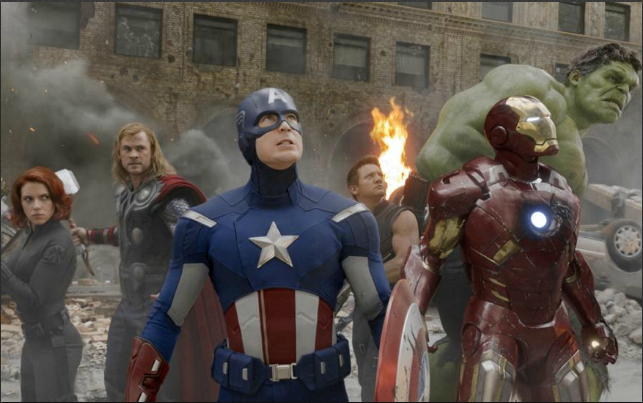
It’s not a spoiler to let you know the Avengers save the world in The Age of Ultron. The spectacular six have rescued the planet before and, no doubt, will save it again in future. In superhero movies the globe is always on the eve of destruction.
The original movie, 2012’s The Avengers, saw the team protect the planet from Thor’s evil brother Loki while in Superman II the Man of Steel battles three Kryptonian criminals set to obliterate our orb. A baddie named M tries to wage world war in The League Of Extraordinary Gentlemen and recently the Fantastic Four prevented a giant cosmic entity called Galactus from gobbling up the earth.
“I see a suit of armour around the world,” says Tony Stark in Age of Ultron. “Peace in our time, imagine that.”
The movies get bigger every time out and with thirty more superhero flicks scheduled for the five years—including Deadpool, Doctor Strange and Gambit—the mind reels at the ways villains might endanger our world. It sounds entertaining but haven’t we’ve already been there? Where do you go from the threat of total annihilation?
Diminishing returns in terms of audience reaction, that’s where. We all know The Avengers will pull out all the stops to save the earth. Buildings will crumble, trucks will go airborne and giant cracks will appear where city streets used to be but by the end credits you know everyone will emerge relatively unscathed, with the bad people vanquished and the good guys grinning from ear to ear. Viewers are left with CGI fatigue, but dammit a catastrophe was averted. Again.
But we’ve been there, done that. Why not freshen things up and turn back the hands of the doomsday clock a few minutes to create tension in the form of different kinds of situations? It sounds counter intuitive—bigger is always better, right?— but imagine Captain America going mano a mano with Kim Jong-un or Iron Man shrinking down to the size of a microbe to battle cancer from the inside à la Fantastic Voyage.
The real world is a very complicated place. Every day the news delivers more bad information than all the tragedies of Aeschylus and Sophocles combined. Stories of beheadings, terrorism and all manner of terrible behaviour flood the airwaves aching to be corrected by some sort of superhero. How great would it be to see warrior princess of the Amazons Wonder Woman unleash the Lasso of Truth on the Canadian Senate or weather maven Storm get all medieval on climate change?
An injection of real world issues might not make for big box office, but it certainly would infuse the movies with a sense of unpredictability—just like real life events. Real life is messy and volatile and that’s what keeps it interesting.
I understand one of the reasons we go to movies like The Avengers: Age of Ultron is to see things we’ll never witness in real life, but it’s hard not to agree with Hawkeye (Jeremy Renner) when he says, “We’re fighting an army of robots and I have a bow and arrow—it makes no sense!” These movies try to dazzle our eyes—and they do!— but bringing them down to earth, literally, might help us engage our brains as well.
“Can we hold them?” asks evil scientist Baron Wolfgang von Strucker (Thomas Kretschmann) as a team of superheroes tear up his supposedly impenetrable HYDRA lair.
“They’re the Avengers,” comes the reply. The only thing missing is the “Duh!” at the beginning of the sentence.
Not only does the exchange answer the question of every film producer who has a movie opening opposite “Avengers: Age of Ultron” this weekend but it also sets a loose, funny tone for the film.
Twenty seconds into the movie we’re already engaged in a wild action scene that puts them in possession of an ancient gem containing artificial intelligence. Tony Stark (Robert Downey Jr.) and Bruce Banner (Mark Ruffalo) intend to use the technology to build a peacekeeping army—“I see a suit of armour around the world,” says Stark. “Peace in our time, imagine that.”—but the plan backfires and instead of creating a global peace initiative they create a robot monster named Ultron (voice of James Spader). “I really miss the days when the weirdest thing science created was me,” says Captain America (Chris Evans). Hell-bent on improving the world by exterminating humanity, Ultron says, “When the dust settles the only things left will be metal.”
Cue the metalocalypse.
While many superhero movies have chosen a dark road—think Christopher Nolan’s ennui ridden “Batman” movies or the dour looking “Batman v Superman: Dawn of Justice”—director Joss Whedon delivers action with a grin. There’s always time for a quip in “Age of Ultron.” The wisecracks are the glue that hold the film together, acting as a bridge between the battle scenes.
Stark is his old cocky self with none of the insecurity of the emo “Iron Man 3” in sight. Gone is the introspection of “Winter Solider.” Sure, Banner is still tormented by his Hulk alter ego—but let’s be honest, if you take away his torment, you take away his character—but nonetheless finds time to do a faceplant into Scarlett Johansson’s chest and Black Widow (Johansson) shows more of her feminine side than ever before, but the film is less interested in the characters than how carnage the characters can cause.
There are action scenes galore. If all you want are trucks flying through the air, buildings crumbling and Iron Man assembling and disassembling, look no further. It’s a smorgasbord of skirmishes, a constant barrage of action scenes, many of which appear in a blur, just glints of metal and flashes of colour. These sequences are stuffed to bursting with an overload of CGI that becomes less interesting the more you watch.
One of the reasons we go to the movies like “Avengers: Age of Ultron” is to see things we’ll never see in real life, but it’s hard not to agree with Hawkeye (Jeremy Renner) when he says, “We’re fighting an army of robots and I have a bow and arrow—it makes no sense!” Whedon has tried to dazzle our eyes—and he does!— but has forgotten about engaging our brains.