“The Boy Next Door” is the kind of movie where when someone says, “You can trust me,” you know the opposite is true. The Jennifer Lopez thriller is a lesson in not trusting neighbors, no matter how good looking they are.
Lopez is Claire Peterson, a recently separated high school lecturer who teaches the classics and wears bubblegum pink lip-gloss. Her soon-to-be ex husband Garrett (John Corbet) is slowly trying to make things work, much to the chagrin of Claire’s best friend (Kristin Chenoweth) who can’t stand him, but to the delight of her son Kevin (Ian Nelson), who misses his dad. When the neighbor’s grandnephew Noah (Ryan Guzman), a surprisingly buff and mature looking nineteen-year-old, moves in he seems like a good role model for Kevin… at first.
He’s polite, can fix anything and takes Kevin under his muscly wing. Unfortunately he’s also in love—some might say obsessively so—with the comely Claire. One long weekend while Garrett and Kevin are on a fishing trip Claire, feeling lonely and a bit drunk, reluctantly allows Noah to seduce her. Apparently in “The Boy Next Door” no doesn’t mean no, it means “no judgment and no rules.”
The next day Claire is filled with regret but Noah is more smitten than ever. Thus begins his form of wooing, stalking her—“I’m not following you,” he says, “I live next door!”—and finagling a spot in her class. His pursuit of her heart escalates to include cut brake lines, dirty pictures and the inevitable moment when she puts an end to the relationship… permanently.
“The Boy Next Door” is as generic a thriller as the bland title suggests. There are unintentionally camp moments of soap opera melodrama but without the kind of trashy fun that would make this a so-bad-it’s-good thriller. Instead, it is simply a bad movie and you can trust me on that.
Everyone knows the children of George Lucas, Han, Luke and Leia, will be closing out the year with the December release of “Star Wars: Episode VII – The Force Awakens.” What is perhaps less well known is that another Lucas fantasy kicks off 2015.
Lucas was inspired by “A Midsummer Night’s Dream” to create the story for “Strange Magic,” an animated jukebox musical set in a fairy world where you can never judge a book by its cover.
Evan Rachel Wood stars as the voice of Marianne, a tough Pat Benatar-type fairy with colourful wings, leather lungs and an attitude. She wasn’t always like that, once she was a gentle fairy princess engaged to the handsome Roland (Sam Palladio) but his unfaithfulness broke her belief in love and now she is alone.
Over in the Dark Forest the Bog King (Alan Cumming), a bad-tempered cockroach looking creatures whose skeleton is more exo than endo, has also lost faith in love. “Love destroys order,” he says, “and without order there is chaos.” To make sure love does not taint his kingdom he imprisons the Sugar Plum Fairy (Kristin Chenoweth), maker of love potions.
The fairy and dark forests collide when a bootleg batch of Sugar Plum’s potion leads to kidnapping and a showdown—and sing-off—between Marianne, the Bog King and their followers.
“Strange Magic’s” story is old fashioned. It’s “Beauty and the Beast” banged together with some Shakespearean farce and even a hint of “The Dark Crystal,” but there is nothing old fashioned about the presentation. The lush animation will blow the retinas off your eyeballs. The creature design owes a debt to Jim Henson and movies like “Labyrinth,” but they are marvelously realized with state of the art CGI and inventive voice work.
Director Gary Rydstrom fills the screen with memorable images, from Marianne splayed across a bed made of a rose bud to the wild kaleidoscope psychedelia of the film’s finale.
Your eyeballs will dance, and with a wall-to-wall musical score made of pop hits from the past fifty years, you might expect your feet to follow, but it’s here the movie doesn’t always deliver. It’s all well and good to transform “I Can’t Help Falling in Love With You” into a Broadway style belter but the abominable Muzak version of “Crazy Little Thing Called Love” would have been better left in the vault. The soundtrack plays like a K-Tel album of love songs—everyone from Elvis and Bob Marley to Heart and Lady Gaga are represented—has a Moulin Rouge-ish feel but isn’t quite as effective as Baz Luhrmann’s megamix.
“Strange Magic” takes some simple ideas—beauty is only skin deep and love conquers all—and sprinkles them with fairy dust to create a musical that plays like “Moulin Rouge” for kids.
“Still Alice” has a Disease of the Week Movie plot but is elevated by a central performance from Julianne Moore. Her portrayal is deeply nuanced, self-aware but most of all, heartbreaking.
Moore plays the title character, a linguistics teacher at Columbia University in New York. She has a career, a loving husband (Alec Baldwin), three grown children Anna (Kate Bosworth), Lydia (Kristen Stewart) and Tom (Hunter Parrish) and early onset Alzheimer’s. She’s a woman who reveled in intellectual success, proud of her vocabulary and mental prowess but lately she can’t remember the small things. She blanks on people’s names and gets lost in familiar places.
Before she becomes incapable of looking after herself she records a message to her future self. In it she describes a contingency plan, a way to end the suffering that will be easy on her and the family.
Later in the film, when we finally see the video message, we are struck by the duality of Moore’s performance. The transformation from early onset to full blown Alzheimer’s has been subtle but constant. Placing her afflicted self side-by-side with her healthier being displays the depth, beauty and subtly of Moore’s work. It’s a showstopper of a sequence that cleverly displays Alice’s deterioration and Moore’s mastery of the character.
Also notable is Kristen Stewart who delivers a rough hewn but tender version of a daughter who is occasionally frustrated by her mother’s situation but slowly come s to form a deeper relationship with her than anyone else in the film. Her reading of a passage from “Angels in America” and the emotional heft that comes with it should mute the ”Twilight” jokes once and for all.
“Butterflies have short but beautiful lives,” Alice says, and while “Still Alice” doesn’t have the raw intensity of films like “Iris” and “Away From Her,” it is a showcase for a beautiful portrayal of a woman who has everything stripped away from her.
Career gearshifts are tough. For every McConaissance there is a Gerard Butler or Katherine Heigl who can’t seem to make the change from rom coms to more serous roles.
For a while it looked like Jennifer Aniston was stuck in the same rut. Forgettable movies like “Love Happens” and “The Bounty Hunter” seemed to pigeonhole her as an American Sweetheart type in a movie market filled to bursting with dramatic darlings.
Lately though she’s been doing some career busting, appearing in raunchy comedies like “Horrible Bosses” and “We Are the Millers” and now “Cake,” a low budget drama about putting the broken pieces of a shattered life back together that should put Rachel on the shelf forever in favor of the more daring work she used to do in movies like “The Good Girl” and “Friends with Money.”
She plays Claire, a churlish woman suffering with chronic pain brought on by a car accident that crushed her leg and took the life of her son. The near death experience blew apart her marriage to Jason (Chris Messina), leaving her alone with her tough-but-tender housekeeper Silvana (Adriana Barazza) and the members of her support group. When Nina (Anna Kendrick), a member of the group, commits suicide Claire becomes obsessed with Nina’s life and death. Her search for answers leads her to Nina’s husband’s (Sam Worthington) door and to a new way at looking at life.
“Cake” has many nicely played dramatic scenes. Putting Aniston’s crusty Claire next to Barazza’s warmhearted Silvana is inspired. Their scenes are by far and away the best things in the movie. When they aren’t sparking off one another the movie loses much of its sizzle.
Not that Worthington fails, he doesn’t, but as part of the Nina/Claire-redemption story arc he’s the engine that drives the most predictable and least interesting part of the story.
Aniston, however, is terrific. The pain that wracks her body and tortures her psyche is evident in every movement, in every word that tumbles from her lips. That doesn’t mean she can’t still deliver a funny line. Ten seasons of sit com work honed that skill to a fine edge so when she asks if Nina’s husband where he got the granite for her gravestone because, “I’m thinking of putting a kitchen rail in my backyard,” it’s prickly but hilarious.
“Cake” is a great showcase for the new, dramatic Aniston but it isn’t a great film. In it’s final moments the movie grasps for a feel good ending which is just slightly out of reach.
The opening moments of “The Humbling” are a fever dream, an anxiety-ridden nightmare. As stage superstar Simon Axler (Al Pacino) prepares to perform “As You Like It” his mind wanders, and soon we see him locked out of the theatre, refused reentry by a series of ushers and stagehands.
In reality he’s safe in the womb of his dressing room, but unease and insecurity wins out and he imagines the worst; an actor barred from the theatre.
It’s a glimpse into the mind of a lion in winter, an actor whose abilities are diminished. His crisis crescendos when he tries to commit suicide on stage after fumbling lines in front of a sold out house.
“You get all the awards, the accolades, the special treatment and what do you do? You end up throwing yourself off the stage, trying to pull some Hemingwayesque suicide.”
His flip into the orchestra pit lands him in rehab where he befriends Sybil (Nina Arianda), a troubled woman who thinks Simon, because of some of the roles he played on film, might be the right man to kill her husband. Later, at home, things get even stranger when he begins an affair with his goddaughter Pegeen (Greta Gerwig), a free spirited lesbian who has had a crush on Simon since she was a little girl.
His emotional recuperation is complicated by Sybil’s unexpected visits, Simon’s bad back and a quickly depleting bank account.
“Why don’t you get me a deal writing my memoirs?” he asks his agent (Charles Grodin). “Isn’t that what washed up actors do?”
Instead he gets another shot at the stage, a Broadway adaptation of “King Lear.”
What is never completely clear is how much of the story is a dream, the product of Simon’s mind playing tricks on him, and how much is real. It’s a provocative setup for the story, a sex farce about a older man and much younger woman, fuelled by the insecurities of a man falling apart professionally and personally, but it doesn’t always work.
Pacino goes all in as Axler. He’s both majestically Shakespearean and pathetically pathological but the movie’s uneven rhythms don’t do him any favors. He’s in almost every scene, but director Barry Levinson (working from a novel by Phillip Roth, adapted by Buck Henry) can’t make up its mind whether he is making a comedy, a psychological drama, romance or portrait of a crumbling man, and Pacino feels cut adrift from scene to scene.
It’s an entertaining performance in a diverting movie but as a statement on aging or insecurity or the folly of infatuation, it never sheds much light on what King Lear called, “this great stage of fools.”
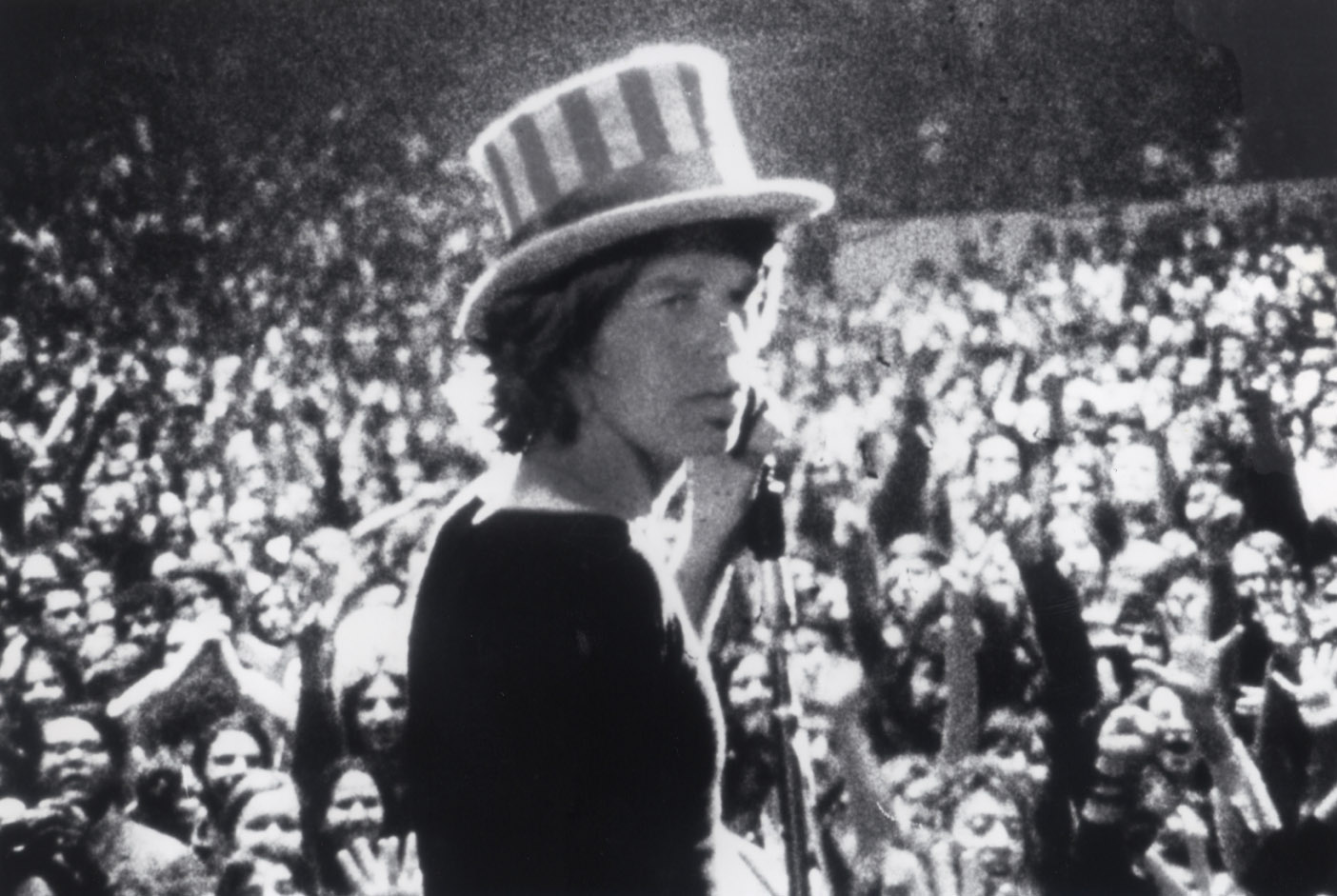
January 25th at 7:00 pm will feature a special screening of Gimme Shelter at the Revue Cinema. Due to the Revue’s inability to obtain the rights to Don’t Look Back, special guest Geoff Pevere will be interviewed by Richard Crouse as they discuss what many consider to be the most impactful music documentary ever produced. Geoff and Richard long-time friends and television co-hosts will discuss the history of rock music as a visual medium and Gimme Shelter’s role in that history.
Gimme Shelter
1970 91 mins
A harrowing documentary of the Stones’ 1969 tour, with much of the focus on the tragic concert at Altamont.
Called the greatest rock film ever made, this landmark documentary follows the Rolling Stones on their notorious 1969 U.S. tour. When three hundred thousand members of the Love Generation collided with a few dozen Hells Angels at San Francisco’s Altamont Speedway, Direct Cinema pioneers David and Albert Maysles and Charlotte Zwerin were there to immortalize on film the bloody slash that transformed a decade’s dreams into disillusionment.
Geoff Pevere is one of Canada’s leading pop culture commentators and movie critics. Geoff was a former host of CBC Radio’s Prime Time program, a movie critic with the Toronto Star for ten years, a TV host and a lecturer on film and media and is currently a movie columnist with the Globe and Mail. He is the co-author of the national bestseller Mondo Canuck: A Canadian Pop Culture Odyssey, his books include Toronto on Film and Donald Shebib’s Goin’ Down the Road, his latest book is Gods of the Hammer – The Teenage Head Story.
Geoff will be signing copies of Gods of the Hammer! If you don’t have your own copy you can pick one up at the Revue before and after the screening.
Alan Cumming’s new character was years in the making. In Strange Magic, a new musical fantasy from the mind of George Lucas, he plays the villainous leader of The Dark Forest, the Bog King.
“Some years you only do three days on it,” he said. “The gaps between when you perform it are so huge. You’re coming back to it with some familiarity but not that much because you might have recorded a song in a couple of hours that you’ve never known before and never hear again and six months go by and you have to go back and sing it again. It is a very interesting, drastic process doing a film like this.”
The toughest part, however, was not spilling the beans on what he was up to.
“You have to sign a confidentiality clause and it was very hush hush. I’d suddenly be going to LA and I’d see friends who’d ask, ‘What are you doing here?’ ‘I’m working on a top secret George Lucas project.’ ‘What is it?’ “I can’t say. It’s top secret.’ Early on I didn’t even know the proper story so I couldn’t have told it. It was quite nice having a secret.”
Inspired by A Midsummer Night’s Dream, Strange Magic is an animated jukebox musical set in a fairy world where you can never judge a book by its cover. Cumming’s character, with his glowing eyes and a skeleton that is more exo than endo, certainly embodies the movie’s message that beauty is only skin deep.
“You have to scare people but ultimately show that he has a nicer side to him.”
The release of the movie caps a busy period for the Scottish born actor. He’s currently on Broadway starring in the revival of Cabaret and can be seen on television in the Golden Globe nominated role of crisis manager Eli Gold on The Good Wife. Off stage, his memoir, Not My Father’s Son, was a recent New York Times bestseller.
“I don’t have many moments right now,” he says. “It’s been a very hectic time but I’m really enjoying stuff. I still am able to have fun. I have Club Cumming in my dressing room. I actually relax and have fun with friends there. It’s not ideal. I would love to have more days to do nothing but I think it is really important when you are really busy in your day to put some hours aside for revelry and relaxation.”
Sometimes clichés are clichés because they are true. No news is good news. A penny saved is a penny earned. Any publicity is good publicity.
No news is usually good news — unless you’re the editor of a newspaper with blank pages to fill — and the math behind a penny saved is a penny earned isn’t so hard to figure out, but recently the veracity of any publicity being good publicity has been put to the test.
The Sony hack and ensuing commotion that swirled around the Seth Rogen movie The Interview garnered headlines around the world, moving the story off the entertainment pages and into the news sections.
Stories, some true some not, and reviews, some good, some not, lit up social media.
The brouhaha surrounding the film lived at the very heart of popular culture for several weeks and even President Obama weighed in. But notwithstanding the endorsement of the most powerful film critic in the world, the movie is unlikely to actually make money.
The Guardian suggests The Interview’s total cost sits somewhere near $80 million in production and marketing costs, and at the time of this writing has only earned $36 million in digital rentals, purchases and traditional theatrical receipts. The Guardian also says Sony could be facing “damage north of $1 billion by some estimates” as a result of the hack.
So, if this was all a massive publicity stunt, as asserted by certain outspoken twitterratti, it was a marketing failure of Titanic proportions and it could even hurt the box office of other films.
This weekend Blackhat stars Chris Hemsworth as the world’s best-looking computer hacker, now serving a 15-year sentence for internet crime.
Authorities give him a get-out-of-jail-free card because he’s the only computer whiz on earth geekified enough to stop a cyber terrorist from causing havoc.
You might think a hacking movie would be perfectly timed to take advantage of the hoopla surrounding the Sony situation and yet Universal made no attempt to connect the dots between real-life events and their movie.
Why? The New York Times, quoting unnamed sources, opined that “ticket buyers could be tired of hacking stories after weeks of media attention on Sony, and a film that is too topical might strike potential viewers as less entertaining.”
Perhaps Universal’s decision not to cash in on the publicity generated by real life events reveals there is no room for current events in a marketplace where two of the top 10 grossing movies of 2014 were based on toy lines (the rest were inspired by novels and comic books) or maybe that sound we hear is the swoosh of an old cliché swirling down the bowl.
Have you ever wondered what happens to old, unfunny Vince Vaughn scripts? They become new unfunny Kevin Hart movies.
“The Wedding Ringer,” the story of a well-to-do but socially awkward guy (“Frozen’s” Josh Gad) who hires a professional best man (Hart) to fool his bride-to-be, is a decade-and-a-half old idea originally intended for “The Wedding Crasher” star.
That script was mercifully abandoned around the time of Y2K only to be resurrected, “Walking Dead” style in 2015 with a new star, but no new laughs.
Gad is Doug Harris. He’s a loner who never had any luck with women until he met Gretchen (“Big Bang Theory’s” Kaley Cuoco-Sweeting), a beautiful woman who loves his bank account as much as she loves him. They plan a big wedding, but as his parents are dead and he has no siblings, his side of the wedding party is nonexistent. With just a week before the big day he hires Jimmy Callahan (Hart) to pretend to be his best man and supply seven groomsmen.
“This is strictly a business relationship,” says Jimmy, “you’re not buying a best friend, you’re buying a best man.”
Of course, this is a bromance, so Doug is actually buying a best friend. As the odd couple careens toward learning the value of real friendship they have many adventures, including lighting Gretchen’s grandmother on fire and indulging in a little bestiality at an out-of-control bachelor party.
“The Wedding Ringer” is an R-rated comedy so lowbrow it makes Adam Sandler’s oeuvre look like Noel Coward. Gad, who became a star on Broadway in “The Book of Mormon” and a hero to kids as Olaf in “Frozen,” and Hart, who’s a gifted stand-up and comic actor, are better than this. In fact, everybody is better than this.
Gad pulls faces, does funny voices and falls through the furniture while Hart does double-speak and slapstick, but “The Wedding Ringer” is a Laugh Free Zone.
I know it’s meant to be a screwball comedy but in order for it to be truly funny as it works its way to the inevitable sentimental climax, it has to have at least one foot planted in reality. A dollop of real human behavior or a tangential link to some earthbound experience would have made these characters human, and relatable, and not simply cardboard cutouts with loud voices and bad judgment.
“The Wedding Ringer” leaves the jokes at the altar.