Ryan Reynolds has carved out a unique and profitable niche for himself on screen. The current king of the non-IP action comedy, he recently scored big hits with “Red Notice” and “Free Guy,” original movies not based on a comic book or existing videogame premise. This week, add to that list “The Adam Project,” a sci fi adventure flick now streaming on Netflix co-starring Mark Ruffalo and Jennifer Garner.
Adam Reed (Walker Scobell), a precocious thirteen-year-old living with his mother Ellie (Garner), is still stinging from the death of his father a year earlier. “Son, you need to think about your future,” Ellie says, “because it’s coming. Sooner than you think.”
In fact, it may have already arrived.
One day Adam finds a wounded fighter pilot hiding in his family’s garage. Turns out the stranger isn’t a stranger after all. He’s Adam (Reynolds) from the future; the grown-up version with a bullet hole in his side and a mission. “You’re me,” says the awestruck youngster. “That’s classified,” says older Adam, “but yes, I once was.”
The time traveller jumped back to 2022 to save the world, using information created by his late scientist father Louis (Ruffalo). To do complete the mission, he’ll need to jump back in time further, this time with young Adam at his side. First though, there is a time travelling villain (Catherine Keener) and the question of how to come to grips with the past while saving the future.
Time travel movies rarely ever make perfect sense, and “The Adam Project” is no different. Time may be a flat circle, and destined to repeat itself, but the cinematic machinations of jumping from year to year, of changing the past from the future, often make my head hurt and take me out of the story.
“The Adam Project” sneaks by, not because of its grasp of the paradox of theoretical physics, but because if the chemistry between Reynolds and his young co-star Scobell.
Reynolds, reunites with his “Free Guy” director Shawn Levy, brings his trademarked charisma and way with a joke, while Scobell, making his acting debut, is a natural foil. He is funny, charming and holds his own against Reynolds, arguably one of the best scene stealers in movies today.
They click and because they do, the movie works. The sci fi aspects of the story, the Stormtrooper-looking soldiers from the future or the noisy CGI climax, don’t make as much of an impression as the film’s heart and soul, the relations ship between the Adams and their father as they heal the wounds caused by their dad’s death.
“The Adam Project” threatens to allow the special effect fireworks to overshadow its story, but contains just enough heartwarming material to earn comparisons to the 1980s Amblin movies that were clearly an inspiration.
The new animated film from Laika, the folks behind beautiful stop motion movies like “Coraline,” “Paranorman” and “Kubo and the Two Strings,” is an odd couple, historical adventure that brings to mind “Raiders of the Lost Ark” and “Planes, Trains & Automobiles.”
Hugh Jackman voices Victorian-era explorer Sir Lionel Frost. Dressed head to toe in houndstooth, he’s an anthropologist of sorts, scouring the world in search of mythical beasts. He tries to lure the Loch Ness Monster with bagpipes. “They do say music soothes the savage beast.“
Despite his adventurous spirit his peers at London’s Optimates Club don’t take him seriously. Desperate to secure his legacy, he follows the lead of an anonymous letter about Bigfoot sightings in America. “He’s neither ape nor man,” he says, “but something in between.” If he can track down the elusive beast he hopes the snobby Lord Piggot-Dunceby (Stephen Fry) will be won over and offer membership into the exclusive club. Trouble is, Piggot-Dunceby is an old racist who doesn’t actually want progress in the form of new biological discoveries or anything else. “We have brought good table manners to savages of the world over,” he says proudly, “Now, they all tinker with changing the world and soon there will be no room left for me.” He’s so dead set against Frost’s mission he hires Stenk (Timothy Olyphant), an assassin to make sure the missing link goes unfound.
Meanwhile, it turns out the elusive Sasquatch (Zach Galifianakis) isn’t so elusive. The 8-foot-tall beast introduces himself almost as soon as Frost arrives in the Pacific Northwest. Mr. Link, as Frost calls him, can speak, has opposable thumbs and, most poignantly, is lonely. “Your world gets bigger every day as mine gets taken away.” He wrote the letter in hopes that Frost would “discover” him and escort him to his ancestral homeland, the Himalayan mountains, where he hopes to meet others like him, his long-long Yeti cousins. “I need someone who knows the wild places of the world,” he says. “Who won’t shoot me.” Together, along with Adelina Fortnight (Zoe Saldana), the widow of Frost’s ex-partner, they set off to Phileas Fogg-it around the world,
In search of adventure and Mr. Link’s long-lost relatives.
“Missing Link” is beautiful looking with the special animated feel that only comes with the stop motion technique. The visuals feel organic, handmade in a way that slicker, computer generated movies simply don’t. In fact, the visuals held my attention even when the story didn’t.
Woven into the script are timely messages about British colonialism, sometimes earnest—“The world,” says The Elder (Emma Thompson) to Frost, “is something to be claimed as a symbol of their worth.”—sometimes funny—they find Shangri-La or in the Yeti language, “Keep out, we hate you.”—that are timely and make a good argument for personal evolution. “Do we shape the world,” asks Frost, “or does the world shape us?”
It’s good stuff and Galifianakis’s Mr. Links is also a treat. An innocent with an imposing physical presence is a classic cartoon trope and with equal amounts of slapstick and poignancy, he livens up the proceedings. Galifianakis does great, understated voice work from the heartbroken—”I don’t want to have to spend the rest of my life alone. Won’t you take me there?”—to the hilarious—”Your utopia sucks!” It’s a wonderful performance that provides the movie with a great deal of heart.
Galifianakis aside, “Missing Link’s” over-all story misses the mark. Fight scenes make up much of the running time but (BIGTIME SPOILER ALERT) it’s Mr. Link’s assimilation into the human world that seems to run counter to the story’s overall anti-colonialist subtext. It puts a pretty bow on the tale and even sets it up for a sequel but makes absolutely no sense given the spirit of the film. Add to that a supporting role for a woman that isn’t quite as evolved as I‘m sure the filmmakers assumed and you have a film that will engage the eyes—it’s beautiful looking—but not the brain.
Guardians of the Galaxy Vol. 2 opens with a battle scene that would not be out of place in almost any other superhero movie.
The set-up has the Guardians — Peter Quill /Star-Lord (Chris Pratt), Gamora (Zoe Saldana), Drax the Destroyer (Dave Bautista) and Rocket (Bradley Cooper) — working for the Sovereigns, a thin-skinned race of aliens who have hired the heroes to protect valuable batteries from an inter-dimensional monster.
The action is as wild and woolly as we’ve come to expect from these big CGI extravaganzas, but the thing that sets the scene apart from all other superhero movies is the sheer, unbridled joy brought to the screen by Baby Groot (Vin Diesel), a tree-like being too small to take part in the fight. Instead he blissfully dances throughout to Mr. Blue Sky, the lush, Beatles-esque ELO song that underscores the sequence.
The scene and the movie brim with the missing element of so many other big superhero movies — fun.
“That’s what we hoped to do,” says star Michael Rooker, “bring back the fun. It was fun as hell doing it.”
Rooker reprises his role as blue-skinned, red-finned mercenary Yondu. The former Walking Dead actor — he played Daryl’s older brother Merle Dixon — jokes that his normal look, his handsomely craggy face, is actually make-up, and the Blue Man Group style we see in the movie is the face he was born with. “It takes four or five hours to get this on,” he says, pulling at his cheek. “The real problem is getting the fin off.”
Yondu’s weapon of choice is a flying arrow made of special sound-sensitive metal he controls through whistling.
“Dude,” he says, “everyone is digging that weapon.” It’s the character’s trademark and Rooker laughs when remembering talking to director James Gunn about the role. “Man, I was glad I was able to whistle.”
“The first time I got to whistle I did the melodic whistle… I hypnotized one of the aliens and then I shot out a piercing whistle. Yondu has different whistles.”
One wild action sequence with Yondu’s deadly arrow and set to ’70s pop ditty Come a Little Bit Closer is a showstopper, an imaginatively staged set piece with a huge body count and just as many laughs.
“That whole sequence is very much like a western gun fight if you think about it,” Rooker says. “You go out, and jacket pulled back, methodical, not fast. It is a total tribute.”
In the scene he is accompanied by two computer-generated characters, Baby Groot and Rocket, a genetically engineered raccoon-based bounty hunter. Neither actually appeared on set while shooting, but Rooker says they were there in spirit.
“Because these movies use a lot of CGI they require your imagination to be fertile and open and ripe for seeding,” he says. “I’m like, ‘There is Baby Groot. He’s over there and he’s sopping wet…What have they done to him?’ I talk to them like they were any other two characters.”
Yondu may be a vicious, arrow-wielding mercenary but he’s also the film’s emotional core and James Gunn says people will be “surprised by Michael Rooker’s performance. He deserves an Academy Award nomination. No joke.”
What does Rooker think? “We’ll see about that bro. I’m up for anything.”
“Guardians of the Galaxy Vol. 2” opens with a battle scene that would not be out of place in almost any other superhero movie. The set-up has the Guardians—Peter Quill / Star-Lord (Chris Pratt), Gamora (Zoe Saldana), Drax the Destroyer (Dave Bautista) and Rocket (Bradley Cooper)—working for the Sovereigns, a thin skinned race of aliens who have hired the heroes to protect valuable batteries from an inter-dimensional monster called the Abilisk. In exchange they will receive Gamora’s estranged sister Nebula (Karen Gillan).
It’s a lot of names and intrigue to keep straight right off the top. The action is as wild and woolly as we’ve come to expect from these big CGI extravaganzas, but the thing that sets the scene apart from all other superhero movies is the sheer, unbridled joy brought to the screen by Baby Groot (Vin Diesel), a tree-like being too small to take part in the fight. Instead he blissfully dances throughout to “Mr. Blue Sky,” the lush, Beatlesque ELO song that underscores the sequence.
The scene and the movie brims with the missing element of so many other big superhero movies—fun.
Anchoring the rock ‘em sock ‘em action is a subtext about family; you can choose your friends but you can’t choose your family. Gamora is bound by blood to a sister with an extreme case of sibling rivalry while Peter must choose between his birth father, a small ‘g’ god named Ego the Living Planet (Kurt Russell), his adopted dad Yondu (Michael Rooker) and his Guardian posse.
Set to a soundtrack of 70s radio hits and a cavalcade of pop culture references “Vol 2” is less story driven than the first film. With the origin tale out of the way it focuses on the characters and their relationships. Director James Gunn doesn’t allow the characters to become overwhelmed by the computer generated imagery. From Rocket’s wisecracks to Peter the semi-inept action hero and Gamora’s pragmatism—“If he does turn out to be evil will just kill him.”—the characters are front and center. Like the true scavengers they are, Drax—with Bautista’s deadpan delivery—and Baby Groot—“He’s too adorable to kill,” says Taserface (Chris Sullivan)—steal the show.
Fans will get what they expect—loads of goofy, gross and gooey cartoon action and cool Day-Glo creatures—but it’s the characters that make it so enjoyable. They spend as much time laughing as they do in action, bringing with them an infectious joyfulness. The movie is at it’s best when the characters are hanging out, when Peter finally gets to play catch with his dad with a ball made of pure energy, when Drax is ribbing Mantis (Pom Klementieff) or when Baby Groot is perched on the shoulders of his Guardian pals.
But Gunn also stages interesting action. The “Come a Little Bit Closer” sequence with Yondu’s deadly arrow is a showstopper, an imaginatively staged set piece with a huge body count and just as many laughs.
“Guardians of the Galaxy Vol. 2” is a mix of high-tech and lowbrow that breaks the sequel curse. It’s a tad too long, succumbs to CGI overload in its final moments and the not so subtle anti-bullying and free to be you and me messaging feels tacked on but is so much fun (there’s that word again) you’ll forgive its transgressions.
There will be a time when the “Guardian of the Galaxy’s” formula of 70s kitsch and wisecracks won’t work but we’re not there yet.
“Live By Night’s” stylish story of gangsters and redemption sees Ben Affleck reteam with crime writer Dennis Lehane. Their last collaboration, “Gone Baby Gone,” was a story of two detectives embroiled in a professional and personal crisis. This time around the personal and professional intermingle once again, but from the other side of the badge.
Affleck, who stars, directs and wrote the screenplay, is Joe Coughlin, the son of a Boston police captain (Brendan Gleeson) who returned from WWI an outlaw, determined not to take orders from anyone ever again. “No man shall rule another man’s life,” he says. A botched bank robbery lands him in jail, at a reduced sentence thanks to his father’s influence. Jail is a breeze, worse for him is his romantic involvement with flapper Emma Gould (Sienna Miller) who also happens to be the girlfriend of powerful Boston gangster Albert White (Robert Glenister).
Sprung from the lockup and beaten to a pulp by White’s men, Coughlin teams with Boston’s other gang boss, Maso Pescatore (Remo Girone). He’s sent to Ybor City, Florida with the task of taking over the lucrative prohibition bootleg booze business, currently run by White. To that end he leaves a trail of blood and bodies but when this demon rum purveyor tries to find a legitimate way to make cash by building a casino, a religious zealot (Elle Fanning) puts a crimp in his less-than-godly pursuits and interests.
“Live by Night” is a muted, sombre film punctuated by Baptists, bullets, broads and booze. Affleck creates a hard-boiled look at gangster life complete with corruption, betrayal and all the usual crime genre tropes but opens it up to include passion, family and redemption.
Coughlin is an interesting character, a man who coveted his amateur crook status and only turns pro—in other words, becomes a gangster—when he is painted into a corner. He’ll gun you down, but he’s no Scarface. Instead Affleck plays him as a stoic man who leads with his heart and only resorts to violence when all other options are exhausted. Later, when his legacy of violence comes back to haunt him, it packs a wallop.
There’s a lot going on in Ybor City. “Live By Night” tackles racism—the KKK plays a big role in the Florida section of the story—religion—thanks to Fanning’s troubled but angelic character—love—in the form of Graciella Corrales (Zoe Saldana)—loyalty and betrayal. It’s a literary stew of themes, held together by the violence and pulpier aspects of the movie.
Seven years ago director J.J. Abrams, the brains behind hit TV shows like Lost and movies like Star Wars: The Force Awakens, thought there was still some uncharted life to be found in the Star Trek universe.
This weekend the third film in his new generation of movies, Star Trek Beyond, puts phasers on stun. Directed by Fast & Furious director Justin Lin it continues Abrams’s mission to seek out new cinematic life and civilizations.
After five television series, ten movies, countless books, comics and video games, a stage version and even an Ice Capades style show Abrams re-launched the big screen Trek franchise. Simply called Star Trek, he took audiences where no man (or director) has gone before, back to the very beginning of the story before James Tiberius Kirk bore an uncanny resemblance to T.J. Hooker.
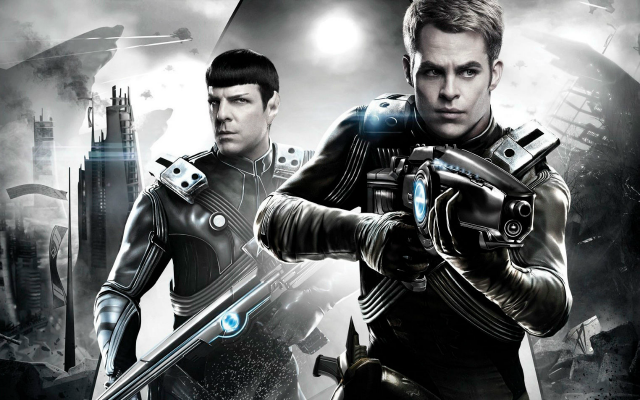
In this prequel to the original series Kirk (Chris Pine) and Spock (Zachary Quinto) are assigned to the maiden voyage of the most advanced starship ever created, the U.S.S. Enterprise under Captain Christopher Pike (Bruce Greenwood).
Star Trek was one of the great popcorn movies of 2009. Notice I didn’t say sci-fi movie. Star Trek is a lot of things but despite all the talk of warp speed, black holes and time travel, it can’t be strictly classified as science fiction. It’s a character based space serial more concerned with the burgeoning relationship between Spock and Kirk than with photon thrusters.
2013’s Star Trek: Into Darkness is a sequel AND a prequel (something so illogical Spock would never approve) that gets underway when an act of terror robs Kirk of a close friend. Determined to bring the perpetrator to justice the reckless Starfleet captain takes the Enterprise and crew to a war zone populated by Klingons and one brilliant and ruthless genetically engineered adversary (Benedict Cumberbatch). To finish his mission he must make difficult decisions.
Abrams finds a balance of old—Kirk, Spock et al—and new—the space suits are redesigned, the tech is different and there are younger characters—that should satisfy hard-core Trekkers and attract tenderfoot Trekkies. For fans there are in-jokes like Kirk telling two expendable members of the landing team to “lose the red shirts.”
At the beginning of Star Trek Beyond Kirk’s life on board the U.S.S. Enterprise has become a grind. He’s three years into a five-year mission and he is, personally lost in space, trying to find meaning in his mission. “It can be hard to feel grounded when even gravity isn’t real.”
Lin, taking over for Abrams, does his best to spice things up for the good captain. The director, best known for his Fast & Furious films, knows there is nothing like a wild alien attack to snap James T. out of his funk. Expect more hi-fly action than sci fi intrigue.
Star Trek Beyond producer Abrams admits he “didn’t love Kirk and Spock when I began this journey, but I love them now.” It seems the fans love his interpretation of the characters as well. Trekkers have embraced the new movies but Abrams knows the Star Trek universe is so vast it’s impossible to please everyone. Instead he says he caters to the average moviegoer “who just wants to be entertained, understand, and care about the world and the characters.” As Spock might say, “Sounds logical to me.”
At the beginning of “Star Trek Beyond” James Tiberius Kirk’s (Chris Pine) life on board the U.S.S. Enterprise has become a grind. Sure Sulu (John Cho) is gay and Ambassador Spock is dead, but Kirk is three years into a five-year mission and he is, personally lost in space, trying to find meaning in his mission. “It can be hard to feel grounded when even gravity isn’t real.”
Director Justin Lin, taking over the rebooted series from J.J. Abrams, does his best to spice things up for the good captain. The director, best known for his “Fast & Furious” films, knows there is nothing like a wild alien attack to snap James T. out of his funk.
Because the movie is pretty much an all-out action flick I’m not going to waste a lot of words describing the plot. Put it this way, there’s an artefact, a piece of a deadly old weapon that an ill-tempered villain named Krall (Idris Elba) desperately wants. Why? “To save you from yourself!” Kirk and the Enterprise crew don’t want the wrinkle-faced alien saving them from anything, particularly when every word out of Krall’s mouth sounds like it was lifted from Sun Tzu’s “The Art of War.” “Unity is not your strength,” he growls. “It is your weakness.” Couple that with the destruction of their beloved ship and they have more than enough reasons for Scotty (Simon Pegg) to jerry rig the warp drive, Bones (Karl Urban) to grumble and complain and Lieutenant Uhura (Zoe Saldana) to excitedly push buttons on her colourful control board.
Lin knows how to stage high-octane sequences, so the film bursts into frenetic action scenes every few minutes. Chekov (the late, great Anton Yelchin) plots a course through the stars and BOOM! action ensues. Spock may be inured but that won’t stop him from being at the center of maelstrom after crazy maelstrom. Lin doesn’t seem to know what to do with the characters, but he sure knows how to entertain the eye with gravity defying actions scenes.
As a result “Star Trek Beyond” doesn’t feel so much like a “Star Trek” movie as it does a sci fi action adventure with some familiar characters. Everyone you expect is present and accounted for—and there’s even tributes to the first generation TV Trek crew—but they are reduced to cartoons, spouting jokey platitudes and techno gobbledygook. Lin can’t decided what’s more important, the science or the fiction.
For all the talk of fighting humanity’s battles, this is the least human “Star Trek” yet. Purists may resent the vaguely detailed characters but those simply looking to have their eyeballs dance around the screen to expertly staged space carnage will find much fast and furious action.
When the first “Avengers” movie with the Hulk came out I asked Mark Ruffalo how tied he was to the franchise. He said he was signed on for a half dozens more films, but also understood the power of the kind of celebrity that comes from starring in blockbuster movies. That power trickles down and makes it possible to more easily raise money for smaller more interesting (my words, not his) projects.
“Infinitely Polar Bear” is one of those movies. Ruffalo stars in and is executive producer of this low budget indie film about Cameron, a manic-depressive man’s efforts to win back the affections of his wife Maggie (Zoe Saldana) and reunite his family.
Based on the real-life childhood experiences of writer-director Maya Forbes, the film shows, in heartbreaking and carefully observed detail, Cameron’s attempts to cope as he raises the couple’s two daughters (Imogene Wolodarsky and Ashley Aufderheide) while Maggie studies in New York.
Forbes has crafted a heartfelt and honest portrait of a loving man struggling to get by day-to-day. Ruffalo and Saldana hand in engaging, nuanced performances. They have chemistry to burn and their affection for one another pours off the screen. Both are from the Marvel Universe and both are using their stardom for good here, but it is Wolodarsky and Aufderheide as the daughters who give the movie its beating heart. Lovely, naturalistic performances ground the movie and prevent it from becoming simply a feel-good dramedy.
“Infinitely Polar Bear” might have had more depth if it spent less time on Cameron’s highest highs and more on his despair, but it’s agile enough to present a fully formed portrait not just of a manic depressive man but of a group of people trying to be a family.
This time around The Hulk used his superpowers for good.
What is it with Mexicans and death?” asks a youngster in the new kid flick from producer Guillermo Del Toro.
It’s a legit question in light of the content of a film that takes place in and around the Day of the Dead, a national bank holiday in Mexico. “Is that National Zombie Day?” asks the same kid.
No it isn’t. Instead its refreshingly dark but delightful story based on folklore with sumptuous visuals and good messages about family, fate and gender dynamics.
The story begins with a bet between spirits La Muerte (Kate del Castillo) and Xibalba (Ron Perlman) on who will win the heart of the beautiful Maria (Zoe Saldana), warrior Joaquin (Channing Tatum) or bullfighting musician Manolo (Diego Luna). The stakes are high. If she marries Joaquin the devious Xibalba will rule in the Land of the Remembered, while La Muerte will be banished to the Land of the Forgotten. As part of a double cross Manolo is plunged into the underworld, only to have to fight his way back to his hometown and the woman he loves.
“Finding Nemo” and “Bambi” aside, mortality is not a big topic in children’s movies. “Book of Life,” however, embraces it; weaving an entrancing story that toggles back-and-forth between the land of the living and dead. It celebrates the vibrancy of the Day of the Dead celebrations, complete with skeletons in dazzlingly costumes and a character with a disembodied head. “The Walking Dead” this ain’t.
For some children the demonic bulls and Xibalba’s grandly goth appearance might be the stuff of nightmares, but the fanciful creations are for the most part kid friendly in a “Nightmare Before Christmas” kind of way.
For parents the scariest thing about the movie may be the appropriation of songs by Mumford & Sons and Radiohead for a kid’s movie.
Director Jorge R. Gutierrez updates traditional mythology with modern storytelling, making sure that the movie moves along at the speed of light. It occasionally feels a bit too jam-packed, with a noisy finale that isn’t nearly as interesting or inventive as the unconventional stuff that came before it, but the pandering to predictability in the final moments doesn’t diminish “Book of Life’s” impact as a beautifully crafted fantasy.