I join CTV NewsChannel anchor Renee Rogers to talk about the new releases in theatres, including the bloody “Mortal Kombat II,” the family murder mystery “The Sheep Detectives” and the road trip “Omaha.”
Fast reviews for busy people! Watch as I review three movies in less time than it takes to make your bed. Have a look as I race against the clock to tell you about the bloody “Mortal Kombat II,” the family murder mystery “The Sheep Detectives” and the road trip “Omaha.”
SYNOPSIS: The sequel to the 2021 reboot, “Mortal Kombat II” sees the champions of Earthrealm forced to into battle to thwart the rule of Shao Kahn, emperor of the Outworld realm.
CAST: Karl Urban, Adeline Rudolph, Jessica McNamee, Josh Lawson, Ludi Lin, Mehcad Brooks, Tati Gabrielle, Lewis Tan, Damon Herriman, Chin Han, Tadanobu Asano, Joe Taslim, Hiroyuki Sanada. Directed by Simon McQuoid.
REVIEW: A mix-and-match of the videogame “Street Fighter II,” fantasy, and martial arts films like “Crouching Tiger, Hidden Dragon” and “Bloodsport,” “Mortal Kombat II” is action-packed, blood-soaked fan service that grabs the spirit of the games for the big screen.
The ultimate clash of the realms begins with the Mortal Kombat champions of Earthrealm—Cole Young (Lewis Tan), Liu Kang (Ludi Lin), Sonya Blade (Jessica McNamee), Jax (Mehcad Brooks), and Kano (Josh Lawson)—joined by Jean-Claude Van Damme wannabe Johnny Cage (Karl Urban) to fight in the Outworld Mortal Kombat tournament. “I got a Saturn Award for best fight scene in film,” Cage says, “so don’t mess with me.”
Determined to expand the realm of Outworld, Genghis Khan-style Emperor Shao Kahn (Martyn Ford) launches a campaign to conquer Earthrealm. “Earth belongs to me,” he says.
As alliances are formed and betrayals brew, the hammer-wielding villain triggers bloody, no-holds barred battles, forcing the Earthrealm warriors to defend their sovereignty. “I hope your ancestors are watching,” Kahn cackles.
There’s more. Way more.
There is an amulet that turns men into immortals, a zombie queen, a vengeance hungry royal daughter (Adeline Rudolph), giants with rows of external, razor-sharp teeth and loads of gushing plasma. Director Simon McQuoid, working from a script by Jeremy Slater, crams a lot of backstory, character work and snappy one-liners into the 116-minute runtime, but let’s be real, the narrative is just the stuff in between the fights.
It’s a simple story of good vs. evil, of a dark lord who craves power, immortality and territory and the heroes who fight back. It’s complicated by alliances and intrigue that nonfans may struggle with, but it’s not about the details. It’s about big IMAX action played out on a screen the size of a basketball court.
On that score “Mortal Kombat II” delivers what fans expect, big eye-popping mano-et-mano battle scenes colored with impossible wuxia style flying kicks and airborne leaps. It’s cool, stylized fight choreography that showcases the franchise’s debt to Hong Kong kung fu and martial arts films.
The cast is game, particularly Karl Urban, who brings some much-appreciated humor to the role of Johnny Cage, a self-described “dinosaur doing karate poses.” He refers to the tournaments as a “Squid Game murder party,” and feels it’s unfair that the others have special powers while, “I’m just incredibly handsome.” His presence breaks up the scenes of squirting plasma and helps establish the homage to New Line Cinema’s 1980s–90s action/horror movie era.
Based on the best of the OG games, “Mortal Kombat II” is a throwback, with brutal battles, to the games and the generation that produced them.
Taking a lead from “How to Train Your Dragon,“ and other movies were fearsome creatures reveal their kinder, gentler selves, “The Sea Beast,” a new animated movie now streaming on Netflix, gives the old “never judge a book by its cover” platitude a nautical twist.
Monster hunter Jacob Holland (Karl Urban) come by his job honestly. As a child his parents were killed in a sea monster attack, one that left him adrift, alone in the ocean. After his rescue by the fearsome Captain Crow (Jared Harris), he devoted his life to the eradication of the sea beasts. “I swore I would do everything I could to keep people safe,” he says.
The worst of the worst, the King Kong of sea beasts is the Red Bluster, a giant lobster-red creature, rumored to be a menace to seafaring society. When Holland and his crew set off in their ship, the Inevitable, to hunt down and kill the menace, they discover a stowaway. Young orphan named Maisie (Zaris-Angel Hator) lost her parents on a sea beast expedition, and she wants in on the action.
There is a lot at stake on this mission. The king and queen have threatened the monster hunters with dire punishment unless the beast is tamed. Maisie, Holland and the crew set off to vanquish the creature, but soon learn that there is more to the story than they could ever have imagined.
“The Sea Beast” has spectacular action sequences with well-crafted computer animation, a compelling story about finding family, and the usual kid movie messages about loyalty and the importance of role models, but what sets it apart is a more subversive idea.
At its heart this is a cautionary tale, a warning to never take things at face value, or blindly put your trust into accepted versions of history. History can be subjective, the movie suggests, depending the source. Are the sea beasts dangerous troublemakers, as king and queen claim? Or are they misunderstood creatures used by the rulers to instill fear and exert control over their subjects? Co-writers Chris Williams (who also directs) and Nell Benjamin have woven big ideas throughout the fabric of the story, encouraging kids to figure out things for themselves and not accept the conventional wisdom.
But don’t get me wrong, this isn’t some anti-imperialist, rebellious screed. It’s an action adventure with a conscience and some very cool “monsters” that kids will fall for at first sight. It slows down in the second half, but the combination of smarts and seafaring fun is a winner.
Over the course of six movies, Thor has been portrayed as a muscle-bound sex symbol; a larger-than-life hero with Shakespearean tendencies, but New Zealander Taika Waititi thinks he has fully realized the character’s potential.
“How do you get the audience to relate to superheroes?” asks Waititi, director of Thor: Ragnarok. “If you take all of them individually from these Marvel or DC movies, they’re very hard to relate to. I can’t relate to the Incredible Hulk other than I get angry sometimes. Thor is essentially a rich kid from outer space. I can’t relate to that so how do you bring them down to our level and give them our kind of problems? That was something we focused on quite heavily in this film even to the point where we have Hulk and Thor sitting on a bed after an argument talking about feelings. We humanized them a bit more and put them in situations we’ve all been in.
“We also took away his hammer and banished him across the universe. He’s really just trying to get home. We’ve all tried to get home at four in the morning, lost, wandering the streets. That’s what this is. We’ve basically made After Hours in space.”
Thor: Ragnarok’s plot sounds like it could be from any generic Avengers film — a world is at stake — but there is no other superhero movie that would see their champions escape through an interdimensional portal named The Devil’s Anus. Yes, there is serious subtext about genocide and displaced persons but thanks to Waititi this is the first Marvel movie to really value comedy over spectacle.
“I had to be respectful of the source material and where the film fit in with all the other things they are doing,” Waititi said. “My whole thing was to give my take on this film and try and make the best film I could whilst letting Marvel keep me in my lane, making sure I didn’t veer off too far to the left or right with their precious character.”
Waititi has remained true to the core of what fans will expect from the crown prince of Asgard as played by Chris Hemsworth, but this time around the Norse God is not exactly your father’s Thor.
“This is a way more colourful and vibrant take on the character and the kind of adventures he has,” the director says. “We borrowed a lot of that design from the great artist Jack Kirby. So right from the start we pulled away from that desaturated, dark style from a lot of other superhero movies. We’re being unapologetic about wanting for this to be a fun adventure through the cosmos and filling it with incredible characters and monsters. It feels like this film was made by six-year-olds. I don’t know if there is any colour left that we haven’t either put into the poster or into the movie.”
Thor: Ragnarok is the Oscar-nominated filmmaker’s first Hollywood movie. He’s best known for oddball work like Boy, Hunt for the Wilderpeople and the horror comedy What We Do in the Shadows, but says his Marvel film shares the same DNA as his smaller movies.
“I definitely feel like this is a Taika Waititi film,” he says. “It could live comfortably in the box set.”
Depending on which side of the interdimensional divide you sit on, superhero movies are either the best thing to happen to Hollywood since the invention of buttered popcorn or the worst thing to happen to film since Steven Seagal.
Before we decide if The Hulk et al are ruining Hollywood, let’s define what a superhero movie is.
This weekend’s Thor: Ragnarok is most definitely a superhero film. It features characters with godlike abilities dedicated to protecting the public from archenemies.
Most superhero flicks — a genre David Fincher refers to as “spandex, blockbuster tentpoles” — whether they are comedic outer-space operas like Guardians Of The Galaxy or heist flicks like Ant-Man, are bound by straightforward morality and the idea that good always prevails over evil.
“It’s a very delicate time right now on Earth,” said Man Of Steel’s Michael Shannon, “and there’s a lot going on that is pretty frightening. It would be nice to believe or think that there was somebody that could protect us from that.”
Director James Wan adds, “All the good superheroes have some kind of social commentary about why they are who they are. It teaches values and so it’s a very important thing.”
The studios — with Marvel leading the charge — have raked in billions of dollars peddling bigger-than-life movies to fan boys and girls but are they self-defeating? Are Batman and Wolverine really ruining the movie business?
Oscar winner William Friedkin thinks so. “Films used to be rooted in gravity. They were about real people doing real things. Today cinema in America is all about Batman, Superman, Iron Man, Avengers, Hunger Games: all kinds of stuff that I have no interest in seeing at all.”
Marvel Cinematic Universe architect Kevin Feige, the man largely responsible for the influx of cinematic superheroes, disagrees. “If you look through the decades of people who’ve been accused of that — Star Wars ruined Hollywood, Steven Spielberg ruined Hollywood —I’ll be in that company any day of the week.”
That’s a flippant answer to a hotly debated and complicated question. At the heart of the discussion is the notion that bigger is always better. Does Hollywood’s love of bombast come at the expense of new ideas? Has the sheer scale of Avengers and Company movies made studios greedy, interested only in brands that will gross hundreds of millions. Why spend $5 million to gross $25 million, the theory goes, when you can spend $180 million on an established brand and make $1 billion?
Others worry that the episodic, homogenous nature of continuing superhero storylines aren’t challenging.
The truth is Wonder Woman and Friends haven’t sucked all the oxygen out of the room. The superhero bubble exists but the commercial and artistic success of movies like Get Out and Colossal balances out the equation. Superheroes may provide bang for the buck but smaller, original films are coming back into vogue.
The world of cinema is a big place. There’s room for both Thor: Ragnarok and The Florida Project. The fact we’re seeing a renaissance of small films playing alongside their risky bigger budget cousins like Dunkirk, signals studios walking back on their commitment to only making astronomically priced superhero movies.
So superheroes haven’t ruined Hollywood. They may be popular now but as Feige says, “As soon as there are a bunch of them that are terrible, that’s when it will end.”
“Darling, you have no idea what is possible.” So says Hela (Cate Blanchett), Thor’s Goddess of Death sister.
She’s a piece of work who thinks nothing of drowning a whole race of people in their own blood to get what she wants, but she has a point. Up until this point no one really knew what was possible with the Thor (Chris Hemsworth) character. Over the course of six movies we’ve seen the crown prince of Asgard as a larger-than-life hero with Shakespearean tendencies and a muscle-bound sex symbol but it took director New Zealand director Taika Waititi to fully realize the character’s potential. Thor has always been quick with a line, but this time around Waititi puts the comedy upfront.
The plot of “Thor Ragnarok” is less interesting than its tone. In a nutshell Thor’s sister, the hella-deadly Hela is back from exile and with Odin (Anthony Hopkins) out of the way, is first in line for the throne of Asgard. She, equipped with an impressive set of black antlers and ruthless nature, plans to go Ragnarok on the citizens of Asgard to fulfill her appetite for destruction.
After some tomfoolery with giant demon Surtur (Clancy Brown)—“Oh, that’s your crown,” Thor purrs. “I thought it was a big eyebrow.”—Thor returns to Asgard, reunites with mischievous brother Loki (Tom Hiddleston) before literally locking horns with Hela and hurled through space and into the hands of the quirky Grandmaster (Jeff Goldblum), a colourfully dressed ruler who offs people with his dreaded Melt Stick and pits the Norse god against his old friend Hulk (Mark Ruffalo) in a gladiatorial match. With Asgard at stake Thor recruits the giant green world breaker and a warrior Valkyrie (Tessa Thompson) to save his planet.
That sounds like it could be the plot from any generic Avengers film—a world is at stake—but there is no other superhero movie that would see their champions escape through an interdimensional portal named The Devil’s Anus. Yes, there is serious subtext about genocide and displaced persons—we hear Led Zep’s “Immigrant Song” twice—but this is the first Marvel movie to value comedy over spectacle. The trademarked Marvel blockbuster action is still there but the gags carry the show.
Certainly “Thor: Ragnarok” is the polar opposite of rival DC’s dark universe but even in its own house, the Marvel Cinematic Universe, it’s a breath of fresh air. Seventeen movies in Marvel has taken a chance, handing the reins over to an idiosyncratic helmer. Waititi’s (who also plays a talkative Groot-like gladiator named Korg) first big studio movie after whimsical indies the adventure comedy “Hunt for the Wilderpeople” feels as close to an auteur film as we’re likely to see in this genre. He brings a zippy sense of fun that showcases Hemsworth’s comedy chops.
Like the rest of the Avengers movies “Thor: Ragnarok” is a tad long and, near the end is overrun by creatures and CGI. Some will complain that the glib tone completely overrides the film’s serious side but the gags and the home-is-where-the-heart-is message make this one of the most human and humane MCU movies yet.
“Pete’s Dragon” is a reboot of a much-loved 1977 Disney musical starring Helen Reddy as the kind-hearted daughter of a lighthouse keeper who adopts Pete, a young boy whose best friend is a dragon named Elliot. Pete and the dragon are back but the songs and Helen Reddy are gone, replaced by Bryce Dallas Howard and an updated look at the story.
Wood carver Mr. Meacham (Robert Redford) likes to tell tale tales about a dragon who lives nearby in the woods of the Pacific Northwest. But are they really tall tales? His daughter, forest ranger Grace (Howard), thinks they are until she meets Pete (Oakes Fegley), a feral 10-year-old mystery boy who says he has survived, solo, in the woods for six years. “Nobody can survive in a forest for six years,” says Mr. Meacham, “at least not alone.” “He says he wasn’t alone,” replies Grace.
Seems Pete’s story echoes the tales Mr. Meacham has been telling about a giant, furry green dragon. The boy says the beast’s name is Elliott (voice of John Kassir). “I need to get back to him,” says Pete. “He gets scared when he’s alone.”
Rather then turn the boy over to Social Services Grace decides to discover if Elliot is real or figment of her father and Pete’s imaginations. “I know these words like I know the back of my hand,” she says. “I couldn’t have missed a dragon.” “Well, you missed Pete,” says her dad.
She enlists the help of her father and Natalie (Oona Laurence), the daughter of Jack (Wes Bentley), the local lumber mill owner. Complicating her search is Jack’s aggressive brother Gavin (Karl Urban) who thinks the dragon is dangerous and plans on capturing it. “Going to go catch a dragon,” he says in a note to his brother.
There be dragons in “Pete’s Dragons,” but “Game of Thrones” this ain’t. As subtle and underplayed as a movie about a dragon can be, the movie is so gentle even the death of Pete’s parents is handled with kid gloves. Instead of wowing the audience with action director David Lowery aims for the heart and hits a bull’s-eye.
The touching story of a boy and his dragon is actually about family and where you find it. The snaggletooth dragon is Pete’s adopted father, a playful gentle giant—he large enough to cover the entire flatbed of an 18 wheeler—who purrs like a kitten and chases his own tail but is fiercely protective of the young boy. It’s a familiar theme in Disney films but Lowery knows that sometimes clichés are clichés because they’re true. He establishes the relationship between Pete and Elliott early on and it is at the heart of the story.
“Pete’s Dragon” feels somewhat old fashioned, harkening back to a time when kid’s movies didn’t contain an ounce of cynicism. This is a simply told story that succeeds because it boils the fanciful tale down to its basics, the power of belief, relationships and friendship… and tops it all off with a cool dragon.
Seven years ago director J.J. Abrams, the brains behind hit TV shows like Lost and movies like Star Wars: The Force Awakens, thought there was still some uncharted life to be found in the Star Trek universe.
This weekend the third film in his new generation of movies, Star Trek Beyond, puts phasers on stun. Directed by Fast & Furious director Justin Lin it continues Abrams’s mission to seek out new cinematic life and civilizations.
After five television series, ten movies, countless books, comics and video games, a stage version and even an Ice Capades style show Abrams re-launched the big screen Trek franchise. Simply called Star Trek, he took audiences where no man (or director) has gone before, back to the very beginning of the story before James Tiberius Kirk bore an uncanny resemblance to T.J. Hooker.
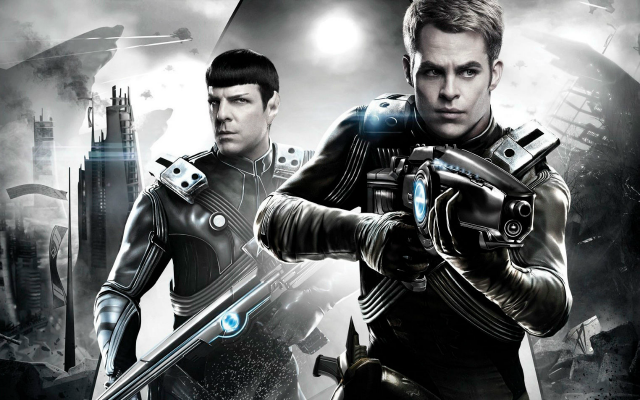
In this prequel to the original series Kirk (Chris Pine) and Spock (Zachary Quinto) are assigned to the maiden voyage of the most advanced starship ever created, the U.S.S. Enterprise under Captain Christopher Pike (Bruce Greenwood).
Star Trek was one of the great popcorn movies of 2009. Notice I didn’t say sci-fi movie. Star Trek is a lot of things but despite all the talk of warp speed, black holes and time travel, it can’t be strictly classified as science fiction. It’s a character based space serial more concerned with the burgeoning relationship between Spock and Kirk than with photon thrusters.
2013’s Star Trek: Into Darkness is a sequel AND a prequel (something so illogical Spock would never approve) that gets underway when an act of terror robs Kirk of a close friend. Determined to bring the perpetrator to justice the reckless Starfleet captain takes the Enterprise and crew to a war zone populated by Klingons and one brilliant and ruthless genetically engineered adversary (Benedict Cumberbatch). To finish his mission he must make difficult decisions.
Abrams finds a balance of old—Kirk, Spock et al—and new—the space suits are redesigned, the tech is different and there are younger characters—that should satisfy hard-core Trekkers and attract tenderfoot Trekkies. For fans there are in-jokes like Kirk telling two expendable members of the landing team to “lose the red shirts.”
At the beginning of Star Trek Beyond Kirk’s life on board the U.S.S. Enterprise has become a grind. He’s three years into a five-year mission and he is, personally lost in space, trying to find meaning in his mission. “It can be hard to feel grounded when even gravity isn’t real.”
Lin, taking over for Abrams, does his best to spice things up for the good captain. The director, best known for his Fast & Furious films, knows there is nothing like a wild alien attack to snap James T. out of his funk. Expect more hi-fly action than sci fi intrigue.
Star Trek Beyond producer Abrams admits he “didn’t love Kirk and Spock when I began this journey, but I love them now.” It seems the fans love his interpretation of the characters as well. Trekkers have embraced the new movies but Abrams knows the Star Trek universe is so vast it’s impossible to please everyone. Instead he says he caters to the average moviegoer “who just wants to be entertained, understand, and care about the world and the characters.” As Spock might say, “Sounds logical to me.”