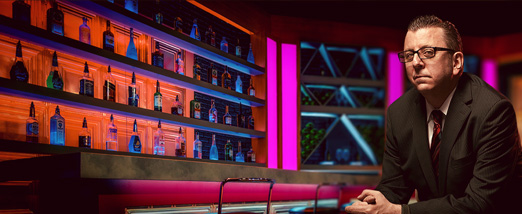
SYNOPSIS: In “Caught Stealing,” a new dark comedy from director Darren Aronofsky, and now playing in theatres, Austin Butler plays Hank, a bartender whose life is turned upside down when he agrees to look after his neighbor’s cat. Drawn into the soft underbelly of 1990s era New York City, Hank finds himself fighting for his life (and the cat’s well-being) at the hands of various gangsters who believe he has something they want. “These guys you’re messed up with,” says Detective Roman (Regina King), “they’re scary monsters.”
CAST: Austin Butler, Regina King, Zoë Kravitz, Matt Smith, Liev Schreiber, Vincent D’Onofrio, Griffin Dunne, Bad Bunny, Carol Kane. Directed by Darren Aronofsky.
REVIEW: “Caught Stealing” is a departure for director Darren Aronofsky. His movies have essayed everything from addiction and apocalypses to isolation and psychological turmoil, and while many of them, like “Black Swan,” “The Wrestler,” “The Whale,” and “Requiem for a Dream,” have been critical and commercial hits, they haven’t been what you would call crowd-pleasers.
His latest film, “Caught Stealing,” starring Austin Butler as a bartender who gets drawn into the criminal underworld of Giuliani-era New York, however, is a crowd-pleaser, but only in the most Aronofsky-esque of ways.
A violent, dark comedy that plays like a cross between Guy Ritchie’s quirky criminal dramas and the Kafkaesque absurdity of “After Hours,” “Caught Stealing” is an adrenalized, twisty trip typical of the genre, but seen through Aronofsky’s edgy lens.
Hank, the charming bartender played by Butler, is not your genre typical everyman who gets in over his head. Aronofsky and screenwriter Charlie Huston, who adapted his own 2004 novel, give Hank layers. He’s a wild child who dances on pool tables and greets the day with a Miller Light. Tormented by nightmares of an alcohol fueled accident that took the life of his best friend, he repeatedly wakes up in a sweat. As his situation spirals out of control his survival is driven by a mix of fear and desperation.
So, he’s the hero, but in true Aronofsky fashion, he’s a morally ambiguous one whose quest for survival comes with a high body count and a trail of destruction. He may not be as relatable as “After Hours’” Paul Hackett, played by Griffin Dunne, who makes an appearance here as coke snorting dive bar owner Paul, but the charismatic Butler keeps him compelling with a combo of vulnerability and steeliness.
Aronofsky populates the rest of the story with a variety of colorful characters, like observant-but-deadly Jewish mobsters Lipa and Shmully (Liev Schreiber and Vincent D’Onofrio), a throwback punk rocker (Matt Smith), gangster Colorado (Benito Antonio Martínez Ocasio, better known as Bad Bunny) and no-nonsense cop Elise Roman (Regina King), but this is Butler’s show.
“Caught Stealing” has the character complexity of an Aronofsky film, but it’s way more fun than he usually has on screen.
SYNOPSIS: In “Blink Twice,” a psychological drama directed by Zoë Kravitz, and now playing in theatres, disgraced tech billionaire Slater King (Channing Tatum) invites cater waiter Frida (Naomi Ackie) to join him and his friends for an idyllic get-a-way on his private island. “Are you having a good time?” he repeatedly asks her as champagne flows, and she is… until, in the blink of an eye, she has a startling revelation.
CAST: Naomi Ackie, Channing Tatum, Christian Slater, Simon Rex, Adria Arjona, Haley Joel Osment, Kyle MacLachlan, Geena Davis, Alia Shawkat. Directed by Zoë Kravitz.
REVIEW: A dark psychological thriller with elements of rage, humour and danger, “Blink Twice” is a confident, if scattered, directorial debut from Zoë Kravitz. A violent riff on “Eternal Sunshine of the Spotless Mind’s” memory erasing, it asks the question, Is it best to live with only good memories, burying the bad so deeply they never resurface?
A fantasy island trip gone wrong, “Blink Twice” takes a while to get where it is going, to let the Twilight Zone-ness of the situation sink in. It’s decadent and drug fueled, set to a soundtrack of dance tunes and King’s constant query, “Are you having fun?” Nothing matters except hedonism, and soon (NO SPOILERS HERE), but not soon enough, we find out why.
At this point “Blink Twice” flicks the switch. What begans as Jordan Peele style exploration of the ultra-wealthy, of the lingering, intergenerational effects of trauma and violence against women, becomes a revenge drama tinged with horror. After a long lead up, however, the transition feels rushed as the true cruelty of the party island, and the men who run it, is revealed.
Kravitz and co-writer E.T. Feigenbaum have a lot on their minds, but more isn’t always better. From the apology tours of cancelled celebrities and sexual violence against women to the price of trauma, white patriarchal privilege and gender disparity, it touches down on a litany of hot button topics. Add to that a private island with a Jeffrey Epstein vibe and a misbehaving billionaire and you have an overload of Twitter/X trending topics. With so much happening, “Blink Twice” feels like it is hop-scotching around its themes and doesn’t add much new to the discourse of any of them.
Still, as tightly packed as the movie is—no shrinkflation here—Kravitz keeps the pace up, nimbly navigating her way through to the film’s finale with style to burn. The direction trumps the storytelling, as Kravitz knows how to stage effective scenes that will entertain the eye and, perhaps even move you toward the edge of your seat.
She is aided by strong performances from the three leads, Ackie, Tatum and “Hit Man’s” Adria Arjona. Tatum is all charm as the romantic lead (for a while anyway) before revealing his true nature in a terrific turn-around for the character.
Ackie and Arjona enjoy the best-written roles and make the most of them. As Frida, Ackie (last seen playing the title role in “Whitney Houston: I Wanna Dance with Somebody”) is relatable as someone who finds themself in an unimaginable situation, before tapping into a newfound iron will.
Arjona takes a role that could have been one-note—a reality show warrior with her eye on the billionaire’s affections—and makes her multi-faceted, kick-ass and very funny.
“Blink Twice” doesn’t entirely work, but as a story about the nature of memory, it is memorable enough to earn a recommendation.
On some level Batman has always been escapist entertainment. The comics, TV shows and movies have always tackled big topics like morality, vengeance and the razor’s edge between anarchy and order but between Adam West’s grin, Michael Keaton’s gadgets and Christian Bale’s colorful foes, escapism is always part of the mix.
“The Batman,” starring Robert Pattison as the Caped Crusader, and now playing in theatres, is three hours of entertaining Bataction but the real-world themes of distrust in elected officials, our constitutions and each other, provide anything but escapism.
The story begins on Halloween night, as costumed criminals swarm Gotham City. As chaos reigns on the streets, the Bat-Signal illuminates the sky. “When the light hits the sky it’s not just a beacon,” says Batman (Pattison), “it’s a warning… to them. Fear is a tool.”
It’s a tool Batman uses effectively. His masked presence, his fists of fury and habit of snarling, “I’m vengeance,” have made him a fearsome presence in Gotham City. The rank-and-file police don’t know what to make of the Caped Crusader, but Detective James Gordon (Jeffrey Wright) sees him as an asset, particularly when high ranking city officials begin dying at the hands of The Riddler (Paul Dano), a psychopath whose costume suggests he is a fan of the Gimp from “Pulp Fiction.”
At each grisly murder the Riddler leaves behind a cutesy card for Batman, inscribed with a riddle, like “What does a liar do when he dies?” that could serve as a clue to solve the crime.
As the evidence, and the bodies, pile up, Batman’s investigation leads him to a wide-ranging conspiracy involving a local crime boss (John Turturro), his minion Oswald Cobblepot a.k.a. The Penguin (Colin Farrell doing a pretty good impression of James Gandolfini), a long-held Wayne family secret and nightclub worker and cat burglar Selina Kyle a.k.a. Catwoman (Zoë Kravitz).
“The Batman’s” almost three-hour running time may seem daunting, particularly in the wake of several overly long superhero movies that haven’t delivered the goods. I’m happy to report that director Matt Reeves has crafted a movie that flies by in the bat of an eye.
This is not an origin story, that tale has been told over and over. It is more of a coming-of-age tale. As played by Pattison, Bruce Wayne is a dour and sour hero who, when asked, “Are you hideously scarred?” replies “Yeah.” His scars, however, are all on the inside.
He is driven by a sense of vengeance to clean up the streets of the kind of people who killed his parents. That, he says, is his legacy, not the fabulously wealth of Wayne Enterprises. As the story progresses his mood doesn’t change—it’s as if Pattison’s perfect cheekbones would shatter if he ever cracks a smile—but his outlook does. Batman may be the face of vengeance, but by the time the end credits roll, he realizes hope trumps vengeance. “People need hope,” he says. “To know someone is out there for them. The city is angry. The city won’t change, but I have to try.”
After five “Twilight” movies Pattison understands how to brood on screen. He is comfortable with the stillness the character requires, which works well to emphasize the Batman’s loner status. The stillness of the character, when he isn’t running, jumping or jackhammering a bad guy, suggests a calm but that sense is betrayed by the simmering rage behind Pattison’s eyes. It is that anger that gives him an unspoken reason to exist.
This is a Batman who is still figuring things out, who is fueled by his single-minded need for revenge, but working to funnel his energies in a way that will benefit him, the people he loves and Gotham City. He doesn’t have superpowers, just a powerful drive and a handful of gadgets. He’s a one-man army, and Pattison does a good job of showing us, not telling us, the complexity of the character.
Director Reeves has stripped away much of the slickness of the Christopher Nolan and Zack Snyder films in favor of a grittier vision. Think 1970s movies like “Chinatown,” “The French Connection” or “Taxi Driver.” Reeves has made a boiled down detective noir that scales back the theatrics of previous versions to concentrate on the personal stuff.
But that doesn’t mean there isn’t action to spare. The new Batmobile, now a muscle car, makes its debut in a wild car chase and Pattison’s Batman doesn’t kill people, unlike Affleck’s take on the character, but that doesn’t mean he isn’t willing to pummel the heck out of his adversaries.
“The Batman” is an interesting new direction for the Caped Crusader movies. There have been better villains in other films and the sins of the father angle has been explored before, but this movie captures the zeitgeist in a very interesting way. It confronts hot button topics like the alt right, agents of chaos and lying politicians, issues ripped from the headlines, but is tempered with a message of hope, of rebuilding belief in the world around us.
I suppose every generation gets the Batman they deserve. Our hard knock world has delivered us a Batman with an edge; a troubled hero who almost succumbs to his worst tendencies, but, in the end, looks toward a horizon of hope. It’s a powerful message for our world gone mad, particularly when it comes from a guy in a mask.
If you already know what a ‘magizoologist’ is you’re likely a fan of J.K. Rowling’s wizarding world. If not, you’ve got some catching up to do before buying ticket to the second instalment of the Harry Potter spin-off “Fantastic Beasts: The Crimes Of Grindelwald.”
When we last saw magizoologist Newt Scamander (Eddie Redmayne) he temporarily put aside his study of magical creatures to travel to New York City and help MACUSA (Magical Congress of the United States of America) bring the powerful Dark wizard Gellert Grindelwald (Johnny Depp) to justice.
The story picks up as Grindelwald escapes. Like all good villains he craves world dominance, but only on his own terms. He believes in wizarding superiority and sets in motion a plan to lead a new Wizarding Order of pure-blood wizards who will rule over all non-magical beings.
Enter Albus Dumbledore (Jude Law), professor of Transfiguration at Hogwarts School of Witchcraft and Wizardry and an influential member of the British Ministry of Magic. To stop Grindelwald’s diabolical plot Dumbledore contacts Scamander, a confidante and former student.
The film based on the second original screenplay from J.K. Rowling is more fantastical than magical. There are all manner of creatures and wizard’s tricks that could only have sprung from her fertile imagination but there is very little actual cinema magic. Sure Potter fans will love seeing Hogwarts and a glimpse of Quidditch again but that is nostalgia, and Alison Sudol’s Judy Holliday impression is as winning as it was the first time out but overall “The Crimes Of Grindelwald” feels like a placeholder for the films yet to come.
Non-Potter-heads will likely be confused by the barrage of names, the myriad of subplots and a deadly scene about the family tree of Credence Barebone (Ezra Miller) that gives the word convoluted a whole new meaning. Part of the joy of the Rowling’s story weaving in the Potter series was its depth and complexity. Here it feels as though she’s being paid not by the word but by the character.
When director David Yates isn’t bathing the screen with blue digital flames and the like there are things to admire. The set and costume design are spectacular, appropriate for both the 1920s setting and the otherworldly characters. Also interesting are the messages, both timeless—the search for identity—and timely—unity, fear mongering and freedom through force—provide subtext that is more interesting than the actual story.
Ultimately “Fantastic Beasts: The Crimes Of Grindelwald,” despite its grand face, feels thin, over written and under dramatic.
To describe “Rough Night,” a new ensemble comedy starring Scarlett Johansson, Zoë Kravitz, Kate McKinnon, Jillian Bell and Ilana Glazer, as a comedy of errors makes it sound more genteel than it actually is. Deadly mistakes are made on this weekend bachelorette party getaway and there is loads of comedy but there is nothing genteel about this dark and debauched movie.
Johansson is Jess, an A-Type candidate for state senate and bride-to-be. When her former college roommates (and fellow beer-pong champions) arrange a weekend in Miami she’s hoping for a quiet, dignified affair. Her friends Alice (Bell), Blair (Kravitz), Frankie (Glazer) and Pippa (McKinnon) Jess’s Australian friend from a semester abroad, have different ideas; ideas that include foam parties, booze and male strippers.
The trouble starts early when Frankie uncorks a bottle of champagne at the airport and the pop, mistaken for a gunshot, causes panic. Checking into their swanky beach house (courtesy of Jess’s biggest and only campaign donors) they get the party started. Adding to the loose atmosphere are the swingers (Demi Moore and Ty Burrell) in the house next door. “This weekend is all about us,” says Jess, “just like old times.” And it is like old times, with camaraderie, laughs and plenty of booze and drugs until Alice accidentally kills the male stripper they hired as entertainment. “It really is a tragedy,” says Pippa, “he could have been a scientist and cured cancer.”
Aspiring politician Jess immediately kicks into survival mode, engaging in the great political pastime, the cover-up. “I know things are crazy right now,” she says, “but you’re going to have a lot of material for my wedding speeches.”
“Rough Night” breathes the same air as other big, raunchy ensemble movies like “Very Bad Things,” “How to be Single,” “The Night Before” and “The Hangover.” It embraces its wild side, adds a dollop of “Weekend at Bernie’s” to take advantage of its star power and push the envelope.
The first half hour plays like a naughty comedy, giddy with the promise of a raunchy good time. The tone changes abruptly as the body lies in a crimson puddle set against the stark white tile floor. There are still laughs but they come from a different place, a nasty place that takes some of the air out of this comedy balloon. It never quite gets to the level of inspired lunacy that “Bridesmaids” found so effortlessly because it doesn’t have the same kind of heart.
It does, however, have several fun moments, both before and after the death, most courtesy of McKinnon, Bell and Paul W. Downs who plays Jess’s nice-guy fiancée Peter.
McKinnon brings a wonky Australian accent and her trademark off kilter presence to the role of the best friend from far away. She plays Pippa like a visitor from Mars not Australia, someone who tries to fit in even though she’s unfamiliar with the ways of the rest of society.
Bell, who has shone in small roles in movies like “Fist Fight,” “22 Jump Street” and “The Night Before” is given a chance to strut her stuff here. She plays Alice as the kind of loose canon who throws up on the bar and nonchalantly says, “It smells like barf here. Let’s get outta here.” She’s the comedic engine who keeps the movie from succumbing to its dark side.
It would be a spoiler to describe Downs’ contribution to the goings on. Suffice to say, it involves Red Bull, gymnastics, adult diapers and a sweet disposition.
“Rough Night” has laughs but they are mostly derived from an unpleasant situation. It’s fun to see how the dynamics of the college friends manifest under stressful circumstances but the strain they feel mirrors the strain the movie feels trying to find a consistent, funny tone.
Where have all the movie stars gone? Once upon a time big names on even bigger marquees were as close to a guarantee of good box office as one gets in the movie biz, but no more.
This weekend The Divergent Series: Allegiant, the third part of the young adult series, hit theatres. Based on a series of successful books, it stars Shailene Woodley and Theo James in a teen epic about dystopia, guilt and artfully tossed pixie haircuts. In the new film the pair risk it all to go beyond the walls of their shattered city to discover the truth about their troubled world.
Woodley and James are appealing performers and despite having chiselled cheekbones, a Golden Globe nomination and a Teen Choice Award for Choice Movie: Liplock between them no one is going to see Allegiant because they’re in it. Why? Because they’re not movie stars, they’re brand ambassadors. The movie’s brand is bigger than they are and that’s the draw.
Young adult movies like Twilight made Robert Pattinson and Kristen Stewart famous and superhero films reignited Robert Downey Jr.’s career and turned Chris Hemsworth into a sex symbol, but none of these actors have scored recent hits outside of their best-known brands.
These days the marketing is more important than the movie star.
It’s almost a throwback to the very early days of cinema when actors weren’t given billing or publicized for the films they made. Fearing performers would demand larger paycheques if they became popular the studios gave them nicknames instead. Hamilton, Ontario born Florence Lawrence was known as the Biograph Girl, named after the studio that produced her films, but with the release of The Broken Oath in 1910 became the first entertainer to have her name appear in the credits of a film.
Floodgates opened, soon names like Mary Pickford (another Biograph Girl), Douglas Fairbanks and Charlie Chaplin festooned not only movie credits but posters as well, usually above the title. The studios seized the marketing value of their actors and for years the star system was a money-spinner.
These stars were so powerful they not only sold tickets by the fistful but also influenced contemporary trends. For instance, it’s rumoured that sales of men’s undershirts plummeted in 1934 when The King of Hollywood, Clark Gable, was seen without one in It Happened One Night. As the legend goes, sales took such a hit several underwear manufacturers tried, unsuccessfully, to sue Columbia Pictures for damages.
For decades stars ruled supreme at the box office, but the business has changed. I’m guessing the movie studios love it because no film brand ever asked for more money or a bigger trailer.
Certainly Tom Cruise can still sell a ticket or three, but only if his movie has the words Mission Impossible in the title and Matt Damon was brought back in to add star sparkle to the new Jason Bourne movie after a lackluster reboot with Jeremy Renner. Jennifer Lawrence is a movie star. Her latest film Joy, the empowering story of a woman and her mop, wasn’t a big hit but without her star power would likely never have been made at all.
It’s not just the movie business’s attitude toward fame that has changed, it’s also ours. Today a proliferation of YouTube superstars and social media has democratized fame and in a world and business where everyone is famous, no one truly is, not even the stars of a blockbuster like The Divergent Series: Allegiant.
“The Divergent Series,” the film franchise birthed from the Veronica Roth’s teen dystopian novels, have always seemed like “Hunger Games” wannabes but the new one, “Allegiant,” will leave no one hungry for more.
The backstory: In “Divergent” a Big Brother style government has divided the post-apocalyptic Chicago into five factions: the altruistic Abnegation sect, the peace loving Amity, the “I cannot tell a lie” Candor group, the militaristic arm Dauntless and the smarty-pants Erudites.
At age sixteen all citizens must submit to a personality test that will help them decide which faction they will join. Beatrice Prior (Shailene Woodley) is from an Abnegation family, but chooses to join Dauntless, the warrior faction charged with protecting the city. During her training it’s discovered she is divergent, a person who cannot be pigeonholed into just one designation.
The second film “Insurgent” saw Tris, her brother Caleb (Ansel Elgort) and boyfriend Four (Theo James) escape the world of factions and live off the grid. They are fugitives from Jeanine Matthews (Kate Winslet), the head of the Erudite faction and an evil brainiac who desperately wants to get her hands on Tris. As a 100% divergent Tris is one of the few who can unlock the secrets of a mysterious box that holds the key to the future of humanity. As revolution brews against Janine, and the fascism of the factions, Tris does the only thing she can do to stop the bloodshed.
That’s the story so far. If you’re still interested and with us, you’re up to speed.
The new film continues Tris’s quest to find out what the heck’s going on. For the first time the core players—Tris, Four, Caleb and a handful of others—go beyond the wall that separates Chicago from the rest of the world. “It’s time to break from the past,” they say in their quest to find a peaceful resolution to the chaos that has characterized their young lives. What they discover is a barren, red-stained place where it rains crimson—“Great! The sky is bleeding!”—and the ground is toxic. Luckily folks who welcome them to the future rescue them. (On a side note, isn’t the future their own present? When does the future become the present and vice versa?) The Chicagoans are detoxified and taken to an oasis built in the former O’Hare Airport to meet a new leader, the charismatic David (Jeff Daniels). Soon, however, they must ask themselves if this new, seemingly utopian society is that much different from the one they left behind? Meet the new boss, same as the old boss.
“The Divergent Series: Allegiant” is as interesting as you would imagine a movie largely set in an airport would be. Opening up the story to include the world beyond the walls should have presented opportunities to expand the story in interesting ways, but in this case more is less. The story limps along, ripe with dialogue exchanges that wouldn’t be other place in a 1980s Jean-Claude Van Damme flick—“ It’s impossible.” “So?” “So… I’ll make it happen.”—talk of genetic tampering and social commentary about how building walls to separate people won’t work (Are you listening Mr. Trump?). Instead of deepening the story the extra stuff muddles whatever point the movie was trying to make in the first place. Like an overcrowded freeway, the amount of traffic, story wise in the film, slows everything down to a stop.
Perhaps it’s because “The Divergent Series: Allegiant – Part 1” is one book cleaved into two movies or maybe it’s because director Robert Schwentke treats this film as a long set up to a finale but none of the new material makes much of an impact. Add to that generic special effects and you’re left with a story that isn’t as divergent from the rest of the YA pack as it would like to be.
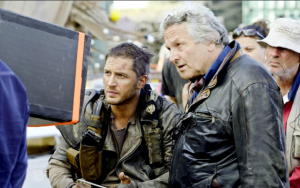
George Miller has made pigs talk and penguins tap dance. He’s been a doctor and a film director. Among the bold faced names on his resume are the titles Babe: A Pig in the City, The Witches of Eastwood, Happy Feet 1 and 2 and Lorenzo’s Oil. One name, however, looms larger than the rest.
Mad Max. Over the course of three films—Mad Max, Mad Max 2: The Road Warrior and Beyond Thunderdome—he introduced the world to post apocalyptic warrior Max Rockatansky, made Mel Gibson a superstar, defined dystopian cinema for a generation or two and created the phrase, “Two men enter, one man leaves.”
This weekend, thirty years after the release of the last Mad Max movie, Miller revisits the character in Mad Max: Fury Road, a reboot starring Tom Hardy and Charlize Theron.
The seventy-year-old director, who raised money to make the first film by working as an Emergency Room Doctor, says the goal of the new movie was to make it “uniquely familiar.”
After years of “following the CG evolution,” using computer generated images to create beautiful animated films, he was keen to go back to “old school” filmmaking “with real cars and real people and real desert.” That means, unlike the Avengers and their ilk, respecting the laws of physics by using practical effects and keeping the action earthbound. In other words, in a call back to the original films, when a car blows up it doesn’t rocket into space. Instead it explodes spectacularly but organically. The wild action you see in Fury Road are actual stunts performed by stunt men and women and not generated by a clever computer operator in a studio.
“It was like going back to your old home town and looking at it anew,” he says.
Miller reveals he originally created Max’s wasteland world while practising medicine.
“I worked for two and half years in a big city hospital. I stayed registered right up past Mad Max 2: Road Warrior. I never even thought there’d be a career. I stayed as a doctor on the first Mad Max because we kept running out of money in postproduction. Then I stayed through to the second Mad Max because if you are doing stunts you are obliged to have a doctor on set. There weren’t big budgets so I ended up running a clinic during lunch time tending to cuts, sunburns, scrapes and all that.”
His two careers have much in common, he says, adding he was “was privileged with a unique point of view as a doctor.”
“I don’t think I’d be the filmmaker I am unless I had that medical education, in two very direct ways. Both of them have a lot of problem solving in there. But the most important way is that as a doctor you are looking at people in extremis from many points of view. You look inside of people. You see people during birth and death and so on. Through microscopes; a lens. So you’re looking from many, many points of view. That’s exactly what you do in cinema. Huge wide shots with massive crowds or you’re looking right down inside someone’s brain, someone’s head.”
As for plans to make another Mad Max right away, he says, “That’s a bit like asking a woman who’s just given birth if she’s going to have another baby.”
The ghostly War Boys of “Mad Max: Fury Road” have a catchy mantra they recite as they go into battle. “I live. I die. I live again!” In some ways it could be the refrain for the series. Begun as a down-and-dirty punk rock vision of a post-apocalyptic Australia, the 1979 no-budget movie made a star out of Mel Gibson and spawned a mini-franchise of two more films, “The Road Warrior” and “Beyond Thunderdome.”
The George Miller films lived, died and now live again courtesy of “Mad Max: Fury Road,” an out-of-control reboot that recreates Max Rockatansky’s dystopian world and then races like hell through it, laying rubber all the way.
Set in an arid, inhospitable world where a snack of raw lizard constitutes a meal, Max (Tom Hardy) is a man who has lost everything, Haunted by “those he could not protect” he is now “a man reduced to a single instinct—survival.” Captured by henchmen of Immortan Joe (Hugh Keays-Byrne, who played Toecutter in the original “Mad Max”), a despot who hoards precious natural resources and only sparingly shares water with his subjects—Don’t take too much water, he says, you will only come to resent it when it isn’t there.—Max is turned into a blood bank for an ailing war boy named Nux (Nicholas Hoult). Subjected to a life of confinement and drained of his own natural resources, Max sees a chance for freedom when Nux and others do battle against Imperator Furiosa (Charlize Theron), a former warrior turned rogue. She’s driving the imposing War Rig—imagine a Monster Truck with an attitude—across the wasteland. With her are Immortan Joe’s five wives—Splendid (Rosie Huntington-Whiteley), Capable (Riley Keough), Toast (Zoë Kravitz), The Dag (Abbey Lee Kershaw) and Fragile (Courtney Eaton)—a natural resource he desperately wants back. Max and Furiosa form an uncomfortable alliance to battle the forces of evil and make it across the desert to Furiosa’s childhood home, a green oasis.
It’s been thirty years since there was a new “Mad Max” movie but “Fury Road” was worth the wait. The years have not stilled Miller’s restless camera or his outrageous way with steampunk influenced design or character names. If Imperator Furiosa isn’t the best character name of the year, I don’t know what is. Her title, however, might as well have been Mad Maxine as she is more the focus of the story than the titular character.
It is a chase movie where characters chase immortality, a new life in a better place, love and one another across a vivid landscape. Gone are the grey tones of dystopian movies like “The Road.” In its place is a dusty but vibrant backdrop that frames the non-stop action. Miller keeps the pedal to the metal but unlike the recent “Avengers: Age of Ultron,” which had a similar angle of attack, he keeps the action earthbound. The laws of physics are respected—when a car blows up it doesn’t rocket into space for instance—by the director’s use of practical effects. Most everything you see on screen are actual stunts performed by real people and not generated by a clever computer operator in a studio later on. The organic nature of most of (but not quite all) the visuals gives the movie extra torque, adding a sense of danger and realism (no matter how unreal the situation) to the large set pieces that make up the bulk of the film.
Hardy pulls his weight as Max. His powerful physicality mixed with a haunted look—maybe we should call him Passive Aggressive Max—and gearbox permanently shifted to survival makes him an imposing center of the film, but it is Theron who dominates.
As Furiosa she lives up to her name as a force to be reckoned with. She’s a one-armed bandit (literally) who not only provides much of the action in the film, but its heart as well.
The real star, however, is Miller. Thirty years after he last played in Mad Max’s world he revisits it with a film that doesn’t feel like a sequel or a reboot, but a fresh look at an familiar character. His off-the-wall sensibility and demented Hot Wheels style designs give the movie a look and feel that no other director could replicate.