Hollywood has a long tradition of bending history to suit their stories.
For instance the title of the historical disaster film Krakatoa: East of Java is a geographical head-scratcher. Krakatoa was actually west of Java. In 10,000 BC woolly mammoths are used as labour to build the pyramids in Egypt. That’s Hollywood history. Woolly mammoths weren’t desert creatures and the pyramids weren’t built until 2500 BC. Then there’s Mel Gibson’s wardrobe from the future in Braveheart. The movie is set in the late 13th century, but the kilts he wears didn’t come into existence until 300 years later.
The movie theatre is definitely not Mr. Parker’s history class.
Detroit, the new film from Zero Dark Thirty director Kathryn Bigelow, aims to bring historical accuracy back to the big screen. The movie focuses on the Algiers Motel Incident, the most infamous episode of the Detroit riots of the summer of 1967. The shocking story details how young African-American men and women sought the safety of the motel only to come under fire from police who handled them as revolutionaries. When it was done three young African-America men lay dead, shot, allegedly at close range. None of the officers charged with the Algiers murders were convicted.
“The Algiers Motel is a real American tragedy,” says Bigelow. “One of the most important aspects of preparing this movie was to spend time with the people who actually lived it.”
Filming this important slice of history brings with it the responsibility of getting it right. To that end Bigelow, screenwriter and former journalist Mark Boal and investigative reporter David Zeman, did considerable research. “My marching orders were to find as many of the principles as I could who could tell us something about their perspective on what happened,” said Zeman.
That may be so, but even the best-researched true-life drama brings with it a degree of artistic licence. Take for instance Bigelow’s last movie, Zero Dark Thirty. She called it a “reported film,” suggesting it existed somewhere in the murky middle between drama and documentary, yet it drew fire from critics (including the CIA) who felt it exaggerated the enhanced interrogation techniques allegedly used in the search for Bin Laden. So despite the opening credit claim that the movie was “Based on Firsthand Accounts of Actual Events” it may have fudged some facts.
So while there’s nothing in Detroit as egregious as Season of the Witch’s plague outbreak 76 years before the Black Death struck, it will not be a 100 per cent true and accurate representation of real life — it’s not possible. What it can do, however, is open a dialogue about the past, and in Detroit’s case, the present.
In a statement Charles Ferrell, the director of public programs of Detroit’s Charles H. Wright Museum of African American History said the film, “echoes the current proliferation of extra-judicial fatal shootings of African Americans by police who have been exonerated and highlights the major issue of criminal police violence and racial injustice that this nation must face and resolve through dialogue and corrective actions.”
Perhaps instead of looking at Detroit as a historical document it might be better used as a springboard for further study and conversation into the systemic racism that allowed the Algiers Motel Incident to happen and why so little has changed in the intervening years.
There is a disclaimer at the end of “Detroit,” Kathryn Bigelow’s latest look back at our recent history. Before the final credits roll a title card reads something to the effect that the details of the bloody Algiers Motel Incident, the most infamous episode of the Detroit riots of the summer of 1967, were pieced together from available sources and eye witness accounts.
It reminds us that what we have just seen is an interpretation of history and not a strict, unequivocal statement of fact. The title card may be a reaction to the backlash that followed Bigelow last film “Zero Dark Thirty.” She called that film, a look at the decade long hunt for Osama bin Laden, a “reported film,” suggesting it existed somewhere in the murky middle between drama and documentary. Despite her claim the film drew fire from critics (including the CIA) who felt it exaggerated the enhanced interrogation techniques allegedly used in the search for Bin Laden.
Her new film is every bit as provocative but whereas “Zero Dark Thirty” felt of its time, “Detroit,” despite its 1967 setting, feels ripped from the headlines. It uses historical fact and dramatization as an urgent plea for further study and conversation into the systemic racism that enabled Detroit police to murder three young African American men and why so little has changed in the intervening years.
The film begins with a police raid of an unlicensed nightclub filled with African American men and women enjoying a drink, some music and each other’s company. Manhandling men and women alike the raid attracts the attention of the entire neighbourhood. As club goers are forced into paddy wagons for the crime of congregating and having a drink, cries of “You can’t do that,” erupt into rage and the frustrated shouts change to “Burn it down.” A riot breaks out leading to looting, curfews and mass arrests.
The story splinters to introduce Philip Krauss (Will Poulter), a racist trigger-happy Detroit cop who justifies gunning down a man who stole a bag of groceries because, “They’re destroying the city.”
Nearby are Larry Cleveland Reed (Algee Smith) and Fred Temple (Jacob Latimore), a wannabe Motown singer and his best friend respectively. When Larry’s big debut at the Fox Theatre is scuttled because of the riot outside the theatre’s doors he Fred head to the Algiers, a nearby hotel, “until all this slows down.”
The laid back vibe at the Algiers seems a million miles away from the violence on the street, which by this point has seen 3200 people arrested and blocks of Detroit burned to the ground. Larry and Fred meet some girls (Hannah Murray and Kaitlyn Dever), listen to John Coltrane and feel safe until another resident, Carl Cooper (Jason Mitchell), shoots a starter’s pistol out the window. “We should teach those pigs a lesson,” he says. The police below, including Krauss, think a sniper is shooting at them and invade the building, guns drawn. By the time their “investigation” is done three young African-America men lay dead, shot at close range.
The lone uniformed voice of reason comes from Melvin Dismukes (John Boyega), a security guard in a grocery store down the street from the Algiers who tries his best to prevent bloodshed.
“Detroit” is an uncomfortable, gruelling watch. The physical intimidation, racially based violence, murders utilized against Reed, Temple and others as they plead innocence, is sickening. “I will kill you one by one until I find out what’s happening here,” says Krauss. Using psychological games and hard-core interrogation tactics he (and a handful of others) terrorizes his suspects and it is gut wrenching. Bigelow has a historical POV setting up the story and in the subsequent court case but her handling of the interrogation sequences is pure psychological horror. Claustrophobic and violent, it is as compelling as it is abhorrent.
Bigelow uses archival footage and stills to set the stage but it is a combo of her kinetic, muscular filmmaking and strong performances that make an impression. Boyega channels a young Denzel Washington, radiating decency while Poulter is a snarling ogre who revels in the powerlessness and dehumanization of his victims. As a paratrooper recently returned from Vietnam Anthony Mackie is a stoic presence amid the chaos.
Best of the bunch is Algee Smith as the young singer whose dreams are crushed when the Fox Theatre is evacuated just before his debut. While the dirty cops assert that “one bad minute shouldn’t define their lives,” it is through Smith’s performance that the long term effects of the Algiers event are the most tangible. The repercussions of that vicious, lawless night echo throughout his psyche, changing him forever.
The story in “Detroit” is fifty years old but the names of Dontre Hamilton, Eric Garner, John Crawford III, Michael Brown Jr., Ezell Ford, Dante Parker or any number of others who have been killed at the hands of the police in recent times, echo throughout.
Topher Grace doesn’t need me to put words in his mouth, but in this one instance I’m going to.
I recently sat down with the former That ’70s Show star to talk about his new Netflix movie War Machine. Based on the Michael Hastings New York Times bestseller The Operators, it fictionalizes the real life career implosion of General Stanley McChrystal, Commander, U.S. Forces Afghanistan. An article in Rolling Stone that reported on the McChrystal’s disappointment with Obama and his policies undid the General’s distinguished career. In the film he is renamed Gen. Glen McMahon and played by Brad Pitt, who also produced the film.
“What I love so much about the film [director and writer David Michôd] made,” said Grace, “and it was in the script but I really felt it when I saw the film, is the emotional journey. That is so hard to get into a war movie. Anyone who is willing to watch it understands it on an emotional level, which is a much more effective way to communicate to the audience than just using facts.”
Here’s where I chime in. “I think that when you have a very specific story it can become universal because of the emotions,” I said. “None of us will find ourselves in that particular situation but all of us, at some time in our lives, will end up in a mess of some kind. It’s relatable.”
“That’s what I meant to say,” said Grace with a laugh. “Can you quote yourself and use that?”
Consider it done.
Grace plays Matt Little, McMahon’s civilian press adviser. He’s young, brash, and according to Grace, not the sharpest knife in the drawer.
“What is the definition of an idiot?” he asks. “Is it knowing you don’t know but still going ahead anyway? I don’t think it is, but that’s who he is.
“On the first day I popped my collar up and the military advisor said, ‘They don’t do that in the military.’ The director said, ‘No, no, no! He’s playing an idiot. He would totally have his collar popped up.’ He’s a civilian and he doesn’t even really care about the war going on.”
The thirty-eight-year-old actor says despite the story’s timely nature and the inclusion of a character based on recently disgraced National Security Advisor Mike Flynn, the film isn’t political.
“I want people to check their politics at the door and take the emotional ride of what it would feel like to be in that position.
“The really cool thing is that it is not an American telling the story. David is a great talent out of Australia and no matter what he brings a non-American POV. The fact that it can be that heightened in terms of humour at some points and so real when they are out on the battlefield is really great. He told me he wanted to make a war film before Brad’s company sent him the book but he couldn’t think of a way to do a war film that didn’t glorify war. This does not glorify war.”
It may not be political but Grace says it is timely.
“We made it in Obama’s America,” says the thirty-eight-year-old actor. “It’s crazy releasing it now. It is timelier than when we shot it. I haven’t been on a lot of projects that were like that.”
Leonardo DiCaprio makes $25 million dollars per movie. So he has money. His best friend is Tobey McGuire and his little black book reads like a Victoria’s Secret catalogue, so he’s never lonely. He has opulent homes on both the left and right coasts of America—one comes equipped with a vitamin C infused shower—and even owns a 104 acre unpopulated island off the coast of Belize.
He’s a superstar with all the creature comforts money can buy. Do you know what he doesn’t have? An Oscar.
He’s come close several times, earning nominations for his work in What’s Eating Gilbert Grape, The Aviator, Blood Diamond and The Wolf of Wall Street but he’s never entered the winner circle.
He’s always been gracious in defeat, smiling and nodding during the Oscar broadcast when someone else’s name is called. “I wasn’t surprised that Jamie got the award,” he said about the 2005 Academy Awards when Jamie Foxx took Best Actor for Ray over The Aviator. “But I knew that cameras would be stuffed up my face so I had my response ready. Anyone who says they don’t practice is a liar.”
He may not have to fake being happy for another actor this year. Pundits are predicting his new movie The Revenant could bring him that elusive honour. He plays American fur trapper Hugh Glass, a frontiersman who became a legend in 1823 when he survived a brutal bear attack and slogged across harsh terrain to get revenge on the man who left him to die.
This is DiCaprio’s Jeremiah Johnson, a movie that masks his matinee idol good looks with facial hair and grimaces. For much of the two-and-a-half-hour running time he is mute, alone on screen crawling across the frozen landscape, slowly inching his way toward vengeance. There are great physical demands made on the actor—the Bear-Maul-O-Rama being just one of the miseries he endures—but this is an internal performance. The character’s strength, pain, frustration, anger and intestinal fortitude are apparent not only in his actions—he cauterizes wounds with gun powder!—but, more importantly, in his eyes. There’s the will to survive and then there’s whatever is driving Glass and whatever that is, it’s written on DiCaprio’s face. It may not be his flashiest role—although he does get to disembowel a horse—but it is one of his best.
Nominations will be announced January 14 so we won’t know until then if he is chosen for sure, but the odds are good. So good that Vanity Fair declared, “This is going to be the year Leonardo DiCaprio finally wins that Oscar.”
Question is, why would someone who has everything want an Academy Award. What difference would it make in his life and career?
The truthful answer is that it would likely make no difference at all to his career, at least financially. He’s already in the top tier of Tinseltown salaries and the fabled “Oscar box office bump”—a sharp spike in ticket sales when the nominations are announced—hasn’t meant much in recent years.
The real win for DiCaprio would be in the prestige department. The Best Actor Oscar is a rare commodity. Only seventy-eight people have them—Daniel Day-Lewis has three, Jack Nicholson and seven others have two apiece—and while he is already a respected performer, winning one would put him in the company of Hollywood legends like Clark Gable, Spencer Tracy and Gary Cooper.
If he becomes the seventy-ninth actor to take home the gold it’s recognition from his peers but besides that, one of those statues is the perfect thing to lend some flair to the man who has everything’s private island décor.
The last time we saw Leonardo DiCaprio he was driving a Ferrari and picking up $26,000 dinner tabs. “The Wolf of Wall Street” star is back on the big screen in “The Revenant,” but now the fancy cars have been replaced with horses, the dinners with raw bison meat.
Very loosely based on real events, DiCaprio plays American fur trapper Hugh Glass, a frontiersman who became a legend when he trekked across country after a brutal bear attack. In the film it’s 1823 and Glass is scouting for a team of fur trappers. The territory is tough, the men even tougher. When Glass is mauled by a bear the company splits into two groups. The first, lead by Andrew Henry (Domhnall Gleeson) heads for home base, while the other—Glass’s son Hawk (Forrest Goodluck), hotheaded trapper John Fitzgerald (Tom Hardy) and the inexperienced Jim Bridger (Will Poulter)—is paid handsomely to stay with Glass, and provide a decent burial when he succumbs to his injuries. Fitzgerald, more interested in getting paid than waiting for Glass to die, hurries the process along, stabbing Hawk and throwing the half dead scout into a hastily dug hole. When Glass comes to he has just one thing on his mind—revenge. “I ain’t afraid to die no more,” he says. “I done it already.”
This is Leo’s “Jeremiah Johnson,” a movie that masks his matinee idol good looks with facial hair and grimaces. His journey is at the heart of the movie but he shares the weight of carrying the film with Hardy. For much of the two-and-a-half-hour running time DiCaprio is mute, alone on screen crawling across the frozen landscape, slowly making his way toward Fitzgerald and his proposed revenge. There are great physical demands made on the actor—the Bear-Maul-O-Rama being just one of the miseries he endures—but this is an internal performance. The character’s strength, pain, frustration, anger and intestinal fortitude are apparent not only in his actions—he cauterizes wounds with gun powder!—but, more importantly, in his eyes. There’s the will to survive and then there’s whatever is driving Glass and whatever that is, it’s written on DiCaprio’s face. It may not be his flashiest role—although he does get to disembowel a horse—but it is one of his best.
Hardy’s Fitzgerald is painted in broader strokes. Driven by greed, this guy makes Bane look as morally bankrupt as Mary Poppins. Intimidating and ruthless, Hardy is a force of nature equal to anything Mother Nature places in Glass’s way.
Perhaps the “The Revenant’s” most complex character is Will Poulter’s Jim Bridger. He’s the runt of the litter, the youngest member of the expedition. Torn between loyalty to Hawk and Glass, his responsibility to his employers and his moral obligations, he is trapped in an impossible situation. Poulter pulls it off with a mix of steely determination and vulnerability.
“The Revenant” is the cinema of misery on screen and off. I’d suggest theatre-goers wear a sweater because the sense of cold and discomfort experienced by Glass is palpable.
On screen the primal story of revenge spares nothing to illustrate the hardships faced by all involved but director Alejandro González Iñárritu hasn’t simply made a gruesome film for the sake of upsetting the audience. Instead, it’s a movie that ends in a question mark. Is Glass’s payback justified or a hollow mission? Iñárritu leaves that decision to the audience, and it is sure to spark conversation as the closing credits roll.
Stories about The Revenant’s rough and tumble shoot have already passed into legend. Harsh filming conditions — it was minus 40 degrees with windchill factor for much of the Alberta shoot — turned the outdoor revenge drama into what one crew member called “a living hell.”
One of the film’s stars says he was “confused and stressed” during the shoot, but wouldn’t have had it any other way.
“It is something that I am only able to analyze and realize in hindsight,” says English actor Will Poulter. “I spent the entire experience peppered with these moments of total confusion and emotional stress; in a turmoil. Now I realize that is what I needed to experience. I wouldn’t have ever wanted to really gain control because then I wouldn’t have been experiencing anything realistic or wouldn’t have captured anything we needed. I’m glad for those moments.”
The 22-year-old, hot off the success of The Maze Runner and We’re the Millers, appears alongside Leonardo DiCaprio and Tom Hardy in the gritty vengeance drama about fur trapper Hugh Glass, a frontiersman who became a legend when he trekked across harsh country after being left for dead following a brutal bear attack. Poulter plays Jim Bridger, an inexperienced fur trapper caught in an impossible situation — torn between loyalty to Glass, his responsibility to his employers and his moral obligations.
“On many occasions (director) Alejandro (Iñárritu) let me be because I was naturally confused and stressed by being pulled in many directions and not knowing what to do. He often thought the most appropriate thing to do was to allow me to be that. I would turn to him and say, ‘I don’t know what to do here,’ and he would say, ‘Why are we even having this conversation?’ The character doesn’t know what’s going on, so why should I?”
The Revenant is the cinema of misery: a primal story that puts its characters through their paces.
“I think this movie is about the human spirit and I think what Alejandro strove to achieve was a film that explored what humans are able to endure and what is worth enduring in this kind of experience. Is it family? Is it money? Is it simply the will to live another day in an environment you love and feel safe in? It’s an exploration of how much we can take as humans and what motivates us to endure these kinds of conditions.”
Poulter says The Revenant is “an emotionally affecting experience,” and adds, “there was no creating that without experiencing a lot of the hardships for real.” The gruelling outdoor shoot took place on 12 different locations in three different countries including Canada, United States and Argentina from October 2014 to August 2015. Thinking about the shoot Poulter remembers the hard times with pride.
“The moments that stick out most for me are those moments where I felt I was pushed to the brink emotionally and physically but achieving the shot or getting the take.
Ending the day was just unbelievable. There are a few of those days that stick out in my mind and that’s why it was so rewarding. It’s one thing to finish a hard day’s (work) and pat one another on the back. It’s another thing to finish a day you didn’t actually think you could get through and then pat each other on the back.”
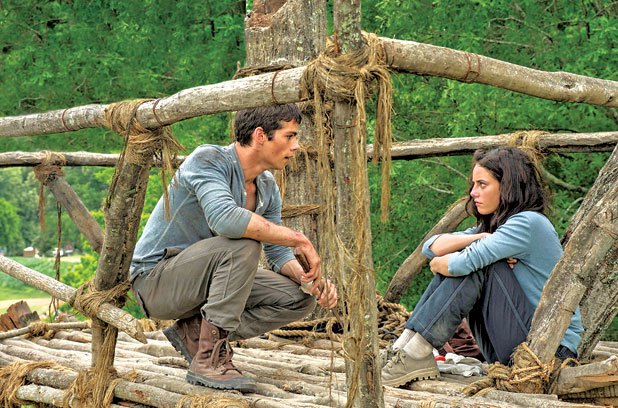
The story in “The Maze Runner” is based on a dare. When Thomas (Dylan O’Brien) is dropped into a mysterious walled world where a society of boys have grown up in the shadow of a giant labyrinth, he is told, “Don’t go in the maze.” Of course he does, because that’s like telling a teen, “Don’t go through that door,” in a horror flick.
The setting is bucolic. A large open green space, dotted by trees, huts built of logs and gardens. The only thing out of place is a large metal elevator that once a month belches to life, bringing supplies and a “greenie” to the surface. These young men arrive with their memories wiped clean, unaware of where they are or why they were brought there. The latest newbie is Thomas (“Teen Wolf’s” Dylan O’Brien), a rebellious young man who doesn’t quite fit into the well ordered life the other boys have created in their walled-in world.
He wants to escape; to become a Maze Runner and see if there is a way to navigate through the ever-changing labyrinth—and its evil guardians the Grievers—that stands between them and whatever is happening on the outside world. When the elevator deposits a girl (Kaya Scodelario) with a note clutched in her hand, “She is the last one,” in the midst, it seems like the time has come to take on the maze.
“The Maze Runner” is based on a series of wildly popular young adult books—so yes, you can look forward to “The Maze Runner 2: Electric Boogaloo” coming soon to a theatre near you—and takes a backwards approach to the storytelling. Here the characters are cyphers with no knowledge of their pasts, so they create personas based on their abilities in the camp. Very “Lord of the Flies.” It’s interesting though, in that unlike most original stores we don’t have to spend much time getting to know the characters, where they came from or what their inner torment is. They don’t know and neither do we. Instead they concentrate on the present—their present—and survival. Imagine if the reality show “Survivor” was set in a world surrounded by an impenetrable maze and the only way to get voted off the island was to be eaten by a giant, mechanical Griever beast.
The immediacy of the story serves it well to a point. Eventually the whole crew, or most of them anyway, attempt the maze at which point the film becomes a standard 3D sci fi chase flick—Watch out for that Griever!—but there are twists and turns to keep things moving along and perfectly set the story up for a sequel.
The movie is buoyed by strong performances from Will Poulter as a young guy content to stay within the walls of his mysterious prison and Dylan O’Brien, who gives the movie its prerequisite heartthrob appeal.
“The Maze Runner” makes comments about the dangers of conformity and the virtues of bravery and loyalty and does appear to be headed into some twisty-turny territory should the next part of the story get made.
Imagine the roar of a jet engine. Then picture yourself being blown backwards by the ferocity of the sound.
That’s the experience I had recently when hosting the Canadian premier of The Maze Runner, a new film based on a popular YA novel about a group of boys (and one girl) who must brave the dangers of a giant labyrinth to gain not only freedom but also their true identities.
There wasn’t a plane in sight, just a theatre packed with young adults. When I made the surprise announcement that some of the film’s stars would be joining us for a Q&A, you would have thought a giant electrical surge had bolted through every seat in the house. As I brought Skins’ star Kaya Scodelario, Meet the Millers’ Will Poulter and Dylan O’Brien, resident heartthrob of Teen Wolf to the stage, the place erupted.
Ears ringing, I asked a few questions, trying to be heard above screams of “I love you!” Not directed at me, but mostly at O’Brien.
As the handsome actor answered a question on bringing the character traits of Thomas alive from the page to the stage, a young woman whooped, “Thomas is hot!” O’Brien played along, saying, “That’s what I really wanted to lift from the page, his hotness. I was really focused on that.”
“You nailed it!” came a voice from the audience.
The enthusiasm wasn’t reserved just for him. Scodelario, a British actress who plays the film’s fierce female lead, could barely be heard above the din as she talked about her character’s empowerment. “I felt very strong playing her,” she said.
“A lot of times in movies, Hollywood and the rest of the world try to soften female characters. We have to see them vulnerable and we have to see them crying, and while that is a part of who we are as women, we can also be tough …”
The rest of her message is lost to the ages, drowned out by, “You go, girl!” hollers and the general melee of excited millennials.
Poulter, a 21-year-old British actor with a resumé that includes the charming Son of Rambow and The Chronicles of Narnia blockbusters, provided comedic relief. When I asked if he modeled his American accent on anyone in particular, he said, “I had to give up modeling, but that’s very sweet. Thanks for asking.”
The trio answered questions, most of which started with, “I just want to say I love you guys,” and ended with the inevitable, “Is there any possibility of getting an autograph or a picture?” for 25 minutes before being whisked away to another city, another press day and another theatre likely full of screaming teens.
Richard hosted a wild Q&A with the stars of the upcoming film “The Maze Runner” at the Cineplex Yonge & Dundas on September 2. In front of a packed audience of fans “Teen Wolf’s” Dylan O’Brien, “Meet the Millers” star Will Poulter and “Skins” actress Kaya Scodelario talked about translating a popular book to the big screen, masking their English accents and why they can’t sign autographs for everyone in the audience.
The movie opens September 19, 2014. Here’s some info form IMDB: Thomas is deposited in a community of boys after his memory is erased, soon learning they’re all trapped in a maze that will require him to join forces with fellow “runners” for a shot at escape.