“In all honesty if I heard about a film about a boy and his horse I wouldn’t want to go see that because I would think it was a family movie,” says English director Andrew Haigh. We are talking about his newest film Lean on Pete, which is, ironically, a film about a boy and his horse.
Based on the book by Willy Vlautin, it sounds like family fare but it is anything but. The cast should be the first clue. Steve Buscemi, Chloë Sevigny and Steve Zahn, all edgy 90s indie virtuosos, are the above-the-title stars, hinting that this isn’t going to be another National Velvet retread.
“The book is sad at times and tragic at times so the movie felt like a faithful adaptation of that. Oddly, I think that’s why I liked it because it was seemingly playing with more traditional ideas but telling the real life version of that. There could be a family movie about a boy on the road with a horse but it not going to be real. It was only after I finished the film that I realised, ‘This is going to be quite a challenge.’”
Charlie Plummer, last seen as John Paul Getty III in All the Money in the World, plays Charley Thompson a fifteen-year-old looking for permanence in his hardscrabble life. To pass the time he gets a job tending to an aging Quarter Horse named Lean On Pete. When the horse’s owner, a crusty old horse trader played by Buscemi, decides to get rid of Pete, to “send him to Mexico”—i.e.: the glue factory— Charley makes off with the horse, embarking on a road trip in search of a better life for both of them.
“It isn’t about the horse,” says Haigh. “It is about Charley’s desperate need for some stability, some security, someone to care for him, someone to care about him. That’s what’s driving him.”
As Charley the eighteen-year-old Plummer is magnetic, quietly creating the character of a desperate young man who does bad things for mostly the right reasons.
“It is not easy trying to cast someone about that age. Especially someone who has to both physically feel right, that they are still a kid but very nearly an adult. I knew I wanted him, in a frame, to look like a kid and then suddenly go older, then younger.
“There a lot of good boys that we had seen but Charley had something different. He approaches scenes in a different way. He doesn’t go the easy emotional way. He finds something a more challenging which sometimes keeps you at even more of a distance but then sometimes pulls you in with that amazing face he has.”
Haigh, who next project is The North Water, a sprawling TV movie about a disgraced ex-army surgeon now working as ship’s doctor on a whaling expedition, hopes people respond to Lean on Pete’s messages of kindness and compassion.
“If people leave the cinema and they feel for that kid and think about him that is all I can really hope for,” he says. “I hope it speaks to the importance of the need to help people who are suffering. I don’t know if people will take that away or not but it is certainly in the DNA of the film.”
The boy-and-his-horse story of “Lean on Pete” sounds like family fare but it is anything but. The cast should be the first clue. Steve Buscemi, Chloë Sevigny and Steve Zahn, all edgy 90s indie virtuosos, are the above-the-title stars, hinting that this isn’t going to be another “National Velvet” remake.
At the beginning of the story fifteen-year-old Charley Thompson (Charlie Plummer) and his single father Ray (Travis Fimmel) are starting their lives over in Portland, Oregon. Charley’s mom went out for cigarettes years ago and never came back. Since then father and son and moved around the country, Ray chasing work, Charley trying to find a place to fit in. They are more like friends than father and son. Ray offers up dubious fatherly advice—“The best women have all been waitresses at some point.”—and finds a new women in every new town.
To pass the time Charley gets a job tending to an aging Quarter Horse named Lean On Pete. Working for crusty old horse trader Del Montgomery (Buscemi) Charley finds purpose and despite the warnings of jockey Bonnie (Sevigny) not to get emotionally involved with the horse—“Don’t think of them as pets,” she says.—the teenager coddles the horse even as it becomes clear Pete isn’t going to win anymore races.
When Del decides to get rid of Pete, to “send him to Mexico”—i.e.: the glue factory— Charley makes off with the horse, embarking on a road trip in search of a better life for both of them.
There are many good messages here for kids about resilience and loyalty but again let me remind you this isn’t a kid’s movie. Del’s foul language and a scene where Charley beats a homeless man with a tire iron rule that out. What we’re left with is a story that feels like it was written for a young adult audience but made by someone weaned on mid-period Wim Wenders. Tonally it feels as though it has one hoof in YA, the other in more adult fare.
Tonality aside, the first hour works very well. Plummer is magnetic, quietly creating the character of a desperate young man who does bad things for mostly the right reasons. His scenes with Buscemi and Sevigny sparkle with a gruff warmth, setting up the lesson in resilience that dominates the second half. As Charley sets off into America’s hinterland Bonnie’s statement of fact, “There’s only so many times you can fall down, right?,” is proven wrong time after time. It’s a road trip of misery that sees Charley survive in very trying circumstances. Paced a little too leisurely in its second hour the road trip section, despite the dramatic events portrayed, is far less interesting than the character work of the first hour.
“Lean on Pete” is an effective portrait of a lonely boy but ultimately simply becomes a laundry list of Charley’s bad decisions.
The Daily Telegraph calls writer/director Armando Iannucci “the hardman of political satire.” As the creator of sardonic films and TV shows like “In the Loop” and “Veep” he’s a vitally caustic comic presence.
As the film begins it’s 1953 and Joseph Stalin (Adrian McLoughlin), the second leader of the Soviet Union, is alive and well. Under his watch death squads are rounding up his enemies, executions are common and the mere mention of his name strikes fear into the hearts of the people. The Central Committee, surround him. There’s the scheming Nikita Khrushchev (Steve Buscemi), the pompous Georgy Malenkov (Jeffrey Tambor), Old Bolshevik Vyacheslav Molotov (Michael Palin) and secret police chief Lavrentiy Beria (Simon Russell Beale). When he suffers a stroke everything changes as his inner circle engage in a power struggle that will determine not only their futures but also the future of the Soviet Union.
The idea of chaos in the halls of power, though set sixty-five years in the past, feels almost ripped from the headlines. With jet black humour “The Death of Stalin” supercharges the farcical elements of a very dark time in history. With the cast using their natural accents—no one here tries to sound Russian—it feels surreal, like Monty Python gone amok. There’s doublespeak, jealousy and sight gags galore as this band of yes-men bumble around in an attempt to seize the Kremlin in the days following their leader’s passing.
Iannucci avoids the danger of trivializing the very real-life tragedy of the story—you hear gunshots off screen for much of the first half of the film—by not glorifying the villains. He takes a sharp knife to the reputations of Stalin, Khrushchev et al, portraying all of them as spoiled incompetents capable only of looking out for number one. In this historical context that approach works to show how absolute power corrupts absolutely.
“The Death of Stalin” is an audacious reimagining of history. Strong comic performances are highlighted in a film that is both frightening and funny at the same time.
To play the title character in “Norman,” a strategist, a consultant who sometimes consults with consultants, Richard Gere dimmed his matinee idol looks with a bad haircut and thick glasses. It’s his best role in years, a character study that gives him the chance to go deep in a movie that isn’t as deep as it thinks it is.
Gere is Norman Oppenheimer, a down-at-the-heels New York City wannabe wheeler-dealer. He’s a connector, a facilitator who brings people together. In conversation he repeats, “I’d be very happy to introduce you,” like a mantra, seven words that could unlock the mysteries of the universe.
Everybody who’s anybody knows who he is but nobody knows anything about him. He’s a cipher who lives on his cell phone, has no office but does have nerve and something to prove. He’s so keen to impress Micha Eshelan (Lior Ashkenazi), up-and-coming Israeli politician he buys him a very expensive gift just minutes after meeting him. “I bought him a pair of shoes,” he says. “The most expensive pair of shoes in all of New York. Best investment I ever made.”
His investment pays off years later when Eshelan becomes the Prime Minister of Israel. Norman’s stock rises considerably but is his relationship with the world leader illegal and corrupt? Is Norman simply a delusional name-dropper or is he the one virtuous man in a den of wolves?
When we first meet Norman he is the living, breathing embodiment of disappointment. A man who rides a razors edge of failure every time he picks up his cell phone. He swallows his pride at every turn, trying to maintain dignity even as he is thrown out of a wealthy man’s home. He’s a goodhearted weasel who lies and cheats in his quest to do the right thing and Gere plays him as a man desperate to matter, to experience the kind of recognition that would come with the right connections.
It feels like he has tasted the good life and, as Eshelan says, “once you have been up, way up, you can’t settle for anything less.” Norman wants more but it’s never exactly sure what that means to him. He’s a fascinating, annoying character and Gere brings him to life.
There’s also interesting work from Ashkenazi, Charlotte Gainsbourg as a crusading lawyer and Steve Buscemi as a rabbi but the film feels cluttered, as though director Joseph Cedar was so fascinated by Norman’s ever spreading web of obligations, he couldn’t stop adding to it.
“Norman” is an in-depth look at a superficial man, a movie that works best when it focuses on Gere and not baroque political intrigue.
In the movies anything is possible. Superheroes routinely save the earth, regular folks can afford to live in fancy New York apartments and infants can talk.
This weekend Alec Baldwin lends his distinctive, raspy voice to the title character of The Boss Baby. Based on a 36-page book by Marla Frazee, it’s a feature length riff on Look Who’s Talking as imagined by Family Guy’s Stewie Griffin.
“I may look like a baby but I was born all grown up,” Boss Baby boasts as he drops into the Templeton family, upsetting only child Tim’s carefree life. Wearing a suit onesie, BB carries a briefcase and speaks the language of the boardroom.
Seems he’s from a purveyor of fine babies, a company that supplies tots via a chute. Those who giggle when tickled are placed with families, those who don’t, like Boss Baby, are sentenced to a Kafka-esque, humourless life in BabyCorp management, kept infant-sized by special formula.
With lines like, “You know who else wears a diaper? Astronauts.” Boss Baby has the movies’s best lines, expertly delivered by Baldwin but he’s not the first talking baby to grace the big screen.
Leone LeDoux was an actor who, when she wasn’t voicing Minnie Mouse in cartoons of the 1930s and 1940s, made a career out of supplying baby vocals for movies. Some, like her work in the short Water Babies, involved creating childlike sounds for on screen infants while others were more involved. In The Reluctant Dragon she gives voice to child genius Baby Weems.
“You’re a quiet little fellow, aren’t you?” coos the nurse.
“Well, there really isn’t much to talk about,” replies Weems.
Other movie babies have had more to say.
Amy Heckerling came up with the idea for the Citizen Kane of talking toddler movies, Look Who’s Talking, when she and screenwriter husband Neal Israel were playing with their new baby. “My husband and I started to put words in her mouth,” she told the Los Angeles Times. “what she might be thinking based on her expressions.” The playful game blossomed into a film starring Kristie Alley, John Travolta and Bruce Willis as the voice of talking newborn Mikey. Heckerling notes that Willis frequently went off script, improvising X-rated lines that couldn’t be used in the film.
The movie gave Travolta’s career a shot in the arm—he hadn’t acted in five years—and started a talking baby trend in pop culture. The next year the sitcom Baby Talk starred the vocal stylings of Tony Danza as Baby Mickey, son of single mom Maggie.
More recently the baritone voiced E-Trade baby, frequently voiced by comedian Pete Holmes, looked to Heckerling’s movie for inspiration. From 2008 to 2014 Elayne Rapping, professor of American Studies at SUNY/Buffalo says the spokesbaby “humanized the whole business of trading. While other babies are just pictures, this one has a personality that is pure pop culture.”
Finally, back on the big screen Baby Geniuses sees Kathleen Turner and Christopher Lloyd as scientists who think that babies are born knowing the secrets of the universe. To learn those secrets they try to decode goo-goo-ga-ga baby talk. Roger Ebert put this movie on his “Most Hated” list and the Stinkers bad Movie Awards nominated Leo, Gerry and Myles Fitzgerald, the triplets who played Sly, the baby genius, as Worst Child Performer.
Based on a 36-page book by Marla Frazee, “The Boss Baby” is a feature length riff on “Look Who’s Talking” as imagined by “Family Guy’s” Stewie.
Tim Templeton (voice of Miles Bakshi, grandson of animation hero Ralph) is an imaginative seven-year-old only child of parents Ted and Janis voiced by Jimmy Kimmel and Lisa Kudrow. “It was just the three of us,” he says. “The Templetons. Three is the perfect number. Interesting fact, did you know the triangle is the strongest shape alive?” He’s content to be the centre of attention but his carefully constructed life is turned upside down when Mom and Dad come home with his little brother (Alec Baldwin).
The baby is… different. “I may look like a baby but I was born all grown up,” he boasts. Wearing a suit onesie he carries a briefcase and speaks the language of the boardroom. “He’s like a little man!” says Mom. Seems he’s from a purveyor of fine babies, a company that supplies tots who arrive via a chute. Those who giggle when tickled are placed with families, those who don’t, like Boss Baby, are sentenced to a Kafka-esque, humourless life in BabyCorp management, kept infant-sized by special formula. “If people knew where babies really came from they’d never have one,” says Boss Baby. “Same goes for hotdogs.”
In his quest for a promotion and a corner office with his own private potty the ambitious Boss Baby lands with Tim and family. He’s placed himself with Ted and Janice to get closer to their boss, Francis E. Francis (Steve Buscemi), CEO of PuppyCorp. Francis is developing a forever puppy, a new designer models of Frankendog, each more adorable than the last. They’re so cute they threaten to soak up all the love usually reserved for babies. It’s a threat to BabyCorp’s giant-sized baby business and if Boss Baby doesn’t get to the bottom of the puppy problem his special formula will be taken away and he will turn into a regular baby. With Tim’s reluctant help he takes on PuppyCorp.
Echoes of the lamentable “Storks” and its baby making company reverberate throughout the “The Boss Baby’s” infant delivery sequence but the comparisons between the two movies ends there.
At the mushy heart of “The Boss Baby” are messages about the importance of family and unconditional love and other kid flick platitudes, but at the forefront is Boss Baby as a more devious version of Beck Bennett, “Saturday Night Live’s” CEO with the body of a baby. Baldwin brings his distinctive rasp to the character, dropping riffs from his “Glengarry Glen Ross” super-salesman character. “Put that cookie down,” he scolds. “Cookies are for closers,” and “You know who else wears a diaper? Astronauts.” With an aplomb that makes the whole silly story worth a look.
Director Tom “Madagascar” McGrath uses various kinds of animation to paint the screen with vibrant colours and images. His ninja spy sequence is striking, drawing from kung fu movies and horror movies to create the film’s most interesting few minutes. Most characters resemble Margaret Keane’s big-eyed children but McGrath finds interesting ways to jazz them up. Baby Boss’s James Brown strut up walkway to the house is more than choreography, it tells you all you need to know about the character before you even see his face. A scene with incomprehensible Elvis impersonators is hilarious and strange for adults and kids alike. In those sequences and small character moments McGrath and company shine.
Despite those character and animated flourishes “The Boss Baby” doesn’t go out of its way to truly distinguish itself. It’s a pleasant diversion for big and small but the story and its lessons feel like things we’ve seen done before and done better.
“We don’t have time for zingers!” says Count Dracula (Adam Sandler) midway through “Hotel Transylvania 2.” No time for zingers, indeed. The sequel to the 2012 kid friendly animated horror comedy is short on laughs but long on sentiment.
Like all of Sandler’s movies—no matter how outrageous the characters—the new one is all about family. It picks up after Drac’s daughter, vampiress Mavis (voice of Selena Gomez) married human Jonathan (Andy Samberg). In a twist on “Twilight,” the vampire mother and human father soon have a child, Dennis (Asher Blinkoff). The question is, which side of the family will it take after, the monster or human?
“Human. Monster. Unicorn. As long as you’re happy,” Drac says to his daughter, while secretly hoping the child will inherit the vampire genes. On the eve of the child’s fifth birthday the boy still hasn’t shoed any signs of vampiric behaviour—“He’s not human,” says the Prince of Darkness, “he’s just a late fanger!”—so Drac and friends—Frankenstein (Kevin James), Wayne the Werewolf (Steve Buscemi), the Invisible Man (David Spade) and Murray the Mummy (Keegan-Michael Key)—take Dennis to their old haunts to teach him their scary skills.
“Hotel Transylvania 2” features great kid friendly monsters designs (that will make equally cool toys) like zombie bellhops and Blobby, a gelatine creature that looks like Grandma’s Gazpacho Aspic come to life but the creativity that went into the creatures didn’t extend to the script.
It’s a sweet enough, amiable story about acceptance and family, but the jokes barely rise to the level of the “101 Halloween Jokes for Kids” book I had when I was ten-years-old. If calling Murray the Mummy “talking toilet paper” makes you giggle, then perhaps this is for you, but by the time they have explained why Drac is called “Vampa” for the second time, you get the idea that Sandler and co-writer Robert Smigel know they should have driven a stake through the heart of this script.
The appearance of Mel Brooks as Great Vampa Vlad simply brings to mind “Young Frankenstein,” one of the funniest horror comedies of all time.
The biggest laughs come from the background, the sight gags that keep things visually frenetic in the first hour.
“Hotel Transylvania 2’s” family friendly scares won’t give kids any nightmares, but it won’t make them laugh either.
There’s something missing in the new Adam Sandler movie. Notable in their absence in this story of a cobbler with the uncanny ability to change into other people, are jokes of, how to put this delicately… a gastrointestinal nature, one of the hallmarks of the Sandleronian oeuvre.
In “The Cobbler” he plays Max Simkin, a shoe repairman from a long line of cobblers. Like his father and grandfather before him, he runs the family business on New York City’s Lower East Side. He’s dissatisfied with his work, with his non-existent love life and living with his elderly mom. When he repairs Leon Ludlow’s (Method Man) shoes on an old stitching machine, unused since his father left the business years ago, Max discovers the machine imbues the shoes with the magical power of transformation. With that discover Max steps into a world of wonder where he can be anyone he wants… as long as he has their shoes and they are size 10 ½.
This is a slight movie; a one-joke idea stretched to feature length with the addition of a crime subplot. There will be no spoilers here, but let it be known that by the end of the movie he becomes known as The Cobbler, a guardian of souls.
There are jokes to be made about walking a mile in a man’s shoes before you can presume to know them, but this movie doesn’t make them. In fact, it makes very few actual jokes. There are laughs but this isn’t one of those Adam Sandler movies that strains to make you giggle several times per minute.
It’s one of his kinder, gentler fantasies, like “Click” or “Bedtime Stories.” Sandler is the likeable center of the story, and he carries it through the first half until the plot starts to become cluttered with characters and later, sentiment. The amazing transformation shoes could have been used to deepen the story by showing Max learn about himself as he learns how the other half lives. Instead he goes undercover to get money to buy his mother a headstone which leads him to help an old man keep his apartment and possibly even get a date with a pretty activist (“Fruitvale Station’s” Melonie Diaz). Deep it ain’t.
Then it flies off into a wild flight of fancy that I still can’t decide if it is the greatest or stupidest plot twist ever in a movie. There’ll be no spoilers here, but let’s just say the film is set up to be the first in a series.
“The Cobbler” has more sole than soul, and is a bit flatfooted in its approach to the story, but it is a nice change to see an Adam Sandler movie and not be bombarded with bathroom humor.
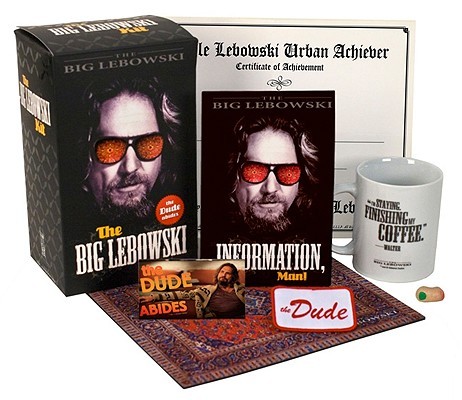
Merry Christmas Dude. This Big Lebowski Kit abides and it’s only $16.95!
From target.com: In 1998 the Academy Award®-winning Coen brothers released the film The Big Lebowski—the hilariously quirky comedy-thriller about bowling, avant-garde art, nihilistic Austrians and a guy named . . . the Dude. Starring Jeff Bridges, John Goodman, Julianne Moore, Steve Buscemi, and John Turturro, The Big Lebowski has grown into a cult classic more than a decade after its original release.
Now Achievers everywhere can enjoy The Big Lebowski Kit—a boxful of fun, Lebowski-style, with:
• Oriental-rug mousepad that “really ties your desk together”
• Severed big toe—with polish! (rubber)
• Magnet with the classic phrase, “The Dude Abides”
• Little Lebowski Urban Achievers Certificate
• “the Dude” embroidered bowling-shirt patch
• 32-page book with trivia and images from the film