“Hostiles,” the new Christian Bale drama, is a period piece with a potent message for today. With a nod to the John Wayne classic “The Searchers,” it’s a sombre tale of a man who must confront his deeply held racism.
Set in 1892, Bale plays Joseph J. Blocker, a U.S. Army captain approaching retirement; soul darkened by a career spent warring with indigenous peoples. He’s lost many of his men at the hands of his enemy, seen his people butchered and scalped. In return he turned battlegrounds into killing fields soaked in blood.
Under orders he reluctantly does one last official job before riding off into the sunset. His commanding officer (Stephen Lang) gives him a choice, escort an old enemy, Cheyenne war chief Yellow Hawk (Wes Studi) now dying of cancer, from an remote Army gaol in New Mexico to the Chief’s home in the grasslands of Montana or face a court martial. Putting together a crew of his most trusted men, including his right hand man Sergeant Tommy Metz (Rory Cochrane), he begins the long, dangerous trek. A day or so in the come across Rosalie Quaid (Rosamund Pike), a widow whose family was slaughter right in front of her.
The physical journey is ripe with danger—they are ambushed by Comanche and must drop off a dangerous prisoner (Ben Foster) along the way—but the metaphysical journey is more interesting. As the days pass Blocker rediscovers his humanity; the man he was before he allowed hate to overwhelm.
Writer, director Scott Cooper’s film drips with gravitas. It is a serious minded look at the bigotry and brutality that fuelled the U.S. Army dealings with the frontier tribes while making room for Blocker’s redemptive arc. But for as beautiful as the movie is, it never feels authentic. Sure you can almost smell the campfires, blood and sweat. Cooper’s details are evocative of a time and place, it’s the relationships between the characters that don’t ring true. The anti-racism message is a powerful and important one but turned into a cliché in its execution. Underdeveloped indigenous characters, all stoicism and nobility, seem to exist only to aid Blocker’s attitude change, which makes the movie feel lopsided, tilted toward Blocker and his band of white saviours.
I think the movie mostly has its heart in the right place in terms of promoting tolerance but the reconciliation portrayed here feels off kilter. (SPOILER ALERT) By the time the end credits roll on this ponderous story, the white viewpoint of the storytelling is made all too clear in a conclusion that sees the two above the title stars come to the rescue of a young indigenous character.
“Hostiles” is a beautifully turned out film. Cooper fills each frame of this deliberately paced movie with a kind of bleak beauty. But with the elegance of the filmmaking comes frustration at the story’s missteps. Bale digs deep, grappling with the anguish and regret that has scarred Blocker’s soul but his transformation doesn’t seem real, or possible.
“A United Kingdom” is a sweeping story all about love—a king’s love of country, love of people, love of his wife—set against seemingly impossible political obstacles. Featuring David Oyelowo and Rosamund Pike as a true-life star crossed couple whose marriage causes an international incident, the movie tells a fascinating story in the most melodramatic way possible.
London, 1948. Seretse Khama (Oyelowo) and Ruth Williams (Pike) meet at a missionary dance and sparks fly. One whirlwind romance later Seretse reveals that when his education is done he must return to Africa to assume the throne as king of Bechuanaland (now Botswana). “I’ve been thinking about my responsibilities in Bechuanaland,” he says. “I know I will never achieve anything worthwhile if I leave my heart here.” Despite the objections of her traditional English parents—Mom thinks she will change her mind, Dad hisses, “You disgust me.”—they marry, triggering a chain reaction of events in England and Africa that threatens his crown, their relationship and the future of his country.
At the dawn of apartheid in southern Africa their marriage is seen as a slap in the face to the British government and a danger to diplomatic relations with other African nations. On a family note in Africa Ruth is not accepted by Seretse’s relations. “It is audacious to come here,” she is told, “married and present yourself as our queen.”
Question is, can their bond withstand the pressures, both personal and political?
“A United Kingdom” has its heart in the right place. It is an unadulterated romance between a man and a woman who must fight to have their love survive. They say things like, “He scares me a bit… the way he makes me feel,” and stare at each other with moon eyes.
It is also a love story of a man and his country, a king with a deep belief in equality and change. “Independence, democracy, a new Africa. It is time,” he says.
Fine, love is complicated, especially when international politics gets in the way but director Amma Asante paints the romance and the politics with the same melodramatic brush. A heightened love story is one thing, but when it comes to the inner workings of international affairs a little restraint might have made the story of ingrained systemic racism more powerful. Instead we are handed evil bureaucrats, secret dossiers and an almost slapstick villain in the form of the British government representative of Southern Africa, Sir Alastair Canning (Jack Davenport). The only things missing from the performance are the gleeful rubbing of hands and a moustache to twirl.
The couple’s dilemma is real and heartbreaking but the theatrical treatment of their plight feels more crowd pleasing than introspective or deeply felt.
“A United Kingdom” is a beautiful looking movie, with solid if histrionic performances that has trouble balancing the romantic and partisan aspects of this touching real life tale.
“Gone Girl” is about many things. It’s about the perfect crime. It’s about the disintegration of a marriage. It’s about the mob mentality that shows like Nancy Grace creates when “innocent until proven guilty” becomes a meaningless catchphrase. Heck, it’s even about proving Tyler Perry actually can act but mostly its about keeping the audience perched on the edge of their collective seats.
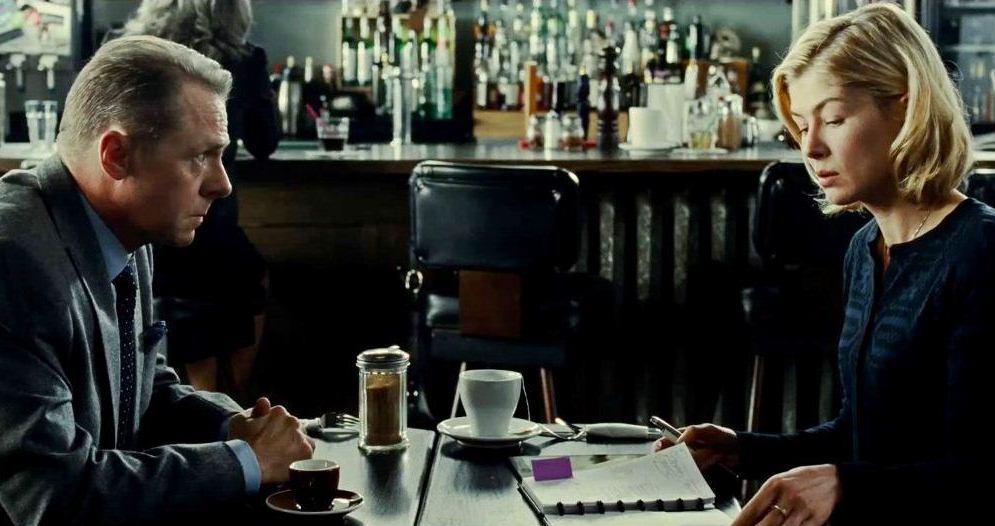
When Amy (Rosamund Pike) and Nick (Ben Affleck) first meet both are writers living in New York City. It’s love at first sight. “We’re so cute I want to punch us in the face,” she says. but after a few years of marriage, a recession and a downsizing from Manhattan to Missouri, things go sour. On the morning of their seventh anniversary Amy disappears, leaving behind only an over turned coffee table and a smear of blood in the kitchen. In the coming days Nick’s life is turned upside down. “It’s like I’m on a Law and Order episode,” he says. His wife is gone, her over protective parents are on the scene and he is suspect number one.
Telling any more of the story would be akin to like giving you a puzzle, with all the pieces in place save for one corner. In other words, the more you know the less fun the movie will be. Director David Fincher has constructed an intricate, he-said-she-said thriller, based on a bestseller of the same name by Gillian Flynn, that relies on the element of surprise.
At the helm is Affleck. He’s terrific in what may be his most natural performance ever. He has the charm of a romantic lead but the soulless affect of a man lost at sea personally and professionally.
Affleck is a bright light but Pike burns a hole in the screen. The former Bond girl and “An Education” star has never been better. Cold and calculating, terrified and terrifying, she puts the femme in fatale. A star in the Brian DePalma mode, she’s capable of almost anything except being ignored. It’s a bravura performance and one that will garner attention come Oscar time.
Fincher has populated the film with strong supporting actors. The unconventional casting of Neil Patrick Harris, as an wealthy, controlling ex-boyfriend and Tyler Perry as a celebrity attorney both work well, but the stand-outs are in the female secondary cast.
As Nick’s twin sister Margo, Carrie Coon is spunky, funny—“Whoever took her is bound to bring her back,” she says of the sister-in-law she doesn’t like.—and finally desperate. Kim Dickens as the no nonsense Detective Rhonda Boney, the lead of the team investigating Amy’s disappearance, provides the procedural portion of the story.
“Gone Girl” is not great art, but it is an artfully made potboiler with memorable performances and slick direction that will keep you guessing until the end.
The internet helped Ben Affleck land the role of Nick Dunne (Affleck), the prime suspect in his wife Amy’s (Rosamund Pike) disappearance, in this weekend’s mystery thriller Gone Girl.
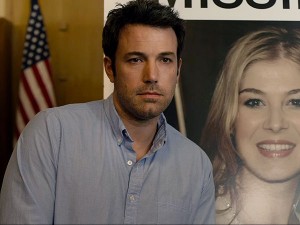
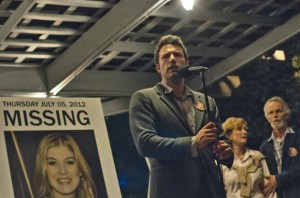
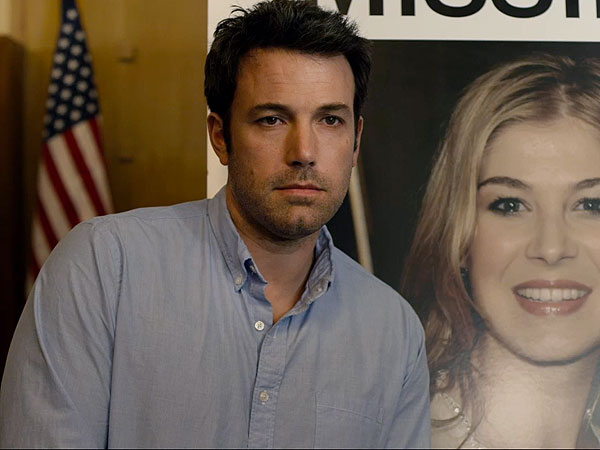
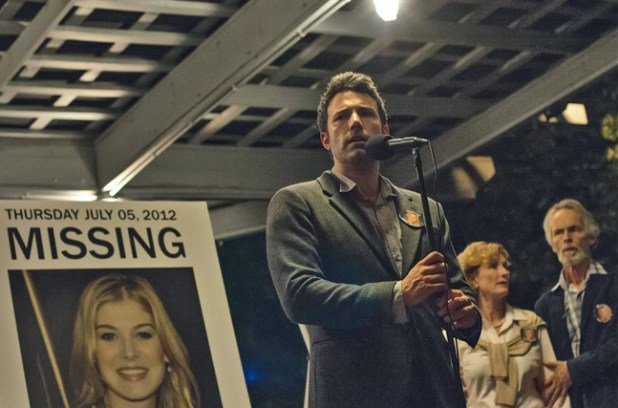
Director David Fincher told Playboy he’s very concerned about what facial expressions actors can bring to his movies so when casting Gone Girl he imagined a scene where Nick Dunne smiles while standing next to a poster of his missing wife.
“I flipped through Google Images and found about 50 shots of Affleck giving that kind of smile in public situations,” Fincher told writer Stephen Rebello. “You look at them and know he’s trying to make people comfortable in the moment, but by doing that he’s making himself vulnerable to people having other perceptions about him.”
There is already Oscar buzz surrounding Gone Girl’s actors. Chris Nashawaty of Entertainment Weekly called Affleck’s work “the most natural performance of his career,” while Digital Spy’s Simon Reynolds said Pike’s performance, “should bag her an Oscar nomination come awards season.”
Fincher’s careful casting has bagged Oscar nods for The Curious Case of Benjamin Button’s Brad Pitt and Taraji P. Henson, Rooney Mara of The Girl with the Dragon Tattoo and Jesse Eisenberg of The Social Network.
The director has an unerring eye when it comes to casting, but it’s not always a smooth process. When he signed on to direct The Girl with the Dragon Tattoo he had actress Rooney Mara in mind to play hacker Lisbeth Salander. She won the role, but not before auditioning five times and beating out better known hopefuls like Natalie Portman, Scarlett Johansson and Jennifer Lawrence. “We didn’t make it easy for Rooney, and there was no way to dissuade her.”
Recently Fincher walked away from a big budget remake of 20,000 Leagues Under the Sea when the studio rejected his casting choice Brad Pitt or Channing Tatum in favor of Chris Hemsworth.
One of the director’s best-known films, Se7en, starred Kevin Spacey as serial killer John Doe who offed his victims in the order of the Seven Deadly Sins. He’s fantastic but he wasn’t Fincher’s first choice. The director wanted Ned Beatty, a shorter, rounder character actor who starred in Deliverance and Nashville. “He should look like a postman,” said Fincher. Beatty turned down the role—“This is the most evil thing I’ve ever read,” he said.—opening the door for Spacey. Trouble was, Spacey wanted too much money. It wasn’t until star Brad Pitt intervened and called the studio to ask that Spacey be hired. The moral of the story? “It pays to be blond,” says Fincher.
This weekend Ben Affleck returns to theatres as the star of the hotly anticipated Gone Girl, an adaptation of Gillian Flynn’s bestselling novel about a man whose life becomes a media circus when his wife (Rosamund Pike) disappears and he is the prime suspect.
It’s a welcome return for the star who once almost wore out his welcome on the big screen.
For a few years in the early 2000s, Affleck was the textbook definition of over-exposed. Between 2001 and 2004 he released a staggering 11 films, took a year off and dumped four more into theatres in 2006. Then (when the tabloids weren’t naming him Sexiest Man Alive, as People Magazine did in 2002), they were detailing the every move of the couple known as Bennifer, a mash-up of Ben and fiancée Jennifer Lopez’s high-wattage names.
You couldn’t go to a theatre, turn on a television or pick up a magazine without seeing his handsome face, and soon enough that ubiquity worked against him.
The Wall Street Journal did the math, reporting Affleck’s recognition factor jumped from 75 per cent to 82 per cent in 2003, but noted the percentage of folks who didn’t like him climbed from 12 per cent to 18 per cent.
In 2004 talent agent Patrick Whitesell told Los Angeles Times writer Kim Masters, “That kind of [media] coverage robs movie stars of their mystique.”
After that period of wild tabloid overexposure ruined his credibility with movie-goers and very nearly turned him into an industry in-joke, Affleck took some time for self reflection — “I was a little bit exhausted of myself,” he said — stopped saying ‘Yes!’ to every script that came his way and earned a second act.
In front of the camera — in movies like State of Play — and behind it, directing the critically acclaimed Gone Baby Gone, the man who had made four dozen movies since 1993 rebuilt his career, focusing on quality rather than quantity.
His next film saw him on both sides of the camera, directing, co-writing and starring in The Town, a crime drama that returned him to the scene of his first success, the Boston of Good Will Hunting. The Oscar-winning Argo followed and soon he’ll be seen as Batman in Batman v Superman: Dawn of Justice.
The days of overexposure have come and gone, and he survived to have a thriving career.
“Now I think I’m kind of seen as just sort of somebody in Hollywood who works,” he says.
A good alternate title for the new Simon Pegg motivational movie would be “Hector and the Secret Life of Walter Mitty.” Both movies feature a man in existential crisis, on a journey to find the missing puzzle piece that will improve their lives. Both stories are thick slices of pop psychology, but appealing casts buoy both.
Hector (Pegg) is a psychologist with a tidy uneventful existence. He shares his predictable and safe life with Clara (Rosamund Pike), an ad agency writer who creates names for pharmaceuticals. They chug along happily until one day Hector snaps and berates one of his patients for not being satisfied with her comfortable life. He set out on an archeological dig of sorts, to discover what happiness means to people. Leaving Clara behind he hits the road as the Indiana Jones of Happiness. First stop China.
Echoes of “Eat Pray Love” reverberate in each of Hector’s layovers. From China to Africa to Los Angeles he collects people and theories of happiness—“My secret of happiness is never asking myself if I’m happy,” says a millionaire (Stellan Skarsgård) in China—making notes in his diary along the way.
The movie screams WHIMSY in capital letters from its opening scene of Hector and a dog soaring above the earth in a World War II RAF bi-plane, to the title font to Hector’s diary drawings that come to life to illustrate the story. The presence of Pegg doesn’t dismiss fears of oppressive whimsy either, as he embraces the story’s quirky tone with a performance that feels like the acting 101 textbook definition of repressed British man, all shy glances and apologetic fumbling.
But then, despite the movie’s somewhat smug tone regarding Hector’s ability to fly around the world and expropriate ideology from people he then leaves behind, and the outdated notion that Clara can’t be happy until she has a child, the movie shifts from twee to a slightly less awkward form of twee. When it drops the pop psychology and focuses on Hector and Clara, it works. He’s still an over privileged prat stumbling around the world in search of an elusive concept, but when the movie switches from magic realism to just plain old realism and the floodgates open for him it is hard not to forgive him the journey.
“Hector and the Search for Happiness” feels like Michel Gondry Lite, but when it and Pegg let the whimsy go, it can be an affecting story.
In the new film Hector and the Search for Happiness, Simon Pegg plays the title character, a psychologist with a tidy, uneventful existence. He shares his predictable and safe life with Clara (Rosamund Pike), an ad agency writer who creates names for pharmaceuticals. They chug along happily until one day Hector snaps and sets out on an archeological dig of sorts, to discover what happiness means to people.
“With this film,” says Pegg, “people will often flippantly say, ‘He lives with Rosamund Pike, he’s got a nice house…’ which so misses the point. You can have all that stuff. The point is we take the least sympathetic demographic on the face of this earth, the white upper middle class male and say, ‘He has a problem.’ It just goes to show that if he can be there and be unhappy then anybody can be unhappy.”
When asked if show biz success is a recipe for happiness both Pegg and Pike chime in.
“It’s a question I have been asked,” says Pike. “Fame and money, surely they are the ingredients to a happy life? The point is we keep sadly seeing that unless you are happy before you get those things it’s not a recipe for happiness.”
“Not to bring it up in a facile way,” says Pegg, “but Robin Williams’ death is an indication of that. I find for me I have to be happy in my real life, in the real world, and if I’m happy there I can be happy elsewhere and can enjoy this job.
“I’ve been desperately unhappy while working. I remember when I went to LA to do Mission Impossible III I wasn’t in a great place and I got there and I remember thinking to myself, ‘I’m in a film with Tom Cruise and yet I’m unhappy.’ It was an epiphany for me.“
“Obviously the idea of a successful career is that you look like a swan gliding and nobody sees the paddling duck feet,” says Pike, “but they’re definitely there. I think the message of the film is ‘You can’t really know happiness unless you are prepared to embrace life with everything it throws at you.’ The unhappiness too. When you go through something horrific in your life, loss or death or illness or whatever, people say this will make you stronger and you think, ‘Oh sod off,’ but of course it does. It makes you appreciate things in the future more and you do feel happier for having been through the bad times.”
Appearing in one of the movies! I was in Red Alert, a short that played before the movie Wet Bum. IT’s not enough that I cover 100 movies during the fest, now I have to be in them too! I even got a review. “@richardcrouse is great in Red Alert…” Mike Bullard wrote on twitter. “I’d like to tell you I didn’t know he was a redhead but I knew… I just knew ok.”
In person Benedict Cumberbatch’s voice sounds like hot melting wax. I liked Sherlock well enough and have seen him in several movies, but for me, and I know I’m the last to get it, his performance in The Imitation Game is a game changer. He plays real-life character Alan Turing, a Cambridge mathematician who volunteers to help break Germany’s most devastating WWII weapon of war, the Enigma machine. It was a top-secret operation, classified for more than 50 years, but that wasn’t Turing’s only secret. Gay at a time when homosexuality was illegal, punishable by jail or chemical castration, he was forced to live a world of secrets, both personal and professional.
Robert Pattinson telling me about how Hollywood was before camera phones: “When I first started going to LA everyone was underage and if you were a famous actor the rules did not apply. You could be a sixteen-year-old and go into a club but now that there are camera phones everywhere that doesn’t exist anymore. That period was so weird. You’d see a fourteen-year-old actor wasted, doing lines of blow on the table. It was crazy. Now they just do it at their parent’s house.”
Julie Taymore telling me that A Midsummer Night’s Dream “It was the first play I ever saw. I saw it here in Canada at the Stratford Festival…”
Michael Moore’s answer to my question about his reaction to all the celebrity he gained after appearing at TIFF 25 years ago with Roger and Me: Asked what was going through his head while all this was swirling around him, Moore says: “Why didn’t I go to Jenny Craig three months ago?”
“I don’t know where they are,” Kingsley says about his characters, “if they’re inside me waiting to come out or whether they are outside of me. Are they hunting me or am I hunting them? I don’t know.”
Repairing Dustin Hoffman’s watch. During a roundtable interview the alarm on his watch went off several times. He gave it to me and I looked up the instructions on how to fix it on Google. “How did it you look it up on line? They have instructions to fix Timexes on line? I don’t automatically go to those things,” he said. During the interview he said: “I was told to take acting. Nobody flunks acting.” Later he said that it wasn’t such a bad choice because, for instance, “No one ever says, ‘I want to be a critic when I grow up.’”
Lowlight… waiting for BIll Murray for seven hours. (Although I love this from @ZeitchikLAT: Bill Murray, offering implicit proof on the merits of Bill Murray Day: “If this is really my day, why do I have to do so much work?”)
Sitting next to next to Boo Radley, Bill Kilgore and Tom Hagan. (Robert Duvall!)
Most quotable actors of the festival? Robert Duvall who said, about acting, “There’s no right or wrong just truthful or untruthful.” He calls Billy Bob Thornton “The hillbilly Orson Welles…” and said “Brando used to watch Candid Camera.” Jane Fonda was a close second when she said acting is great for the heart but terrible for the nerves… “Butts have become more in fashion… (since Barbarella) and “Television is forgiving to older women and making it possible for us to have longer careers.”
“I have distilled socialism in this box and am taking it back to America.” – Robert Downey Jr in my roundtable interview.
#TIFF14 socks day 3. Chris O’Dowd called them “powerful.” and Rosamund Pike said, “I’m enjoying your socks. They make me happy.”
Watching “Whiplash” knock the socks off an audience at an IMAX P&! screening. It is part musical—the big band jazz numbers are exhilarating—and part psychological study of the tense dynamics between mentor and protégée in the pursuit of excellence. The pair is a match made in hell. Teacher Fletcher, played by J.K. Simmons is a vain, driven man given to throwing chairs at his students if they dare hit a wring note. He’s an exacting hardliner who teaches by humiliation and fear. This movie doesn’t miss a beat.
Love this quote: “Being in the military,” said Adam Driver of This Is Where I Leave You, “believe it or not, is very different than being in an acting school.”