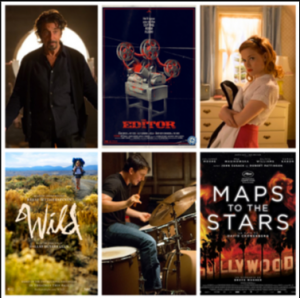
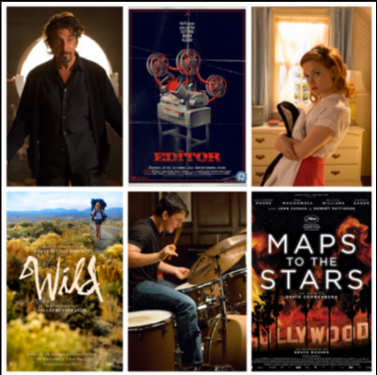
“Wild,” the new film from Jean-Marc Vallée, the Academy Award nominated director of “Dallas Buyer’s Club,” is a road movie. Or rather, a path movie as star Reese Witherspoon hardly spends any of her 1000-mile journey from Mojave Desert to Canada on an actual road.
Witherspoon is Cheryl Strayed, a literate young woman whose life spins out of control after a family tragedy. To ease her pain she steps outside of her marriage to Paul (“The Newsroom’s” Thomas Sadoski) and into a world of booze, drugs and anonymous sex. She calls herself an experimentalist—the “girl who says yes instead of no”—but when she hits rock bottom she runs away from the past toward an uncertain future, cleansing herself and her soul with a 1000-mile trek on the Pacific Crest Trail. “I’m obsessive,” she says, “but this is stretch for me.”
Most road movies are linear. They start at point ‘a’ and by the time the main character is at point ‘z’ they have undergone a spiritual journey as well as a physical one. In “Wild” Cheryl moves continuously moves forward but the story jumps to-and-fro with flashbacks to her childhood and drug fuelled past. The fractured timeline supplies an impressionistic look at Cheryl’s life, as though we are sifting through her memories, looking for clues as to why she ended up on the trail.
It’s a dreamily effective way to tell her story. Filled with happiness, pain, sorrow and more melancholy than a Patsy Cline ballad, it feels like a life on parade. Like puzzle pieces the snippets piece together to eventually form a whole.
The story of Cheryl’s physical survival—too tight boots, toenail trauma, dehydration—is less interesting than her quest for emotional survival. Witherspoon is best not when she’s fumbling with a bowl of “cold mush” or a broken propane heater, but when she puts herself “in the way of beauty, to become the woman her mother (a terrific Laura Dern) said she could be.” Mom told her to “find your best self and hold on to it,” which is not only good advice but also gives Witherspoon the chance to dig deep to find the character.
She can play the comedic bits—struggling with a backpack twice as big as her and being mistaken for a “lady hobo”—but it’s the sensitive stuff that hits home here.
It’s too bad that the movie, in its last thirty minutes, doesn’t trust the audience to process what it just saw. Near the end spirit animals appear and Witherspoon’s narration recaps her journey. Unless you walk in during the movie’s last act you already know everything about the journey and don’t need a summary.
Luckily the last few minutes also contain a scene so strange and emotional it rescues it from tipping over into sentimentality. Walking along the path, almost at her destination, Cheryl encounters a young boy and his grandmother. After some conversation the lad sings a verse or two of “Red River Valley” and provides the movie with one of its quietly emotional highlights.
“The Good Lie,” a new drama starring Reese Witherspoon in full-on Sandra “The Blind Side” Bullock mode, shines a light on an important story but does so in a familiar way.
The story begins during Sudan’s civil war, a brutal conflict that forced thousands of people—most of them little more than children—to walk thousands of miles to flee the violence. Almost all ended up in refugee camps, some for years. “The Good Lie” is aboutleft four “lost” boys and girls who were given a chance at a life in America. Mamere (Arnold Oceng), Jeremiah (Ger Duany), Paul (Emmanuel Jal) and Mamere’s sister Abital (Kuoth Wiel) are the recipients of humanitarian aid and relocated to the US, but due to a bureaucratic rule Abital is separated from the men.
In charge of finding work for the new comers is Carrie (Witherspoon), a case worker who, at first, is looking to get their file off her desk but soon becomes involved in their lives and their need to be reunited as a family.
Academy Award-nominated “Monsieur Lazhar” director Philippe Falardeau is straightforward in his telling of this story, mixing the human interest story with large dollops of humor and humanity, but echoes of other movies, like “The Blind Side” and “Dangerous Minds” reverberate throughout.
Falardeau focuses on the story of the refugees but the inclusion of Carrie, Witherspoon’s well-meaning case worker, shifts attention away from the crux of the story, as if the Sudanese somehow has more gravitas if told through a North American lens.
It is, however, a well-intentioned, feel good movie, nicely performed by Witherspoon and the Sudanese cast—Duany and Oceng are stand-outs—that is more successful at raising a smiles than awareness.
Metro’s Reel Guys columnists Richard Crouse and Mark Breslin take a look at this year’s crop of potential crowd pleasers at the festival.
Richard: Mark, every year I look forward to covering the festival with a mix of dread and anticipation. The dread part comes from knowing how I’m going to feel once the 10 days of 18-hour shifts is finally over. The drooling anticipation part comes along with the slate of films TIFF offers up. This year the new David Cronenberg film is top of my list. In Maps to the Stars, he showcases the stupid, venal and stratospherically self-involved behaviour that goes on behind the scenes in Beverly Hills’ gated communities. The idea of debuting a jaundiced look at Hollywood at the biggest film festival in North America appeals to my rebellious side.
Mark: Can’t wait, Richard, for this or any other Cronenberg! I’m also a big fan of Jason Reitman, who consistently delivers movies that plumb the abyss of the zeitgeist. His latest, Men, Women, and Children, should be no exception. Based on one of my favourite novels by Chad Kultgen, it’s a look at how the Internet is warping families, twisting our sexuality and mediating our desires. Oh, and it’s a comedy.
RC: Mark, the sci-fi musical genre has been sadly overlooked at TIFF in past years. That changes with Bang Bang Baby, starring Jane Levy as a 1960s teenager whose dreams of rock ’n’ roll stardom are dashed when a chemical leak in her town causes mass mutations and “threatens to turn her dream into a nightmare.” Then there’s The Editor, a giallo-comedy tribute to the films of Mario Bava and Dario Argento about a one-handed film editor who becomes the prime suspect in a brutal series of murders.
MB: Sounds great, Richard! I’ll stand in line to see the new Denys Arcand film, An Eye For Beauty. Here’s a director not afraid to take a satirical look at our modern mores, but he’s never tackled a love story before. Some of it takes place in Toronto, so I’m expecting a sly gimlet-eyed view from this great Québécois director.
RC: Speaking of great Québécois directors, Jean-Marc Vallée, the Canadian Oscar nominee for Dallas Buyers Club, returns to TIFF with Wild, starring Reese Witherspoon in the story of a woman who finds an escape from her self-destructive ways on a 1,100-mile solo hike along the Pacific Crest Trail. I’m also psyched about Haemoo. With a script by Snowpiercer penner Bong Joon-ho, this movie about a fishing crew smuggling illegal immigrants from China to Korea promises wild action and unexpected thrills.
MB: Richard, do you realize all our picks inadvertently turned out to be Canadian directors? I’m looking forward to Black and White by Mike Binder. It promises to be a heartfelt drama about an interracial family with issues. Binder is from Detroit but went to summer camp in Muskoka, so he qualifies as an honorary Canuck.
The Toronto International Film Festival premieres some of the best movies across the globe and attracts some of the biggest names in Hollywood. This year is certainly no exception with expected appearances from Reese Witherspoon, Robert Downey Jr., Kristen Wiig, Bill Murray and more.
Each year we get the inside scoop on the hottest TIFF movie premieres from renowned Canadian critic Richard Crouse, an expert in what films to see…and what films to skip…
Last year ago a documentary called “West of Memphis” detailed the gruesome murders of three children, the subsequent trial of teenagers Jessie Misskelley Jr, Damien Echols and Jason Baldwin, the court case that found them guilty and, finally, the evidence that suggested otherwise.
It was an in-depth look at a case that had already inspired three documentaries in the Paradise Lost series and a number of books.
Now comes “Devil’s Knot,” director Atom Egoyan’s dramatization of the events leading up to the murders and the “Satanic panic” that fuelled the hysteria surrounding the subsequent trial.
The movie’s first twenty minutes captures the easy-going pace of life in West Memphis, Arkansas. It’s into this dreamy setting that Pam Hobbs (Reese Witherspoon) sends her young son off to play with a friend. She never sees her son alive again. After a massive search the boy and two others are found, hogtied and naked at the bottom of a stream, ominously called Devil’s Creek.
Blame for the deaths falls to three teens—Misskelley Jr (Kristopher Higgins), Echols (James Hamrick) and Baldwin (Seth Meriwether)—outsiders, heavy metal fans and suspected Satanists.
“You don’t look like that when you’re a normal person,” says Pam, taking in Damien’s all black attire and detached demeanor.
The case, ripe with flimsy evidence, attracts the attention of investigator Ron Lax (Colin Firth) who senses that the teens are being railroaded because they are different. “A town loses three of its children,” he says, “and then sacrifices three more in the name of revenge.”
The rest of the story is well documented. The three are found guilty and serve eighteen years until the three were offered an Alford Plea, a little used petition that sees them released from prison on the proviso that they plead guilty to the crime.
In the past the story has usually been told from the point of view of the “killers” and their supporters. “Devil’s Knot” focuses on the Hobbs family—including stepfather Terry, who, it is suggested may have been involved in the killing—and the private investigator. It’s a slightly different take on the tale, although the details are familiar from the other retellings of the story.
The connect-the-dots procedural is buoyed by some top-flight performances. As Vicki Hutcherson, a woman tempted by Echols’ charisma, Mireille Enos is a live wire and Witherspoon deftly captures the grief of a mother and the skepticism of someone who is not buying into her town’s lynch mob mentality.
“Devil’s Knot” does a good job of telling a fascinating, if somewhat familiar story. Fans of the “Paradise Lost” and “West of Memphis” movies won’t find much new information here, but Egoyan has stripped away the clinical nature of the documentary to reveal the personalities behind the headlines.
This has been a banner year for celebrity bios on film. Phillip Seymour Hoffman is a lock for an Academy Award nomination for his performance as the title character in Capote and David Strathairn’s turn as Edward R. Murrow in Good Night and Good Luck has won raves. Add to the list of possible nominees the two leads in Walk the Line. Joaquin Phoenix as Johnny Cash and Reese Witherspoon as June Carter are both Oscar worthy in a film that, unfortunately, isn’t a match to their talents.
Walk the Line follows the tried and true film biography template that Ray mined so successfully last year, providing the greatest hits of Cash’s life—a traumatic childhood event, a cruel father, years of pill popping, an on-again-off-again relationship with June Carter Cash and his rise to fame—in a competent but disposable film.
Phoenix—who imitates Cash’s vocals in a convincing deep rumble—brings the larger-than-life Cash crashing down to earth, playing him as a weak-willed man who fought a lifelong battle with the demons of his past. In Walk the Line’s version of events popping pills was the only remedy for Cash’s daddy issues. Reese Witherspoon’s June Carter is the best performance since Election. Her façade of cheeriness carefully masks Carter’s own inner heartbreak and inner strength. The scenes they share are the film’s strongest and it’s a pity that their relationship isn’t the main focus of the story.
Walk the Line is slick Hollywood product—everything that Johnny Cash wasn’t—and could have benefited from a more audacious and gritty approach.
The success of movies like The Bells of St Mary’s and A Christmas Carol triggered an avalanche of Yuletide themed movies from producers eager to cash in on the spirit of the season. Every year a new one comes out and for every hit there are a Santa’s sack of stinkers like Jingle All the Way and Surviving Christmas. This year’s entry is Four Christmases, the story of two smarmy yuppies played by Vince Vaughn and Reese Witherspoon who lie to their families—“You can’t spell families without ‘lies,’” Vaughn says—to get out of spending quality time with their siblings and parents over the holidays. When they get caught in the lie they must spend four Christmases, one with each of their divorced parents.
Every year Brad (Vaughn) and Kate (Witherspoon) sidestep family obligations at Christmas with a series of well crafted lies. They usually tell the folks they have volunteered to do charity work in third world countries but instead take off for the sunny climes of Fiji or some other exotic vacation spot. When their flight gets cancelled and they end up on the news the jig is up—they’ve been busted and have to make the rounds visiting their families. There’s Brad’s crusty old father (Robert Duvall) and his Ultimate Fighter brothers (Jon Favreau and Tim McGraw), Kate’s mother (Mary Steenburgen) and nymphomaniac aunts and grandmother, Brad’s free-loving hippie mother (Sissy Spacek) and Kate’s sensitive but aloof father (Jon Voight). Of course by the end, despite their families foibles, they realize that there is nothing more important than family.
Four Christmases tries for the tricky balance between comedy and heart-warming and almost succeeds. In its first hour it mostly goes for laughs, using Vaughn’s fast-talking jive, slap stick and some outrageous characters to keep the needle on the laugh-o-meter clicking into the red. Sprinkled throughout the four family tour are some good moments and funny situations and some sequences that strain to find the joke which is pretty much on par with an average mainstream comedy not written by Seth Rogen.
Then in the last thirty minutes it’s as if someone flicked off the funny switch and the tone suddenly shifts into heart-warming and it’s here that the movie earns a big lump of coal. The edge of the past sixty-minutes evaporates and all of a sudden we’re watching a TV movie of the week about family values. Reese Witherspoon can pull this off. She’s likeable, emanating a warm fuzzy glow when she’s on-screen. Vaughn can’t. His inborn edginess works well in something like the R-rated Wedding Crashers but falls very flat in family fare; ditto his patented mile-a-minute patter. In fact, his two funniest scenes—both mush mouthed television appearances—work because he finally drops the smart-Alec rapping.
When the movie turns mushy you have to care about the characters in order to care about their love lives, and Vaughn’s lack of warmth works against him here. You’ll see the “family is everything” message coming a mile away; the trouble is by the time it hits you may not care.
Four Christmases isn’t a truly bad movie, just a really predictable one.
Normally I’m not a stickler for punctuation. I’ve been known to drop a comma or two and throw in an inappropriate semi-colon here and there, but the lack of a question mark at the end of the title “How Do You Know” really bugs me. Does director James L. Brooks not have Spelling and Grammar check on his computer? Was star Reese Witherspoon sick the day they taught question mark use in school? What could possibly be the excuse for such an egregious and flagrant abuse of the English language?
In the film Witherspoon is a aging pro athlete at the end of her career. For twelve years she was the star of the USA Woman’s Softball Team, but when she gets cut she finds herself adrift in life. Caught in a love triangle between two men—Paul Rudd and Owen Wilson—who love her for completely different reasons, she must choose one of them but first has to learn how to know when she’s in love.
Even though I was in a bad mood because of all this question mark business, “How Do You Know” still managed to mostly win me over not because it is great, because it isn’t—it rises to the level of good, but not much further than that—but because of its appealing cast.
Witherspoon has been absent from the big screen for two years—her voice work in “Monsters vs. Aliens” doesn’t count—and in that time many have tried and failed to find the rom com sparkle she so effortlessly brings to this movie.
Rudd, as the slightly awkward suitor being investigated for fraud, brings the funny and the mushy and Owen Wilson’s immature pro-ball player is a very funny throwback to his “Zoolander” days.
A big surprise is Kathryn Hahn, as Rudd’s empathic assistant. Best known for roles on television in shows like “Crossing Jordan” and “Hung,” she’s a live wire who brings much to the movie, including its most moving scene. A bigger surprise is Jack Nicholson as Rudd’s devious father. He’s worked with Brooks before, earning two Academy Awards in the process, but here he’s wasted in a role that gives him little to do. For the first time in years Nicholson barely registers on screen.
“How Do You Know” suffers from a weird rhythm, unnecessary minutes in the third act and a major unresolved plot point but is rescued by the enthusiasm of its cast.
A better title for this movie would have been Legally Bland. The makers of the sequel to 2001’s surprise hit comedy Legally Blonde seem to have pushed the new film through the dreaded “movie de-flavourizer,” sucking all the charisma, fun and worst of all, the humour, out of the script. Even Reese Witherspoon, who charmed her way into the Hollywood a-list as pretty-in-pink Elle Woods in the first instalment, seems flat and uninspired.
The story, such that it is, holds a bit of comedic promise. Woods, the not-so-ditzy blonde, wants to invite the mother of her closet friend to her upcoming wedding. That friend is, of course her dog Bruiser, and unfortunately the mother is trapped in an animal testing facility. After trying to convince her stuffy law firm to take action against the laboratory, and getting herself fired in the process, she decides to take on Washington. From here on in the movie follows the pattern established by the original, minus the jokes. As Elle tries to get an animal rights bill passed in congress she is pitted against a series of sit-com worthy characters that are eventually won over by the perky fashionista.
It’s all very trite, which is fine, this is a summer teen movie after all, but the complete absence of chuckle worthy material makes what should have been a light and airy film float like a lead balloon. Not even the reliable Bob Newhart as the wise doorman can wrestle a laugh out of this script.
Making a sequel can be a nasty, unforgiving business – in this case the original was as sweet and gooey as pink cotton candy while Legally Blonde 2: Red, White and Blonde is a sugarless retread.