SYNOPSIS: In “The Instigators,” a new heist comedy film now streaming on Apple TV+, Matt Damon and Casey Affleck play desperate father Rory and ex-con Cobby, unlikely partners thrown together to rob a corrupt politician’s war chest. When the caper goes sideways, the inept thieves hit the road, doing whatever it takes to stay one step ahead of the police, the mayor’s henchman and a vengeful crime boss. “We’ve got to find these guys before the cops do,” says kingpin Dechico (Michael Stuhlbarg), “and put them down before they can talk.”
CAST: Matt Damon, Casey Affleck, Hong Chau, Michael Stuhlbarg, Alfred Molina, Jack Harlow, Ving Rhames, Ron Perlman, Paul Walter Hauser, Toby Jones. Directed by Doug Liman.
REVIEW: Fresh off their success in “Oppenheimer,” Damon and Affleck reteam in a movie that mixes-and-matches a caper with a political satire, action with a buddy comedy. It’s a laundry list of genres, but it works, aided by a terrific ensemble cast and the steady hand of director Doug Liman.
Liman and Damon, of course, first worked together twenty-two years ago on “The Bourne Identity.” While their new movie features some action, a really solid car chase and exploding buildings, the two characters, super spy Jason Bourne and the down-on-his-luck Rory, are polar opposites.
Bourne suffered from psychogenic amnesia, and used his special set of skills to rediscover his past. Rory is very much aware of his past, of his failings as a father, and Damon plays him as an everyman, a desperate guy who’ll do whatever it takes to make a few extra bucks for his estranged family, no matter the cost to him personally. Damon skilfully balances the character’s backstory with the increasing absurdity of his present-day situation.
In a rare humorous performance, Affleck is the more obviously funny character, and yet, Cobby is not just comedic construct. He’s a small-timer, used to things going sideways, and much of the humor in the film comes from his deadpan reactions as their situation worsens.
In a strong supporting cast, featuring heavy-weights like Michael Stuhlbarg and Alfred Molina in what are essentially extended cameos, Hong Chau as Rory’s psychiatrist, is a standout, both empathetic and hilarious.
“The Instigators” has everything you expect from a film about a heist gone wrong, but really, it’s not about the robbery or the explosions. It’s about the budding friendship between Rory and Cobby. Brought together by adversity and desperation, they become unlikely allies in a film that cleverly and humorously breathes new life into the failed-criminals-on-the-run genre, through interesting characters, some high-powered action and genuinely funny situations.
LOGLINE: “Inside Out 2,” a new animated movie from Pixar now playing in theatres, returns to the inner workings of the mind of Riley. Emotions like Joy, Sadness, Anger, Fear and Disgust have helped Riley get through life successfully to the age of thirteen. “Thirteen years of hard work wrapped up in what some might call our masterpiece,” says Joy. Now a teenager, however, Riley’s emotions have been taken over by Anxiety, Envy, Ennui and Embarrassment, leaving Joy and Co on the outside.
CAST: Amy Poehler, Phyllis Smith, Lewis Black, Diane Lane, and Kyle MacLachlan, Tony Hale, Liza Lapira, Maya Hawke, Ayo Edebiri, Adèle Exarchopoulos, Paul Walter Hauser. Directed by Kelsey Mann
REVIEW: After a few films that didn’t live up to the gold standard established by movies like “Up” and “Toy Story,” “Inside Out 2” is a return to form for Pixar. It may not have the emotional originality of the first film, but it does deliver a touching coming-of-age story by way of an adventure through the evolving personality of a thirteen-year-old.
Inventive and vivid animation bring to life the processing plant where Riley’s emotions originate. Part high tech work station, part ephemeral mindscape, it’s a cool, and eye-catching, backdrop to the story.
As for the story, it’s a typical tale of growing up, the complexity of navigating emotions with relationships and family life, but it is reshaped by a healthy dose of imagination. Director Kelsey Mann toggles between Riley’s inner and outer life, deftly displaying the multiplicity of emotions that makes her human. It’s a romp, but it’s also a lesson in life and the things that give Riley a sense of self.
Added to the returning voice cast—Poehler, Smith, Black, Lane, and MacLachlan—are standouts Adèle Exarchopoulos as Ennui—“It’s what you would call ‘the boredom.’”—Envy as voiced by “The Bear’s” Ayo Edebiri and Maya Hawke as Anxiety.
As portrayed in the film, Anxiety is a juxtaposition of good and bad as Riley learns to harness the tension that accompanies the emotion for her own good. It’s an interesting take, and Hawke brings the character to life with a spirited performance. “Don’t worry Riley,” she says, “you’re in good hands. Now let’s change everything about you.”
Like the best of Pixar, “Inside Out 2” is doubled edged. It’s an adventure story for kids, but one that transcends the form with abstract, adult thoughts on the things that make us, us.
Richard Crouse makes a Salty Dog, the perfect cocktail to enjoy while paying tribute to animal actor stars of “Cruella,” the latest Disney live-action reboot. Come have a drink and a think about “Cruella” with us!
“Cruella,” now available in select theatres and on Disney+ with Premier Access, is an origin story that explains the reason why one of Disney’s greatest villains hates Dalmatians.
One eventful day defined Estella’s (Tipper Seifert-Cleveland) life. In less than twenty-four hours, the precious preteen with the distinctive mop of black and white hair, got kicked out of an upscale private school, snuck into a fashion show and thought, “for the first time in my life, I feel like I belong,“ and developed a lifelong hatred of Dalmatians. I won’t say why, but she does have a good reason to harbor animosity toward the spotted dogs. Most tragically, she lost her mother that same day.
Cut loose and alone, she lands in 1964 London. Falling in with petty thieves Jasper (Joel Fry) and Horace (Paul Walter Hauser), Estella (now played by Emma Stone) forms an impromptu family, pulling off scams using disguises designed and made by her own hand.
Still, she’s not satisfied. “I want to be a professional designer,” she says, “not a thief.”
Securing an entry level job at an upscale department store, she gets the attention of The Baroness (Emma Thompson), a cruel, imperious clothing designer who says things like, “Gratitude is for losers.” She is the undisputed matriarch London fashion and will crush anyone who gets in her way.
As Estella rises through the ranks, she becomes aware of a connection between The Baroness and the death of her mother. Until then, she believed she was responsible for her mother’s passing and had gone through the five stages of grief. Denial, anger, bargaining, depression and acceptance. Now she adds a sixth stage, revenge.
“I’m starting to remember that you have an extreme side,” says Estella’s old friend Anita Darling (Kirby Howell-Baptiste).
Determined to ruin The Baroness, break her spirit, her confidence and her business. Estella creates an alter ego, the disruptive Cruella. In a series of staged public stunts Cruella humiliates The Baroness and becomes the darling of the fashion world. “Some call her a designer,” a TV talking head breathlessly reports, “some call her a vandal.”
As the “mad, bad and just a little bit sad” Cruella’s antics escalate, Estella’s personality grows fainter. “I’m not sweet Estella, try as I might. I’m Cruella.”
“Cruella” has lots going for it. Great costume design, a rippin’ soundtrack and arch attitude, but by the time the end credits roll, it is all about the dueling Emmas, Stone and Thompson.
“Wow,” says Cruella. “You really are a psycho. “How nice of you to say,” The Baroness snaps back.
Both hand in flamboyant performances that capture the wickedly humorous tone of the story.
Stone’s performance straddles the line between her two characters as Estella’s attempts to fit into the regular world fade, as bits and pieces of Cruella’s anything goes mentality filter through until she goes full-on baddie. The punk rock-glam inspired clothes help in the transformation, but the heart comes from Stone, who does something difficult, bring a tragic heart to a villain.
As The Baroness, Thompson is the is the Queen of the Side Eye. It’s a wonderfully comedic performance, equal parts disdain, evil and ridiculous, she redefines arrogance. Think “The Devil Wears Prada” with a sharper edge. It’s the kind of work you want to watch at least twice to catch all the small bits of business she weaves into the performance.
Propelled by the performances and a music-heavy soundtrack featuring everything from The Doors and Nina Simone to Iggy & The Stooges (this must be the first Disney film to feature the proto-punk tune “I Wanna Be Your Dog”) and Tina Turner, “Cruella” rocks along at a clip until it loses steam near the end as it prepares itself for the sequel.
Until then, however, “Cruella” is the most audacious of the recent live action reimaginings of a classic Disney character.
Mild mannered office worker Sid Straw, played by “Veep”/”Arrested Development” star Tony Hale in the new V.O.D. comedy “Eat Wheaties!,” claims to be a close acquittance of “Huger Games” star Elizabeth Banks.
“There is no such thing,” says her manager (Sarah Chalke).
As the cringe comedy begins Sid is unlucky in love, an expert in saying the wrong thing, misreading signals and trying too hard. “I understand that I am not the most exciting person out there,” he says. When he is named co-chair of the upcoming University of Pennsylvania’s reunion it is the beginning of a spiral. Setting up a Facebook page to publicize the event, he repeatedly messages Banks, an alumnus he claims to have been acquainted with decades ago.
Not realizing the posts are public, he bombards her account with a series of personal notes inviting her to the reunion. His many messages go unnoticed by the star but not her team, who file a restraining order against him. When the posts go viral—“What does that mean?” he asks.—his life unwinds as he is publicly and personally humiliated.
Based on the novel “The Locklear Letters” by Michael Kun, “Eat Wheaties!” (that was Banks’ catchphrase in school), is a mix of tragedy and comedy, made human by Hale’s performance. Sid could have been a collection of quirks but Hale paints him differently. Sid is a lovable loser and Hale plays him as a sweet, lonely guy, oblivious to the hole he’s digging for himself.
Hale is supported by a great supporting cast, including Paul Walter Hauser, Elisha Cuthbert, Lamorne Morris and Robbie Amell, who play off Sid’s social awkwardness with good-natured sympathy.
“Eat Wheaties!” is a tightly paced comedy which is more about kindness and doing the right thing than it is about knee slapping jokes. It is occasionally knee-slapping funny but the laughs come from kind-heartedness, not cruelty and that makes this quirky comedy a winner.
“Songbird,” a new film produced by Michael Bay and now on premium VOD, feels ripped from the headlines.
Like, today’s headlines.
The first film to shoot in Los Angeles during the lockdown details life during COVID.
Set in 2024, during the fourth year of pandemic, COVID has mutated, leaving the United States under martial law were infected citizens are forcibly removed from their homes. Treated like walking, talking biohazards they are housed in concentration camps called Q-Zones.
Meanwhile, motorcycle courier Nico (KJ Apa) is immune. A recovered COVID patient, he has the antibodies to fight off the disease. When his locked-down girlfriend Sarah (Sofia Carson) is suspected of contracting the virus, Nico springs into action to save her from being taken away.
There are side characters galore, like Bradley Whitford’s sex-crazed record producer, a lovelorn veteran played by Paul Walter Hauser, Demi Moore’s protective mom and an over-the-top Peter Stormare as the evil head of the Los Angeles’ “sanitation” department–but most of them exist only to heighten the grim desperation of the situation.
“Songbird” isn’t a politicized screed about masks or the virus’ origin. Instead, it’s a star-crossed style romance—”You’ve never been in the same room,” says Sara’s mother, “but he loves you.”—set against the backdrop of the worst world event in decades.
It would be one thing if “Songbird” had something to add the conversation about COVID, but it doesn’t. Instead, it plays off our worst collective fears in clumsy and exploitative ways.
It’s likely to appeal to conspiracy enthusiasts who may finger their tinfoil hats in excitement at the mention of bracelets for “munies”—the immune—an unchecked department of sanitation who arrest at will, apps that will report you if your temperature is above normal and ever-present surveillance.
For those not inclined toward dystopian extremes, “Songbird” is a crass reminder of the real-life death, sickness, unemployment and heartache COVID has wrought. It feels tone deaf, and worse, it’s a bad movie.
Spike Lee movies are like onions. Peel off a layer and there’s a new one beneath. Take that off and another reveals itself. His latest, “Da 5 Bloods,” now streaming on Netflix, is even more multi-faceted than usual. The director calls it a “gumbo,” a rich stew of varied ingredients. It’s a two-and-half-hour Vietnam War legacy film featuring a Trump supporter in a leading role. It’s a searing look at how African American soldiers fought in a war for a country that didn’t support them and it’s an adventure film, à la “The Treasure of the Sierra Madre” with action scenes and even buried treasure.
Most of all, it feels like a film that only Spike Lee, the auteur, could have made.
The story centers on the Bloods, MAGA-man Paul (Delroy Lindo), Otis (Clarke Peters), Melvin (Isiah Whitlock Jr.) and Eddie (Norm Lewis), four African American vets who return to Vietnam almost fifty years after their last tour of duty. They hope to recover the remains of, “the best damn soldier who ever lived,” their Squad Leader, Stormin’ Norman (Chadwick Boseman).
It’s a noble mission indeed, but there’s more. A lot more in the form of CIA gold bars intended as bribes for the Vietnamese government but hijacked by the Bloods and hidden in the jungle. “We’ve been dying for this country from the very get,” says Norman in a flashback. “We give this gold to our people.”
It seems like a foolproof plan but almost as soon as the men land in Vietnam they are beset with problems, some new, some a product of their past. “Being back here is not easy,” says Paul.
“Da 5 Bloods” weaves archival footage of Rev. Dr. Martin Luther King Jr., Muhammad Ali, Angela Davis and Kwame Ture among others, and 60s era music into the narrative, creating a vivid portrait of time and place. Add to that a study of the effects of PTSD, political corruption and some interpersonal politics between the main characters—including Jonathan Majors as Paul’s estranged son David—action scenes and a slimy banker (Jean Reno) and you have a big, bold movie that aims to entertain and reckon with social issues that linger years after the Vietnam War ended.
“Da 5 Bloods” explores areas of the African American experience in Vietnam that have never been exclusively the subject of a film. Lee and co-writer Kevin Willmott, with whom the director shared an Academy Award for Best Adapted Screenplay for “BlacKkKlansman,” have crafted a poignant, if slightly overlong, look at the lasting effects of fighting a war for freedoms the Bloods and their counterparts were being denied at home. “Black GI,” taunts propagandist Hanoi Hannah (Van Veronica Ngo) on Radio Hanoi, “is it fair to serve more than the white Americans who sent you here?”
Lee makes daring choices—not de-aging the older actors in the flashback scenes, for instance—but never obscures the film’s central message. “Every time I walk out my front door I see cops patrolling my neighborhood like it’s some kind of police state,” Stormin’ Norman says, circa 1971. “I can feel just how much I ain’t worth.” The pain and anger in those words, and in this film, is undiminished by the passing years.
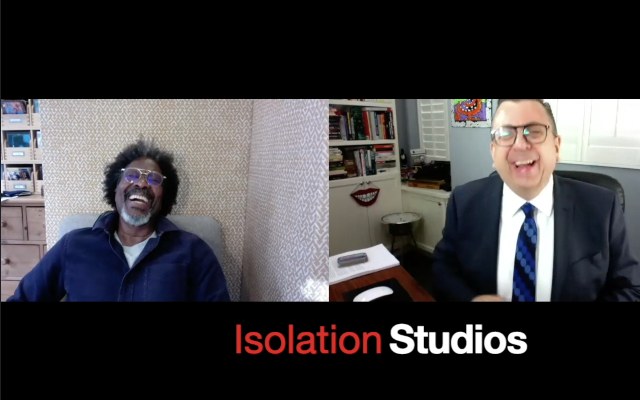
Check out episode eighteen of Richard’s new web series, “In Isolation With…” It’s the talk show where we make a connection without actually making contact! Today, broadcasting directly from Isolation Studios (a.k.a. my home office), we meet Clarke Peters, one of the stars of the new Spike Lee joint “Da 5 Bloods.” It’s an adventure movie that also examines the role of African American soldiers in Vietnam and how that conflict affected the rest of their lives. We talk about how he was accused of draft evasion by the FBI, how life during the pandemic has taught us to think about more than just ourselves and why he considers himself a stage actor first and foremost.
Here’s Clarke Peters on being a stage actor: “For those actors who understand the magic of it, we also understand that there’s a great responsibility in it. It is not about your ego. You are not the star. It’s the story that you’re telling, that’s the star, and you tell that story as best as you can. Through the years you find ways to hone your craft, so that you know that if I hold on for just two seconds longer before saying this next word that a tear is going to come up in somebody’s eyes over there, or that the whole audience is going to fall out and laughter. That’s a hell of a power to have and a hell of a responsibility, but also very necessary service for society in the situation that we’re in now.”
Then, we meet photographer and documentary film maker Paul Perrier. As many of us sheltered in place at the beginning of the pandemic Paul grabbed his camera and hit the streets, taking photos of people and their masks. The result is The Toronto Portrait Project, a series of photographs that document the face… or I guess… faces of the pandemic.
Watch the whole thing HERE on YouTube and HERE on ctvnews.ca!