“Youth,” the second English language film from “The Great Beauty” director Paolo Sorrentino, takes on some of life’s great questions, life and death stuff painted with remorse, hope and, most importantly, a large helping of whimsy.
Set in a chic hotel in alpine Switzerland, retired composer Fred Ballinger (Michael Caine) and his childhood friend, film director Mick (Harvey Keitel) are plotting the next moves in their careers and lives.
Ballinger wants to disappear, fade away from public life and live quietly. He refuses repeated requests to perform his best known work at a command performance from Queen Elizabeth’s envoy (Alex Macqueen) and tells his assistant, Lena (Rachel Weisz) who also happens to be his daughter, to turn down a French publisher who desperately wants him to write a memoir.
Mick is in a different place. After a string of flops he’s writing a new film to feature his greatest star, Brenda Morel (Jane Fonda). They’ve made a dozen films together but he sees the new movie, “Life’s Last Day,” as a comeback and their greatest collaboration.
“Youth” is a study of these two men. Other things happen of course; Lena’s husband leaves her for a pop star—in a po-mo twist real life singer Paloma Faith plays herself as the home wrecker—a movie star (Paul Dano) researches a new role at the hotel and Miss Universe (Madalina Diana Ghenea) makes a memorable appearance, but the attention is focussed on Fred and Mick and their divergent paths to happiness.
Their journeys are bathed in Sorrentino’s impeccable images. The film is a lush tapestry of beautifully composed frames and optical delight. Ornate and elegant, the visuals are as complex as the film’s multilayered look at life’s rich pageant. Fred and Mick have lived life, and now in their final years try and assess the value of their experience. Sounds heavy but its not. It’s fleet footed, taking time only to luxuriate in the details of their lives and surroundings.
“Youth” is a mediation on life and age that succeeds by the director’s craft. Talking to a young colleague Mick demonstrates the effects of age by having her look at the distant mountains through a telescope. The mountains appear to be close. Then he flips the scope around and changes the perspective. “Being young makes everything close,” he says. “Being old makes everything far away.” Like the rest of the film it’s simple and subtle but is perfectly realized by Sorrentino’s mastery of blending story, ideas and images.
Usually the scariest thing about Vin Diesel is the amount of money his movies make. The Fast and Furious franchise has raked in more than $4 billion. Add in revenue from Guardians of the Galaxy and Riddick and you have a truly terrifying amount of money.
In his new film, The Last Witch Hunter, the raspy-voiced actor boasts, “You know what I’m afraid of? Nothing,” as he delivers scares playing an immortal warrior who must prevent evil New York witches from destroying the world. The 48-year-old is so convinced the movie will do well, he’s already announced that the studio is developing a sequel.
“The first one doesn’t hit theatres until October 23rd,” he wrote on Facebook in July, “yet they want me to commit and already block out time to film it.”
Before Fast and Furious made him Hollywood’s version of an ATM, Diesel made baby steps towards becoming a superstar. Director Steven Spielberg saw Multi-Facial, Diesel’s self directed, written, produced and scored über low budget short film and was so taken with the young actor he had the role of Private Caparzo in Saving Private Ryan specially written for him. The result was an effective performance that mixed physicality with poignancy. Winning the role, he says, was “like one of those Hollywood fairy tales that you never believed.”
Critics began to take notice. New York Times critic A.O. Scott said he, “may be the sexiest ugly man in movies since Anthony Quinn” as Diesel lent his distinctive gravelly voice to the title character in the animated film The Iron Giant and played streetwise stockbroker Chris Varick in the 2000 stockbroker drama Boiler Room.
His breakout performance came with the sci-fi film Pitch Black. “Richard B. Riddick,” he says by way of introduction. “Escaped convict. Murderer.” Artificial eyes allow Riddick to see in the dark, making him very useful when bloodthirsty creatures attack during a month-long eclipse. The character became a franchise for the actor, spawning sequels, video games and animated films.
“I know it sounds corny but I feel like I learn about myself when I play that character,” said Diesel. “Going to that dark isolated place produces some kind of vision or understanding about myself. He mirrors my own quest for identity, my eternal quest as a child.”
Movies like Knockaround Guys and Babylon A.D. played on his tough guy persona, but with The Pacifier he tried to switch from cracking ribs to tickling funny bones. Playing a Navy Seal assigned to protect a house full of out-of-control kids, he attempted to prove he was more than just a muscle mass that got lucky in pictures. The chaotic comedy made some money, but ultimately proved Diesel’s strength lay in muscle, not mayhem.
Since then he has stayed the course, pumping out action-adventure films — including the soon-to-be relaunched xXx — proving himself to be a great action star. Smarter than Stallone, younger than Schwarzenegger and with even less hair than Bruce Willis, his appeal transcends his biceps, as he also appears to have a brain in his head. Throw in a large dollop of charisma and look out Jason Statham, you’re about to be kick boxed into the old age home.
Vin Diesel looks good for an 800 year-old-man… er… immortal witch hunter. He’s Kaulder, a former mortal whose family was wiped out by the Witch Queen’s (Julie Engelbrecht) deadly black plague. The only way to destroy her is to still her beating heart, but before he can do so she places a hex on him. With all his family gone he has nothing to live for, so she curses him with immortality.
Centuries later he’s a supernatural superman, living in a swank Central Park South apartment and bedding flight attendants when he’s not subduing bad witches. Known as “the Weapon,” he works with a Dolan—a spiritual advisor—and helps enforce the uneasy truce that has been struck between witches and humans. When Dolan 36 (Michael Caine) steps down and winds up dead within twenty-four hours (“I’ve seen people get old, retire and die but rarely on the same day,” Kaulder says.) the hunter knows evil forces are at work. With the aid of Dolan 37 (Elijah Wood) and an unlikely witch ally (“Game of Thrones” star Rose Leslie) Kaulder seeks to finally put an end to an ancient evil.
“You know what I’m afraid of?” asks Kaulder. “Nothing. It’s boring really.” And so is “The Last Witch Hunter” because nothing remotely scary happens. It’s as though the film was originally written as a straight ahead action movie. Here’s the pitch: Gravelly-voiced man fights the baddies with the help of an aging mentor and a sidekick. It’s the generic hero’s journey. It’s “The Dark Knight” without the cape (but with Michael Caine). It feels like someone read the script early on and said, “You know what would make this great? Witches and Vin Diesel,” but even the addition of supernatural elements like Dreamwalkers, cranky witches and immortality can’t disguise the fact that this is as generic an action movie as we’ve seen this year.
It follows a familiar pattern: Action scene followed by witch hunting mumbo jumbo that segues into a fight scene. Reset with a buddy, buddy scene featuring dialogue like, “You’re not qualified for what happens next.” Add to the mix flashbacks, light romance and loud special effects and you have every generic action movie ever made… with witches.
Diesel is fast and furious enough to deliver the “Conan the Barbarian” level dialogue (like: “The benefit of eternal life is that I get to kill you twice!”) with conviction but the movie is dull enough you’ll wish these witches would go away for a spell.
In the upcoming film Kingsman: The Secret Service, Colin Firth plays a veteran of an independent international intelligence agency.
“The Kingsmen agents,” he says, “are the new knights.” He recruits a rookie (Taron Egerton) into the agency’s training program — “the most dangerous job interview in the world” — just as twisted madman Valentine (Samuel L. Jackson), launches a plan to bring down the Kingsmen and cause world chaos.
Echoes of James Bond hang heavy over the story. There are suave spies, a warped villain in the vein of Dr. Julius No or Ernst Blofeld, an evil henchman, or in this case henchlady, named Gazelle (Sofia Boutella) who has knives where other people have feet. Above all, it has gadgets. Firth and his fellow agents — Michael Caine and Mark Strong — have umbrellas that deflect bullets and Zippo lighter hand grenades among other thingamajigs that no spy should leave home without.
Ever since 007 was kitted out with an attaché briefcase equipped with a folding sniper rifle, ammunition, a knife and 50 gold sovereigns in From Russia With Love, gadgets have become de rigueur in spy stories.
From jetpacks to a mobile phone with a stun gun and fingerprint scanner, Bond always had the coolest contraptions. His most famous gadget, the Aston Martin DB5, was introduced 22 minutes into Goldfinger. Bond’s big rig came fortified with machine guns, ejector seats, a back shield, oil slick, rotating licence plates and tire slicers.
The car has appeared in six movies with later models featuring upgrades like a rear facing water canon, a jetpack stowed in the trunk and a cloaking shield.
Bond’s awesome auto has inspired many other souped-up spy-mobiles, including the Pontiac GTO from xXx. Xander Cage’s (Vin Diesel) car came with stinger missiles, parachutes, a flame-thrower and exploding hubcaps.007 and xXx have sweet rides, but the Our Man Flint spy parody had the wildest stuff. Derek Flint’s (James Coburn) watch not only told time but doubled as a microscope and his lighter had “82 different functions,” he said, “83 if you want to light a cigar.”
Four years ago a restaurant tour by two British comedians resulted in one of the most charming films of 2010. “The Trip” was an improvised journey not just through Northern England’s culinary scene but through the psyches of Steve Coogan and Rob Brydon as they comment on life, usually while doing spot-on Michael Caine impressions.
The Michael “You were only supposed to blow the bloody doors off!” Caine impressions are back in full force in “The Trip to Italy,” as are the laughs and the self-aware conversations.
This time around Coogan and Brydon rent a Mini Cooper and retrace the steps of the Byron and the other Romantic poets’ grand tour of Italy set to the music of Alanis Morissette’s “Jagged Little Pill.” They eat, banter and take in the view from Liguria to Capri. Between a hysterical re-imagining of the dialogue from “The Dark Knight Rises”—“I can Hardy understand what Tom’s saying.”—and a one-sided conversation with a preserved corpse in Pompeii, is a study on everything from fatherhood to fame to faithfulness.
Director Michael Winterbottom luxuriates in the chemistry between the two men. They are naturals, an intellectual version of The Two Ronnies, who riff on everything from pop culture hot buttons like Batman and pop music to the carnal exploits of Lord Byron. Their interplay is the key to keeping the rambling narrative on track and it is enough. They are the film’s glue and the sheer joy of watching them spar prevents the film from dipping into self-indulgence. That, and the gorgeous scenery.
“The Trip to Italy” is a riotous comedy that finds time for self-reflection, Roger Moore impressions and the timeless Alanis Morissette vs Avril Lavigne debate and it is intimate and infectious.
Susan Smythe-Bishop is not only one of the country’s most talented film publicists, but she is also a mean cake designer and baker and a gifted artist. On her website www.theaccidentalvicepresident.com she showcases her story and her art. Most recently she kindly included Richard on her Wall of Fame, a collection of drawings of “the kind and hard working artists” she has worked with over the years. Other entries include Michael Caine, Bryan Cranston, Jackie Chan, David Cronenberg and Sir Anthony Hopkins. Have a look now before she changes her mind and replaces Richard with David Hasselhoff!
“You’re a con artist,” wrote Karina Halle in Sins & Needles. “A liar. A thief. An unredeemable soul.”
She might also have added to that colourful list really interesting movie character.
As despicable as flim flam artists may be, there is no denying they make good film subjects.
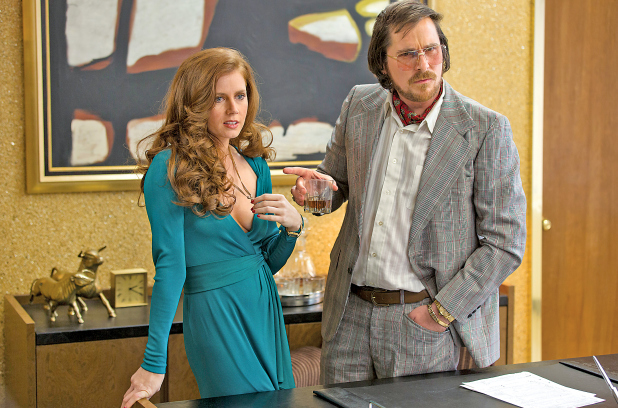
This weekend in American Hustle, Christian Bale plays Irving Rosenfeld, a con man forced to help the FBI ensnare a group of corrupt politicians in the ABSCAM sting operation.
Although American Hustle director David O. Russell says his film is a fictionalized account of events, the ABSCAM operation was headline news in the early 1980s and Hollywood took notice.
In 1982 director Louis Malle was making plans for a May start date on an ABSCAM film called Moon Over Miami starring Dan Aykroyd and John Belushi. Belushi was to play Melvin Weinberg, based on the same man as Bale’s character in American Hustle.
The movie was scuttled following Belushi’s death in March of that year.
That con man film never saw the light of day, but many others have.
Everyone knows The Sting and The Grifters, but lesser seen is David Mamet’s The Spanish Prisoner, a complicated story starring Campbell Scott as Joe Ross, a man who invents a process “to control the world market.” Concerned that he will not be properly compensated for his work he contacts Jimmy Dell (Steve Martin), a wealthy businessman who offers to help. Little does Ross know that he has just stepped into a world of deception that will change his life.
Steve Martin’s performance in The Spanish Prisoner was Oscar worthy, but it wasn’t the first time he played a confidence man on film.
In the comedy Dirty Rotten Scoundrels he starred opposite Michael Caine as a scruffy con man trying to muscle in on some high end business on the French Riviera. Caine’s suave grifter makes a bet with Martin. Whoever can con Soap Queen Janet Colgate (Glenne Headley) first will walk away with $50,000.
The movie was written for Mick Jagger and David Bowie who were looking to do a project together after the success of their Dancing in the Street video. The rock stars dropped out before cameras rolled — Bowie later said both were, “a bit tweezed that we lost out on a script that could have been reasonably good” — and replaced by Martin and Caine whose hilarious performances earned the movie a spot on Bravo’s 100 Funniest Movies list.
Playing Odin, the one-eyed king of Asgard and father to the main character in Thor: The Dark World, was a part time job for Oscar winner Anthony Hopkins.
“I was doing another movie at the same time, Red 2 with Bruce Willis,” he says. “So I didn’t know where I was. Sometimes, while I was waiting for the pick up I’d wonder what I was doing that morning. Today I’m with Bruce until 4 o’clock in the afternoon and then go do a little bit of Thor.”
Although he says Thor’s Marvel comic book roots “is a world that is alien to me” he relished the chance to play Odin for one simple reason. “I love acting,” he says.
“It’s interesting, you go from one actor in a different kind of movie to playing a god in another. I love it.
“People always ask me this, ‘What drew you to the part?’ I say, ‘Well, they offered it to me.’
“The generic answer is, I just like to work. I can’t analyze why a part is good or not. Dress me in the armor and cloak and it makes me look handsome, I guess. I hope.”
He adds the new film “feels different, in a good way,” from the original 2011 installment. “No better, no worse, just different. More earthbound because we filmed in England and the weather is always very dreary and grey there. That’s why I live in California.”