Sally Potter’s “Roads Not Taken” is a bleak film given life by a resolute performance from Elle Fanning as Molly, a young woman caring for her father, a writer with early onset dementia.
Javier Bardem is Leo, a man who lives in a rundown apartment in Brooklyn. When we meet him, he’s lying in bed, unable to answer calls from his concerned daughter. Molly arrives to find him comatose but alive. Relieved, she spends the day navigating her father’s schedule of doctor’s visits and clothes shopping, made all the more difficult by his worsening condition and the insensitive reaction of almost everyone they come in contact with, including ex-wife Rita (Laura Linney). “He just pretends to not remember things,” she says, “to make me feel guilty.”
Breaking up the day-to-day are flashbacks—or are they hallucinations?—from Leo’s past life. “Where have you been all day dad,” Molly asks as his mind reels backwards through time to a romance with Dolores (Salma Hayek) in rural Mexico and sojourn in Greece where he meets a beautiful young woman who reminds him of his daughter.
As a portrait of a fragmented mind, apparently based loosely on Potter’s experience with her younger, musician brother Nic, “The Roads Not Taken” succeeds because of the performances. The story telling is ragged, jarring as it jumps through time without providing enough connective tissue to hold together.
Fanning, as a person who realizes she must grieve for her father before he is gone, drips compassion. It’s heartfelt work that gives the movie a pulse. “No matter how far away you go,” she says. “No matter what they says, “you are always you.” Bardem, essentially playing three characters, is effective, allowing just enough of Leo’s personality to shine through to make us understand who he once was.
“The Roads Not Taken” is not an easy movie to watch. It brims with empathy for Leo but allows the story’s grief and regret overpower its message of steadfast love.
CHIPs: It’s a remake, a comedy and an action film and yet it doesn’t quite measure up to any of those descriptors. It’s a remake in the sense that writer-director-star Dax Shepard has lifted the title, character names and general situation from the classic TV show but they are simply pegs to hang his crude jokes on.
The Circle: While it is a pleasure to see Bill Paxton in his last big screen performance, “The Circle” often feels like an Exposition-A-Thon, a message in search of a story.
The Fate of the Furious: Preposterous is not a word most filmmakers would like to have applied to their work but in the case of the “Fast and Furious” franchise I think it is what they are going for. Somewhere along the way the down-‘n’-dirty car chase flicks veered from sublimely silly to simply silly. “The Fate of the Furious” is fast, furious but it’s not much fun. It’s an unholy mash-up of James Bond and the Marvel Universe, a movie bogged down by outrageous stunts and too many characters. Someone really should tell Vin Diesel and Company that more is not always more.
Fifty Shades Darker: Depending on your point of view “Fifty Shades of Grey” either made you want to gag or want to wear a gag. It’s a softcore look at hardcore BDSM (bondage, discipline, sadism and masochism) that spanked the competition on its opening weekend in 2015. Question is, will audiences still care about Grey’s proclivities and Ana’s misgivings or is it time to use our collective safeword? “Fifty Shades Darker” is a cold shower of a movie. “It’s all wrong,” Ana says at one point. “All of this is wrong.” Truer words have never been spoken.
The Mountain Between Us: Mountain survival movies usually end up with someone eating someone else to stay alive. “The Mountain Between Us” features the usual mountain survival tropes—there’s a plane crash, a showdown with a cougar and broken bones—but luckily for fans of stars Idris Elba and Kate Winslet cannibalism is not on the menu. Days pass and then weeks pass and soon they begin their trek to safety. “Where are we going?” she asks. “We’re alive,” he says. “That’s where were going.” There will be no spoilers here but I will say the crash and story of survival changes them in ways that couldn’t imagine… but ways the audience will see coming 100 miles away. It’s all a bit silly—three weeks in and unwashed they still are a fetching couple—but at least there’s no cannibalism and no, they don’t eat the dog.
The Mummy: As a horror film it’s a meh action film. As an action film it’s little more than a formulaic excuse to trot out some brand names in the kind of film Hollywood mistakenly thinks is a crowd pleaser.
The Shack: Bad things in life may be God’s will but I lay the blame for this bad movie directly on the shoulders of director Stuart Hazeldine who infuses this story with all the depth and insight of a “Davey and Goliath” cartoon.
The Snowman: We’ve seen this Nordic Noir before and better. Mix a curious lack of Oslo accents—the real mystery here is why these Norwegians speak as though they just graduated RADA—Val Kilmer in a Razzie worthy performance and you’re left with a movie that left me as cold as the snowman‘s grin.
Valerian and the City of a Thousand Planets: Movies like the high gloss crime thriller “La Femme Nikita,” the assassin mentor flick “Léon: The Professional” and outré sci fi opera “The Fifth Element” have come to define director Luc Besson’s outrageous style. Kinetic blasts of energy, his films are turbo charged fantasies that make eyeballs dance even if they don’t always engage the brain. His latest, “Valerian and the City of a Thousand Planets,” not only has one of the longest titles of the year but is also one of the most over-the-top, retina-frying movies of the year. Your eyes will beg for mercy.
Wonder Wheel: At the beginning of the film Mickey (Justin Timberlake) warns us that what we are about to see will be filtered through his playwright’s point of view. Keeping that promise, writer, director Woody Allen uses every amount of artifice at his disposal—including cinematographer Vittorio Storaro’s admittedly sumptuous photography—to create a film that is not only unreal but also unpleasant. “Oh God,” Ginny (Kate Winslet) cries out at one point. “Spare me the bad drama.” Amen to that.
THE UGLY
Song to Song: I think it’s time Terrence Malick and I called it quits. I used to look forward to his infrequent visits. Sure, sometimes he was a little obtuse and over stayed his welcome, but more often than not he was alluringly enigmatic. Then he started coming around more often and, well, maybe the old saying about familiarity breeding contempt is true. In “Song to Song” there’s a quick shot of a tattoo that sums up my feelings toward my relationship with Malick. Written in flowery script, the words “Empty Promises” fill the screen, reminding us of the promise of the director’s early work and amplifying the disappointment we feel today. This is the straw that broke the camel’s back, the Terrence Malick movie that put me off Terrence Malick movies. I’ll be nice though and say, it’s not him, it’s me.
EXTRA! EXTRRA! MOST COUNFOUNDING
mother!: Your interest in seeing “mother!,” the psychological thriller from “Black Swan” director Darren Aronofsky, may be judged on your keenness to watch American sweetheart Jenifer Lawrence flush a beating heart down a toilet. Aronofsky’s story of uninvited guests disrupting the serene lives of a poet and his wife refuses to cater to audience expectations. “mother!” is an uncomfortable watch, an off-kilter experience that revels in its own madness. As the weight of the weirdness and religious symbolism begins to feel crushing, you may wonder what the hell is going on. Are these people guilty of being the worst houseguests ever or is there something bigger, something biblical going on?
Aronofsky is generous with the biblical allusions—the house is a paradise, the stranger’s sons are clearly echoes of Cain and Abel, and there is a long sequence that can only be described as the Home-style Revelation—and builds toward a crescendo of wild action that has to be seen to be believed, but his characters are ciphers. Charismatic and appealing to a member, they feel like puppets in the director’s apocalyptic roadshow rather than characters we care about. Visually and thematically he doesn’t push button so much as he pokes the audience daring them to take the trip with him, it’s just too bad we didn’t have better company for the journey.
“mother!” is a deliberately opaque movie. Like looking into a self-reflective mirror you will take away whatever you put into it. The only thing sure about it is that it is most confounding studio movie of the year.
There are many types of movies about people who deal in death to make a living. There’s the cold-blooded killer story, the revenge drama and even comedic takes on killing for fun and profit. Assassins can be men, women, children and even robots.
In this weekend’s American Assassin Michael Keaton is the teacher, a Cold War veteran who trains undercover executioners. He teaches counter-terrorism operative Mitch Rapp, played by Dylan O’Brien, the ropes of the killing game.
A quick look back at decades of death merchant movies reveals a set of rules and philosophies assassins will always follow.
When we first met John Wick he resembles the Sad Keanu meme. He’s a broken hearted man whose wife has recently passed away. He’s a loner until a package arrives at his door. It’s a puppy, sent by his wife just before she died, in the hopes that the dog’s love will help ease his pain. For a time it works, but when some very bad men break into his house to steal his Mustang, the dog winds up as collateral damage. With the last living touchstone to his late wife gone, Wick reverts back to his old ways as a mad, bad and dangerous to know assassin bent on revenge. We learn that you can quit, but you’ll always get pulled back in.
“People keep asking if I’m back and I haven’t really had an answer,” says Wick. “But now, yeah, I’m thinkin’ I’m back. So you can either hand over your son or you can die screaming alongside him!“
Charles Bronson, as the skilled slayer in The Mechanic teaches his young protégé, played by Jan-Michael Vincent, some basic hitman lessons. “Murder is only killing without a license,” he says, adding that when you shoot someone do it right. “You always have to be dead sure. Dead sure or dead.”
That’s key killer advice, but slow down, there is a progression to becoming a hitman.
In The Professional Leon (Jean Reno) details the system. “The rifle is the first weapon you learn how to use,” he says, “because it lets you keep your distance from the client. The closer you get to being a pro, the closer you can get to the client. The knife, for example, is the last thing you learn.”
Along the way movie assassins also learn that relationships are verboten.
Remember what happened to Mr. and Mrs. Smith (Brad Pitt and Angelina Jolie)? “Your aim’s as bad as your cooking sweetheart,” taunts John to Jane, “and that’s saying something!”
Day of the Jackal’s would-be Charles de Gaulle assassin (Edward Fox) adds, “In this work you simply can’t afford to be emotional,” although sometimes feelings inevitably get in the way. Just ask Prizzi’s Honor’s Charley Partanna (Jack Nicholson) who memorably said, “Do I ice her? Do I marry her?”
Once they’ve learned the ropes, one question remains: Why do movie assassins kill?
Max Von Sydow plays one of the great movie killers in Three Days of the Condor, Sydney Lumet’s classic story of conspiracies and murder. His reasoning for doing what he does is chillingly simple. “The fact is, what I do is not a bad occupation,” he says. “Someone is always willing to pay.” The Matador’s Julian Noble (Pierce Brosnan) agrees, “My business is my pleasure,” he said.
Your interest in seeing “mother!,” the new psychological thriller from “Black Swan” director Darren Aronofsky, may be judged on your keenness to watch American sweetheart Jenifer Lawrence flush a beating heart down a toilet. Doesn’t appeal? Perhaps get your pulse racing with “It” instead. If it does, read on.
Lawrence and Javier Bardem are “mother” and “him,” a May-December married couple living in a remote and rambling countryside Victorian mansion. It’s a house with a history. Partially destroyed by a fire—which also claimed him’s first wife—the place has memories. Him, a poet, has been blocked ever since the fire, but finds solace in one of the few things to survive the blaze, a crystal that he now displays in his home office. Despite mother’s efforts to make the house a home—“I want to make a paradise,” she says.—a pall hangs over her wannabe Eden.
The weird factor amps up when a man (Ed Harris) shows and is invited by him to stay the night. He’s oddly antagonistic and inappropriate—“Your wife? I thought it was your daughter!”—but him treats him well, like a long lost friend. She feels like a third wheel in her own home.
The next day the stranger’s wife (Michelle Pfeiffer) arrives, making herself at home. She asks unusual, probing questions—“Why don’t you want to have kids? I have kids. That is what’s gonna keep your marriage is growing.”—and likes to booze it up during the day. Mother, unable to understand the new guests or her husband’s behaviour toward them, is further alienated when their aggressive, argumentative sons (real life siblings Brian and Domhnall Gleeson) show up. It begins to feel like a home invasion rather than a visit.
Paranoia grows as Mother becomes pregnant and a celebratory dinner turns to violence and murder. That’s not a spoiler. ‘mother!” is so bonkers mere words on a page can barely do it justice. Is that my failing or the film’s?
Aronofsky makes movies that refuse to cater to audience expectations. “mother!” is an uncomfortable watch, an off-kilter experience that revels in its own madness. As the weight of the weirdness and religious symbolism begins to feel crushing, you may wonder what the hell is going on. Are these people guilty of being the worst houseguests ever or is there something bigger, something biblical going on?
Aronofsky is generous with the biblical allusions—the house is a paradise, the sons are clearly echoes of Cain and Abel, and there is a long sequence that can only be described as the Home-style Revelation—and builds toward a crescendo of wild action that has to be seen to be believed, but his characters are ciphers. Charismatic and appealing to a member, they feel like puppets in the director’s apocalyptic roadshow rather than characters we care about. Visually and thematically he doesn’t push button so much as he pokes the audience daring them to take the trip with him, it’s just too bad we didn’t have better company for the journey.
“mother!” is a deliberately opaque movie. Like looking into a self-reflective mirror you will take away whatever you put into it. The only thing sure about it is that it is most confounding studio movie of the year.
Much has changed in the six years since the Black Pearl’s last voyage. Of late Johnny Depp, the previously beloved star of the “Pirates of the Caribbean” flicks, has been tabloid fodder, his personal life a treasure trove of scandal. Will Deep’s martial and financial peccadillos harm the new movie’s bottom line, sinking the once mighty franchise in a one-way trip to Davy Jones’s Locker? Or will Captain Jack Sparrow once again frolic down the plank to titanic grosses? Those are the questions hanging heavy over “Dead Men Tell No Tales,” the fifth “Pirates of the Caribbean” movie.
“The dead have taken command of the sea. They’re searching for Sparrow!”
The new adventure sees a new villain, undead pirate hunter Capt. Salazar (Javier Bardem), unleash an army of ghost sailors from a mysterious nautical underworld called the Devil’s Triangle. His plan is to hunt down and kill every sea going pirate with one name at the top of his list, Captain Jack Sparrow. Seems Sparrow not only doomed Salazar to watery purgatory decades ago but also has a compass that can break the ghost sailor’s hex curse.
“Find Jack Sparrow for me and relay a message from Captain Salazar. Tell him, death will come straight for him. Will you say that to him, please?”
Sparrow (Depp), meanwhile, has lost his mojo. After a wild bank robbery that tore up half of the island of Saint Martin but yielded little in the way of doubloons, Jack loses his luck and his crew. Reduced to helming the Dying Gull, a small and barely seaworthy ship, he must now fight for his life. To survive he has to locate the Trident of Poseidon, a divine artefact that can break any curse at sea. Helping on his mission are Carina Smyth (Kaya Scodelario), an astronomer with a diary filled with cryptic Trident clues and directions and Royal Navy sailor Henry (Brenton Thwaites).
Also mixed up in the action are returning characters, blacksmith-turned-Captain of the Flying Dutchman Will Turner (Orlando Bloom), Elizabeth (Keira Knightley), Turner’s wife and Henry’s mother, one-legged pirate Captain Hector Barbossa (Geoffrey Rush) and Captain Jack’s First Mate Joshamee Gibbs (Kevin McNally).
New comers include witch Haifaa Meni (Golshifteh Farahani) and Paul McCartney as a jokey pirate behind bars, eagerly awaiting a beating.
“Pirates of the Caribbean: Dead Men Tell No Tales” is more of a linear adventure than the series’ last few instalments. It’s a tale of mysticism and slapstick, a story that freshens up the franchise, although it cannot be denied that the originality and ingenuity of the first movie has turned into a fine mist that colours this movie but has no where near the impact of the original.
Once again Depp slurs and sashays through the movie, getting the biggest laughs. Sparrow is still an interesting character, a debauched scallywag (apparently based on Keith Richards) who appeals to children and adults alike. The embattled actor hams it up, giving audiences what they expect from Sparrow but whether moviegoers still want to see him in his best-known role is hard to say.
Tonally Depp hits the right notes but the movie is all over the place. Kid friendly slapstick is abundant but there is also a fair amount of PG+ swashbuckling, action and swordplay. And don’t get me started on the nightmare inducing zombie sharks.
Parents of small children will want to keep that in mind, and the two-hour plus running time. Like so many tent pole movies “Dead Men Tell No Tales” suffers from more-is-more syndrome. The action is easier to follow than in the Gore Verbinski films but watery climax is too long and a coda, reuniting the characters for one last hurrah, is unnecessary and adds little to the film except for a few extra minutes.
“Pirates of the Caribbean: Dead Men Tell No Tales” is a crowd pleaser and by far the best of the bunch since the first one. It contains all the elements you expect from the “Pirates” franchise and even a few you don’t but takes on water in its final half hour.
Sean Penn is back on the big screen this weekend in The Gunman, his first leading role in almost four years. It can’t rightly be called a comeback because he never really went away. Supporting roles in The Secret Life of Walter Mitty and Gangster Squad have generated column inches, but in the last five years he has devoted more energy to raising money for earthquake relief in Haiti than to being a movie star.
In the film he plays Special Forces military contractor Jim Terrier. By day he protects foreign workers in the Democratic Republic of Congo but he moonlights as a hired gunman for big corporations. His assassination of the Congolese Mining Minister forces him to flee the country and changes the course of his entire life.
It’s what Penn jokingly calls “geriaction,” an action movie starring a middle-aged actor. Other than that, don’t expect to hear him speak a great deal about his new film. “Honestly within a week after I’ve finished shooting a film I’ve almost forgotten it,” he said recently.
In February he was honoured with an honorary Cesar Award for “choosing his films with sensitivity and commitment.” At the ceremony the “legend in his lifetime” watched a clip reel spanning the width and breadth of his career, including excerpts from Dead Men Walking, Mystic River and Milk.
Later the actor said, “I remember playing none of those scenes. I remembered the movies [but] I saw myself in scenes with actors I didn’t even know I’d ever worked with!”
To jog Mr. Penn’s memory here’s a “compenndium” of some of his memorable roles:
1. In Milk Penn won a Best Actor Oscar playing the real-life Harvey Milk, a native New Yorker who became America’s first openly gay man to be elected to public office. Penn fully embraces Milk, from the thick New York accent that characterized his speech to the goofy grin that endeared the real-life activist to his supporters, both gay and straight.
2. This Must be the Place is a rare thing. I speak of that elusive beast Pennigma Seanun comoedia—the Sean Penn comedy. He plays a retired and world-weary American rock star living with his wife (Frances McDormand) in Ireland. This is Sean Penn like we’ve never seen him before. With poufy hair, black toenail polish and affected vocal cadence—like Andy Warhol on Quaaludes—he creates an intriguing, strange character.
3. In Hollywood dramedy Hurly Burly Penn played against type as Eddie, the hyperactive casting agent. It’s an emotionally raw performance—witness Eddie try and use cocaine to snort away his troubles—but one without the studied glumness that he frequently brings to the screen.
4. Fair Game could be re-titled One Hundred Minutes of Sean Penn Yelling ‘If We Don’t Tell the Truth No One Will!’ He’s Joseph Wilson the real-life whistleblower who claimed the Bush administration falsified information about the existence of weapons of mass destruction in Iraq. Penn is passionate, crafting a performance so big it has it’s own gravitational pull.
5. Finally there’s All the King’s Men, a movie memorable for all the wrong reasons. Penn is a fine actor, but as Willie Stark, (loosely based on Louisiana governor Huey P. Long) he is so over-the-top it’s as if he’s acting in a different movie than the rest of the cast. It’s a vein-popping, arm-waving performance that suggests that maybe he should lay-off the Red Bull.
With the release of “The Gunman” Sean Penn joins the ranks of middle-aged actors looking to Neesonate their careers. Liam Neeson famously made the leap into action movies later in life, a move that has revitalized his career and generated millions of box office bucks.
Penn, fresh from the gym and frequently shirtless, plays Special Forces military contractor Jim Terrier who protects foreign workers in the Democratic Republic of Congo by day and sidelines as a hired gunman for big corporations by night. His he assassination of the Congolese Mining Minister (Clive Curtis) forces him to leave the country, his job and girlfriend Annie (Jasmine Trinca) behind. Eight years later he’s back in Africa. This time around instead of killing people he’s trying to do some good but three armed killers determined to do him in throw his humanitarian mission off track. His past has caught up to him and if he is to survive he has to return to his old ways.
Thrillers don’t get much more generic than “The Gunman.” It has all the elements of “Bourne Identity” or “Taken.” There are exotic locations, guns galore and loads of handheld camera, what’s missing is the thrills. Despite suitably menacing performances from heavyweights like Ray Winstone, Javier Bardem (despite his Foster Brooks drunk routine), Idris Elba and Mark Rylance everything is so by-the-numbers it’s as if the script (based on the 1981 novel The Prone Gunman by Jean-Patrick Manchette) was written to pay homage to older, better thrillers rather than offering up anything new.
Sloppily written—the “mess with the bull and you’ll get the horn” bull fighting climax takes place in present day in Catalonia even though they banned the sports years ago—with clunky dialogue and loose ends galore—what happens to Annie’s adopted baby?—“The Gunman” is unlikely to give Penn the necessary Neesonudge to reinvent his career.
“The Counselor” is the feel bad movie of the year.
Bleak and hopeless, it’s an ice-cold crime drama that examines the reasons and consequences of crime instead of focusing on the crime itself. It’s a stylish cautionary tale about the worst of human behavior driven by greed, lust and hubris; a non-action, action movie where most of the fireworks are in McCarthy’s dialogue. Luckily actors like Javier Bardem, Brad Pitt, Rosie Perez and Michael Fassbender are there to keep the fuse lit.
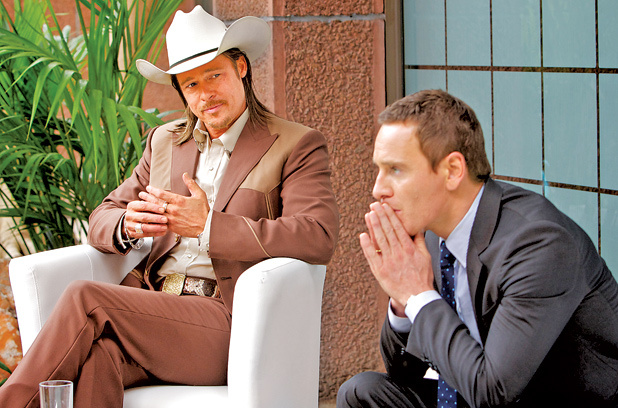
In Cormac ‘No Country for Old Men’ McCarthy’s screenwriting debut he tells a gritty story about a greedy lawyer (Fassbender) in over his head after dipping his toe into the narcotics trade with charismatic drug lord Reiner (Bardem) and his sociopath girlfriend Malkina (Cameron Diaz).
When the deal, smuggling carrying 625 kilos of cocaine from Mexico to Chicago, goes south after one “we’ve got a problem” phone call, the Counselor finds his life swirling out of control.
Spiraling around this grim vortex are womanizing middle-man Westray (Pitt), prison inmate Ruth (Rosie Perez) and the counselor’s long-distance girlfriend Laura (Penélope Cruz).
In “The Counselor” director Ridley Scott mutes his usual high-octane visual sense to focus on the words.
And there’s a lot of them.
Talky to the extreme, the entire movie is built around dialogue that sounds like it flowed from the hardest boiled crime writer out there, which I guess McCarthy is now that Elmore Leonard is working from his celestial typewriter. Catch phrases abound—“You don’t know someone until you know what they want,” for example—but it is wordy. Sometimes brilliantly so, but the pacing, particularly in the first hour, will be thought of as hypnotic by some, slow by others.
Scott takes his time creating tension in every scene, which really begins to pay off in the second hour when the themes of truth or consequences really start to pay off. “If you think you can live in this world and not be part of it, you’re wrong,” the Counselor is told, just after it’s too late to change his fate.
Or the most part the acting is top notch. Fassbender’s shift from confident criminal to a man who lands himself in a world of trouble after doing a good deed gives a nakedly raw performance. As his desperation grows his defenses drop and the weight of what he did in the name of greed crushes him.
Perez and Pitt (who’s in his “Killing Them Softly” mode here) are both fine, and it’s hard to imagine anyone else describing a “gynecological” love scene between a woman and a car with as much strange gusto as Bardem. “You see something like that,” he says, “and it changes you.”
These actors bring the words to life. Unfortunately the same can’t be said for Diaz, whose cold-blooded take on the character is too detached to be truly effective.
Like “Killing Them Softly,” another thriller that relied on dialogue and ideas to provide the thrills instead of gunshots and explosions, “The Counselor” will polarize people. Some will find it a head scratcher, others will be drawn into its uncompromising look at life and death, cartel style.
Still others, like me, will be left half in, half out, wishing the film’s virtues—it’s dialogue and ideas—were propped up with just a bit more attention to plot and possibly some warmth. But the chilliness of the story and characters may be McCarthy’s point. Early on Malkina says, “I don’t think truth has a temperature,” which sums McCarthy’s ice cold look at primal, criminal behavior.
Cormac McCarthy may not be a household name around your place, unless you live with the Coen Brothers or maybe with the Pitt’s.
Literary critic Harold Bloom called the writer one of the four major American novelists of his time, and he has two all-star movies set for release, which may make his name a little more commonplace.
Later in 2013 James Franco directs, scripts and stars in Child of God, an adaptation of Cormac’s 1973 novel about, “a dispossessed, violent man whose life is a disastrous attempt to exist outside the social order.”
This weekend a star-studded cast lead by Brad Pitt, Cameron Diaz and Michael Fassbender headline The Counselor, directed by Ridley Scott.
Producer Steve Schwartz says the story of a lawyer in over his head after dipping his toe into the drug trade, “may be one of McCarthy’s most disturbing and powerful works.”
And that’s saying something about the writer who gave us a character like No Country for Old Men’s killing machine Anton Chigurh. Empire.com warned that when, “McCarthy throws “a dark character at you, it’s a safe assumption that you’re not going to be able to get them out of your head for a good, long while—if ever.”
As written by McCarthy and played by Javier Bardem, who earned an Academy Award for Best Supporting Actor for the part, Chigurh is merciless, a murderer who makes life and death decisions with the flip of a coin.
The Road—a 2007 Pulitzer Prize winner for fiction—is another disturbing McCarthy novel adapted for the big screen.
The story is simple. A man and his son (Viggo Mortenson and Kodi Smit-McPhee) try to survive in a dystopian world. Armed with only a gun and two bullets they must scavenge for food amid the ruins and protect themselves from cannibals who roam the desolate land.
The Road is a movie based on small moments set against a big backdrop. No parent will be able to forget the stark image of seeing a young boy who doesn’t know what a can of Coke is or a father teaching his son how to commit suicide.
It’s tough, no nonsense work from a writer who says he’s “not that big a fan of exotic foreign films,” especially movie with magical realism. “You know, it’s hard enough to get people to believe what you’re telling them without making it impossible,” he says. “It has to be vaguely plausible.”