Julia Roberts is one of the biggest female movie stars of all time. With a career box office north of $2 billion she, and her megawatt smile, were the stuff of blockbusters throughout the 90s and early 2000s. She was everywhere, and then, somewhere around the time Jennifer Lawrence was celebrating her thirteenth birthday Roberts stepped away. Not completely, but she jumped off the Hollywood treadmill, doing what movie stars who have nothing left to prove do.
That is, whatever she wanted. She stayed out of view, voicing a couple of animated movies and popping up in the occasional film, some high profile—like the ensemble of Ocean’s Twelve—some not—like Fireflies in the Garden—but the days of solo Pretty Woman-esque success were, by her own choosing, behind her. By and large her choices became a bit more eclectic as she relied less on the famous smile and more on flexing her acting muscles. Since 2004’s Closer her filmography has been splintered between crowd pleasers like Eat Pray Love, dramas like August: Osage County and misfires like Secret in Their Eyes.
This weekend she’s back working with the director who helped make her famous starring in Mother’s Day, her fourth collaboration with filmmaker Garry Marshall. The pair make a movie roughly every ten years, from 1990’s Pretty Woman to Runaway Bride in 1999 to 2010’s Valentine’s Day to this year’s entry, and their combo usually delivers big box office.
In between her the commercial films she makes with Marshall, Roberts makes a movie a year and while they haven’t always connected with audiences many are worth a look.
Duplicity is a romantic comedy about espionage. Imagine if Rock Hudson and Doris Day starred in Mission Impossible. Instead you have Roberts as an experienced CIA officer looking for a change and Clive Owen as a charming MI6 agent. Both left the world of international intrigue for the infinitely more profitable task of corporate security. Together they launch an elaborate plan of corporate dirty tricks to steal a top-secret formula that will revolutionize the cosmetics industry. Roberts and Owen are witty and charming and Duplicity, with its entertaining performances and stylish look, is a bit of fun despite its convoluted story.
August: Osage County, an all-star remounting of Tracey Letts’s hit Broadway play, gives Roberts her juiciest role in years. As Barbara she’s a bit of an enigma. She’s a jumble of mixed, complicated emotions, capable of both great kindness and compassion but able only to express herself through tough love. When she explodes she lets loose a lifetime of rage stemming from her mother’s (played by Meryl Streep) mistreatment. When they go head-to-head it is the clash of the titans and an unforgettable scene.
Finally, there’s Larry Crowne, a boomer comedy aimed at audiences with memories long enough to remember when gas only cost 54 cents a litre, none of your neighbours had foreclosure signs on their front lawns and Tom Hanks and Roberts ruled the box office. It’s an uplifting comedy about middle age, brave enough to tackle modern problems like downsizing and foreclosure, but non-challenging enough to weave all the bad stuff into a pseudo romantic comedy. Hanks and Roberts cut through the material like hot knives through butter and Julia treats audiences to one of her trademarked laughing scenes.
Does Garry Marshall work for Hallmark or does he just love holidays? In the last few years he has turned his lens toward “Valentine’s Day” and “New Year’s Eve,” movies that bundle stars of dubious box office power in big, glittery packages to celebrate the holidays with all the joy and emotional resonance of a Budweiser Clydesdale commercial.
This weekend he casts his maudlin eye toward “Mother’s Day,” a look at mother’s and daughters featuring a Holiday Parade Womb Float.
Marshall continues with the scattershot story telling of his other holiday movies, presenting the story montage style. It’s as though he’s surfing the net, jumping from site to site, looking for something interesting to rest on. Three stories randomly dovetail together with contemporary motherhood as the glue that binds them.
Sandy (Jennifer Aniston) is a divorced mother of two whose kids like her ex’s much younger wife (Shay Mitchell). Sandy’s gym is run by widower Bradley (Jason Sudeikis), a guy with kids of his own who dreads Mother’s Day. Then there’s Kristin (Britt Robertson), a young woman searching for biological mom, Home Shopping Network star Miranda (Julia Roberts). The final flower in the Mother’s Day bouquet is Jesse (Kate Hudson), an overstressed mom who, along with her doctor husband Russell (Aasif Mandvi), is trying to deal with an unexpected visit from her squabbling, judgemental parents (Margo Martindale and Robert Pine).
There’s more—it’s a Gary Marshall All-Star-Holiday-Extravaganza so there’s always more—like Jesse’s gay sister Gabi (Sarah Chalke), Timothy Olyphant as Sandy’s former flame and a Jennifer Garner cameo—which I suppose is appropriate because the holidays are supposed to bring everyone together are they not?
“Mother’s Day” is filled to over flowing with faux heart warming moments, like a Lifetime movie on steroids. It hits all the emotional hot buttons—a dead wife who also happens to be a veteran, abandonment, first love, an awkward dad, kids growing up too fast—and tops off the whole thing with two, count ‘em two, dewy-eyed American sweethearts, Roberts and Aniston. To avoid troubling the audience with actual human emotions Marshall runs the whole thing through The Sitcomizer™ to ensure maximum blandness and erase the possibility that viewers will see something they haven’t already witnessed a hundred times before.
None of that would matter much if the movie was funny but real laughs are scarcer than last minute Mother’s Day brunch reservations. A likeable cast is wasted on a movie that panders to greeting card sentiment and slapstick.
The best part of “Mother’s Day” is that it puts Marshall one closer to running out of holidays to cinematically celebrate. What’s next? Hug Your Cat Day starring Courteney Cox and Luke Perry?
In the film Race, Toronto-born actor Stephan James plays the greatest and most famous athlete in track and field history. But, when he was approached about the part, James wasn’t sure exactly who Jesse Owens was.
“When I got that call that they’re making a Jesse Owens biopic I scratched my head a little,” the 22-year-old says.
“He won those gold medals, right? How many did he win again? I didn’t know how many he won or where he won them or under what circumstances or when this all took place.”
He quickly learned about Owens’s early career, the Ohio State races that made him a legend and how an African American runner stared down Hitler by winning four gold medals at the 1936 Berlin Olympics.
“After reading the script and researching his life to find out the backstory I was literally blown away. Blown away that this had taken place almost 80 years ago.”
The film documents 28 turbulent months in Owens’s life, from just before he enrolled in university to the Olympics where, ESPN would later say, the runner “single-handedly crush[ed] Hitler’s myth of Aryan supremacy.”
Jason Sudeikis, who plays Owens’s college trainer Larry Snyder, says he wanted to make the movie because “it didn’t lean on any one thing. It was bigger than just a sports film. It wasn’t pontificating, we didn’t treat Jesse with kid gloves and only as an icon. We can’t have all our heroes with giant hammers and capes. While that is good at the box office and for people with stock options I don’t know how good it is for little boys and girls who think that is the only way they can become a hero. We got to show the humanity behind him, we see him warts and all. You see his petulance, you get to see his indecision, you see him make horrible missteps as a husband and father, and yet all through that adversity he has the humility and integrity to correct those mistakes. That is just as heroic as whipping Hitler’s buns for four gold medals.”
James, who was recently seen as civil rights leader John Lewis in the critically acclaimed Selma, felt the weight of playing a legend on screen.
“It is one thing to be leading your own film,” he says. “To be number one on that call sheet, to know you have the biggest workload, to know that there are millions of dollars and ideas on your head. It’s another thing to play Jesse
Owens, the icon, the man, the myth, the legend. A guy who is not only a pivotal person in American history but world history, so I knew I had my work cut for me. The pressure was there. Obviously he’s not alive but his family is and have been very much involved since the beginning. There is a certain responsibility to play a real character, of course, but the great Jesse Owens is a whole other thing.”
After starring as Owens in Race, James has his sights set on playing another kind of hero. “I want to play Spider-Man,” he says. “I think that would be dope. I’ve always wanted to play a superhero but Spider-Man is so cool, so unassuming. I think I can relate a little.”
The title of a new historical drama works on two levels. On the surface “Race” is about Jesse Owens, the greatest and most famous athlete in track and field history. It is the story of his early career and the Ohio State races that made him a legend but it is also about how an African American runner stared down Hitler and won.
The story begins 28 months before the 1936 Olympics in Germany. Owens (Stephan James) is a freshman at Ohio State University. As one of the few African American students at the school he faces daily indignities like not being allowed to use the showers until all the white athletes are finished.
Track and field coach Larry Snyder (Jason Sudeikis) senses Jesse’s potential and trains the young man, refining his technique. “Everyone says he’s a natural, best they’ve ever seen.” The pair work towards a goal, the 1936 Olympics in Berlin. “If he works on his ‘start,’” says Snyder in a telling bit of foreshadowing, “you’re looking at a 1936 gold-medal winner at the Olympics.”
In the ramp-up to the games Owens smashes long-held world records, becoming a local celebrity and a natural choice to lead America’s entry in Berlin, but he has doubts.
“I heard they don’t care much for coloured folk over there,” he says.
“Don’t care much in Columbus either,” replies Snyder. “Is that going to be a problem?”
Add to that the enormous demands on him to win and pressure from the NAACP to stay at home and to show solidarity for the oppressed people of Germany and Owens is conflicted. Eventually the weight of race and politics are pushed aside—“Out there on that track you’re free of all of this,” says Owens. “There’s no black-and-white just fast and slow.”—and the rest, as they say, is history.
We all know pretty much how “race” will end so the trick for director Stephen Hopkins is to keep it entertaining along the way. For the most part he does, amping up the story with melodrama and an old fashioned story of triumph.
The racing scenes are effectively rendered and a sequence where Jesse learns to block out all the distractions brings the audience into the mindset of a runner for whom focus is the key to winning. Also, in the parallel story of the Olympics committee’s decision to partake in the games is a particularly chilling shot of the proposed Nazi Embassy next to the White House.
Melodramatic though the presentation, there is an undeniable gut-punch that comes along with the dramatization of inhumanity, whether it is the personal slight of Owens being called names on and off the track or the Nazis ousting Jewish families from their homes. Hopkins infuses both with meaning, using them to push the story forward.
It’s in the Synder character the movie stumbles. Sudeikis plays this tough-talking, hard-drinking excuse for an inspirational character with a kind of heightened reality that adds to the melodramatic feel of the film.
Stephan James remains at the heart of the film, steady and strong able to convincingly play the athlete and the man.
Ultimately “Race” isn’t really about race or, specifically racing. It’s about sportsmanship and the ability of sports to cut through personal prejudices of all sorts. As a sports movie it gets less exciting when it leaves the track but as a story of human determination and will it earns a gold medal.
“Sleeping with Other People” might have been more effective if it didn’t adhere so strictly to the old possum that men and women can’t be friends. Lainey and Jake have a wonderful platonic relationship, spending quality time walking in Central Park, sharing secrets and generally doing the things friends do in lieu of pawing at one another. In the end it feels like a cheat (MILD SPOILER ONLY IF YOU HAVE NEVER SEEN A ROM COM AND CAN’T FIGURE OUT WHAT IS GOING TO HAPPEN TO THESE TWO) to pair them off at the end when it would have been far more interesting for the pair to remain platonically involved and explore the dynamics of that relationship. To have them fall into one another’s arms and beds is the crowd-pleasing way out, but less satisfying as a look at the way actual humans relate to one another.
Sudeikis and Brie are a fetching couple and have good chemistry. In their quieter moments they’re quite appealing but this is no 21st century “When Harry Met Sally.” Jake’s fast patter is only about half as charming as the movie thinks it is and Lainey’s obsession with Matt feels overwrought and unreal, like “Fatal Attraction” without the simmering rabbit. The occasional bits of sharp dialogue and the laughs are welcome, but generally everything—the plot points and base emotions—are telegraphed early and often.
Watching “Sleeping with Other People” I couldn’t help but think the movie focused on the wrong couple. Jake’s business partner Xander (Jason Mantzoukas) and his wife Naomi (Andrea Savage) are a much more dynamic duo. Too bad director Leslye Headland didn’t give them more attention while Lainey and Jake worked through their issues off screen.
At one time or another everyone has fantasized about, if not killing, then at least doing grievous bodily harm to an employer. The guys in Horrible Bosses, the 2011 comedy starring Jason Bateman, Charlie Day and Jason Sudeikis, actually tried to make their fantasies reality.
The idea of squaring off against the boss man struck a chord with a lot of people and the movie raked in more than $100 million. So the inevitable sequel, Horrible Bosses 2, hit theatres earlier this week.
They’ll have to go some ways to top the last trio of bad bosses: Jennifer Aniston as a foul-mouthed sexual predator with a bad habit of using laughing gas as foreplay; a manic boss with no scruples in the form of Kevin Spacey; and a drug-addled loser with a penchant for cocaine and masseuses who inherits a business from his papa, played by Colin Farrell, who berates his employees for coming in late after attending his dad’s and their old boss’s funeral.
“Well, maybe that excuse would have flown when my dad was here, but I’m in charge now.”
But even that terrible trio pales in comparison to the worst movie bosses of all time.
One of the worst is Working Girl’s Katharine Parker (Sigourney Weaver). Parker is two-faced, and attempts to pass off her trusted secretary Tess McGill’s (Melanie Griffith) ideas as her own. Roger Ebert said of Weaver’s performance, “From her first frame on the screen, she has to say all the right things while subtly suggesting that she may not mean any of them.”
In the end, Tess teaches her a lesson about honesty and gets Katharine fired.
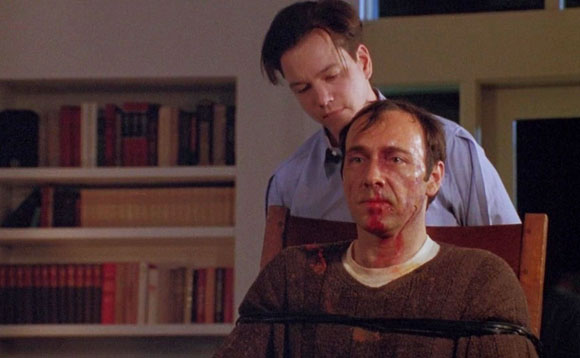
Katharine looks like a pussycat compared to Buddy Ackerman (Kevin Spacey), the tyrannical Hollywood producer in Swimming with Sharks.
“You are nothing!” he says to his new assistant Guy (Frank Whaley). “If you were in my toilet I wouldn’t bother flushing it. My bathmat means more to me than you!”
Guy finally snaps, kidnaps Buddy and tortures him. But in an unexpected twist, the extreme behaviour earns Buddy’s respect and Guy gets a promotion.
Finally, if you mix the swooping white hair and bad attitude of Cruella DeVille with the people skills of Vlad the Impaler, you will come up with Miranda Priestly, the worst boss in all of moviedom. Played by Meryl Streep in The Devil Wears Prada, Priestly is the editrix of a fictional fashion magazine called Runway who never met an assistant she couldn’t humiliate with a withering glance and a few choice words. “By all means, move at a glacial pace,” she says to newbie Andy Sachs (Anne Hathaway). “You know how that thrills me.”
“Horrible Bosses 2” is being billed as a comedy and stars people—like the Jasons, Bateman and Sudeikis, Charlie Day and Jennifer Aniston—usually associated with making people laugh, but does the almost complete absence of anything giggle worthy preclude us from labeling it a comedy? Discuss.
In the second peek at the pitiful employment record of Nick (Bateman), Kurt (Sudeikis) and Dale (Day), the guys go into business for themselves. Their product, the Shower Buddy—a shower nozzle that shoots shampoo and conditioner as well as water—seems like a sure fire As-Seen-On-TV hit but when a shady billionaire (Christoph Waltz) tries to swindle them out of their livelihood they decide to get even by kidnapping his son (Chris Pine). “If we’ve learned one thing about ourselves,” says Nick, “it’s that we’re not murderers.”
Off the top it has to be said that Bateman, Sudeikis and Day have great chemistry together. They joke, jostle and jape like brothers, giggling their way through the movie as if they are in on a fantastic gag that only they get. The trio seems to be having fun, and judging by the outtake reel that plays over the credits, the set was filled with laughter every time someone blew a line. If only the audience could have as much fun watching the movie as the cast did making it.
“Horrible Bosses 2” is a demotion from the original film. There are more laughs on the average job application than in this workplace “comedy.” It’s misogyny masquerading as humour, with unlikeable characters and an inane premise that diminishes in interest as the running time increases.
Everyone has fantasizes about if not killing, then at least doing grievous bodily harm on an employer. The guys in “Horrible Bosses,” a new comedy starring Jason Bateman, Charlie Day and Jason Sudeikis, actually do something about it.
Chances are you’ve never had a boss as mean, manipulating or just plain odd as the bosses in this movie. These people make Genghis Khan look like an equal opportunity employer. Bateman works for Kevin Spacey, a corporate shark not above exploiting his workers and then taking a promotion and pay raise for himself. The cast’s other Jason, Sedaris, is saddled with Colin Farrell an unscrupulous coke head with a bad attitude and an even worse comb over. Finally Day works for Jennifer Aniston, a dentist who uses laughing gas as a sex toy.
All are stuck in their jobs and fed up with the daily humiliation offered in their workplaces decide to do the only thing a reasonable person would do—kill their bosses.
OK, I was joking about the reasonable person part. Of course no reasonable person would try to hire a hit man on the Internet or break into their bosses homes looking for ways to kill them, but this is a comedy so we’ll accept that. Or will we? The movie stars off strong, funny and well paced but it’s central premise—let’s kill our bosses!—seems forced and it sucks some of the funny from the middle part of the movie.
There are laughs for sure, but the bungling of the crucial set up scene left me feeling like I was watching a funny enough movie marred with a silly premise.
The cast holds up well. The Jasons bring their usual brand of well practiced funny, and “It’s Always Sunny in Philadelphia” star Charlie Day is a funny find but thesis rises here are Farrell and Aniston. We’ve seen Spacey do this kind of thing before, the manic boss with no scruples (ie: “Swimming with Sharks”) but his cast mates are breaking some new ground. Farrell throws vanity out the window to play a drug addled loser with a penchant for cocaine and masseuses. He’s funny and edgy and does work here unlike we’ve seen before from him.
Aniston leaves her America’s Sweetheart persona behind to play a foul mouthed predator with a bad habit of using gas as foreplay. If this doesn’t wipe away any traces of Rachel left over from her TV work, I don’t know what will.
“Horrible Bosses” is a darkly funny employee revenge film that mostly works, I just wish the motivation felt more authentic.
“Hall Pass” can’t rightly be called a romantic comedy because there is very little actual romance contained in its story of two couples who are experiencing the martial blahs. Instead let’s call it a mid life comedy.
In this Farrelly Brothers film Owen Wilson, Jenna Fischer, Jason Sudeikis and Christina Applegate are Rick, Maggie, Fred and Grace, two long time couples in stale, sexless marriages. After an embarrassing incident at a friend’s home the fed up wives decide to give their husbands a “hall pass”—a week long holiday from marriage in an effort to prove to them that the grass is not greener on the other side of the nuptial fence.
The kind of gross out humor you would expect from the purveyors of films like “There’s Something about Mary” and “Dumb and Dumber” is firmly in place here. Unfortunately “Hall Pass” isn’t anywhere near as funny as either “Mary” or “Dumber”—even though the Farrely’s obsession with overly tanned people is firmly in place—but as puerile as it may be the charming cast wrings whatever humor there is to be found out of the script. Because of them the movie has a fairly constant ripple of giggles punctuated occasionally by big laughs.
It’s a thin premise, stretched almost to breaking, with a moral—surprise, surprise, single life isn’t all it’s cracked up to be—that seems very predictable, especially coming from the Farrelys. Luckily good casting and the odd well timed joke elevates “Hall Pass” from the level of a Katherine Heigl couples comedy, but just barely.