As the calendar turns the page to 2017 let’s have a look back at the great people I met, wrote about or chatted with in 2016. Warren Beatty gave me his home telephone number, I drank cranberry juice with Denzel Washington, had Elvis’s girlfriend and JFK’s mistress on my radio show and fulfilled childhood dreams by hanging out with Iggy Pop and Cheap Trick. On stages, studios, in hotel rooms, on phones and even in the back of taxis, they spoke and I listened. Here’s some of the best stuff I heard this year:
Casey Affleck on throwing himself into the role of a depressed man in Manchester by the Sea: “It’s what you have to do. You have to go there, show up on set and be prepared to play the scene with the right feelings, the way it is supposed to be. I’m just not good enough to show up in a great mood, say good morning to everybody, check in with the kids and read the paper and then walk into the scene and be believably gutted in the way he is supposed to be. He carries around all this guilt, he’s devastated and filled with self loathing so I have to start way back in preproduction and try to slip into these bad feelings and stay there for as long as I can. If you just showed up and tried to walk through it or do anything but give 100 percent you’d really look like a jackass.”
Warren Beatty talking about casting Lily Collins in Rules Don’t Apply: “I believe very much in what I call ‘the blink,’” says Beatty. “That is the superiority of the unconscious knowledge as compared to conscious knowledge. The knowledge that when we sit and we really give it some thought, the thought we feel it is due. That thought can be misleading when we could have trusted our initial instinct, the blink. I think the unconscious has a lot more intelligence in it than the conscious.
“It was a blink with Lily. I can only say I loved the way she looked. I loved the way she sounded. I loved the way she talked. There was an integrity about her I felt I could believe in this circumstance and at the same time she looked like someone to me who Hollywood would want to exploit.”
Director Uwe Boll on why he’s quitting filmmaking: “I’ve been using my money since 2005 and if I hadn’t made the stupid video game based movies I would never have amalgamated the capital so I could say, ‘Let’s make the Darfur movie.’ I don’t need a Ferrari, I don’t need a yacht. I invested in my own movies and I lost money.”
The Magnificent Seven director Antoine Fuqua on casting Denzel Washington: “I wanted to see Denzel Washington on a horse.” AND “My idea was, if Denzel walks into a room, the room stops. If Clint Eastwood walks into a room, the room stops. Is it because he’s a gunslinger or is it because of the colour of his skin? We’ll let the audience decide.”
Rebecca Hall on playing Christine Chubbuck in Christine: “I don’t think I have given [a role] like it before and I probably won’t again because it is one of those jobs that if you are incredibly lucky you get maybe three of them in a career. And that’s only if you are incredibly successful and lucky and often only if you were a man.”
Jonah Hill on how some people respond to his morally ambiguous characters: “A lot of times Wall Street bros will come up to me as if [Wolf of Wall Street] is their Goodfellas or Scarface. People see what they want to see. It is a little scary sometimes when people misinterpret.” And how he reacted after a crew of South African arms dealers approached Hill in a restaurant after seeing a trailer for War Dogs: “You don’t want to make it an overly uncomfortable environment while that is happening,” he says, “but you also don’t want to lie and be dishonest that you are agreeing with them. You don’t want to make them feel bad about their misinterpretation. It’s an unusual an awkward situation to be sure. In the end, we all want to be seen as heroes in our own story, I guess.”
Isabelle Huppert on the unique tone of her film Elle: “Sometimes you are in a Hitchcock thriller. Sometimes you are in a psychological study. Sometimes you are in a comedy and at the end of the day you are in none of those; you are in a Paul Verhoeven film.”
Riley Keough on what she learned while making American Honey: “I learned not to drink too much.”
Spike Lee on casting Jennifer Hudson as the mother of a slain child in Chi-Raq: “Do you know Jennifer Hudson’s history? It is known knowledge that Jennifer’s mother, brother and nephew were murdered in Chicago. I think that’s extra gravitas that you have with Jennifer Hudson in this film. This is not an act for her. She got hit directly by gun violence on the South Side of Chicago. I didn’t want her to think that I was exploiting her. I knew I wanted her for the part but there was some length of time before I got the courage to approach her. Also, when we did meet I was babbling. She said, ‘Spike, I know why you want me to do this film, so just stop. I’ll do it.’ I was trying to be sensitive and I turned out to just beat around the bush. I said, ‘I’ll just shut up and say thank you.’”
Stan Lee on naming his characters using alliteration —think Peter Parker, Bruce Banner, Matt Murdoch and Reed Richards: “It’s because I have a bad memory. If I could remember one of the names like Spider-Man, if I could remember his first name was Peter then I knew his second name began with a P. That is really the only reason. I have a terrible memory for names and by making the first and second letter the same, if I thought of one name I had a clue as to what the other was.”
T.J. Miller, star of Office Christmas Party: “Let’s talk comedy in a time of tragedy. I have a political obstacle to my social mission statement,” he says. “The social statement was, tragedy permeates our everyday lives, people are lonely, they’re scared, they have death anxiety, they don’t know how to attribute meaning to their own existence, so through comedy we can provide an opiate or distraction that permeates our everyday lives. Through satire we can hopefully frame the world in a way that people can laugh at. Also I aim to help people, through my stand up, to release the death anxiety. I aim to help people not take themselves so seriously.”
Queen of Katwe star David Oyelowo on working with nonactors on the film: “I actually took a bunch of the kids to see Jurassic World while we were doing the film and Madina (Nalwanga), who plays Phiona, sat next to me and was clutching me the whole time, terrified by the movie. She turned to me and said, ‘Is this what we are doing?’ I asked her if she had ever seen a film before and she said no. We were halfway through shooting a film in which she is playing the lead.”
Snowden co-star Zachary Quinto on how says working on Snowden made him think differently about even simple Internet searches: “I had this experience the other night. I was shopping for a washer and dryer online. I was Googling the consumer ratings. I left that search and went to another website and immediately the pop up ads on this other website, which had nothing to do with consumer reports or shopping, were about washers and dryers. What we are willing to sacrifice in our privacy without even thinking about it for convenience sake, what we’re willing to give up in our own freedoms and interests just in sitting down at our computers is shocking. You can take precautions. You can take steps to enact two-step verifications and put tape over your laptop (camera) and strengthen your passwords but all you need to do is shop for appliances and you are exposing yourself to some kind of tracking, a collection of data.”
Arrival director Denis Villeneuve on filmmaking: “It is a privilege when you can take a camera and ask people to sit for two hours in a theatre,” says Villeneuve. “It is nice if you take that privilege to explore something out of our reality, to bring some poetry to it.”
Moon Zappa on how she grew up with a rock star dad: “I longed for structure. When I saw John Hughes films I was, ‘Wait! People sit at a dinner table? Wait! People say sorry?’ Even to this day when I see somebody with a sweater draped over their shoulders, or a loafer or an exposed ankle, I’m like, ‘That is so exotic.’ I think if I had grown up in the repression my father encountered I would also have put two rocket boosters on my back, but growing up like that was too much. It was like fastball pitches every single minute.”
Most of these interviews went well and were a pleasure to do… but not all. Below is the terrible tale of a day wasted waiting for Idris Elba’s phone call.
Can You Hear Me Now? Can You Hear Me Now? Waiting For Idris Elba.
Idris Elba is a busy man. He’s released seven movies this year and has several more on tap for 2017. He’s on track to join Dwayne Johnson, Jennifer Lawrence and Leonardo DiCaprio as one of the world’s highest earning actors after turns in the mega-grossing The Jungle Book, Finding Dory and Zootopia.
If you don’t know the name you haven’t been paying attention. Rev up Netflix and check out his work on TV shows like The Wire or Luther and movies like RocknRolla or Beasts of No Nation and become a fan. You should know he was once voted one of People magazine’s 100 Most Beautiful People in the World and more than one twitter friend of mine refers to him as a “pretend boyfriend.”
Not only busy but good looking as well! I was pleased to be granted a fifteen-minute phone interview to discuss his debut in the Star Trek franchise as Krall, a hostile alien who causes trouble for Kirk, Spock and company in Star Trek Beyond.
I don’t usually write questions but I thought I might ask him if he watched Star Trek as a child. Would he consider himself a Trekker? Did he have a favourite Star Trek character growing up? Did he wonder what Star Trek fans would think of the predatory new character? Are there parallels between the film—and his character—and our world today? Has he considered what being part of the legacy of the show means?
If there was time at the end I might even follow up on the rumours and ask if he even wants to play James Bond.
Then the first call came in. “Idris is running behind.” Cool. This happens all the time on press days. Then another call and another and another. My phone hasn’t gotten this kind of workout since a Nigerian Prince called over and over to solicit my assistance in moving his fortune to North America. Each time a publicist announced another delay with the assurance the interview would still happen. As the time wore on the actual length of my interview began to tumble downhill from fifteen minutes down to seven.
In all two hours passed from my scheduled start time until my phone rang for real.
“Hi Richard, I’ll connect you with Idris,” said the perky voice on the other end of the line.
Silence.
A minute passed before Elba’s familiar husky London accent filled my ear. Hallelujah! Better late than never. We talk over one another. “Hello… HELLO… Can you hear me?” It’s a bad cell phone connection. It sounds as if we’re talking through two tin cans connected by strings but I’ll take it.
I ask him about his childhood memories of Star Trek.
“It was a show me, my mum and my dad watched together,” he says. “They both liked it. It was a show that really took your imagination places. That’s my early memory of it. It was a really imaginative show that showed space travel in a way that was different, you know?”
It took him 23 seconds to speak the 50 words that told me his parents liked Star Trek. I mention this because as soon as he stopped talking and I started asking the next question I heard a strange beep beep sound followed by… nothing. The great void. No more husky voice. And like that, poof. He’s gone.
“Are you still there? I think we just lost him,” the eavesdropping publicist said. “Let me get him back for you. Just one second.”
I had visions of the actor walking around Fifth Avenue desperately yelling into his phone, “Can you hear me now? Can you hear me now?” but in my heart I knew that wasn’t happening.
Minutes later she’s back. “I’m so sorry. We lost him. I know you only had a couple of minutes to speak with him…” actually it was twenty three seconds… “Thank you so much for taking the time to speak with him.”
My interview with Idris was over. Still born. Terminated before it even really began.
Was I mad? Not really. Frustrated? Yes. Not only had I wasted the afternoon waiting for Idris but now I didn’t have a story to file.
My friends on social media didn’t exactly see it my way. “What do you expect?” wrote one person. “He is the hottest man alive.” Another chose to look on the bright side. “That’s 45 seconds more Idris than the rest of us.” (I hadn’t yet timed the actual quote when hit facebook to vent.)
In the end it’s not a big deal. I’m choosing to look at the bright side. I didn’t get to chat with him but I do have a contender for the Guinness Book of World Records for Shortest (And Least Satisfying) Interview Ever.
Seven years ago director J.J. Abrams, the brains behind hit TV shows like Lost and movies like Star Wars: The Force Awakens, thought there was still some uncharted life to be found in the Star Trek universe.
This weekend the third film in his new generation of movies, Star Trek Beyond, puts phasers on stun. Directed by Fast & Furious director Justin Lin it continues Abrams’s mission to seek out new cinematic life and civilizations.
After five television series, ten movies, countless books, comics and video games, a stage version and even an Ice Capades style show Abrams re-launched the big screen Trek franchise. Simply called Star Trek, he took audiences where no man (or director) has gone before, back to the very beginning of the story before James Tiberius Kirk bore an uncanny resemblance to T.J. Hooker.
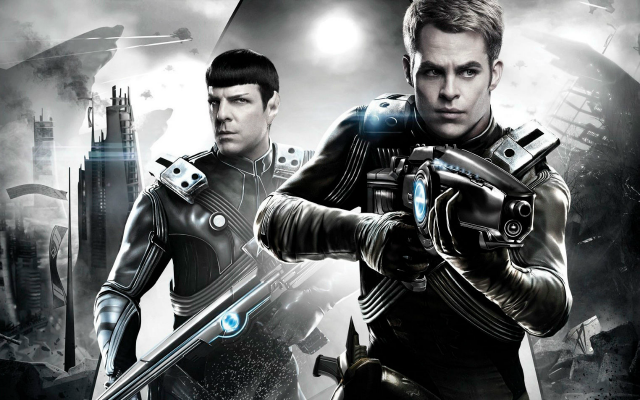
In this prequel to the original series Kirk (Chris Pine) and Spock (Zachary Quinto) are assigned to the maiden voyage of the most advanced starship ever created, the U.S.S. Enterprise under Captain Christopher Pike (Bruce Greenwood).
Star Trek was one of the great popcorn movies of 2009. Notice I didn’t say sci-fi movie. Star Trek is a lot of things but despite all the talk of warp speed, black holes and time travel, it can’t be strictly classified as science fiction. It’s a character based space serial more concerned with the burgeoning relationship between Spock and Kirk than with photon thrusters.
2013’s Star Trek: Into Darkness is a sequel AND a prequel (something so illogical Spock would never approve) that gets underway when an act of terror robs Kirk of a close friend. Determined to bring the perpetrator to justice the reckless Starfleet captain takes the Enterprise and crew to a war zone populated by Klingons and one brilliant and ruthless genetically engineered adversary (Benedict Cumberbatch). To finish his mission he must make difficult decisions.
Abrams finds a balance of old—Kirk, Spock et al—and new—the space suits are redesigned, the tech is different and there are younger characters—that should satisfy hard-core Trekkers and attract tenderfoot Trekkies. For fans there are in-jokes like Kirk telling two expendable members of the landing team to “lose the red shirts.”
At the beginning of Star Trek Beyond Kirk’s life on board the U.S.S. Enterprise has become a grind. He’s three years into a five-year mission and he is, personally lost in space, trying to find meaning in his mission. “It can be hard to feel grounded when even gravity isn’t real.”
Lin, taking over for Abrams, does his best to spice things up for the good captain. The director, best known for his Fast & Furious films, knows there is nothing like a wild alien attack to snap James T. out of his funk. Expect more hi-fly action than sci fi intrigue.
Star Trek Beyond producer Abrams admits he “didn’t love Kirk and Spock when I began this journey, but I love them now.” It seems the fans love his interpretation of the characters as well. Trekkers have embraced the new movies but Abrams knows the Star Trek universe is so vast it’s impossible to please everyone. Instead he says he caters to the average moviegoer “who just wants to be entertained, understand, and care about the world and the characters.” As Spock might say, “Sounds logical to me.”
At the beginning of “Star Trek Beyond” James Tiberius Kirk’s (Chris Pine) life on board the U.S.S. Enterprise has become a grind. Sure Sulu (John Cho) is gay and Ambassador Spock is dead, but Kirk is three years into a five-year mission and he is, personally lost in space, trying to find meaning in his mission. “It can be hard to feel grounded when even gravity isn’t real.”
Director Justin Lin, taking over the rebooted series from J.J. Abrams, does his best to spice things up for the good captain. The director, best known for his “Fast & Furious” films, knows there is nothing like a wild alien attack to snap James T. out of his funk.
Because the movie is pretty much an all-out action flick I’m not going to waste a lot of words describing the plot. Put it this way, there’s an artefact, a piece of a deadly old weapon that an ill-tempered villain named Krall (Idris Elba) desperately wants. Why? “To save you from yourself!” Kirk and the Enterprise crew don’t want the wrinkle-faced alien saving them from anything, particularly when every word out of Krall’s mouth sounds like it was lifted from Sun Tzu’s “The Art of War.” “Unity is not your strength,” he growls. “It is your weakness.” Couple that with the destruction of their beloved ship and they have more than enough reasons for Scotty (Simon Pegg) to jerry rig the warp drive, Bones (Karl Urban) to grumble and complain and Lieutenant Uhura (Zoe Saldana) to excitedly push buttons on her colourful control board.
Lin knows how to stage high-octane sequences, so the film bursts into frenetic action scenes every few minutes. Chekov (the late, great Anton Yelchin) plots a course through the stars and BOOM! action ensues. Spock may be inured but that won’t stop him from being at the center of maelstrom after crazy maelstrom. Lin doesn’t seem to know what to do with the characters, but he sure knows how to entertain the eye with gravity defying actions scenes.
As a result “Star Trek Beyond” doesn’t feel so much like a “Star Trek” movie as it does a sci fi action adventure with some familiar characters. Everyone you expect is present and accounted for—and there’s even tributes to the first generation TV Trek crew—but they are reduced to cartoons, spouting jokey platitudes and techno gobbledygook. Lin can’t decided what’s more important, the science or the fiction.
For all the talk of fighting humanity’s battles, this is the least human “Star Trek” yet. Purists may resent the vaguely detailed characters but those simply looking to have their eyeballs dance around the screen to expertly staged space carnage will find much fast and furious action.
Disney animator Trent Correy may be an Ottawa native, but three years of living and working in Burbank, Calif., have changed him.
“I get home about once or twice a year now,” he says. “It’s hard to go in the winter, my body has adapted to here. I tend to send my parents photos of me on the beach in February when it is -42 C back home. I have flip flops on now while we’re talking just to turn the knife a little bit.”
Ironically the sun worshipper’s breakout was helping to animate the snowman Olaf in Frozen. You’ve also seen his handiwork in Big Hero 6 and this weekend he’s back with the furry and funny film Zootopia.
“The nice part of Zootopia was working with a number of different characters,” says the Algonquin College graduate. “I worked with everything from a mouse to a sloth to an elephant. It kept the job very interesting.”
Set in an alternate universe where animals, both predator and prey, live harmoniously in a city called Zootopia, the movie’s funniest sequence involves a slow moving sloth named Flash. It was the first scene Correy helped animate. “There are a lot of challenges animating a sloth moving at that speed,” he says, “and a lot of other challenges animating a mouse or an elephant with their different weights and animal attributes.”
The 28-year-old is a rising star at Disney — he’s currently working on the mythological epic Moana — so it might come as a surprise that he didn’t take art in high school.
“I failed art,” he admits. “It was totally my fault. I wasn’t into the art history stuff at the time and I was really interested in drawing cartoons. That was looked upon as not real art so the teacher and myself had disagreements. I ended up having to take drama, and that’s fun too.
“I did always love to draw. I have to thank my mom, who is an artist, who encouraged me to draw and keep going.”
He rediscovered his passion for art after high school and now joins the rather long and impressive list of Canadians who are helping to shape the future of animation. I ask him why Canadians are so in demand as animators.
“There is a rich history of animation in Canada with the NFB and a lot of TV work in the ’80s and ’90s,” he says. “I think a lot of it has to do with work ethic. I tend to see a lot of people who come from TV animation who are faster. They have to be because they get paid per frame in a lot of places in Canada, whereas here it’s salary. So to make your money you have to be fast, you have to be efficient and you have to be economical in your choices.
“Our whole crew here is very international, we have people from all over the world. I think there is a bit of, ‘I’m coming from a different country and I’m trying to prove myself in this big place.’ It feels so far away from Ottawa.”
Around this time of year bunnies usually visit kids with baskets of jellybeans and chocolate. This March, however, a baby rabbit named Judy “Don’t call me cute!” Hopps bounces into theatres bringing with her a message of tolerance. The new Disney film “Zootopia” is social commentary disguised as a furry and funny cartoon.
Growing up on a carrot farm Judy (Ginnifer Goodwin) has dreamed of being a police officer in the city of Zootopia, despite the fact, as her father (Don Lake) constantly reminds her, “There’s never been a bunny cop.” In fact, her parents preach the virtues of complacency and want her to go into the family business and become a carrot farmer. “It’s OK to have dreams,” says dad, “just as long as you don’t believe in them too much.”
The call to service to too strong, however, and she soon graduates for the Police Academy at the top of her class. Despite her small size (Message #1: Never give up on your dreams.) she’s sent to Zootopia’s city center, a cosmopolitan place filled with hustle and bustle and animals of all shapes and sizes. “In Zootopia,” she says, “anyone can be anything.”
She’s a keener who introduces herself with, “Ready to make the world a better place?” only to be assigned to parking enforcement duty. True to form she becomes the city’s best ticketer (Message #2: Be The Best Version Of You!) but is unsatisfied by the work. When a missing otter case falls into her lap she starts her investigation by questioning a con artist named Nick Wilde (Jason Bateman), a sly fox with a smart mouth and underworld connections. Together (Message #3: We all do better when we work together.) they learn to look past sly fox/dumb bunny stereotypes (Message #4: Er… look past stereotypes and don’t judge others.) and uncover a plot that threatens Zootopia’s basic precept of celebrating one another’s differences. (Message #5: There is beauty and strength in diversity.)
There are more messages in “Zootopia” than in Hillary Clinton’s private server’s spam folder but the film doesn’t feel like a Successories motivational poster come to life. The life lessons are nicely woven into the story and washed down with a spoonful of humour. Kids and parents alike should find Flash, the fastest sloth at the DMV funny, although for very different reasons, while a “Godfather” take-off will likely mean nothing to children but give older folks a chuckle.
Co-directors Byron Howard, Rich Moore and Jared Bush pack every inch of the frame with in-jokes, like a billboard for Zuber car services, the carrot logo on a smart phone, or my favourite, the sloth’s mug that reads “You want it when?” If the messages don’t connect the animation will.
“Zootopia” is more than just another cartoon to entertain the eye. It’s a timely and relevant children’s tale with a social agenda.
A friend is boycotting the Academy Awards because his favourite film of 2015, Star Wars: The Force Awakens, didn’t make the Oscar’s Best Picture list.
The awards, he says, aren’t relevant because they ignore genre movies and in this particular case, have snubbed the most financially successful film of the year. In fact, the old canard that the Academy doesn’t honour genre movies with Best Picture nods has been shot down this year with nominations for The Martian and Mad Max: Fury Road.
The Oscar folks also gave The Force Awakens five nominations and in recent years Inception, Avatar, District 9, Lord of the Rings: The Return of the King and Django Unchained have all earned top nods with LOTR taking home the gold.
Genre movies do just fine with the Academy. No need for C-3PO to cry little metal tears. To the Academy’s credit, not recognizing the year’s box office behemoth while giving Room, a modestly grossing movie, Best Picture, Actress, Directing and Adapted Screenplay nods, actually suggests the Academy will not be wowed by wheelbarrows of cash.
Perhaps the truth is that the Oscars, and awards shows in general, are only as relevant as you want them to be. Are they as important as the Republican debates? It’s all just show biz, so maybe. Ultimately, unless you’re an actor, a director or a shareholder in a nominated film the Oscars are probably not extremely significant to your life. I pay attention to them as a function of my job, and I enjoy them, but this year I’m on board with my friend but for different reasons.
I’m disappointed in Oscar’s failure to acknowledge diversity. For the second year in a row all 20 acting nominations went to white actors. To be clear I’m not implying the Academy is overtly racist. There are too many voters for there to be a conspiracy to keep actors of colour out of the headline categories. Have you ever gone to a restaurant with more than 10 people and tried to get everyone to agree on an appetizer for the table? It’s nearly impossible. Now imagine trying to arrange collusion between 6,000 members of the Academy. Totally hopeless.
So if it’s not a conspiracy why were stellar performances from Creed’s Michael B. Jordan, The Hateful Eight’s Samuel L. Jackson, Sicario’s Benicio Del Toro, Beasts of No Nation’s Idris Elba or any of Straight Outta Compton’s top line cast not nominated? I think it’s a combination of studio decision makers, who tend to be white, male and older coupled with the same demographic of voters at the Academy.
It’s a systemic issue being addressed by Academy president Cheryl Boone Isaacs’ effort to mould the Academy’s membership to be more in line with the population.
Until the Oscars represent the full width and breadth of the best in Hollywood, regardless of race or gender, they will continue to slide toward irrelevancy. My guess is that the most interesting part of this year’s ceremony won’t be who wins Best Actor but host Chris Rock’s opening monologue, which, if the movie gods prevail, will address the situation in no uncertain terms. It’s a speech I’m predicting will be just as entertaining and provocative as any of the nominees, Star Wars: The Force Awakens included.
“I’m a good boy from a good family,” says Agu (Abraham Attah), the preteen protagonist of the drama “Beasts of No Nation.” His father is a teacher, his mother a churchgoing woman. Big brother is a muscle-head teen with a crush on local girl.
As civil war comes to his village (in an unnamed African country), summary executions become common and soon Agu is left alone and on a run for his life. He finds a new family as a child soldier under a rebel Commandant (Idris Elba). “A boy is very, very dangerous,” he says. “He has two eyes to see, two hands to strangle and fingers to pull a trigger. Leave this in my charge. I will be training him to be a warrior.”
The Commandant is charismatic leader, a master of indoctrination and brainwashing who weaves a protective web around the young boy, creating a family unit for the boy as he turns him into a killer. Agu is convinced the very real war is personal; it’s a battle against the people who killed his father. He ‘s taught the art of cruelty, how to hack a man to death with a machete and kill people by inserting grenades into their mouths.
The trip into the heart of darkness is sidelined by the Commandant’s own journey into Colonel Kurtz territory. Disillusioned, Agu begins to understand “the only reason we are fighting anymore is to be dying.”
“Beasts of No Nation” is a harrowing experience. It’s not the kind of movie you leave the theatre saying, “I really enjoyed that.” Instead, it’s an experience, an unforgiving film that begins by allowing us to get to know Agu’s family before tragedy strikes, then torments us with the terrifying sound of gunfire heard from inside a hiding place before showing us Agu’s descent into a hellish kind of survival. It’s ruthless and brutal, perhaps best summed up in the plainspoken words of the boy himself. “I saw terrible things and I did terrible things.” Be prepared, he may be a lot of things, but he’s not a liar.
Sean Penn is back on the big screen this weekend in The Gunman, his first leading role in almost four years. It can’t rightly be called a comeback because he never really went away. Supporting roles in The Secret Life of Walter Mitty and Gangster Squad have generated column inches, but in the last five years he has devoted more energy to raising money for earthquake relief in Haiti than to being a movie star.
In the film he plays Special Forces military contractor Jim Terrier. By day he protects foreign workers in the Democratic Republic of Congo but he moonlights as a hired gunman for big corporations. His assassination of the Congolese Mining Minister forces him to flee the country and changes the course of his entire life.
It’s what Penn jokingly calls “geriaction,” an action movie starring a middle-aged actor. Other than that, don’t expect to hear him speak a great deal about his new film. “Honestly within a week after I’ve finished shooting a film I’ve almost forgotten it,” he said recently.
In February he was honoured with an honorary Cesar Award for “choosing his films with sensitivity and commitment.” At the ceremony the “legend in his lifetime” watched a clip reel spanning the width and breadth of his career, including excerpts from Dead Men Walking, Mystic River and Milk.
Later the actor said, “I remember playing none of those scenes. I remembered the movies [but] I saw myself in scenes with actors I didn’t even know I’d ever worked with!”
To jog Mr. Penn’s memory here’s a “compenndium” of some of his memorable roles:
1. In Milk Penn won a Best Actor Oscar playing the real-life Harvey Milk, a native New Yorker who became America’s first openly gay man to be elected to public office. Penn fully embraces Milk, from the thick New York accent that characterized his speech to the goofy grin that endeared the real-life activist to his supporters, both gay and straight.
2. This Must be the Place is a rare thing. I speak of that elusive beast Pennigma Seanun comoedia—the Sean Penn comedy. He plays a retired and world-weary American rock star living with his wife (Frances McDormand) in Ireland. This is Sean Penn like we’ve never seen him before. With poufy hair, black toenail polish and affected vocal cadence—like Andy Warhol on Quaaludes—he creates an intriguing, strange character.
3. In Hollywood dramedy Hurly Burly Penn played against type as Eddie, the hyperactive casting agent. It’s an emotionally raw performance—witness Eddie try and use cocaine to snort away his troubles—but one without the studied glumness that he frequently brings to the screen.
4. Fair Game could be re-titled One Hundred Minutes of Sean Penn Yelling ‘If We Don’t Tell the Truth No One Will!’ He’s Joseph Wilson the real-life whistleblower who claimed the Bush administration falsified information about the existence of weapons of mass destruction in Iraq. Penn is passionate, crafting a performance so big it has it’s own gravitational pull.
5. Finally there’s All the King’s Men, a movie memorable for all the wrong reasons. Penn is a fine actor, but as Willie Stark, (loosely based on Louisiana governor Huey P. Long) he is so over-the-top it’s as if he’s acting in a different movie than the rest of the cast. It’s a vein-popping, arm-waving performance that suggests that maybe he should lay-off the Red Bull.
With the release of “The Gunman” Sean Penn joins the ranks of middle-aged actors looking to Neesonate their careers. Liam Neeson famously made the leap into action movies later in life, a move that has revitalized his career and generated millions of box office bucks.
Penn, fresh from the gym and frequently shirtless, plays Special Forces military contractor Jim Terrier who protects foreign workers in the Democratic Republic of Congo by day and sidelines as a hired gunman for big corporations by night. His he assassination of the Congolese Mining Minister (Clive Curtis) forces him to leave the country, his job and girlfriend Annie (Jasmine Trinca) behind. Eight years later he’s back in Africa. This time around instead of killing people he’s trying to do some good but three armed killers determined to do him in throw his humanitarian mission off track. His past has caught up to him and if he is to survive he has to return to his old ways.
Thrillers don’t get much more generic than “The Gunman.” It has all the elements of “Bourne Identity” or “Taken.” There are exotic locations, guns galore and loads of handheld camera, what’s missing is the thrills. Despite suitably menacing performances from heavyweights like Ray Winstone, Javier Bardem (despite his Foster Brooks drunk routine), Idris Elba and Mark Rylance everything is so by-the-numbers it’s as if the script (based on the 1981 novel The Prone Gunman by Jean-Patrick Manchette) was written to pay homage to older, better thrillers rather than offering up anything new.
Sloppily written—the “mess with the bull and you’ll get the horn” bull fighting climax takes place in present day in Catalonia even though they banned the sports years ago—with clunky dialogue and loose ends galore—what happens to Annie’s adopted baby?—“The Gunman” is unlikely to give Penn the necessary Neesonudge to reinvent his career.