“The Many Saints of Newark,” the sprawling big-screen prequel to the iconic television series “The Sopranos,” feels more like a pilot for a new show than the origin story of one of television’s most famous families.
Broken into three parts, “The Many Saints of Newark,” uses narration, courtesy of Tony Soprano’s late associate Christopher Moltisanti (Michael Imperioli), to break down the movie’s interconnected story shards.
Firstly, there is Dickie Moltisanti (Alessandro Nivola), Soprano Family soldier, father of Christopher, cousin to Carmela Soprano, uncle to Tony. He’s hooked up, wily and impulsive but also treacherous. When his father, the slick sociopath ‘Hollywood Dick’ (Ray Liotta), returns from Italy with a new bride (Michela De Rossi), it triggers chaos in the Moltisanti family.
In Dickie’s orbit is Harold McBrayer (Leslie Odom Jr.), an African-American numbers runner for the Mob, galvanized by the 1967 Newark race riots to go out on his own and, finally, Tony Soprano, played by William Ludwig as a youngster, Michael Gandolfini, the late James Gandolfini’s son, as a teenager. As Dickie’s thirst for power spins out of control, he becomes a surrogate father to Tony, hoping to pass along something good to the impressionable younger man as a way to atone for his sins.
“The Many Saints of Newark” is vivid in its portrayal of the period. Covering roughly four years, from 1967 to 1971, it uses the turmoil of that time in American life as a backdrop for the explosive nature of Dickie’s world. That atmosphere of uncertainty makes up for a story that, despite some glorious moments, often feels rushed as it careens toward an ending that doesn’t mine the rich psychological landscape of these characters, which is what we expect from David Chase and “The Sopranos.”
The actors are game.
Nivola brings equal parts charisma, danger and depth to a flawed character who is the ringmaster to the action. Unlike many of the other characters, like the conniving Junior Soprano (Corey Stoll), henchman Paulie Walnuts (Blly Magnussen) or consigliere Silvio Dante (John Magaro), who come with eighty-six episodes of baggage, Dickie is new and can be viewed through fresh eyes.
Michael Gandolfini takes on the Herculean task of revisiting a character his father made one of the most famous in television history and brings it home by showcasing the character’s volatility and, more importantly, his vulnerability. He’s a troubled kid, on the edge of turning one way or the other, and even though we know how the story goes, Gandolfini’s performance suggests there is more to know about Tony Soprano.
If there is a complaint, it’s that both Tony and McBrayer, two of the main cogs that keep this engine running, get lost in “The Many Saints of Newark’s” elaborate plotting. Ditto for the female characters. Despite tremendous work from Vera Farmiga as Tony’s poisonous mother Livia and De Rossi as Dickie’s step-mom, the women often feel peripheral to the tale, in service only to the men’s stories.
“The Many Saints of Newark” brings with it high expectations but falls short of coming close to the greatness of its source material. “The Sopranos” broke new ground, changing the way gangster stories (and all sorts of other stories) were told on television. “The Many Saints of Newark” settles for less as an exercise in nostalgia.
Richard Crouse interviews Mena Massoud, the Canadian star of the Disney live action remake of “Aladdin.” They talk about working with Will Smith, why he switched from neuroscience to theatre school and supporting ethnically diverse Canadian artists.
Coming hot on the heels of Disney live action reboots of classics like “Cinderella,” “Beauty and The Beast” and “The Jungle Book” comes “Aladdin,” Guy Ritchie’s reimagining of the all singing, all dancing, all powerful Genie made famous by the late, great Robin Williams.
The story begins when “street rat” and thief Aladdin (Mena Massoud) helps a beautiful woman (Naomi Scott) he believes is a handmaiden to the daughter of the Sultan of Agrabah (Navid Negahban), escape from the police after a misunderstanding in the market. After a wild chase—part musical theatre, part parkour—they spark, bonding over the vagaries of their own circumstances. She’s trapped by palace life, he by a life of poverty. “It’s kind of sad having a monkey as the only parental authority in my life,” he says of Abu, his kleptomaniac pet monkey and constant companion.
She is, of course not the handmaiden, but the Princess Jasmine, a woman who longs to take over for her father but is stymied in her ambition by tradition. The law says she cannot take the throne and must marry a prince. When one royal suitor compliments her on her beauty she says, “We have the same titles but are never described the same way,” before dismissing him.
Meanwhile back at the palace, the Sultan’s power-hungry advisor Jafar (Marwan Kenzari) also has his eye on the throne. Using hypnotism he controls the ruler, but wants more. More, in the form of a magic lamp hidden deep in the Cave of Wonders. “Once that lamp sits in my hand I will sit on the throne,” he cackles. Trouble is, everyone who ventures into the cave dies. Jafar needs someone with serious skills to get in, grab the lamp and get out. When he meets Aladdin, he uses his access to the princess to strike a deal. “Retrieve the lamp from the cave and I will make you rich enough to impress a princess.”
The perilous journey to the lamp reveals the star of the show, a magical blue Genie with the power to grant three wishes to the keeper of the lamp. There are some catches though; he can’t make anyone fall in love with him or raise the dead. He also cautions against wishing for wealth and power the very two things Jafar and Aladdin covet.
Despite all its pomp and circumstance the live action remake of the beloved animated “Aladdin” does not exactly transport us to a whole new world. Ritchie fills the screen with colour and pageantry, staging large scale Bollywood-style dance numbers and, in the case of the Genie’s signature tune “Friend Like Me,” a maximalist CGI orgy that gives Flo Ziegfeld a run for his money. Even when he is more restrained, he isn’t that restrained. The rendering of Princess Jasmine’s big solo “Speechless,” one of the new songs by the “Dear Evan Hansen” composers Benj Pasek and Justin Paul, plays like a Bonnie Tyler power pop video from the 1980s.
Style has never been Ritchie’s problem. His camera is always in motion, caressing the screen with acrobatic shots and tricky editing. His movies make your eyeballs dance but often at the expense of the characters who get lost in the theatricality of the presentation.
He’s in fine form in “Aladdin” although overcooked CGI overwhelms the finale in a rush of animated imagery. The characters work hard to sparkle but get lost amid the ruckus and with them gores much of the film’s heart. The ending is loud and large but fails to make an emotional impression. Sometimes less is more.
As Princess Jasmine, Scott has more to do than in the original and does so in much more modest clothing. No animated bellybuttons here. Massoud gives the social climbing Aladdin a certain impish charm in an energetic performance. More baffling is Kenzari as the monotone villain Jafar. All scowls and surly attitude, he’s the least interesting villain on Ritchie’s resume.
The screen is filled with people but, let’s face it, the character everyone is most interested in is the big blue Genie. He’s the star of the show but in many ways it’s the film’s most thankless role. Robin Williams made the Genie his own in a performance that still sparkles with life more than twenty-five years later. Smith battles against some unfortunate CGI and the memory of Williams to make the character his own. He’s part match-maker, part magic-maker and part mirth-maker. Fortunately for Ritchie Smith’s charisma elevates the performance from merely mimicking his predecessor.
“Aladdin” is not so much a remake but an up-dating for a new generation. Some of the revisions are welcome. Jasmine is a now fully rounded character and some unfortunate lyrics, like “It’s barbaric but hey, it’s home,” have been removed. Other changes don’t work as well. Can someone explain why Iago (voiced by Alan Tudyk), a comedic highlight from the 1992 film, has been reduced to a few squawks and repeated phrases?
Despite the updates and the pomp “Aladdin” feels underwhelming by the time the end credits roll. The songs frequently interrupt the flow of the story, creating a stop-and-go feel that sucks some of the film’s momentum away.
The actor Ike Barinholtz is best known for playing the dim-witted Morgan Tookers on “The Mindy Project.” What’s less known is that in real life Barinholtz is a news junkie who was inspired to write his new film, “The Oath,” during the first Thanksgiving Dinner following Donald Trump’s 2016 electoral victory.
This Thanksgiving is set against a backdrop of sweeping new legislation that will affect every American. Called the Patriot’s Oath, it’s a document the government expects every red-blooded American to sign as a declaration of their loyalty. One couple, the hot-headed ideologue Chris (Barinholtz) and his unflappable wife Kai (Tiffany Haddish), refuse to sign. As their extended family, including Chris’s sister Alice (Carrie Brownstein), conservative brother Pat (Jon Barinholtz) and his Tomi-Lahren-Lite girlfriend Abbie (Meredith Hagner), convene just days before the Loyalty Pledge signing deadline, the situation spirals out of control. Two officers from the Citizen’s Protection Unit (John Cho and Billy Magnussen) show up at Chris and Kai’s front door, armed with questions, toxic masculinity and a disregard for the law.
“The Oath” is part political satire, part home invasion movie. Pitched just a hair under hysterical, it’s a timely dark comedy that seeks to shine a light on the political chasm that divides the left and right wings. Under some well-crafted jokes bubbles a righteous rage worthy of Alex Jones if he leaned left rather than alt-right. Barinholtz uses a sledgehammer to explore the basis of belief, the very thing that can either bring us together or, more often than not, tear us apart. Subtle it is not.
“The Oath” doesn’t dig much deeper than that, however. It skims the surface of how divisive politics drives wedges between friends and family but tends to lean toward broad comedy to make its point rather than insight.
“Game Night” is a new thriller comedy with Jason Bateman that is more comedy than actual thriller.
Bateman and Rachel McAdams are Max and Annie, two competitive people who meet at a trivia night, bond over obscure “Teletubbies” facts, fall in love and get married. They’re so into games they even play Just Dance at the wedding reception.
Cut to a couple of years later. They are comfortably tucked away in the suburbs and hosting weekly game nights with friends, the dimwitted Ryan (Billy Magnussen) and long time couple Kevin and Sarah (Lamorne Morris and Hamilton, Ontario-born Kylie Bunbury). They used to invite neighbours Debbie and Gary (Jesse Plemons), but since Debbie moved out they take great pains to ensure that Gary, a creepy cop, doesn’t find out about their get-togethers.
On a personal level they’re trying to have a baby, but it isn’t going well. Their doctor (Camille Chen) thinks stress is making it impossible for them to conceive. The source? Max’s brother Brooks (Kyle Chandler), a good looking, venture capitalist who loves to flaunt his wealth. “He’s like the Mark Wahlberg to Max’s Donnie,” says Ryan.
When Brooks rolls into town, driving Max’s dream car, a vintage Stingray, he throws a special game night at his new, rented mansion. With no Risk, Scrabble or Monopoly in sight, the regular gamers gather for a murder mystery party. The winner gets the Stingray. “This will be a game night to remember,” Brooks says.
When the murder mystery turns into a real kidnapping the game players are sucked into a world of intrigue as they have to solve the “game.“ Seems there’s more to Brooks than meets the eye. “I can’t believe your brother has been lying to us this whole time,” guffaws Ryan. “He’s even cooler than I thought.”
This isn’t a Hitchcock movie. There’s no real mystery in “Game Night,” just some twists and turns and engaging performances from a cast game to have fun. It’s more about spending time with the characters on their wild night out.
Much of the humour comes from the casual back-and-forth between Bateman and McAdams. They interact like an old married couple, not people in a bad situation. Bateman is a natural at this kind of deadpan comedy and McAdams, who generally features in dramas, keeps pace. Their chemistry is one of the reasons this slight comedy works as well as it does.
Magnussen, who plays a likable dim bulb, and Morris and Bunbury who work their way through a mystery of their own making aid the above-the-title stars. The biggest surprise and certainly the film’s oddest performance belongs to Plemons. Best known for his work on “Breaking Bad” and “Fargo,” he mixes deadpan delivery with a thousand-yard-stare that is as unnerving as it is funny.
“Game Night” isn’t slap your knee funny but it is an amiable enough comedy that makes up in charm what it lacks in procedural thrills.
I wonder if, in 200 years, aliens will study all our dead Instagram accounts to gain insight into our way of life. If so, you could forgive them if they surmised that everyone in 2017 lived perfect, #blessed lives filled with the wonders of avocado toast and gorgeous sunsets.
The perfectly curated worldview of Instagram is at the heart of Aubrey Plaza’s dark new film Ingrid Goes West. The former Parks and Recreation star plays the title character, a lonely New Yorker who befriends people on Instagram only to get upset when they don’t let her into their lives. Fixated on a Californian social media star with a seemingly perfect life played by Elizabeth Olsen, Ingrid uses her inheritance money and, as the title tells us, goes west in search of the perfect life she sees on her phone everyday.
“Ingrid is in every scene of the movie,” Plaza says, “and I’ve never been in a movie where I’m in every single scene. It was exciting to me, the idea that I would have so much time to take that character on a journey and dig really deep and peel back all those layers. I really related to the idea of feeling like you want to connect and you want someone to like you.”
Plaza is on Twitter (@evilhag) and Instagram (plazadeaubrey) but says the movie reinforced the idea that everything on social media is not real life.
“It really reminded me of how all of the perfect, beautiful things you see are not real,” she says. “They’re purposeful. The film is a great reminder that we are all flawed and we have to be careful about the stories we tell about ourselves. I think it is important to build awareness about how it makes us feel at the end of the day.
“For me, personally, I always try to be authentic in every way that I can, but it really hard on social media because you have so much control over what you can show. As a consumer of it I think the movie has taught me that it is not always what it seems.”
Ingrid Goes West has the makings of either a comedy or psychological thriller but mostly plays like a cautionary tale. As a portrait of a woman who buys into the InstaMyth of an effortlessly curated life, it’s a withering comment on the real stories behind social media’s hashtagged pictures. Unlike her onscreen alter ego Plaza understands ‘likes” do not equal love.
“I’m really interested in talking about social media and encouraging other people to talk about it and how it is affecting them and how much time they spend on it,” she says, before adding, “Personally I hope it goes away. I hope it doesn’t stick around forever. I’m sure it will change. It will morph into something else.”
The thirty-three year old actress admits social media has positive aspects but remains sceptical of its effects.
“There are people who get support there and it is a global connector so I don’t want to dismiss those parts of it,” she says, “but I think there is something so isolating about it. That is what I really don’t like. There is more value in being present and living in the world that you are in.”
Recently an article titled, “My Instagram’s Perfect, My Real Life is Not,” described the author’s myriad of professional and personal problems. It’s a laundry list of millennial angst framed by a line that appears midway through the story. Everything is real life was going wrong, but, she says, “you wouldn’t know any of this if you were to look at my social media presence.”
It’s not an uncommon story. In 200 years from now aliens, who will only understand the world through dead Instagram accounts, will believe that everyone lived perfect, #blessed lives filled with the wonders of avocado toast and gorgeous sunsets. Carefully curated Instagram pages, and a woman who loves them, are at the heart of “Ingrid Goes West,” a new film starring Aubrey Plaza and Elizabeth Olsen.
Plaza plays Ingrid, a lonely New Yorker who befriends people on Instagram only to get upset when they don’t let her into their lives. “Lame and basic,” Ingrid goes so far as to show up, uninvited, to a “friend’s” wedding with a can of mace. Insta-blocked after that event, she fixates on Taylor Sloane (Olsen), a Californian social media star with a seemingly perfect life. With inherited money from her late mothers and state Ingrid, as the title tells us, goes west in search of the perfect life she sees on her phone everyday.
A fat bank account and plenty of nerve—Ingrid kidnaps Taylor’s dog so she can return him and insinuate herself into her life—she becomes friends with the InstaStar and her artist husband (Russell Wyatt). At first everything is hunky dory.
“You’re so funny. You’re so awesome. You’re the greatest person I have ever met,” gushes Taylor after knowing Ingrid for only a day. Soon, though, Ingrid is exposed for what she the possessive sociopath—a single white female for the Internet age—who gets jealous when Taylor hangs out or worse, is photographed with other people, and even her own brother.
“Ingrid Goes West” has the makings of either a comedy or psychological thriller but mostly plays like a cautionary tale. A portrait of a woman who buys into the InstaMyth of an effortlessly curated life, it’s a withering comment on the real stories behind social media’s hashtagged pictures. “Likes” do not equal love.
At the heart of this is Plaza, an actor unafraid to plumb the depths of desperation in her characters. Unlikeable in almost every way, Ingrid is as deep as a lunch tray and yet, because Plaza plays her as a human and not simply a caricature, she remains compelling.
Olsen, whose famous twin sisters were proto Instagram stars, embodies the kind of superficial social media maven who thinks nothing of asking—with a perfect vocal fry—a stranger to lay on the ground to take the perfect “candid” shot of her fabulous life. She’s the neo-American Dream, a perfectly fluffy confection with a dark heart and a permanent spot on the guest list for every hot club in town.
On the sidelines, but still memorable is O’Shea Jackson as Ingrid’s Batman-obsessed landlord Dan. He isn’t given much to do—he spends more time reading comics than cruising Instagram—but is a likeable and charming presence.
“Ingrid Goes West” essays the phony baloney world of social media but does so with grace and depth, exposing the disconnect many people feel in a digital world.
Have you ever heard the saying, “Be careful what you wish for because you just might get it”? It’s a fitting maxim for the new Disneyfied version of Stephen Sondheim’s musical “Into the Woods.” Of course, it is one of the themes of the show, but on another level, for the people who have long hoped to see a screen adaptation of the legendary musical, it may not be a situation of wish fulfillment.
Fans of the stage show will notice a few liberties have been taken with the show’s book. The changes are slight—for instance, the prince does not sleep with the Baker’s Wife, although they do have an encounter—but purists may feel like their beanstalk has been shaken a bit too much.
Casual fans of big screen musical theatre, however, will find a handsomely mounted reworking of the popular show, filled with the stuff of fairy tales: beautiful princesses, handsome but dimwitted princes, witches and even a giant or two.
The story is broken into two halves, a sunnier and irreverent “Once Upon a Time” first half that introduces the Baker (James Corden) and his Wife (Emily Blunt), a couple unable to have children because of a Witch’s (Meryl Streep) curse. The old crone agrees to undo the spell if the pair supply her with four items, a cow as white as milk, a cape as red as blood; hair as yellow as corn and a slipper as pure as gold.
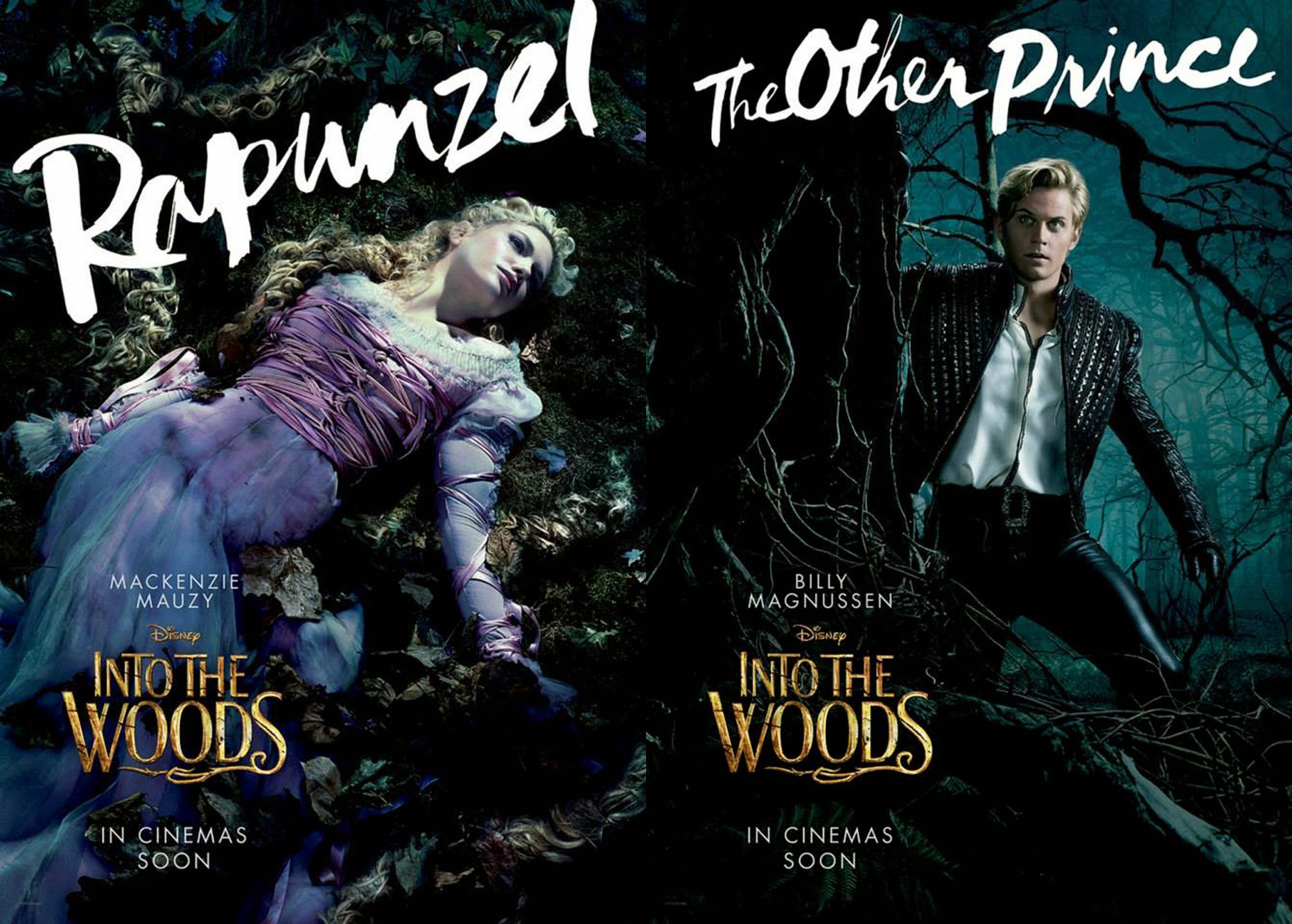
Their search takes them into the woods and in collision (and later in collusion) with Jack (Daniel Huttlestone), later of Beanstalk fame, Little Red Riding Hood (Lilla Crawford) after the Big Bad Wolf (Johnny Depp) has swallowed her whole, Rapunzel (Mackenzie Mauzy) and Cinderella (Anna Kendrick).
The second half, the darker side of the fairy tale world, begins where the happily ever after part usually sits. When a female giant comes to the woods looking for Jack, the boy who killed her husband, the story takes a turn, teaching a lesson about wish fulfillment and responsibility for our actions.
“Into the Woods” has more to do with the original Grimm Brother Fairy Tales—the ones where evil stepmothers sawed the toes off their daughters to fit into golden slippers—than anything Disney has ever attempted before. The stereotypes are all present and accounted for, but under the prince’s brocade jackets or the Witch’s wild mauve wig, are complex characters that veer from comedic to serious to poignant, often in the same scene.
The cast is comprised of actors who can sing, warbling to Sondheim’s rich score. Standouts include “Agony,” an amusing duet between the two princes (Billy Magnussen and Chris Pine) and the Witch’s swansong “Last Midnight.”
On the downside, it feels a bit overlong and the Big Bad Wolf scene could have been renamed the Huge Unctuous Wolf, given Depp’s oily interpretation of the character.
“Into the Woods” survives the script meddling through strong staging, good performances and sheer wish fulfillment to make end up at it’s own kind of happily ever after.
I learned a great deal during my interview with Mackenzie Mauzy and Billy Magnussen. The Manhattan based performers brought me up to speed on the rite of passage for all New York actors, Rapunzel’s hair and whether or not Meryl Streep likes men in blue tights.
The pair play Rapunzel and Rapunzel’s Prince in the big screen adaptation of the legendary Broadway musical Into the Woods. The two relative new comers—she’s best known as Abigail on Forever while he made a memorable appearance on Boardwalk Empire and will soon be seen in an upcoming Steven Spielberg spy thriller—help bring fairy tales to life as part of a large ensemble that includes Johnny Depp, Emily Blunt and Meryl Streep.
Which leads me to the first thing I learned during our chat.
“Meryl’s a beast,” says Magnussen. “She’s the one who got me the job. I was in a play and she saw it and recommended to me [director] Rob [Marshall] and [producer] Mark Platt. The play was Vonya and Sonia and Marsha and Spike and I dress up as a prince because we’re going to a costume party. It’s all about the blue tights.”
“Meryl likes the blue tights,” laughs Mauzy.
Next I discovered the wig Mauzy wears in the film put her at a follicular risk.
“They used my hair and braided it into the extensions,” she says. “It was thirty feet long so I wrapped it around my arm. I had a little fake one for rehearsal but I asked to actually wear [the real one] one day so I could figure out how to be mobile. It’s a tripping hazard! We joke about how I had a really strong left bicep for a couple months.”
Then Magnussen enlightened me on a rite of passage for New York actors, “Once you get on Law and Order,” he says, “you’re really an actor.” Both have done time in the L&O trenches. Mauzy played a child killer named Carly Di Gravia—“It’s weird I remember that name,” she says.—while Magnussen says, “It was one of my first jobs. They bleached my hair white and I was a Southern male prostitute. How do you tell your mom? Hey watch this!”
Finally, one I gleaned one last pearl of knowledge from Mauzy. Apparently it’s OK to call Stephen Sondheim, legendary Into the Woods composer and eight time Tony Award winner, Steve. “Everyone calls him Steve!” she laughs. “He likes to be called Steve! It is weird. Steve Sondheim.”