Reminders of real life were all around us at this year’s Toronto International Film Festival. From the digital screenings we watched at home to half empty, socially distanced screenings at venues like The Princess of Wales Theatre. But when my mind wanders back to September 2021, I won’t be thinking of having to show my proof of vaccination or the social distancing in theatres.
What will linger?
The images of Anya Taylor-Joy in “Last Night in Soho,” crooning an a cappella version of the Swingin’ Sixties anthem “Downtown,” and “Dune’s” Stellan Skarsgård doing his best impression of Marlon Brando in “Apocalypse Now,” come to mind immediately.
Those moments and others like them are the reason the movies exist. They transcend the vagaries of real life, transporting us away from a place where masks, vaccine passports are the reality.
And boy, did we need that this year.
Here a look back at some of the moments that made memories at this year’s TIFF:
“Night Raiders,” a drama from Cree-Métis filmmaker Danis Goulet, draws on the historical horrors of the Sixties Scoop and Residential Schools to create an unforgettable, dystopian scenario set in the new future. It effectively paints a somber portrait of totalitarian future, packed with foreboding and danger. The story is fictional but resonates with echoes of the ugly truths of colonization and forced assimilation. Goulet allows the viewer to make the comparisons between the real-life atrocities and the fictional elements of the story. There are no pages of exposition, just evocative images. Show me don’t tell me. The basis in truth of the underlying themes brings the story a weight often missing in the dystopian genre.
I asked Danis Goulet about having many of her characters in Night Raiders speak Cree: “It is everything to me,” she said. “My dad is a Cree language speaker. He grew up speaking Cree. He learned to speak English in school. His parents were Cree speakers. And coming down to my generation, I’m no longer a Cree speaker and there are entire universes, philosophies and poetry and beauty contained in the language. When we think of where our heritage lies, maybe some people think of museums. For me I think it is in the language. I think that richness doesn’t just offer Indigenous people something. I think if others looked closer at what the language tells us about the history of this land, they would be incredibly amazed. My dad has looked at references in the language that talk about the movement of the glaciers, so, foe me to have the Cree language on screen is everything. I’m in my own process. I go to Cree language camp to try and learn back the language and the language gives back in a way that is so healing and incredible. It is one of the greatest gifts in my life. So, the opportunity to put my dad’s first language on the screen, and the language of the Northern Communities where I come from, and my language that I lost, is the best. It’s incredible.”
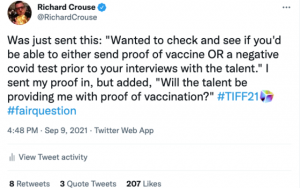
From Twitter: @RichardCrouse Was just sent this: “Wanted to check and see if you’d be able to either send proof of vaccine OR a negative covid test prior to your interviews with the talent.” I sent my proof in, but added, “Will the talent be providing me with proof of vaccination?” #TIFF21 #fairquestion 4:48 PM · Sep 9, 2021· 8 Retweets 3 Quote Tweets 206 Likes
There is no mention of COVID-19 in the Jake Gyllenhaal thriller “The Guilty.” But make no mistake, this is a pandemic movie, A remake of 2018 Danish film “Den skyldige,” it is essentially a one hander, shot on a just a handful of set with strict safety protocols in place. Gyllenhaal, as 911 operator Joe Baylor, may be socially distanced from his castmates, but his performance is anything but distant. Played out in real time, “The Guilty” builds tension as Baylor races against a ticking clock to bring the situation to a safe resolution for Emily. Director Antoine Fuqua amps up the sense of urgency, keeping his camera focused on Gyllenhaal’s feverish performance. The close-ups create a sense of claustrophobia, visually telegraphing Baylor’s feeling of helplessness and his crumbling mental state.
The sound of an audience laughing, applauding, crying, or whatever. Just being an audience. The big venues were socially distanced, and often looked empty to the eye, but when the lights went down and folks reacted to the opening speeches or the films, it didn’t matter. Roy Thomson Hall, with its 2600-person capacity, may have only had 1000 or so people in the seats, but for ninety minutes or two hours they formed a community, kindred souls brought together after a long break, and it was uplifting to hear their reactions.
“Flee” is a rarity, an animated documentary. A mix of personal and modern world history, it is a heartfelt look at the true, hidden story of the harrowing life journey of a gay refugee from Afghanistan. Except for a few minutes here and there of archival news footage, “Flee” uses animation to tell the story but this ain’t the “Looney Tunes.” Rasmussen used the animation to protect Amin’s identity, but like other serious-minded animated films like “Persepolis” and “Waltz with Bashir,” the impressionistic presentation enhances the telling of the tale. The styles of Rasmussen’s animation change to reflect and effectively bring the various stages of Amin’s journey to vivid life. It is suspenseful, heartbreaking and often poetic.
I asked “The Survivor” star Vicky Krieps about working opposite Ben Foster: “The first day I came [on set] I was very intimidated,” she said. “I wouldn’t say scared, but it felt like a wall to me. It began like this. There was no small talk. There was no, ‘How are you?’ He was already in character and it was very clear. I thought, ‘OK, I have to play his wife.’ And then, something really interesting happened. I like having a challenge and this felt like a challenge. So, I needed to find a way [to relate to him] because I knew I was going to be his wife. How do I do that? Imagine it as a wall, but then in the wall there are eyes. I used those eyes and I felt like I could open a window, and inside of those eyes was a horizon where I could go. I liked to say to Ben, ‘And then we would dance.’ Sometimes I wrote to him and said, ‘It was nice dancing today.’”
“Last Night in Soho,” from director Edgar Wright, is a love letter to London’s Swingin’ Sixties by way of Italian Giallo. Surreal and vibrant, and more than a little bit silly, its enjoyable for those with a taste for both Petula Clarke and murder. It begins with verve, painting a picture of a time and place that is irresistible. A mosaic of music, fashion and evocative set decoration, the first hour brings inventive world building and stunning imagery. Wright pulls out all the stops, making visual connections between his film and the movies of the era he’s portraying and even including sixties British icons Rigg, Tushingham and Stamp in the cast.
I asked “Dune” star Rebecca Ferguson why she said reading Frank Herbert’s novel was like doing a crossword puzzle: “Sometimes I wonder what comes out of my mouth,” she said. “My mother and many of my friends sit and do crosswords, but I have never been in that world. There is a way of thinking around it. It’s logical, mathematical. You need to be able to see rhythms. Whatever it is. Reading “Dune” was quite dense and I think for people who are immersed into the world of science fiction, they understand worlds and Catharism and this planet and that planet. It is just another picture, which, not to stupefy myself, I am intelligent enough to understand it, but there is a rhythm. I think it is me highlighting the fact that people who live and breathe science fiction, they get it at another level.”
“Dune,” the latest cinematic take on the Frank Herbert 1965 classic, now playing in theatres, is part one of the planned two-part series. “Dune” is big and beautiful, with plentiful action and a really charismatic performance from Jason Momoa as swordmaster Duncan Idaho. It is unquestionably well made, with thought provoking themes of exploitation of Indigenous peoples, environmentalism and colonialism.
I will give “The New Mutants” director Josh Boone a couple of points for attempting to push the limits of what an X-Men movie can be. The spin-off of the Marvel comics, now playing in theatres, isn’t about saving the planet or battling little green beings from outer space.
Boone mixes and matches the superheroes with psychological horror, placing people with extraordinary powers battling their own, earthbound demons. It’s a genre film, but not a memorable one. In this case, you can’t spell “generic” without “genre.”
The story centers around Dani Moonstar (Blu Hunt), an indigenous teen whose entire reservation was wiped off the face of the earth by… something. For some reason she survives, only to find herself chained to a hospital bed in a mysterious facility. Enter Dr. Reyes (Alice Braga), a kindly (or is she?) physician who unchains Dani and explains the situation to her. “You’re in a safe place,” the good (once again, is she?) doctor says. “Nothing can hurt you here.”
Soon she is introduced to the other inmates… er… patients. There’s Russian meanie Illyana Rasputin (Anya Taylor-Joy), a mutant who can teleport and slice people to bits with an arm that morphs into a sword. Rahne Sinclair (Maisie Williams) is part human, part werewolf and can smell trouble from a mile away, while hunky Roberto da Costa (Henry Zaga) is so hot he will occasionally burst into flames. Completing the line-up is Sam Guthrie (Charlie Heaton), a southerner whose slowed down drawl hides the fact that he’s gifted with thermo-chemical energy propulsion that would make Usain Bolt look like a slow poke.
As young adults they are new to their powers, attending therapy sessions with Dr. Reyes to learn how to control their abilities.
How does Dani fit in? What are her powers? That’s what Reyes wants to find out. What will she do with that information? “This isn’t a hospital,” warns Illyana. “It’s a cage and you’re trapped in here forever.”
“The New Mutants” then becomes a guessing game as strange things start happening. Bad dreams terrorize Dani’s fellow mutants, each reliving a terrible, formative moment in their development. “We’re trapped in here with demons!” Roberto shrieks.
Boone conjures up some eerie imagery. Illyana’s slender-man wannabe ghouls are unsettling, but the idea of the manifestation of the character’s fears has been done before and done better in movies like “It.”
Eventually “The New Mutants” biodegrades into a computer-generated slog as the movie approaches the end of its 90-minute running time. Whatever character work the cast, who are actually quite good, have done to involve the viewer is undone by a series of loud episodes that favor empty spectacle over humanity.
Like the offspring of Jane Austen’s original text and “Clueless,” the 1995 American coming-of-age teen comedy it inspired, the new version of “Emma,” now on VOD, is a period piece with a modern sensibility.
Anya Taylor-Joy is the title character, a young woman of high birth. As the opening credits say, she is “handsome, clever and rich and had lived nearly twenty-one years in the world with very little to distress or vex her.” She lives in a large manner house with servants and her father (Bill Nighy), a dour gent who constantly feels a draft. Next door is the wealthy and handsome George Knightley (Johnny Flynn), a landowner who is almost like a brother to Emma.
When she isn’t painting portraits of her friends Emma meddles in the life of her naïve protégé Harriet (Mia Goth). Harriet loves a local farmer, but Emma, hoping the young woman will marry up, pushes her toward the town vicar (Josh O’Connor). Romantic complications and status problems arise when the impossibly wealthy Frank Churchhill (Callum Turner), who catches Emma’s eye, and the poor but beautiful Jane Fairfax (Amber Anderson) return to town at the same time.
At the heart of every scene is Taylor-Joy. As Emma she is whip smart, arrogant, devious and charismatic even when she’s being unpleasant. Her journey toward self-awareness is an eventful one, speckled with manipulation, some kindness and casual cruelty. One of the film’s best scenes involves an offhand remark that deeply cuts a down-on-her-luck acquaintance (Miranda Hart). In this one scene Emma’s entire attitude toward class is laid bare. She can be cruel and unthinking because the subject of her insult is not of the same social strata. Taylor-Joy brings the mix of sophistication and brattiness necessary to understand why Emma is the way she is. She has lived a life with no fear of social reprisal but will not be able to move ahead until she learns about sensitivity. It’s in there, all Emma has to do is find it.
Every frame of “Emma” is sumptuous, like “Downton Abbey” on steroids, but this isn’t “Masterpiece Theatre.” It brims with life and mischievousness, becoming more alive as Emma inches toward adulthood.
Director Autumn de Wilde has assembled a top flight cast of character actors to decorate the already beautiful scenery. Nighy literally leaps into frame, delivering a deadpan performance tempered with some good physical humour. Hart is both annoying and vulnerable before her character’s circumstance takes a heartbreaking turn. The supporting cast isn’t always given much to do but each, particularly Goth as a young woman who wears her emotions on her sleeve, help us understand the mosaic of Emma’s life.
“Emma” is a tad too long as the mixed messages and missed connections build up, and the story’s inherent rom com format—there’s even a running to the airport, or in this case a carriage, scene—seems familiar, but retains the wit that has made the story a classic.
I’ll start this review with a spoiler to a movie that came out almost three years ago. This will be the last spoiler you’ll see here. Here we go, the twist at the end of M. Night “Let’s Twist Again” Shyamalan’s “Split” revealed that his story of serial killer with twenty-three established personalities also had a twenty-fourth, a superhuman character known as The Beast. What’s more—because why settle for one twist when you can have two?—The Beast lives in the same universe as the 2000 film “Unbreakable.”
Shyamalan’s new film “Glass” acts as a sequel for both films, bringing together James McAvoy as “Split’s” Kevin Wendell Crumb and “Unbreakable” stars Bruce Willis as the heroic David Dunn and Samuel L. Jackson’s mass murderer Elijah Price, a.k.a. Mr. Glass.
Here’s the spoiler free synopsis: Dunn, the invulnerable security guard with the extrasensory ability to sense the crimes people have done by touching them, is hot on the heels of Crumb’s collection known as The Horde, looking to end his killing spree. “When I find the Horde,” Dunn says, “I’ll take a mental health day.”
Following a confrontation Crumb and Dunn psychiatrist Dr. Ellie Staple (Sarah Paulson) captures them, placing them in Ravenhill Memorial Pyschiatric Research Hospital, the same institution as Price. “It’s a place for people who think they are comic book characters,” says Hedwig, one of Crumb’s personalities. Convinced they all suffer from delusions of grandeur, her treatment involves convincing them that they are human, not superanything.
That’s all you get from me. Cue the plot twists.
I like a twist as much as the next person. I still remember having my head knocked back by movies like “The Crying Game” and Shyamalan’s “The Sixth Sense” but can we now call a moratorium on multiple twists? Shyamalan has made a career out of subverting people’s expectations but there are more twists in the last twenty minutes of “Glass” than you can shake a Syd Field book at. In this case more is not more.
Leading up to the twist-o-rama is an examination of what would happen if we learned that superheroes are real. To accomplish this Shyamalan has Paulson’s good doctor spend a good portion of the running time trying to convince the superhero that there is nothing special about them. It’s less than dramatic. Worse, the film’s ideas on the existence of extraordinary beings (AGAIN, NO SPOILERS HERE) have been beaten to death in everything from the “X-Men” films to “Watchmen” and “Batman v Superman: Dawn of Justice.”
Despite a bit of fun from McAvoy’s ever shifting characters and Willis’s Gandalf / action hero robe “Glass” is a slog. Talky and meta, it’s being billed as a “film that took 19 years to make,” but doesn’t feel worth the wait.
Let’s twist again, like we did last summer! Or in this case, like we did a decade or so ago when director M. Night Shyamalan became the master of the trick ending. Remember the twist in “The Sixth Sense”? It was one of the best surprises in movie memory. Ever since little Haley Joel Osment uttered those four words that sent chills down audience’s spines—“I see dead people”—Shyamalan has been largely unsuccessful in recreating that kind of jolt for his audience.
His new film, a psychological horror called “Split,” comes close to re-establishing Shyamalan’s reputation as the ziggiest zagger of a storyteller in Hollywood.
The dark story begins in broad daylight with the kidnapping of teens Claire (Haley Lu Richardson) and Marcia (Jessica Sula) and Casey (Anya Taylor-Joy). The three friends are plunked down into an airless basement dungeon, held captive by Kevin (James McAvoy), a man with dissociative identity disorder. In other words his mind has cleaved into twenty-four separate and distinctive personas. Think “Psycho” times 12. To escape the girls must appeal to Kevin’s better nature or natures before the final personality, The Beast, shows up and they become, “sacred food.”
Shyamalan will earn a good chunk of the credit for “Split,” for writing the twisty-turny story, for choosing the anxiety-inducing soundtrack, for constructing a (mostly) taut and tense pulpy thriller with loads of black humour but it is McAvoy that makes the movie memorable.
From the button-down, neat-freak Dennis, to nine-year-old Kanye West fan Hedwig to the sinister Patricia, he jumps from personality to personality, breathing life into each of his characters. The changes are frequently lightening fast. A furrow of a brow, the tightening of the lips and presto-chango, he’s someone else. It’s bravura work, unafraid to go over-the-top, embracing each and every character as if they were the star of the show.
Like all good Shyamalan movies (and some bad ones too) there is a twist, and a good one, but you’ll have to buy a ticket to find out what it is. There will be no spoilers here. Suffice to say the curve ball works thematically as well as providing several ‘What the Hell!!’ moments.
“Split” is wild and wooly, uniting, for the first time in a long time, Shyamalan’s talent for keeping the audience on the edge of their seats and his ability to change the game in the final act.
“The Witch” is the kind of horror film that is not content to simply say “Boo!” There are few, if any, jump scares in the film. Instead, it’s the kind of puritanical folk tale that slowly burrows itself into your brain, leaving you queasy and uneasy.
Set in New England, 1630 the movie centers on Christian settlers William, Katherine (Ralph Ineson and Kate Dickie, both of “Game of Thrones”) and their five children, a family banished from their church and community to eek out a life on the outskirts of town. Bordered by an ominous forest, their remote new home offers little in the way of comfort, spiritual uplift or sustenance.
Plagued by grinding poverty and crop failure, the devote family is rocked when their baby son baby son is stolen while under the care of eldest daughter Thomasin (Anya Taylor-Joy). The disappearance is chalked up to something satanic—perhaps a witch from the woods—and a pall of distrust and fear envelops the family, tearing away at the very core of their lives—their faith.
“The Witch” is a slow burn (in hell). Screenwriter and first time director Robert Eggers takes his time building up to a bewitchingly strange climax, toggling between paranoia and illusory (or are they?) elements to allow the dread to mount.
He creates a compact but complete and complex world for his characters to inhabit, chock-a-block with interesting details. Much of the dialogue was borrowed from contemporary trial transcripts and journals and comes heavily laden with religious fervour and the wilderness provides a gloomy backdrop, providing with creepy sounds and the possibility of evil. Everything, every creaking tree branch, every image seems to take on meaning as the hysteria increases.
As William, Ineson is a stern, austere man ruled by his religion, even if it means denying his daughter. The real revelation here is Anya Taylor-Joy as the put-upon daughter whose tests the family’s ideas of faith, loyalty and love.
“The Witch” won’t be for everyone, and certainly not for casual horror fans. There’s no Freddys or Jasons in sight, just pure terror.
 From Twitter: @RichardCrouse Was just sent this: “Wanted to check and see if you’d be able to either send proof of vaccine OR a negative covid test prior to your interviews with the talent.” I sent my proof in, but added, “Will the talent be providing me with proof of vaccination?” #TIFF21 #fairquestion 4:48 PM · Sep 9, 2021· 8 Retweets 3 Quote Tweets 206 Likes
