CTV NEWSCHANNEL: RICHARD’s MOVIE REVIEWS FOR FRIDAY JANUARY 30, 2026!
I join the CTV NewsChanel to talk about the desert island drama of “Send Help,” the déjà vu of “Shelter” and the awesome animation of “ARCO.”
Watch the whole thing HERE!
I join the CTV NewsChanel to talk about the desert island drama of “Send Help,” the déjà vu of “Shelter” and the awesome animation of “ARCO.”
Watch the whole thing HERE!
 Fast reviews for busy people! Watch as I review three movies in less time than it takes to make a smoothie! Have a look as I race against the clock to tell you about the desert island drama of “Send Help,” the déjà vu of “Shelter” and the awesome animation of “ARCO.”
Watch the whole thing HERE!
SYNOPSIS: In the Oscar nominated animated film “Arco,” now playing in theatres, a ten-year-old from a utopian society time travels to the dystopian world of the year 2075. “Arco, why have you come to our time? This period, it’s the worst of humanity.”
CAST: Natalie Portman, Mark Ruffalo, Will Ferrell, America Ferrera, Andy Samberg, Flea. Written and directed by Ugo Bienvenu. Produced by Natalie Portman.
REVIEW: A family-friendly sci fi story, the animated “Arco” is an adventure film that shuns spectacle, in favor of ideas and introspection.
The action begins in 2932 with ten-year-old Arco (Juliano Krue Valdi) living a nice life in a picturesque tree city with his family. Like all preteens, he’s curious about everything, including why his family time travels on the weekends. Turns out, they go back in time to harvest extinct plants and bring them back to their world. He wants to go too, in hopes of seeing a dinosaur, but is too young.
Taking matters into his own hands, he steals his sister’s time travel suit and careens fifty years into the past. Instead of dinosaurs he finds a dystopian world, ravaged by storms, fires and other ecological disasters, where robots raise families for absent parents who only appear to tuck the kids via hologram.
There he meets Iris (Romy fay), a young girl who wants change her damaged world.
Together, with the help of Iris’s robot caretaker Mikki (Mark Ruffalo), they try and find a path home for Arco and a path forward away for Iris’s doomed world.
A story of connection and hope, “Arco” is a colorful, whimsical adventure that balances the melancholy of a world falling apart with some humor—mostly courtesy of three conspiracy theorists, Dougie, Stewie, and Frankie, voiced by Will Ferrell, Andy Samberg and Flea—and the hopeful, sweet relationship between Arco and Iris. If Steven Spielberg dabbled in animation after watching a bunch of Studio Ghibli films, this is possibly the kind of tone he’d hit.
The English version (dubbed from the original French) is a little slow in its midsection, but lively voice work and beautiful, organic looking 2D animation pick up the slack.
As it winds toward an optimistic conclusion “Arco” regains its momentum, finishing off the climate change tale on a hopeful, humanistic note. It’s a coming-of-age story, not just for Arco and Iris, but for the idealistic notion that the future lies in the hands of today’s youth.
SYNOPSIS: Based on the non-fiction 2021 book “Paradise: One Town’s Struggle to Survive an American Wildfire” by Lizzie Johnson, “The Lost Bus” sees Matthew McConaughey navigate a bus full of children through one of California’s deadliest wildfires.
CAST: Matthew McConaughey, America Ferrera, Yul Vazquez, and Ashlie Atkinson. Directed by Paul Greengrass.
REVIEW: The old saying that something “spread like wildfire” is brought to literal life by director Paul Greengrass and stars Matthew McConaughey and America Ferrera. Shot cinema verité style, “The Lost Bus’s” story of heroism amid the burning inferno of the 2018 California Camp Fire is an intense, you-are-there experience.
McConaughey is Kevin McKay, a struggling, divorced dad living in small town California. His son Shaun (Levi McConaughey) would rather live with McKay’s estranged wife, his elderly mother (played by McConaughey’s real-life mom Kay McCabe McConaughey) is in failing health, and even his dog is ill. His job as a school bus driver gives him barely enough hours to make ends meet.
When a spark from a downed power line erupts into an out-of-control wildfire, McKay is pressed into service. What begins as a straightforward pick-up of twenty-two kids and their teacher, Mary Ludwig (America Ferrera), becomes a life-and-death drive into the blazing heart of the inferno.
Greengrass’s restless camera is in constant motion as he captures the fiery action, but this isn’t an action film. Instead, it’s a horror film that casts the relentless fire as the monster. If you have ever wondered how a fire can spread so quickly, so intensely, wonder no more. Greengrass’s powerful images show the flaming rampage in vivid detail. From a spark to a living hell, you can almost feel the heat coming off the screen as the flames rapidly eat up everything in their path.
Driven by the intensity of the images, the movie is an immersive experience. Add to that the inherent peril for the kids on the bus who risk being cooked alive inside the 18-ton oven and you have relentless, high stakes storytelling.
Greengrass’s visuals are top shelf, urgent depictions of the hellish inferno so it’s unfortunate the dialogue and character development don’t keep pace. McConaughey’s McKay is all struggle and furrowed brows, but the character feels like a generic everyman hero plucked from a 90s-era disaster movie.
Made for Apple TV+, “The Lost Bus” will get a short run in theatres before moving to streaming, but Greengrass clearly had the big screen in mind when composing the film’s visuals. The epic nature of the film’s fire scenes may not translate well onto smaller screens.
Despite the title, “Dumb Money,” a new ripped-from-the-headlines dramedy starring Paul Dano, now playing in theatres, is a smart take on how an on-line investment blogger led the French Revolution of Wall Street.
Dano is Keith Gill. By day he’s a financial trader, at night he’s Roaring Kitty, host of a quirky on-line show broadcast from his Brockton, Massachusetts basement. Wearing tie-dyed cat t-shirts, topped with a red headband, he offers up stock advice for a tiny audience, who respond with torrents of abuse. In early 2021 he makes waves when he goes all in, sinking his life’s savings, into an unorthodox hunch.
“Yo! What up everybody,” he says on the show. “Roaring Kitty here. I’m going to pick a stock and talk about why I think it is interesting, and that stock is GameStop.”
Wall Street hedge funders had been short selling the video game retailer’s stock, hoping to profit if the stock fails, but Gill thinks the stock is undervalued, that there is life left in the company. His passion for the GameStop slowly wins over his handful of viewers, who snap up the cheap stock. As more and more people buy, the stock rises, and soon rockets to upwards of $500 a share.
The ”retail traders,” the students and restaurant workers who take Roaring Kitty’s advice, get rich while the billionaire hedge funders, in particular Gabe Plotkin (Seth Rogen) of Melvin Capital, begin to lose money, to the tune of $1 billion a day.
Roaring Kitty becomes an internet sensation, an underdog David against Wall Street’s Goliath.
“A lot of people feel the system is broken,” he says. “The whole idea of the stock market is if you’re smart, and maybe with a little luck, you can make your fortune. Certainly not anymore. There’s no hope for the little guy. But maybe now there is.”
As the stock soars, the mainstream media takes notice, as does the White House and Congress.
“You got the rich dudes pissing their pants,” says Keith’s brother Kevin (Pete Davidson). “They’re coming after you.”
Once you get past the dense financial jargon about short selling, etc, “Dumb Money” is a fist-in-the-air crowd pleaser. It’s a very specific story, based on true events, but there is a Frank Capra-esque quality to the account of outsiders giving the middle finger to power, and, for the most part, winning.
Dano is nicely cast as Gill, an outside who, as an agent of chaos, briefly fought against a rigged system and emerged victorious. In addition to bearing a remarkable resemblance to the real Gill, Dano brings forth the resolute nature of the character, a man who valued the power of the class movement he started more than the dollars that accumulated in his portfolio.
Stealing scenes is Davidson as Keith’s wild card younger brother Kevin. He is as brash as Keith is reserved, as impulsive as his brother is methodical, and provides a blast of energy every time he’s one screen.
“Dumb Money” doesn’t get too bogged down by the financial verbiage, although it may be worth a trip to the “short sell” Wikipedia page before buying a ticket. It’s a rousing, high energy story of leveling the playing field that captures the spirit of the time.
Those expecting “Barbie,” the new battle-of-the-sexes fantasy starring Margot Robbie as the titular doll, to be a two-hour advertisement for Mattel may be shocked to discover that it is actually an esoteric movie about what it means to be human. It’s Existential Crisis Barbie!
“Since the beginning of time,” intones narrator Helen Mirren, “since the first little girl ever existed, there have been dolls. But the dolls were always and forever baby dolls, until…” Barbie came along.
By design, the blonde plastic doll with arched feet and optimistic outlook, first introduced in 1959, could be and do anything. “Thanks to Barbie, all problems of inequity and feminism have been solved.”
At least that’s what “stereotypical” Barbie (Robbie) believes.
She lives in the fluorescent Barbieland, a feminine nirvana where “every day is the best day ever. So was yesterday, and so is tomorrow, and every day from now until forever.”
Barbies, like Robbie’s Barbie, and doctor Barbie (Hari Nef), Barbie with a Nobel Prize in physics (Emma Mackey), mermaid Barbie (Dua Lipa), Supreme Court Justice Barbie (Ana Cruz Kayne), president Barbie (Issa Rae), among many others, live in Dreamhouses, without a care in the world.
Along for the ride are Barbie’s platonic friends, the Kens (played by Kinglsey Ben-Adir, Scott Evans, Simu Liu, and Ncuti Gatwa). Barbie may have a great day every day, but lovesick Beach Ken (Ryan Gosling), only has a great day when Barbie looks at him.
It’s mostly all sunshine and dance parties in the candy-colored Barbieland, but lately Barbie is troubled. “Do you ever think about dying?” she wonders aloud.
Just as disturbing, after a fall, her arched feet, perfectly suited to the extra high heels she always wears, have gone flat. “Some things have happened that might be related,” she says. “Cold shower. Falling off my roof. And my heels are on the ground.”
Turns out, there is a rift in the time and space continuum between the doll and the real world. Barbieland’s elder, Weird Barbie (Kate McKinnon), advises Barbie that the only way to resolve her creeping ennui is to visit to the real world and find the little girl who is playing with her. The two are inexplicably intertwined. If the girl is sad, it could be rubbing off on Barbie.
“I’ll be back in no time with perfect feet,” she says, “and it will be like nothing happened.”
Transported to Venice Beach, the real world isn’t exactly what Barbie, and Ken who eagerly tagged along, expected. “No one rests until that Barbie is back in the box,” orders the Mattel CEO (Will Ferrell).
Unlike the doll that inspired the movie, “Barbie” has a big, beating heart. A study in what it means to be alive, to be a woman, feminism, patriarchy and toxic masculinity, it is a hilarious and humanist social satire that may win a world record for the use of the word “patriarchy” on film.
Director Greta Gerwig, who co-wrote the script along with Noah “The Squid and the Whale” Baumbach, takes a maximalist approach in creating Barbie’s thermonuclearly pink world. It’s a perky and playful take on her life, like a Barbie Dreamhome brought to magical life. It leans heavily into Mattel lore and is sure to stoke feelings of nostalgia for Barbie-heads. “I’m the Barbie you think of when someone says ‘Barbie,’” she says.
But as Barbie leaves behind the superficial life she knew before, her head fills with something unfamiliar; a flood of feelings. Her exposure to subjugation and objectification in a world opposite of the feminist utopia of Barbieland—“Basically everything men do in your world,” she says, “women do in mine.”—has a profound effect on her self-identification. She may still dress like “Hot Skatin’ Barbie” but her outlook has changed, she now craves meaning in her life, to understand who she really is.
Robbie brings breathes life into Barbie’s journey in a fully committed performance that is often as hilarious as it heartfelt. In a more comedic role, Gosling steals the picture as Ken, a soppy, dim-witted guy whose exploration of misogyny takes up much of the film’s last half.
“Barbie” is not your typical summer blockbuster, or your regular toy-based movie. It is both those things, of course, but it somehow finds a way to push back and be its own plastic and political thing. It has both style and substance, and while its story may get overactive and muddled in its last reel, Gerwig’s point of view on gender roles and the way that women are treated in society pulls few punches.
IMDb lists dozens of titles containing the phrase “dragon slayer.” The Hobbit author J.R.R. Tolkien described dragon Smaug as “a most specially greedy, strong and wicked worm.” The Flight of the Conchords have a song called “Albi the Racist Dragon,” and on Dragon Day at Cornell University, an effigy of one of the giant beasts is burned while students shout and dance.
From “Game of Thrones” to “DragonHeart” the winged creatures are portrayed as fiery, fearsome creatures. Only one movie franchise shows the flip side, cinematic dragons who are more misunderstood than actually evil. “How to Train Your Dragon: The Hidden World” is the final instalment of the wildly successful trilogy of tales about a dragon whisperer and his flying pet.
Hero Hiccup (voice of Jay Baruchel), now the chief of the dragon-friendly Viking Isle of Berk, and his fire-breathing friend Toothless are growing up. Romance is in the air. Hiccup may or may not propose to Astrid (America Ferrera) while Toothless falls for a Light Fury, a smaller dragon whose colouration allows her to hide in clouds.
All is well until Grimmel (F. Murray Abraham), a dragon hunter whose goal is to exterminate all dragons, disrupts Berk’s romantic idylls. As Grimmel’s dark threat hangs over Berk, Hiccup searches for a safe haven for both dragons and Vikings, the fabled Hidden World. “I don’t see a way of staying here any longer,” he says. “If we want to live in peace with our dragons we need to disappear off the map.”
The “How to Train Your Dragon” movies have always been cinematic. Director Dean DeBlois’s camera is in constant motion capturing the choreography of flocks of dragons as they soar through the air or Hiccup’s more outlandish adventures. “The Hidden World” is no different. Beautifully animated, it makes the most of its visuals, presenting gorgeous landscapes of Berk and the beautiful phosphorescent caves of the Hidden World that feel like they sprang from the pages of one of Cressida Cowell source novels.
The dragons come in all shapes, sizes and colours. From fierce to funny they each have distinct personalities. The mating dance between Toothless and the Light Fury is goofy, sweet fun, like something out of a NatGeo documentary on dragon rituals. DeBlois’s animators have found new and subtle ways to add expression to their scaly faces that helps bring them to vivid life.
There is less story in “The Hidden World” than the previous franchise entries. There are good messages about selflessness, the importance of love—the old chestnut about loving something enough to set it free is emphasized—topped off by more timely ideas about finding ways to co-exist.
The goofy humour that gave the other films much of their charm is intact but the emphasis is placed on large-scale action sequences and set pieces. The characters have grown up and so has the action. Dragons spew green acid and the swashbuckling is frenetic which may be too much for younger viewers.
“How to Train Your Dragon: The Hidden World” feels like a film that has grown along with its core audience. Determined to supply a satisfying ending to the franchise DeBlois delivers a movie that pushes the boundaries of the series while still maintaining the soul that earned the fans in the first place.
To paraphrase the tagline of the original “Superman” movie for “How to Train Your Dragon 2,” “You will believe a dragon can fly.”
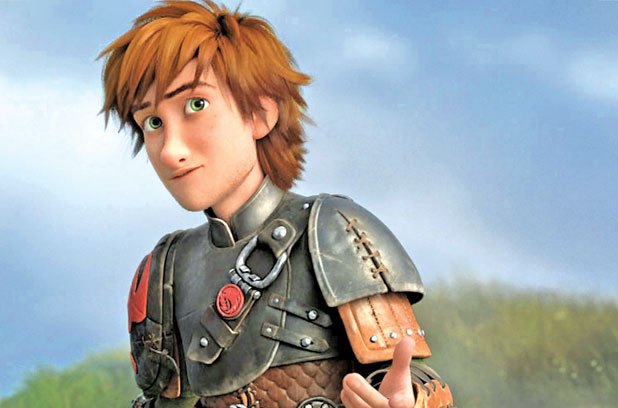
The story begins five years after the original 2010 movie. Hiccup (Jay Baruchel) is now an older and wiser teenager and master Dragon Whisperer. Through his efforts the citizens of his hometown, the Viking village of Berk, no longer fear dragons. In fact, the fire breathers have become part of the fabric of life. They have dragon races—that resemble Harry Potter’s Quidditch matches—and live a peaceful life co-existing with their serpentine pals.
Peace is threatened when Dragon Trappers, lead by the evil Drago Bludvist (Djimon Hounsou), set their eye on the domesticated dragons of Berk. To avoid a war Hiccup and his girlfriend Astrid (America Ferrera) must change Drago’s mind about enslaving dragons.
The follow-up to “How to Train Your Dragon” half-a-billion-dollar grossing coming-of-age story is more of an action/adventure movie than the original. It begins with a stunning aerobatics sequence that shows Hiccup and his trusty sidekick Toothless soaring through the air doing barrel rolls, loops and stunts usually only seen at airshows. The slick and sassy scene sets the tone for the rest of the movie. It’s a wild ride and one that reinvents the franchise.
Director Dean DeBlois has taken some chances with the story, deepening and darkening the tone with subplots about family relationships, prejudice and sacrifice. Some of the imagery is intense—the “alpha” dragons look like they sprung from the mind of H.P. Lovecraft—and may be a bit traumatic for toddlers, but should be fine for kids 6 and up.
It’s not all sturm and drang, however. Baruchel brings the fun with his expressive voice and the script is gently humorous. The focus is firmly on the action/adventure aspects of the story, but there are laughs along the way for ids and adults.
Without slavishly aping the original it thematically expands the universe, building on ideas established in the movie that audiences first fell in love with. In other words, it’s a sequel, with recognizable characters and situations, but also works as a stand-alone film.
Most of all it’s about the on screen imagery. Inventive sequences—it “rains” fish at feeding time in the dragon sanctuary for instance—and beautiful animation carry the day.
“How to Train Your Dragon 2” is high on spectacle and never wastes an opportunity to entertain the eye and up the wonder factor, but it’s not just shock and awe. An emotional subplot regarding family adds some weight to the fantasy elements of the story.
 Jay Baruchel has a unique voice. Instantly recognizable, the nasally twang he uses to bring the character of How to Train Your Dragon 2’s Hiccup to life is so distinctive it even has it’s own facebook fan page.
You would think that kids, who made the Viking teenager and his dragon Toothless so popular on the big screen—the original 2010 movie grossed almost half a billion dollars— and on the TV show and video games, would be thrilled to meet the man behind the voice. Right?
“Friends who have kids will say, ‘Hey! Look! It’s Hiccup,” and then it is utter, sheer disappointment,” he says. “‘This is not Hiccup. It’s a real life human dirt bag I’m looking at.’ Although I have to say I was in a liquor store in Los Angeles a few months ago and I was saying something to the cashier and this guy turned around and said, ‘You’re funny. You know you’re doing something right when you get recognized by your voice,’ but usually with the kids, they’re super bummed to actually meet me.”
Baruchel has voiced Hiccup in two films (with at least one more on the way) and forty episodes of the television show. Director Dean DeBlois says that the actor and the character are now interchangeable, with Brauchel bringing character ideas to the table every time out.
“How much input I ultimately have is purely up to (Dean),” says Baruchel. “I have played this character for seven years and I think he has a very specific way of speaking and a specific way of communicating. What’s really cool is that Dean, who created this epic world that comes from his head and heart, and who has so many things to think about, still finds time to be a collaborator and will always allow me to find my own way into things. I’d like to think we can equally take ownership over (Hiccup).”
One of Hiccup’s vocal tics unmistakably came from Baruchel—his habit of calling his dragon by the nickname Bud.
“That is clearly me,” he says. “I remember the first time we did it in the first one and it just kind of stuck and became a thing. I call everyone Bud in real life and half the work is for me not to call every character in this movie Bud. It’s kind of specific to Toothless now. I still fit in some hoser wherever I can.”