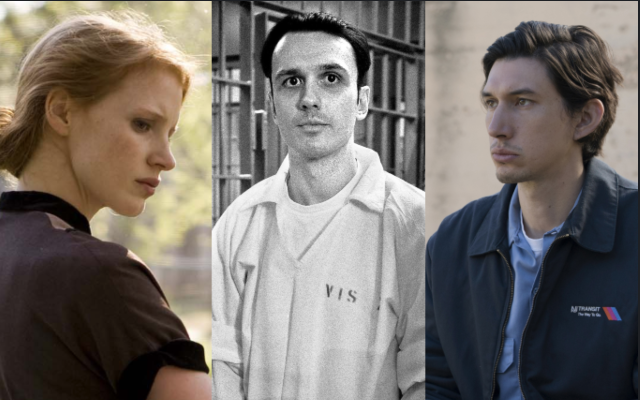
The new Jim Jarmusch movie is a week in the life of Paterson, the man and the place.
Adam Driver is Paterson, a poetry writing New Jersey bus driver from Paterson, New Jersey. He lives with Laura (Golshifteh Farahani), a dreamer who wants to open a cupcake shop and make them rich or, maybe, become a country singer and their dog Marvin.
For Paterson, every day is pretty much the same as the lone before it. He wakes up early and eats Cheerios before packing a lunch into a metal lunch box and heading to work. A William Carlos Williams—the famous New Jersey poet—fan, he pens carefully worded free verse poems in an ever present notebook. The only things that change in Paterson’s life are the ever-shifting faces of his passengers and Laura’s career choices. When she isn’t painting black-and-white geometric designs on eery surface of their small home she is dreaming about whatever it is that may come next for her. When his notebook is damaged Paterson musty rediscover the possibilities of the blank page.
“Paterson” is a wonderfully leisurely movie. It’s not in a hurry to get where it is going, instead luxuriating in the mundane aspects of Paterson’s life punctuated by on-screen depictions of his poetry. What could have been insufferable turns into a beautifully rendered portrait of people who find beauty and art in every day life.
There are small conflicts sprinkled throughout, a bus breaks down and lovers quarrel, but “Paterson” isn’t about that. It’s about gentle, loving performances from Driver and Farahani and the beauty of overheard conversations and the day to day of regular life.
Paterson, the new movie from director Jim Jarmusch is a week in the life of Paterson, the man and the place.
Adam Driver plays Paterson, a poetry writing New Jersey bus driver from Paterson, New Jersey. He lives with Laura (Golshifteh Farahani), a dreamer who wants to open a cupcake shop and make them rich and their dog Marvin.
Paterson is a wonderfully leisurely movie. There are small conflicts sprinkled throughout, a bus breaks down and lovers quarrel, but Paterson isn’t about that. It’s about gentle, loving performances from Driver and Farahani and the beauty of overheard conversations and the day-to-day of regular life.
After the success of Star Wars and everything else you’ve been in recently, you must get offered every script out there. Why choose this one?
Jim [Jarmusch]. It’s a director’s medium so if I get lucky enough to work with great directors, that’s the only thing as far as a game plan I have. I have gotten to do that with really great people and it feels good. I’m lucky in that I get to choose things now, but choose things from what I’m offered. The scale doesn’t matter.
So it doesn’t matter whether you’re shooting for twenty days or you’re gone for six months? Is it just the love of acting?
Yes. It’s a very strange job. It seems you get to do your job twenty percent of the time and then you talk about it forever. For me the doing of it is the best. The things surrounding it don’t matter. Trailers, money, they don’t matter if you get to work with really great people. Then hopefully what you’re making is bigger than any one person and it feels relevant, as much as you can attach meaning to your job. The love of collaborating with people who are on the same page and want to make the best version of it is really exciting.
I think you can attach meaning. Movies like this are worth talking about…
I don’t like to say what meaning I attach to my work. Half of the experience of watching a play or something in a movie theatre is that everyone is coming from somewhere else. No one lives inside the movie theatre. They’re bring all their baggage and if they’re coming there not ready to be affected then they probably won’t be affected. But whatever meaning they pick out of the movie, that means something to them or doesn’t mean anything to them, is completely subjective.
A movie like Paterson is a beautiful slice of life but it is probably going to speak to the audience that will be very different from say, Suicide Squad, but Paterson isn’t going to make $165 million in its opening weekend.
WHAT?!
But for me that makes it valid and interesting.
Really great movies have a longer shelf life. You come back to them later and find new things in them. So many times, and this is so obvious, you watch a movie and you’re not ready for it and you come back to it later because you’re a different person and suddenly it speaks to you in a different way. When they are well crafted they have that shelf life whereas a lot of things are made for one weekend.
The new Jim Jarmusch movie is a week in the life of Paterson, the man and the place.
Adam Driver is Paterson, a poetry writing New Jersey bus driver from Paterson, New Jersey. He lives with Laura (Golshifteh Farahani), a dreamer who wants to open a cupcake shop and make them rich or, maybe, become a country singer and their dog Marvin.
For Paterson, every day is pretty much the same as the lone before it. He wakes up early and eats Cheerios before packing a lunch into a metal lunch box and heading to work. A William Carlos Williams—the famous New Jersey poet—fan, he pens carefully worded free verse poems in an ever present notebook. The only things that change in Paterson’s life are the ever-shifting faces of his passengers and Laura’s career choices. When she isn’t painting black-and-white geometric designs on every surface of their small home she is dreaming about whatever it is that may come next for her. When his notebook is damaged Paterson must rediscover the possibilities of the blank page.
“Paterson” is a wonderfully leisurely movie. It’s not in a hurry to get where it is going, instead luxuriating in the mundane aspects of Paterson’s life punctuated by on-screen depictions of his poetry. What could have been insufferable turns into a beautifully rendered portrait of people who find beauty and art in every day life.
There are small conflicts sprinkled throughout, a bus breaks down and lovers quarrel, but “Paterson” isn’t about that. It’s about gentle, loving performances from Driver and Farahani and the beauty of overheard conversations and the day to day of regular life.
Director Martin Scorsese has always been torn between the scared and the profane. His greatest work has always grappled with sin and redemption, populated by characters like “God’s lonely man,” truth seeker and psychopath Travis Bickle.
Over forty years ago he did a voice over in “Mean Streets” that could inserted (with certain modifications) into his latest film, a seventeenth century epic based on Shūsaku Endō’s 1966 novel “Silence.”
“You don’t make up for your sins in church,” he says. “You do it in the streets. You do it at home. The rest is bull**** and you know it.”
In this case “the streets” are a foreign land, but the spiritual journey is not that different.
“Silence” begins in 1633 with the disappearance of Father Cristóvão Ferreira (Liam Neeson), a Portuguese Jesuit priest who has gone missing while on mission in Japan.
Christianity is an outlawed religion and those who hide Christians are tortured and killed. Two young priests, Sebastião Rodrigues (Andrew Garfield) and Francisco Garrpe (Adam Driver), acolytes of Ferreira, convince Father Valignano (Ciarán Hinds) to allow them to travel to Japan to locate their mentor. “How can we abandon our mission?” asks Rodrigues. “How do we neglect the man who shaped our faith? We have no choice but to save his soul.”
The year is 1640 and they are the last two priests to go to Japan. “An army of two,” says Valignano. An arduous journey leads them to a country more dangerous and complicated than they anticipated. Christians are desperate for their word but live in fear. Officials insist, “Your doctrine is of no use in Japan. We have concluded it is a danger.” If caught by colonels of the country’s inquisitor Inoue Masashige (Issey Ogata) Christians are first asked to committed apostasy—step on an image of Jesus Christ—to denounce their faith or be killed.
As the bodies pile up around them on heir search the question must be asked, are they helping or are they foreigners who bring disaster with them? “Think of the suffering you have inflicted on these people,” says Masashige, the cheery faced inquisitor with a squeaky voice, “just for your vision of a church.” If the priests die the Japanese church dies with them but will the suffering of their people be enough to compel them to make the painful act of love ever performed, apostasy?
“Silence” is a meditative movie about the strength of faith and the limits to which it can be stretched. It is a physical and sacred journey à la “Heart of Darkness.” A look into obsession, colonialism and martyrdom, it is a deliberately paced—i.e: a slow, almost glacial tempo—film unafraid to submerge the viewer in the suffering of its characters. Make no mistake, this is no “Passion of the Christ” with its love of violence and blood. This is a 160 movie that examines the intersection of agony and ecstasy, but does so as an exercise of the mind. There are uncomfortable images, but Scorsese plays it straight, presenting the instances of torture as expressions of the power of belief not merely physical agonies. The movie may start with a beautifully composed shot of the dismembered heads of two priests but the violence here isn’t glamourized, it is organic to the story and even more chilling as a result.
Also, anyone expecting the usual Scorsese stylistic flourishes may be disappointed. There are no Rolling Stones songs or slow motion. There are a few overhead shots but nothing as showy as the long, uninterrupted tracking shot in “Goodfellas.” Instead it’s a classically made film with some serious Kurosawa mojo.
As the Jesuits Garfield and Driver convey divine confidence and yet, as their faith is tested and doubt seeps in, they play their characters as priests battling to do the right thing in the face of suffering and insurmountable odds. Both must make the choice between their beliefs and the stark reality of the consequences of their belief. Both bring humanity to characters who could have been simply portals for some kind of celestial message.
Most memorable is Issey Ogata as the grinning inquisitor Inoue Masashige. The very definition of the ordinariness of evil, he is a cruel man with a smile on his face and a scar on his heart. Think “Inglorious Basterds’s” Hans Landa with the faux gentility of Auric Goldfinger and you get the idea.
“Silence” is a rarity, a big, epic film that values introspection. It’s a companion piece to Scorsese’s other religious offerings—“The Last Temptation of Christ” and “Kundun”—but a more complicated film than either of those. It is about faith but more importantly, also about the distinction between religion and spirituality and Scorsese does not back away from diving into those murky theological waters.
In the films Take Shelter and Mud director Jeff Nichols explored themes of social anxiety caused by fear of the unknown. When I suggest that his new movie, Midnight Special, a sci fi road film about a father and a son with special powers, continues that examination he agrees, but only to a point.
“I certainly think you could make that statement and it would be fair,” he says, “but it doesn’t exactly line up with what I was thinking.
“I was thinking about what it is to be a parent. I think being a parent is to have faith in the unknown. You don’t know what your children are going to grow up to be. You don’t know what’s going to happen to them. You don’t know if they are going to make it all the way. You have to have faith in who they can be, who they are developing into. Who they are currently. I think that is what parenthood is and I think that is why there is so much fear and anxiety that comes from being a parent.”
Nichols says he originally came up with the idea for a “sci fi government chase film,” but adds, “That could be really silly so I think it is up to me as a filmmaker to apply these kind of personal feelings I have and my relationships to the locations and to the world at large to try and ground this film and give it some kind of actual purpose.”
To complete the picture Nichols cast Michael Shannon as the father. A frequent collaborator, Shannon has starred in all Nichols’s films, including the upcoming Loving.
“I think he makes me a better writer, especially in a film like Midnight Special where I’m trying to reduce the need for backstory to be delivered through monologues. When you have a person like Mike he fills all the spaces between the lines with all that subtext. He carries it on his face, in his continence. He is the complete story and he doesn’t even have to say a word.”
Midnight Special is the extraordinary kind of sci fi movie that teases out the information bit by bit. We learn enough to stay involved and are treated to several spectacular and exciting scenes along the way, but when it comes time to put a period on the story, Nichols instead uses an ellipsis in a metaphysical ending that will mean different things to different people. It owes a nod to his old hero Stephen Spielberg but feels distinctly like a Jeff Nichols film.
“If you look at ET and the bicycle flying and all these other moments that are classic moments in Spielberg films, they are wonderful. I don’t do that. For better and for worse I don’t do that. Maybe it’s because I live in the modern age and am a bit more of a pessimist. I don’t consider myself a cynic. I like films that ultimately are hopeful but there is a different kind of conclusions in my films than his films. I think my films point toward hope but don’t fully embrace it. I think that is the difference. It could also be the difference between a blockbuster and whatever this is going to be, but that is who I am as a person.”
“Y’all have no idea what you’re dealing with, do you?” asks cult leader Calvin Meyer (Sam Shepard) of his FBI interrogators in “Midnight Special.” They don’t, and for much of the running time of the film, you won’t either. Director Jeff Nichols has made a wilfully obtuse, but fascinating, sci fi drama that will keep you guessing, even after the credits have rolled.
The movie begins as an apparent missing child story. We’ve seen the scene before. A dowdy motel room, armed kidnappers, a child hidden under a sheet. What’s unexpected is how agreeable the eight-year-old Alton Meyers (Jaeden Lieberher) is. He hugs Roy (Michael Shannon) and sits quietly in the backseat as Lucas (Joel Edgerton) drives.
Seems Roy is the boy’s biological father and the men have kidnapped the boy from The Ranch, a cult compound run by Brother Calvin Meyer (Sam Shepard). The goal is to allow the boy to fulfill his destiny, but what exactly is that?
Is he a prophet? A saviour? Or a weapon, as the FBI and NSA officer Paul Sevier (Adam Driver) believe?
The boy has powers. Visible spectrums of light come from his eyes. In other words, the kid has gifts and rays shoot from his eyeballs. While on The Ranch would also speak in tongues. To the cult his is ravings have become scripture, to the FBI they appear to contain highly guarded secrets of national security. The date Friday March 6 looms heavy in the text, and with the date fast approaching the FBI want to know what might happen on the day.
“What do you think will happen on March 6?” they ask one cult member.
“If Alton is with us we will be saved,” she replies.
As the FBI amp up their chase for the boy, Sarah (Kirsten Dunst), Roy’s ex and Alton’s mother, joins in to help her son complete his journey. “The date and place is everything,” says Roy. “It’s all we have.”
“Midnight Special” is a special kind of sci fi film. The story is more about fear of the unknown and belief than flying saucers or little green men. Mulder and Scully would love it. Director Nichols has belief, belief that his audience will stay with a movie that doesn’t make it easy for them, that doesn’t stick to Robert McKee’s golden rules of script writing. Instead it teases out the information but only to a point. We learn enough to stay involved and are treated to several spectacular and exciting scenes along the way, but when it comes time to put a period on the story, Nichols instead uses a an ellipsis in a metaphysical ending that will mean different things to different people.
This is a, “Buy the ticket, take the ride,” movie. Is it satisfying? Yes, if you don’t expect answers to all the questions the film raises. It’s more “2001: A Space Odyssey” than “The Day the Earth Stood Still,” although this movie does share Klaatu’s cool eye lasers. Both are good, interesting pictures, but one is unconventional and brave enough to ask more than it answers.
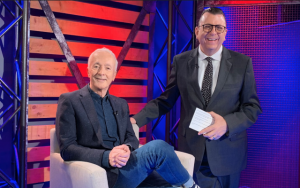
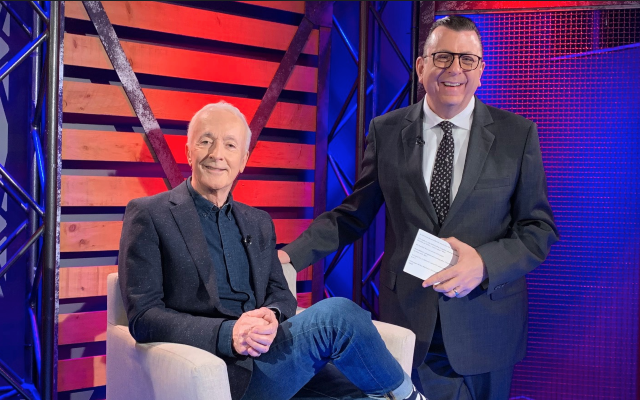
Having one of the most recognizable voices in movie history can lead to some surreal moments. Just ask Anthony Daniels. He’s played C-3PO in all seven Star Wars films, including this weekend’s Star Wars: The Force Awakens and once rented a car with a very familiar voice on the GPS.
“I felt uncomfortable with me —very clearly — giving me instruction for something I didn’t know. I found it quite bizarre. I was driving thinking, ‘This is unnatural.’”
Other times the voice, which in real life is less mannered than his on-screen counterpart, brings him unexpected recognition.
For some of his fans, seeing isn’t believing — hearing is.
“One of the most charming things that happens to me is when an adult will bring a child to me and say, ‘He doesn’t believe you’re C-3PO.’
“And why would he? I’m some old guy with white hair. Then I do the voice. You see the sound go in one ear and then there is an absolutely realistic time delay whilst the synapses process this. Nothing happens for a second-and-a-half, then suddenly there’s a smile and excitement. I love that delay while they process it. You couldn’t buy that. I’ve been given that and it gives me utter joy because it is without guile. It is just an honest recognition of something I did.”
A week before Daniels trekked to Tunisia in 1976 to begin shooting the sci-fi space opera, he was a stage actor performing in Tom Stoppard’s absurdist play Rosencrantz and Guildenstern Are Dead.
“It’s about two nobodies,” he says. “Rosencrantz is a bit gung ho, (he) doesn’t think. Doesn’t work things out really; just goes for the main thing. His friend Guildenstern is much more reserved, much more intellectual. He thinks about things. Worries about things.
“There I am a week later playing C-3PO in the desert with R2D2. I would say it was three or four years later that something in my brain went, ‘Wait a minute, R2 and 3PO are Rosencrantz and Guildenstern.’ There is a nice synergy there, or connection I think. 3PO is the clever one and R2 is the gung ho one. They’re odd couple buddies. It is a great dynamic to act off.”
Today C-3PO and R2D2 are seen as a classic combo, but during filming, Daniels had his doubts it would work.
“The problem for me was R2D2 never made any sounds so I was playing off myself. Not to aggrandize myself, but it was quite a challenge. It was a bit like a terrible Whose Line Is It Anyway? where you pretend a chair is your best friend.
“When I saw the final movie and there were R2’s beeps and responses, to me it was total magic because that was the first time I ever saw it. They had woven a conversation after the fact.”
Playing the golden droid has been a lifelong career for Daniels. The 69-year-old actor was just 30 years old when he first donned C-3PO’s suit and has since appeared in person or voice in dozens of movies, television shows, commercials, PSAs and live events as the character. He’s even in the legendary The Star Wars Holiday Special and says he’s been “very lucky to be given the chance” to play C-3PO but calls that his “business life.”
“I don’t go around saying, ‘Do you know who I am?’
When I suggest he could at least use his fame and the C-3PO voice to get great tables in restaurants he says, “No, no, no. Then they’d say there’s no table tonight or tomorrow. I don’t think people would be too terribly impressed to have me in the restaurant. Were I to enter in a gold suit then I could have the entire room to myself!”
There’s good news for Star Wars fans. The initials in director J.J. Abrams’s name definitely do not stand for Jar Jar. His take on the “Star Wars” universe does everything the much-maligned prequels did not; that is it focuses on character and adventure not treaties or political dealings. It delivers a nostalgic blast while at the same time offering a new hope that the series can be freshened up.
Set thirty years after “Star Wars: Episode VI – Return of the Jedi” and the defeat of the Galactic Empire, “The Force Awakens” sees Han Solo (Harrison Ford), Chewbacca (Peter Mayhew) and a new set of allies—including scavenger Rey (Daisy Ridley), Finn (John Boyega) an AWOL Stormtrooper and budding resistance fighter, daredevil pilot Poe Dameron (Oscar Isaac) and the lovable basketball-shaped droid BB-8—battle against “a dark shadow spreading across the galaxy,” Darth Vader wannabe Kylo Ren (Adam Driver). They all have one goal in common, to locate missing Jedi Knight Luke Skywalker (Mark Hamill).
That’s it, just a barebones synopsis with no spoilers. I’m going to leave you to discover “Star Wars: The Force Awakens” with fresh eyes because for the first time in over thirty years there is a “Star Wars” movie that delivers the same kind of wide-eyed joy as Lucas last delivered when Luke still had two hands.
Abrams gets away from the political bafflegab that made the prequels such a chore. Instead he returns to the basics, good vs. evil, fathers and sons, keeping it on track as an action-adventure with great characters.
Rey is the female lead everyone has been waiting for Marvel to make a movie about. Abrams beat them to the punch. She’s powerful, human, self sufficient—“Don’t take my hand,” she snarls at Finn as he tries to lead her to safety—and would never even consider wearing a gold bikini.
As a Stormtrooper who finds redemption Finn is the catalyst for much of the film’s action. He’s a little bit goofy, a lot brave and in over his head but because he thinks with his heart and not his head he’s a welcome, charming presence.
Poe Dameron has the swagger of a young Han Solo while BB-8 has personality plus and purrs like a cat. Kylo Ren, on the other hand, is a robed evildoer prone to childish temper tantrums.
Connecting these new characters to the universe are legends from the past, Han Solo, Chewbacca and Leia (Carrie Fisher).
Teaming Solo, Chewie and the Millennium Falcon provides an undeniable nostalgic rush but they are here as more than just cameos to pay tribute to the past. Ford’s Spencer Tracy-esque vibe allows him the gravitas to utter lines like “The galaxy is counting on us,” while sidekick Chewie says much without actually speaking words. Leia has a smaller role, but it’s a blast to see Ford and Fisher, both looking age appropriate, together again.
Their first meeting exemplifies the movie’s playful tone. “You’ve changed your hair,” Hans says to his old flame, noticing her famous bagel hair buns are gone. What could have been a grand reunion is underplayed and instead the call back to the past is presented as a warm moment between two old friends.
It’s that kind of warmth and humanity that separates “The Force Awakens” from other big budget blockbuster entertainment. The finale is big and loud like the Marvel movies but unlike “The Avengers” films Abrams keeps the emotional core alive right up until the end. It’s the right mix of space-opera-cool and character that will please the hard-core fans that see this as just another piece of a much larger puzzle but also works as a standalone story as well.
“Star Wars: The Force Awakens” is a blast, nostalgic and otherwise.
There’s good news for Star Wars fans. The initials in director J.J. Abrams’s name definitely do not stand for Jar Jar. His take on the “Star Wars” universe does everything the much-maligned prequels did not; that is it focuses on character and adventure not treaties or political dealings. It delivers a nostalgic blast while at the same time offering a new hope that the series can be freshened up.
Set thirty years after “Star Wars: Episode VI – Return of the Jedi” and the defeat of the Galactic Empire, “The Force Awakens” sees Han Solo (Harrison Ford), Chewbacca (Peter Mayhew) and a new set of allies—including scavenger Rey (Daisy Ridley), Finn (John Boyega) an AWOL Stormtrooper and budding resistance fighter, daredevil pilot Poe Dameron (Oscar Isaac) and the lovable basketball-shaped droid BB-8—battle against “a dark shadow spreading across the galaxy,” Darth Vader wannabe Kylo Ren (Adam Driver). They all have one goal in common, to locate missing Jedi Knight Luke Skywalker (Mark Hamill).
That’s it, just a barebones synopsis with no spoilers. I’m going to leave you to discover “Star Wars: The Force Awakens” with fresh eyes because for the first time in over thirty years there is a “Star Wars” movie that delivers the same kind of wide-eyed joy as Lucas last delivered when Luke still had two hands.
Abrams gets away from the political bafflegab that made the prequels such a chore. Instead he returns to the basics, good vs. evil, fathers and sons, keeping it on track as an action-adventure with great characters.
Rey is the female lead everyone has been waiting for Marvel to make a movie about. Abrams beat them to the punch. She’s powerful, human, self sufficient—“Don’t take my hand,” she snarls at Finn as he tries to lead her to safety—and would never even consider wearing a gold bikini.
As a Stormtrooper who finds redemption Finn is the catalyst for much of the film’s action. He’s a little bit goofy, a lot brave and in over his head but because he thinks with his heart and not his head he’s a welcome, charming presence.
Poe Dameron has the swagger of a young Han Solo while BB-8 has personality plus and purrs like a cat. Kylo Ren, on the other hand, is a robed evildoer prone to childish temper tantrums.
Connecting these new characters to the universe are legends from the past, Han Solo, Chewbacca and Leia (Carrie Fisher).
Teaming Solo, Chewie and the Millennium Falcon provides an undeniable nostalgic rush but they are here as more than just cameos to pay tribute to the past. Ford’s Spencer Tracy-esque vibe allows him the gravitas to utter lines like “The galaxy is counting on us,” while sidekick Chewie says much without actually speaking words. Leia has a smaller role, but it’s a blast to see Ford and Fisher, both looking age appropriate, together again.
Their first meeting exemplifies the movie’s playful tone. “You’ve changed your hair,” Hans says to his old flame, noticing her famous bagel hair buns are gone. What could have been a grand reunion is underplayed and instead the call back to the past is presented as a warm moment between two old friends.
It’s that kind of warmth and humanity that separates “The Force Awakens” from other big budget blockbuster entertainment. The finale is big and loud like the Marvel movies but unlike “The Avengers” films Abrams keeps the emotional core alive right up until the end. It’s the right mix of space-opera-cool and character that will please the hard-core fans that see this as just another piece of a much larger puzzle but also works as a standalone story as well.
“Star Wars: The Force Awakens” is a blast, nostalgic and otherwise.