“The Age of Adaline,” a new romantic fantasy starring Blake Lively, asks a simple question: Is falling in love worth the trouble when there is no chance of growing old together?
Love, and almost everything else is tricky for Adaline Bowman (Lively). For nearly eight decades she has been frozen at age 29. Her daughter (Ellen Burstyn) looks like her grandmother while Adaline has been immune to the ravages of time. Over the years she has become closed off, rarely making friends and never dating lest she be found out and experimented on to discover the secret of eternal youth. Every ten years she moves, changes her identity and starts all over again.
Just days before a move from San Francisco to Oregon, her life is thrown off schedule when she meets Ellis Jones (Michiel Huisman), a handsome philanthropist who falls in love with her at first sight. Despite her better judgment she becomes involved with him, but as their relationship deepens a revelation threatens to reveal the truth about her strange life.
“Age of Adaline” is a movie that requires a serious leap of faith on the part of the viewer. It’s ripe with Nicholas Sparks style clichés—a woman who never thought she’d love again finds happiness, but at what cost?—and fantastical elements that would even test even Ponce de León’s belief in eternal youth.
Then there is a plot twist of sorts. They’ll be no spoilers here, but suffice to say Adaline has had a complicated love life and the repercussions of decades old romances echo through time affecting her present day relationship. It’s a weird turn that dips into creepy/absurd territory and is an unsatisfying climax to the film.
On the upside Lively is, well, lively, bringing pathos and vulnerability to Adaline. Her mannered speech sounds right for someone who came of age in a different time and she almost manages to pull off most of the film’s groaner dialogue. There’s a laugh in her voice when a random himbo tries to throw her a line, and then embarrassed says, “I guess you’ve heard that before…” “I have,” she giggles, “from a young Bing Crosby… type.” It’s a cheeseball line, but she pulls it off… barely.
“The Age of Adaline” is a silly movie that requires an almost impossible level of suspension of disbelief but somehow the metaphysical melodrama, with its lovely design and strong performances over comes the ridiculous plotlines to become an almost timeless romance.
In his directorial debut Russell Crowe wasn’t content to simply make one movie. Instead he made “The Water Diviner,” an all-encompassing film that is a war story, a family drama, a road movie, a romance, an ode to tolerance and the tale of a man with mystical powers.
Crowe sets the backdrop for the story with an opening scene detailing one of the great Allied disasters of World War One, the Battle of Gallipoli. In a standoff between the Turkish Army, led by Major Hasan (Yilmaz Erdogan) and the ANZACS (Australian and New Zealand Army Corps) horrific loss of life led to the Australian Army retreating, leaving behind many fallen comrades.
Cut to the Australian out back. Joshua Connor (Crowe) is a burly farmer with a gift for finding water in the arid countryside. His wife is a broken woman, devastated at the loss of their three sons, all killed in combat at Gallipoli. She switches between blaming Joshua for allowing them to go to war and pretending they are still alive. When her grief becomes too much, he makes her a promise, “I’ll find them, love,” he says, “I’ll find them and bring them back to you.”
Next stop, Constantinople. Connor travels to the exotic Turkish land to find the remains of his sons, bring them back to Australia and bury them in home soil. There he meets hotelier Ayshe (Olga Kurylenko) and her precocious son Orhan (Dylan Georgiades). Romance brews, war between the Greeks and the Turks heats up, and honour is tested as this fish-out-of-water makes his way through the Ottoman Empire.
There is much to like in “The Water Diviner.” Andrew “Lord of the Rings” Lesnie’s cinematography is handsome and effective throughout, particularly in the war scenes. The storytelling is clear and concise and doesn’t glorify war or demonize the Turkish Army and there are nice performances throughout. Young Georgiades is a spark plug and Erdogan is the epitome of grace under fire and dignity. Crowe brings low key determination tempered by stoicism while Kurylenko, who is usually treated as part of the set decoration, is soulful in her portrayal of a war widow who has a hard time accepting that her husband isn’t coming back from the battlefield.
As good as Crowe and Kurylenko are it’s their relationship that brings the melodrama to a movie that doesn’t need a love story to keep our attention. The goo-goo eyes on display bring to mind “A Good Year,” Crowe’s ill-advised attempt at adding rom com stardom to his resume. It feels out-of-place and unnecessary in a movie that already hits many organic emotional highs in the story of a father searching for his dead sons.
“The Water Diviner” is a sweeping historical drama about one man; a personal story set against a huge backdrop that studies a father’s sorrow and a nation’s tribulations.
“Ex Machina” is a high tech thriller that by and large ignores the tech to get down to the nitty gritty. Director and screenwriter Alex Garland (who previously scripted “28 Days Later” and “Sunshine”) places the story firmly in the world of artificial intelligence and then showcases the humanity (or lack thereof) of his characters, both flesh-and-blood and robotic.
When we first meet Caleb Smith (Domhnall Gleeson) he is a young, talented programmer at Bluebox, the world’s leading search engine. He is also the winner of a company wide contest to spend a week with Bluebook’s reclusive CEO, Nathan “The Mozart of Code” Bateman (Oscar Isaac). He arrives at Bateman’s remote complex to discover he is to take part in a Turing Test (named for “The Imitation Game’s” subject Alan Turing) to evaluate the ability of an automaton named Ava (Alicia Vikander) to show intelligent behaviour equal to, or undifferentiated from, that of a human being. Over seven sessions Caleb forms a deep connection with Ava as his relationship with alpha-male Nathan crumbles. In the end the young man must undergoes the greatest test of all—figuring out who to trust, man or machine.
With the cool austerity of Stanley Kubrick director Garland creates the antiseptic world of Bateman’s lair. Clinical and precise, it’s a stark backdrop for a sci fi story that is more concerned with ideas than special effects. It’s a “Frankenstein” story that is, as Bateman says, not interested in what people are thinking, but how people think.
And it will make you think. The Turing Test premise is an excuse to hang a thriller on, one that uses Ava’s artificial intelligence to have a look at how people can be manipulated with the bat of an eye or tilt of a head. Coupled with that it raises real issues regarding internet security—how much should your internet provider really know about your habits, likes and dislikes?—and surveillance.
I have to be deliberately sketchy with the plot details so as not to spoil the climax, but it’s a story that will stimulate conversation but does not ignoring the emotional elements of the Caleb’s tale.
Isaac once again proves to be a quiet but potent on-screen force as Bateman, always the smartest guy in the room, but one lacking the interpersonal skills to truly connect with people. Gleeson (who will next be seen alongside Isaac in “Star Wars: Episode VII – The Force Awakens”) is sympathetic and determined but it is Vikander who really impresses. She’s equal parts warmth and chilly precision as a robot who wants more than to be a machine.
“Ex Machina” is being presented as sci fi, but it really is a human drama; a human drama where the main character has a fibre optic nervous system.
“Ex Machina” opens April 24 in Toronto and Vancouver!
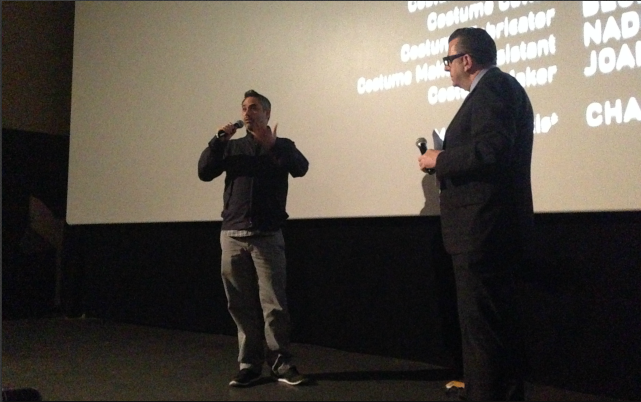
Richard will host a Q&A with “Ex Machina” director Alex Garland at the Varsity Cinema on Monday April 20, 2015.
Domhnall Gleeson, Oscar Isaac and Alicia Vikander star in Ex Machina, a sci-fi/psy-fi thriller that offers a chilling look into the not-too-distant future of artificial intelligence. Filled with plenty of twists, the film marks the directorial debut of Alex Garland, who wrote the script and has also penned acclaimed sci-fi fare like 28 Days Later and Sunshine.
Caleb (Gleeson), a 26-year-old coder at an internet-search giant, wins a competition to spend a week at the private mountain retreat belonging to Nathan (Isaac), CEO of the company. Nathan is not only reclusive, but also rich, with property that goes on forever. On the way, the helicopter pilot tells Caleb, “We’ve been flying over his estate for the past two hours.”
Upon arrival, Caleb finds out that Nathan wants him to participate in an experiment – testing an artificial intelligence, housed in the body of a beautiful girl named Ava (Vikander). As Caleb finds himself falling for Ava, a dark psychological battle ensues, where loyalties are torn between man and machine. What does Ava really want? And what is Nathan up to?
With a silver-clad scalp and mesh-wrapped waist, Ava is a breathtaking vision who walks like a dancer (perhaps enhanced by Vikander’s training as a ballerina). Nathan’s retreat is built into rock, yet slick and shiny with glass walls that peer out onto a landscape of streams, peaks and greenery.
The film was partially shot on location in Norway.
A quick internet search turns up many adjectives used to describe Daredevil star Deborah Ann Woll; gorgeous, talented and cute to name just a few.
The redheaded actress uses other terms to describe herself.
“There’s nerd, geek, all those words,” she says. “I am settling closer and closer to dork. I am a very proud dork.”
The former True Blood star—she played fierce teenage vampire Jessica Hamby for seven seasons on the hit show—embraces her inner dork—“I’m Dungeons and Dragons player, a Mystery Science Theatre buff. I like board games.”—and says the role playing games have benefits beyond entertainment value.
“Sometimes I feel socially awkward. I feel like sometimes I have trouble connecting to people who are more extroverted. Something like Dungeons and Dragons or a board game is a way for me to be social but it takes some of the responsibility off of me myself. If I don’t feel impressive as myself, I can feel impressive as Mistress Pyrona, the Genosi Sword Maiden. Like my acting, it gives me a little bit of support.
“Playing Dungeons and Dragons isn’t at all like acting but it is that idea that you can be braver when you’re someone else.”
On the Netflix series Daredevil she plays Karen Page, secretary and soon-to-be love interest of Matt Murdock, a blind lawyer who moonlights as crime fighter Daredevil. The character has been around since the first Daredevil comic in 1964 but has changed substantially over the years. Page began as innocent and sweet but slowly morphed into a “heroin addicted porn star,” a complexity of character that gives Woll lots to work with.
“I like characters that change. For my Karen I said, ‘Alright, she’s going to have moments when she’s innocent, sweet and fun to be around and she’ll have moments where she’s dark and a little addicted to that adrenaline rush and danger. I want both of those things to live in her at the same time.’ We started her with a bit of a past, which hopefully, if we get to do any more of Daredevil we’ll find out about.”
Woll knows the fans care about the characters, and so far the reaction has been good to what she’s doing with Karen.
“They don’t care about it because they think you’re hot and they want to see you take your top off,” she says, “they care about it because they really want it to be the Karen they love and respect.”
The best horror films are never only about the Double Gs—guts and gore. Sure, part of the appeal of scary movies is that they make the hairs on the back of your neck stand on end, and that frequently requires a spray of blood or a nightmarish vision of terror in the form of Freddy Kruger or Jason Voorhees, but great horror films are always about something other than the thrills and chills.
To be truly effective scary pictures must tap into a collective anxiety; societal hot buttons that elevate the frights to a new level. For instance, Frankenstein plays on people’s fear of science while Godzilla is an obvious cultural metaphor for nuclear weapons in reaction to the devastation of the bombings of Hiroshima and Nagasaki and you don’t have to be Sigmund Freud to see Dracula as the metaphorical embodiment of everything from drug addiction and old age to alternative lifestyles and capitalism.
Perhaps the most socially self-aware horror film of all is Night of the Living Dead. It’s got zombies galore but director George A. Romero had the braaaiiins to include a subtext that echoed the contemporary state America’s of race relations, the horrors of Vietnam and cynicism with government. It’s the best of both worlds—a thought-provoking movie that gushes with gore.
Film historian Linda Badley suggests Night of the Living Dead horrifies because the zombies weren’t bizarre creatures from outer space or from Dr. Frankenstein’s laboratory, but because, “They’re us.”
This weekend a new film, Unfriended, turns the camera, or in this case the Skype screen, on us in an eerie story about bullying. On the surface Unfriended may look like a cheapo teen horror flick with a cast of unknowns—which it is, but so was Night of the Living Dead—but by basing the plot in the world of social media and the bad behaviour that comes along with anonymous avatars, it becomes a ripped-from-the-headlines comment on a very touchy societal subject.
The movie begins a year after Laura, a popular high school student, was cyber shamed into killing herself. A teenage girl is on a group Skype session when she begins to receive cryptic and threatening messages from Laura’s old account. As the movie unfolds secrets are revealed and the danger is amped up.
The mysterious killer is a hoary old horror convention, but here it’s told in the contemporary language of Millennials. Unsurprisingly, the movie has already sparked the interest of the Y Generation—the trailer garnered almost 300,000 Twitter comments on its first day—who relate to the setting—by-and-large it takes place on a computer screen—and who are all too familiar with the everyday brutality of Twitter, Facebook, Skype, Instagram and Spotify. They understand what a minefield the web can be and the filmmakers realized the narrative possibilities of creating cinema’s first deadly internet troll. Freddy Kruger is your father’s baddie; the new horror comes in bits and bytes.
Similar to Psycho’s Norman Bates or the undead of 28 Days Later, the kids of Unfriended tell a very specific story—the sad tale of a teen suicide—that becomes a universal horror tale by making the characters and setting ordinary and relatable. Like the best of classic fright films, it breathes new life into a form we’ve seen before by recontextualizing it for a new generation.
Years from now when people look up the meaning of the word “unnecessary” in the dictionary the definition will be the synopsis of “Paul Blart: Mall Cop 2.”
In the original 2009 movie Blart (Kevin James) was living the life of a security guard—excuse me, Security Officer—at New Jersey’s West Orange Pavilion Mall after failing the physical portion of his State Trooper’s exam. He was a lovesick loser, unlucky at love and life.
Things have changed a bit since then. He’s still working security, but is flying high off his last major caper, single-handedly taking on a group of thugs who took over the mall and held his lady love hostage on Black Friday, the busiest shopping day of the year.
In the new film he’s in Las Vegas attending the Security Officer’s Convention. Tagging along is daughter (Raini Rodriguez) a teen working up the courage to spill the news that she’s leaving home for university in Los Angeles. On what should be one of the greatest nights of his life—delivering the keynote speech at the convention—duty calls when a disgruntled high roller (Neal McDonough), who lost a bundle on his last visit to the casino, kidnaps Blart’s daughter and attempts to recoup his money by stealing priceless art from the Wynn Hotel.
You have to wonder why Kevin James waited six years to make a Paul Blart sequel. After seeing number two I’m tempted to think it was to give people enough time to forget how brutally unfunny the first movie was. You have to hand it to him, however. With “Paul Blart: Mall Cop 2” he’s managed to top the first movie, making a comedy even more relentlessly unfunny than the first one.
There are, to be generous, about three laughs in “Paul Blart: Mall Cop 2,” all of which can be viewed in the trailer. The other 89 minutes are filler. The audience I saw it with seemed to be laughing out of pity rather than because anything in the movie is actually amusing.
In the old days monsters were usually found in places like Transylvania or in remote castle laboratories, recognizable by protruding fangs or giant, square green heads but Frankenstein and Dracula are now symbols of an older kind of scare fare. Today, as the movie “Unfriended” shows us, the most terrifying places on earth aren’t far flung physical locations but closer-to-home sites like Twitter, Instagram and Skype.
“Unfriended” begins a year after popular high school student Laura (Heather Sossaman), was cyber shamed into killing herself when an unflattering video of her passed out at a party went viral.
Jealous of her popularity, six of Laura’s schoolmates—Blaire (Shelley Hennig), Jess (Renee Olstead), Val (Courtney Halverson), Ken (Jacob Wysocki), Adam (Will Peltz), and Mitch (Moses Jacob Storm)—were chief among the internet bullies behind the distribution of the video.
One night, on the anniversary of their classmate’s death, and during a group Skype session, they begin to receive cryptic and threatening messages—“If you hang up all your friends will die!”—from Laura’s old account. “It’s a glitch!” “Well, the glitch just typed!”
Secrets are revealed and the danger is amped up as they try and save themselves by checking chat rooms like “Do Not Answers Messages From the Dead.” Something is, as they say, srsly messed up. Cue the cyber screams.
The mysterious killer is a hoary old horror convention, but here it’s told in the contemporary language of Millennials who are all too familiar with the everyday brutality of social media. They understand what a minefield the web can be and the director, Leo Gabriadze, realized the narrative possibilities of creating cinema’s first deadly internet troll. Freddy Kruger is your father’s baddie; the new face of horror comes in bits and bytes. After all, what’s more terrifying than a missing “forward” button on an e-mail?
“Unfriended” is a “Blair Witch Project” for a new age. It’s a found footage film of sorts—the action takes place entirely on a computer screen—and there are no bells and whistles. Entire scenes go by with very little or no dialogue, just the eerie clicks of a computer mouse and there is even an homage to the famous “Heather’s extreme close-up” from the 1999 film.
It’s a very modern thriller that relies on old school scare generators like unnerving silence, anticipation and darkness and shadows, while throwing in a little gore—hand in a blender!—for good measure.
“Unfriended” puts very real seeming (although slightly hysterical) teens in an unreal situation. As the stakes rise so do the emotions, so parents, be warned that you may be as horrified by the language as you are by the thrills and chills.