We can all imagine the fear that comes along with being chased by a werewolf. Or waking up to find Dracula staring down at you. They are living, breathing (or in Drac’s case, dead and not so breathing, but you get the idea) embodiments of evil. But how about inanimate objects? Have you ever been terrified of a lamp? Or creeped out by a tire?
In The Possession, a Dybbuk Box purchased at a yard sale brings misfortune to everyone who comes in contact with it.
It’s not the first time that the movies have imbued an inert object with evil powers.
There have been loads of haunted houses in the movies. In most of them, however, the house is merely a vessel for a spirit or some unseen entity that makes its presence know by making the walls bleed or randomly slamming doors. Rarer is the house that is actually evil.
Stephen King wrote about a house that eats people in the third installment of his Dark Tower series. On screen Robert Zemeckis and Steven Spielberg visualized the idea in the appropriately titled Monster House.
In this animated movie three teens figure out the house across the street is a man-eating monster.
By the time they got around to the fourth installment of the most famous haunted house series, the Amityville Horror, filmmakers had to figure out a new plotline apart from the tired “new owners move in to the house, get freaked out leave,” storyline. In The Amityville Horror: The Evil Escapes, a cursed lamp causes all sorts of trouble when it is shipped from the evil Long Island house to a Californian mansion.
Much weirder is Rubber, the story of a killer tire — yes, you read that right — with psychokinetic powers — think Carrie with treads — who terrorizes the American southwest. It’s an absurdist tract on how and why we watch movies, what entertainment is and the movie business, among other things. But frankly, mostly it’s about a tire rolling around the desert and while there is something kind of hypnotic about watching the tire on its murderous journey — think Natural Born Killers but round and rubbery — that doesn’t mean Rubber is a good movie.
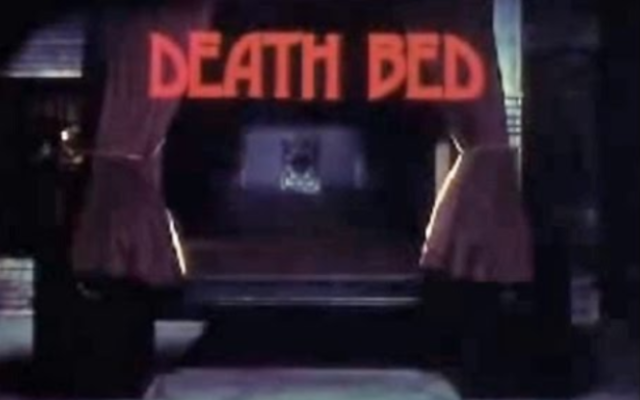
Finally, think bed bugs are bad? How about a hungry bed? The title of this one sums it up: Death Bed: The Bed that Eats.
Fast reviews for busy people! Watch as I review three movies in less time than it takes to slam the door! Have a look as I race against the clock to tell you about the teen horror of “Whistle,” an amorous “Dracula” and the mockumentary “The Moment.
SYNOPSIS: “Dracula,” a new take on Bram Stoker’s classic vampire novel, now playing in theatres, is a love story about a 15th-century prince who spends four hundred years searching for the reincarnation of his late wife.
CAST: Caleb Landry Jones, Christoph Waltz, Zoë Bleu, Matilda De Angelis, Ewens Abid, David Shields, Guillaume de Tonquédec, Raphael Luce. Directed by Luc Besson.
REVIEW: This isn’t Bram Stoker’s “Dracula.” It’s maximalist French director Luc Besson’s “Dracula” with all the good and bad that implies.
A love story and an origin tale, the movie begins with Prince Vladimir of Wallachia (Caleb Landry Jones) i.re. Vlad the Impaler, renouncing God after the death of his beloved wife Elisabeta (Zoë Bleu) at the hands of the Ottomans.
Now called Dracula, he spends the next four hundred years drinking blood to stay “alive,” and using a specially formulated vampire perfume to entice women as the lovelorn vampire searches for the reincarnation of his late wife.
“I’m just a poor soul condemned by God and cursed to walk in the shadow of death for all eternity,” he says, “and sustain myself on fresh blood. Human blood is recommended.”
During real estate negotiations Dracula discovers that Mina (Zoë Bleu again), the wife of Parisian solicitor Jonathan Harker (Ewens Abid), is the woman he’s been searching an eternity for. Tracking her down, he convinces her that she is the reincarnation of Elisabeta and offers her eternal life.
“I would recognize you in another lifetime, entirely in different bodies, different times, and I would love you in all of them until the very last star in the sky burned out into oblivion.”
Meanwhile, a Vatican-sponsored vampire hunting priest (Christoph Waltz) is on the hunt for Dracula and his deadly disciples.
Luc Besson has never been known for a light touch. His films, like “The Fifth Element” and “Léon: The Professional,” are crowd-pleasing, style over substance movies that entertain the eye with high concept visuals and high energy action. Unafraid of spectacle, his films are often bold, often cheesy and often sumptuous.
“Dracula” is all those things. Besson’s study of eternal love has philosophical undertones, but, true to form, excess is the name of the game here, not metaphysical discourse. A scene in the court of Versailles, for instance, where Dracula tests out his special perfume is both lovely and lurid, but another sequence in which Drac repeatedly tries to kill himself in the wake of his wife’s death doesn’t have the intended pathos. Instead, it feels like an outtake from one of Abbott and Costello’s horror comedies.
Gorgeous costume and set design set the stage for Besson’s flashy gothic romp, distracting from a distinct lack of chemistry between the star-crossed soulmates. Landry is more convincing as a monster than lovelorn creature of the night, even if his 400-year-old-man makeup is a little rough. If this pair met in a singles bar, you wouldn’t think they had enough of a spark to make it to the dance floor, let alone inspire a lusty 400 yearlong journey.
Despite flaws that would put a stake in the heart of many other films, “Dracula” is entertaining, if only because Besson shakes up the familiar story to focus on the amorous rather than the murderous.
SYNOPSIS: A gothic tale of an ancient vampire’s infatuation with an innocent young woman, Robert Egger’s “Nosferatu” is a reimaging of F. W. Murnau’s 1922 expressionist horror masterpiece “Nosferatu: A Symphony of Horror.”
CAST: Bill Skarsgård, Nicholas Hoult, Lily-Rose Depp, Aaron Taylor-Johnson, Emma Corrin, Ralph Ineson, Simon McBurney, and Willem Dafoe. Directed by Robert Eggers.
REVIEW: In a showstopper of an opening, the story of “Nosferatu” begins as Ellen (Lily-Rose Depp) telepathically awakens an ancient evil in the form of Count Orlock, a.k.a. Nosferatu from the dead.
Years later this story of evil and sacrifice continues in 1838 Germany with Ellen, now newly wed to real estate agent Thomas Hutter (Nicholas Hoult).
Recently, Ellen’s nights have been flooded with terrifying dreams she doesn’t understand. Thomas dismisses them as “enchanted memories,” but she thinks her visions portend something terrible for the couple.
When Thomas’s boss Herr Knock (Simon McBurney) asks him to travel to the Carpathian Mountains to meet with an elderly new client named Count Orlock (Bill Skarsgård)—“He has one foot in the grave,” jokes Herr Knock—Ellen doesn’t want him to go, but the job offers the kind of money they need to start a family and soon Thomas is off.
Weeks pass. Ellen’s dreams become so intense her doctor calls in Prof. Albin Eberhart Von Franz (Willem Dafoe), a metaphysician and occult scientist who declares, “I have seen things in this world that would make Isaac Newton crawl back into the womb!”
Meanwhile, at Orlock’s creepy castle, the arduous journey and sleep deprivation caused by strange dreams has left Thomas weakened and afraid. Are his dreams morbid fairy tales, as Orlock suggests, or has the Count, a.k.a. Nosferatu, placed a spell on him, as it appears he has on Ellen?
In Germany, as Orlock’s ship heads for their shores, Ellen and others are held in his telepathic sway. “There is,” Von Franz says, “a dread storm rising.”
Director Robert Eggers breathes new life into “Nosferatu’s” withered lungs, staying true to his gorgeously gothic aesthetic while at the same time paying tribute to F. W. Murnau’s classic 1922 film. Immaculately crafted, unsettling images of scurrying rats, crumbling castles and ominous shadows projected by flickering candlelight create a nightmarish canvas onto which this story of dark obsession and sacrifice is projected.
It will be categorized as a horror film, and there are elements of gore, death and the unnerving auditory experience of hearing Count Orlock drain his victims, but it is an old-school horror movie that aims to unnerve its audience with just a few jump scares and no vats of fake blood. Eggers conveys terror with the film’s atmosphere of dread and depiction of madness, decay and unrelenting, elemental evil.
As the film’s tragic heroine Ellen, Depp carries much of the story’s emotional darkness. Ellen is tormented by visions she doesn’t understand, but Depp doesn’t play her as a victim. It’s more like she’s trapped in a toxic relationship and, as such, carries a complex panoply of feelings. Fear and lust top the list, but ultimately it is the steeliness Depp gives her that makes Ellen a compelling but helplessness and hunted character.
The beating—or, in this case, non-beating—heart of the story is Bill Skarsgård as the vampiric Count Orlock. The Dracula stereotype of the vampire with a cape is out of the window. Instead, Orlock is a long-dead Transylvanian noble man, a figure from some folk tale mythology, complete with a bushy moustache and opulent clothing befitting his aristocratic status. But whatever he was when he was alive, he has transformed into a sinister being, a partially decomposed primordial vision of terror. Unseen for most of the film, save for some stunning shadow play early on, Orlock is an avatar of evil and entitlement.
From Orlock’s slow, deliberate speech to his ferocity, Skarsgård, unrecognizable under an inch of make-up, plays him as though he’s just stepped out of a nightmare.
As Thomas, Hoult is a sturdy leading man, and Dafoe, continuing his exploration of off kilter old timey doctors, is obviously having fun, and brings a hint of lightness to this very dark tale.
“Nosferatu” is a story of shadows and light, both thematically and in its visual style.
In one creepy flourish Eggers utilizes shadows to represent the spread of Orlock’s influence. The image of his hand slowly casting shade over Thomas and Ellen’s hometown of Wisborg is eye popping, both visually and metaphorically. As a stylist Eggers creates an atmosphere of evil that emerges from the darkness, painstakingly enveloping all in its path. There is a terrible beauty in these images, one that plumbs the depths of Orlock’s depravity in ways that is both spellbinding and repulsive.
By the time the end credits roll “Nosferatu” is both a compelling homage to, and a reimaging of, Murnau’s original film. The atmosphere of dread remains, given new life with impressive visuals, but it is in Egger’s revision of the core story of obsession and sacrifice that the film becomes truly horrific.
“The Last Voyage of the Demeter,” a new horror film now playing in theatres, is based on the chapter “The Captain’s Log” from Bram Stoker’s novel “Dracula.” Told through news clippings and notes from the captain’s log of the Demeter, the chapter details the horrifying voyage that brought Count Dracula to England.
Haven’t read the book? Then think of it as “Alien” on the high seas. A claustrophobic nineteenth century thriller, it swaps out the commercial space tug Nostromo and Xenomorph creature for the merchant ship Demeter and the most famous vampire of all time.
Set in 1897, the story begins when the Demeter is chartered to carry fifty mysterious, unmarked wooden crates, contents unknown, from Eastern Europe to England. “Our charter has agreed to pay a bonus for timely arrival in London,” says Captain Eliot (Liam Cunningham).
The bonus pay will be hard earned by the crew… if there is any crew left by the time they hit dry land.
When someone or something begins attacking the on-board livestock at night, rumors fly amongst the crew. “Evil is onboard,” says Olgareen (Stefan Kapicic). “Powerful evil.”
That evil comes in the form of Dracula (Javier Botet), a 400-year-old aristocratic vampire who feeds on the crew, killing them one by one, to regain his full powers. “The thing wears the skin of a man,” says stowaway Anna (Aisling Franciosi). “In the night it drinks our blood, and he is on the ship. Which means we will never leave it.”
“The Last Voyage of the Demeter” isn’t exactly Dracula’s story. We get some of the usual vampire lore, and he is certainly a presence, but this is the story of the crew fighting against a great unknown. Director André Øvredal takes his time introducing the characters and setting up the situation on the ship before the first kill. Then, he builds tension slowly, shrouding the screen in fog and dark shadows where strange things just might be lurking. When the carnage begins, Øvredal keeps the bloodsucker mostly out of sight, hidden in corners, shot in tight close-ups, building anticipation for the eventual monstrous reveal.
It’s a nice twist on the usual Dracula movie. It eschews the Bela Lugosi vampire model in favor of a more rough-hewn, demonic aesthetic, like Nosferatu, with needle teeth and wings. They rid him of any of the hypnotic charm he may have had in the hands of Lugosi or Christopher Lee. In this film, he is evil incarnate, as though sprung from the deepest, darkest regions of the human imagination.
“The Last Voyage of the Demeter” conjures up its scares with practical effects, with very little CGI or green screen work. Built of tension and fear, it makes for an old-fashioned fright fest, one more interested in simple, old-school scares than heavy special effects driven terror. It’s a little heavy handed in its final moments, as it attempts to set up a sequel, but if the next one is as brutally elemental and frightening as this one, I’m in.
“Renfield,” a new horror comedy starring Nicholas Hoult as the beleaguered familiar to the Prince of Darkness (Nicolas Cage), pays homage to the menace of Universal’s 1931 “Dracula,” while adding some fun with the addition of gory laughs.
Hoult is Robert Montagu Renfield, an assistant to the narcissistic Count Dracula, galvanized with just enough vampiric power to be able to subdue victims for his master’s pleasure.
“Renfield,” sneers Dracula, “your sole purpose is to serve me! Now let’s eat!”
Together for almost 100 years, Renfield spent most of that time eating bugs and risking life and limb to provide for Dracula’s voracious appetite. He’s at his wit’s end, but it’s not until his latest job, looking for potential victims at a counselling group for people trapped in toxic relationships, turns from a hunting ground to a self-actualization session, that he has a moment of clarity.
“I will no longer tolerate abuse,” he says, after listening to the stories shared by the group. “I deserve happiness.”
His journey to a normal life begins with Rebecca Quincy (Awkwafina), a New Orleans traffic cop still stinging from the loss of her father at the hands of the violent Lobo crime family run by Ella (Shohreh Aghdashloo). When Renfield uses his Dracula-given powers to save Rebecca and others from mob enforcer Teddy Lobo (Ben Schwartz), he is seen as a hero for the first time in his life. Empowered, he now faces his greatest enemy, his employer Dracula.
“I will unleash an army of death,” Dracula threatens. “Everyone you care about will suffer because you betrayed me.”
Perhaps an alternate title for “Renfield” might have been “Dracula: I’m OK, You’re OK.” A mix of Bram Stoker and group therapy pioneer Joseph H. Pratt, it is a modern interpretation of the Dracula legend and therapeutic treatment that doesn’t take itself too seriously. The blend of self-help and horror is absurd, but director Chris McKay keeps his foot on the pedal, barreling through the story and recreating vampire lore–in this version, for instance, eating bugs isn’t a sign of madness, it gives Renfield superhero ability—with the efficiency of Van Helsing’s stake carver.
In on the fun are the dueling Nics, Hoult and Cage. This is the hapless Renfield’s story, so his search for freedom and redemption takes a chomp out of the film’s economical 90-minute running time, allowing Hoult to go from sniveling supernatural servant to empowered paladin at a quick pace. It’s a fun, lightweight performance, that works whether he’s opposite Awkwafina, who plays it broad, or Cage who is equal parts creepy, campy and dangerous.
With a mouthful of needle-like teeth, super strength and an uncanny resemblance to Bela Lugosi, Cage sinks his teeth into Dracula in a performance that benefits from the actor’s gonzo approach. He is supernatural, but his narcissistic “I’m the real victim here!” attitude is deeply human, often hilarious and is the lifeblood of the film.
“Renfield” is based on an original pitch by Robert Kirkman, co-creator of “The Walking Dead,” so you know it will deliver the old-school splatter, but it is the way it updates and pays homage to the Dracula legend, filtered through some very dark comedy, that gives it its bite.
Everybody needs somebody to love. I mean, c’mon, even Dracula had a girlfriend. The Count’s bloodsucking “brides” provide the inspiration for a contemporary horror film called “The Invitation,” now playing in theatres. It’s the story of vampires and a wedding invite the main character Evie (Nathalie Emmanuel) should have declined.
When we first meet Evie, she is a struggling New York City artist and cater waiter mourning the loss of her mother. “It was always just my mom and me,” she says. “To have a family, that’s what I really want.” To that end she does a DNA test to see if she can shake any long-lost relatives out of the family tree. To her surprise she discovers Oliver (Hugh Skinner), an English cousin, and wouldn’t you know it, he’s going to be in New York the following week.
Over dinner she tells him that her mother always wanted to take her to England to learn about their family history.
“There’s a wedding coming up. You should come. Everyone is dying to meet you,” he says in a funny bit of foreshadowing.
Turns out the extended family lives in a house that makes Downton Abbey look like a dump. Presided over by the aristocratic “Rockefeller rich” Walter (Thomas Doherty), it is the picture of lavish English countryside life. “Welcome to the new Carfax Abbey,” says cousin Oliver.
Underneath the perfectly manicured lawns, and the starched suits of the maids and footmen, however, are deadly secrets. As the wedding day approaches, Evie’s questions about the whereabouts of the bride and groom are brushed off with vague responses. “The groom and the bride will make their grand entrance tomorrow,” she is told.
On the day, Evie learns too late that she isn’t just a guest at the wedding.
“To Evie,” says Walter proposing a toast on the wedding night, “my new bride.”
Set amid the Abbey’s gothic architecture, what begins as a fish out of water story quickly turns sinister as the things that go bump in the night start bumping but don’t expect much more than a few carefully crafted jump scares. Director Jessica M. Thompson keeps the horror strictly for folks who thought “Twilight” was the best vampire movie ever.
That’s not to say there isn’t a well-staged scene or two in “The Invitation,” but when the best scene in a vampire romance is a sequence where the lead gets a clumsy manicure, it suggests deficits in the horror department.
Perhaps it’s because the trailer for “The Invitation” gives away very major plot point, or perhaps it’s because there are no real surprises in the story, but, either way, this is one bloodless vampire tale.
 We can all imagine the fear that comes along with being chased by a werewolf. Or waking up to find Dracula staring down at you. They are living, breathing (or in Drac’s case, dead and not so breathing, but you get the idea) embodiments of evil. But how about inanimate objects? Have you ever been terrified of a lamp? Or creeped out by a tire?