Director Antoine Fuqua’s remake of “The Magnificent Seven” literally starts with a bang.
A series of mine explosions echo through Rose Creek, signalling unrest in the tiny mining town. Bartholomew Bogue (Peter Sarsgaard) has taken over, terrorizing the town with hired goons. He’s a cruel man who guns down citizens and says to his henchmen, “Leave the bodies where they lie. Let them look at them for a few days.” Bad Bart wants the land but is only will to pay a pittance per parcel. “Those of you who signed the deeds will get your $20,” he sneers. “And those who don’t, God help you.”
The townsfolk are helpless. Bogue has killed a half dozen men and with the sheriff on his payroll will continue to do as he pleases. Fed up and recently widowed, Emma Cullen (Haley Bennett) turns to hired gun Sam Chisolm (Denzel Washington) for help. “You don’t need a bounty hunter,” he says, “you need an army.” Despite the massive odds against them Chisolm assembles a rag tag team of killers, gamblers and outlaws—Josh Farraday (Chris Pratt), Goodnight Robicheaux (Ethan Hawke), Jack Horne (Vincent D’Onofrio), Billy Rocks (Byung-hun Lee), Vasquez (Manuel Garcia-Rulfo), and Red Harvest (Martin Sensmeier)—to go up against the ruthless robber baron in what promises to be a better than OK gunfight at the corral.
“The Magnificent Seven” is a classic looking western with a modern pace. Fuqua chooses not to mess with the key oater elements. He papers the screen with acres of open land, seven tough men, one or two resilient women and a sea of cowboy hats. He is respectful to the form and doesn’t try to bring the genre into the twenty-first century with frenetic editing—I’m looking at you Timur “Ben-Hur” Bekmambetov—or contemporary language. It’s a western, with all that entails; good vs. evil with some moral ambiguity thrown in for good measure.
Also thrown in for good measure is a heap of star power. Washington is a cool character, quietly deadly. He says cool stuff—“Chisolm, should I know that name?” he’s asked. “You should know it from your obituary,” he replies.—and is the movie’s charismatic center. Chris Pratt’s easy charm gives Washington a run for his money, but this is really Denzel’s movie from top to bottom.
Hawke and D’Onofrio do interesting character work. As the shell-shocked Robicheaux Hawke is equal parts swagger and skittishness while D’Onofrio is practically unrecognizable as the squeaky-voiced Jack Horne.
The remaining member of the seven aren’t given much to do other than pull triggers and nod in agreement to Chisolm’s plans, but they are an interesting bunch nonetheless.
At a little over two hours “The Magnificent Seven” could be leaner and well, maybe not meaner—I would not be surprised if it had the highest body count in a western ever—but tighter. There is a mid-movie sag as the plans for the final shootout are being finalized but the ballet of bullets at the end is epic, if not a little excessive, putting a fitting cap on a story that is slight but entertaining for most of the running time.
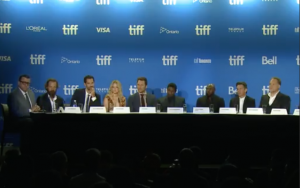
Richard hosts the “Magnificent Seven” TIFF press conference with (from left to right) Richard, Peter Sarsgaard, Manuel Garcia-Rulfo, Haley Bennett, Chris Pratt, Denzel Washington, Antoine Fuqua, Ethan Hawke, Vincent D’Onofrio, Lee Byung-hun and Martin Sensmeier.
As Dave Edmunds once warbled, “From small thinks baby, big things one day come.”
In Hollywood right now no one is bigger than Chris Pratt. His films Guardians of the Galaxy and The Lego Movie were two of the top five grossing hits of last year and Jurassic World is pegged to light up the box office with an estimated $100 million take this weekend.
Esquire has declared him “awesome” and The Guardian noted “there’s a lot of love for Chris Pratt right now.” He has momentum, the kind of Hollywood heat that gets your name mentioned as the lead in every big movie, including the proposed reboot of Indiana Jones. In fact, some even label him the next Harrison Ford.
The hype swirling around the affable thirty-five-year-old actor places him at the top of the Hollywood ladder, but it certainly wasn’t always that way. A scan of the early credits on IMDB does not point toward superstardom.
Guest spots on the short-lived bounty hunter series The Huntress and a third lead in the so-little-seen-it-doesn’t-even-have-a-Rotten-Tomatoes-rating action film The Extreme Team seem positively high profile compared to his first credit.
Pratt was working as a waiter at the Bubba Gump Shrimp Co. restaurant in Maui when actress Rae Dawn Chong came in for lunch. She happened to be in the midst of casting Cursed Part 3, a short horror satire about a director who tries to convince his actors and crew not to flee when a mysterious killer visits the set.
Pratt was living with a group of friends in a van, doing stand-up comedy and community theatre when he approached the Quest for Fire star. “I said, ‘I know you. You’re a movie star, right?’ She said, ‘You’re cute. Do you act?’”
Chong thought he’d be a good fit for the part of “a beautiful kid to play the Brat, an actor who complains out loud about having to make out with an older actor, played by Donna Mills.”
The film was set to roll in five days and after a quick audition Chong offered Pratt a plane ticket to California and the role of Devon. “I had far more confidence than capability at the time,” he says, “but I knew I could do it.”
Shot next door to Michael Jackson’s Neverland Ranch, Cursed Part 3 isn’t much of a movie, but Pratt made $700 for his debut, money he invested in a car so he could drive to auditions.
“I went from waiting tables in Maui to waiting tables in Beverly Hills,” he says of Cursed Part 3, “but with a little bit of movie experience under my belt.”
The film was a stepping-stone to bigger and better jobs, including the role that made him a star, Pawnee City Hall shoe-shiner Andy Dwyer on Parks and Recreation.
Movie stardom was harder to come by. Losing blockbuster roles like Avatar’s Jake Sully and Captain James Kirk of the rebooted Star Trek was discouraging, but he was determined to act. “People have to work,” he said. “I just don’t want it to be at a restaurant.”
With big budget movies on the way like the proposed sci fi adventure Passengers with Jennifer Lawrence and an all-star remake of The Magnificent Seven, it doesn’t look like he’ll have to dust off the Bubba Gump Shrimp Co. uniform again any time soon.
For the fourth time all heck breaks loose on Isla Nublar when gene-spliced dinosaurs get loose and start chowing down on humans. And you thought genetically modified food was bad for your health.
“Jurassic World” is set in a theme park of the same name, a bigger, flashier version of the one first seen in “Jurassic Park.” For years over 20,000 people a day have come to visit the dino petting zoo and see the T-Rex in his “natural” habitat. Think SeaWorld with Archaeopteryx instead of dancing dolphins and you get the idea. Business is brisk but park director Claire (Bryce Dallas Howard) feels their exhibits are old hat, as exciting as a clown in an elephant suit.
“No one is impressed by dinosaurs anymore,” she says. “Consumers want bigger, louder and more teeth.”
Her solution is to genetically manufacture a designer dinosaur, a hybrid of T-Rex DNA and bits and pieces from several other creatures. Called Indominus Rex, it’s a fearsome fifty-foot tall beast with fierce intelligence and an attitude to match. When it escapes (that’s not a spoiler, just a fact of life in the “Jurassic” films) Claire calls upon dino trainer Owen Grady (Chris Pratt)—he’s the Cesar Millan of the dinosaur world—to bring the situation under control before her two visiting nephews get eaten or a military contractor (Vincent D’Onofrio) who wants to repurpose the beasts as weapons.
“Jurassic World” is a respectable entry into the “Jurassic Park” genus. It’s a monster movie, with a bigger, louder and toothier villain than the previous films, but not quite as many thrills. It’s near impossible to top the visceral thrills of Steven Spielberg’s original movie so director Colin Trevorrow doesn’t try. Instead he weaves an homage or two to “Jurassic Park” into the fabric of the story and makes sure there are roaring dinosaurs and snarling Raptors on screen as much as possible. They run, leap and do battle in a climatic scene that can only be described as ridonkulous. The tempered skill Spielberg brought to the first movie is replaced by bombast, but what can we expect form a movie whose manifesto is, “No one is impressed by dinosaurs anymore; consumers want bigger, louder and more teeth”?
Pratt takes a step closer to claiming the role of Indiana Jones by playing Craig as the wisecracking but charming and resourceful hero and “New Girl” star Jake Johnson offers some welcome comic relief. Howard is self-possessed and intense, and has good chemistry with Pratt.
“Jurassic World” is a fun summer distraction, with enough of its predecessor’s DNA to be worth a look.
Interviewers love talking with Robert Downey Jr., not just because he’s one of the biggest movie stars in the world, but also because he’s a one-man quote machine.
Walking into a room full of Canadian reporters to chat up his latest film, The Judge, he’s wearing a festooned shirt — and that is the only word that can be used to describe his flamboyant sartorial choice — with a pattern that resembled a bisected tree trunk. More intriguingly he carried a small green, nondescript box.
Asked what was inside he said, “I have distilled socialism in this box. It wasn’t easy. I’m bringing it back to America.”
And the quotes kept coming.
The Judge is a family drama about Hank, a hotshot, big-city lawyer who returns to his hometown for his mother’s funeral. He’s been estranged from his father, Judge Joseph Palmer (Robert Duvall), for years — “He’s dead to me” — but is forced to re-examine everything he knows about his dad when the judge is accused of murder.
Downey says, “I found myself crying all the time,” (great quote No. 2 for those keeping track) during filming, but not because he was reflecting back on his own life. “I got caught up in the reality the movie expresses,” he says. “Hank’s mom’s funeral is every funeral and Hank’s cut-off with his dad is every cut-off that anyone has ever had. It’s not even particularly a father-son story because the judge could have been the mom. I just think about these family dynamics and they light up constellations that are very emotional” (great quote No. 3!).
He describes shooting the movie as a “weird game of Sudoku” (great quote No. 4) in terms of making sure the emotional moments didn’t stack up against one another, blunting their impact.
“You can’t just play 120 catharses in a row,” he says. “I hate it when I see that in movies. It’s like, ‘All right, is everyone always crying in real life?’”
The first step in finding the character meant not allowing his Hollywood persona to bleed into Hank. “That was the first thing I had to smash,” he says.
“Hank is really observing this situation that’s happening around him and to him and he becomes this person who has to go through this terrible and wonderful crucible. It was really just about doing less and less and less and less and I like being busy. I like to talk and I like to be active and all that stuff, so sometimes I felt like I was literally just sitting on my hands.”
He leaves us with one last great quote that sums up his emotional response to the film. “It kicks me in the stomach in the nicest way.”
You get value for your money in Robert Downey’s Jr’s new film “The Judge.” Stepping away from the superhero movies that made him a household name, he stars in a film with so many story shards and plot derivations you need a scorecard to keep up.
It’s a legal drama. No, it’s a manboy coming-of-age story. Wait! It’s also romance, a dramedy, a father-and-son tale and a mystery. The only genres missing are horror and science fiction and I suspect they will be included on the director’s cut Blu Ray.
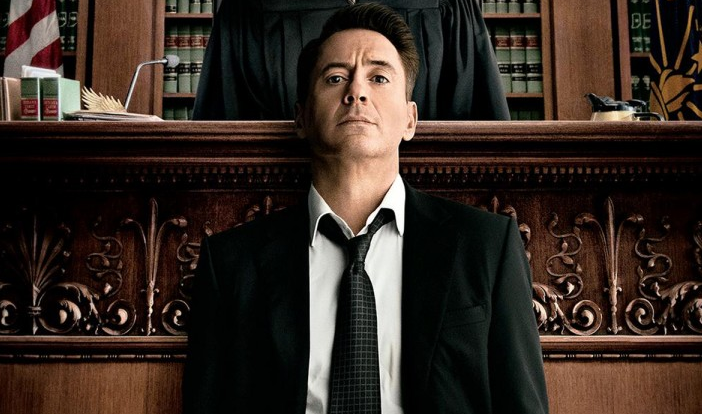
Downey Jr is Hank Palmer, a hotshot defense lawyer. He’ll do anything to win and is proud of it. “Everybody wants Atticus Finch,” he says, “until there’s a dead hooker in the hot tub.” In court he’s Iron Man, an unstoppable force with a thick skin and a quick line. He’s the same outside of court as well, except when it comes to his father.
He’s been estranged from Judge Joseph Palmer (Robert Duvall) for years—“He’s dead to me.”—but is forced to see him when his mother passes away. Returning to his hometown of Carlinville, Indiana for the funeral Hank must confront the life he left behind—ex-girlfriend Samantha (Vera Farmiga), brothers Glen (Vincent D’Onofrio) and Dale (Jeremy Strong) and his cold-fish father. The quick in-and-out trip is extended, however, when the Judge is accused of murder and Hank becomes his lawyer.
“The Judge” feels like Oscar bait. It’s a long movie with a wide story arc that gives its leads ample opportunity to strut their stuff. Downey hands in a solid, if somewhat familiar performance while Duvall plays elder statesman, resurrecting the alpha male feel of “The Great Santini.” Both are used to good effect and the supporting cast keeps things humming along despite a story that pushes credulity to the limit.
The devil is in the details and when the details, no matter how small they are, verge on silly, they become a distraction.
Most of the silly stuff comes in the form of the clues Hank pieces together while forming the Judge’s defense and the trial itself. There will be no spoilers here, but suffice to say the whole thing hinges on a bit of information so implausible that it gives new meaning to the term suspension of disbelief. Trouble is, it didn’t have to be that way. There were any number of ways to establish the point in question (OK, HERE’S AMILD SPOILER ALERT: It involves chemotherapy and a cottage) without trying so hard, but that’s not the kind of film this is.
“The Judge” is the hardest working movie in show business. It’s a film that wants to check all the boxes and tries just a little too hard. Downey and Co. float above it all, however, touching down every now and again to introduce a new plot twist and deliver the occasional touching moment.