Making Bruce Springsteen laugh: I made Bruce Springsteen laugh on Thursday. We talked at a lunch for his movie “Western Stars” and I told him about my first time using a Sony Walkman. I borrowed a Walkman, used the last of my cash to buy a “Born In The USA” cassette and walked through the Eaton Centre with the thing turned up to 11. As let the music reverberated around my head I remember thinking, “This is so much easier than lugging the stereo around.” He liked the story and said, laughing, “Thanks for telling me that.” #Boss
Daniel Craig’s thick-as-gumbo accent in the stylish whodunnit “Knives Out.” As Benoit Blanc he brings a courtly charm to the role of the Southern-American Hercule Poirot. It’s worth the price of admission alone to hear his pronunciation of the word “your,” as in “Yew-our in big trouble now.”
Star selfies: Often my favorite things don’t take place on the stage or screen. I like the smaller, intimate moments that add a sense of normalcy to the chaos that reigns over the festival. This year, backstage at the press conference for “Blackbird” I watched Susan Sarandon, Sam Neill and Rainn Wilson goof it up for a selfie on the actress’s phone. It was a nice, unscripted moment at an event often built on artifice. Later Sarandon glammed it up, taking off her reading glasses in favour of dark sunglasses for an official photo shoot.
Willem DaFoe’s beard in “The Lighthouse.” The actor embodies the craggy old character who has spent his life on the ocean or at the watchtower, looking like a Royal Doulton Old Salt mug come to life, speaking like a character right out of Melville. You can almost smell the rum breath, filtered through a beard that would make Captain Morgan jealous.
The timely commentary of “Joker.” Although ripe with elements from older movies like “Death Wish,” the God’s lonely man favorites “Mean Streets” and Taxi Driver” and echoes from real-life forgotten names like Bernard Goetz, “Joker” is no period piece. It’s as timely as the yesterday’s headlines. A study of everything from alienation and disappointment to the failure of social safety nets and access to weapons, it’s a character study not just of the Joker but of a troubled time.
“Sound of Metal’s” devastating sound design. Applying immersive sound design, writer-director Darius Marder toggles between the point-of-view of a heavy metal drummer who has lost his hearing and real-world sounds. As his desperation and frustration grow the muffled sounds of the world filtered through his damaged ears hammers home the overwhelming effects of hearing loss.
David Foster’s candor. At the gala for the doc “David Foster: Off the Record” the hit-maker joked with director Barry Avrich about the artists NOT included in the film. “Where’s Boz Scaggs? Where’s NSYC? Where’s Richard Marx?” Avrich replied, “He turned us down.” With timing that Jack Benny would admire Foster paused, looked at the audience and said, “Well then, f**k Richard Marx.”
Renée Zellweger’s way with a line in “Judy.” Dressed in a colourful lamé stage costume a forty-seven-year-old Judy Garland wanders around a hip Hollywood party. When someone says, “Look, it’s the world’s greatest entertainer,” she grins and says, “Is Frank Sinatra here?” It’s a throwaway mind expertly delivered, that helps find the humour and humanity in a person often simply regarded as a tragic figure.
My most liked tweet during TIFF: “Just saw a pug on Bloor Street yawn and it gave me more pleasure than many of the movies I have seen recently. #yawningpug”
“A Beautiful Day in the Neighborhood” quietest moment: In one nervy scene children’s television icon Mister Rogers (a remarkable Tom Hanks) and journalist Lloyd Vogel (Matthew Rhys) “take a minute to think about all the people who loved us into being.” For sixty, silent seconds they stare at one another, allowing their minds to drift. Director Marielle Heller lets the moment sink in and in the silence—even the background noise is blocked out— we are reminded how little time we all spend, day in and day out, in quiet contemplation. It may be the movie’s most telling scene, the one that details how far away society has moved away from the core values of kindness and understanding Rogers preached.
“Jojo Rabbit’s” unexpected soundtrack: “Komm, gib mir deine Hand” the German language version of “I Want to Hold Your Hand” fills the soundtrack as images of Hitler Youth pumping their fists in the air fill the screen, providing a brilliant and subversive comparison of two kinds of fanaticism, Beatlemania and National Socialism. Later David Bowie’s “Helden” (“Heroes”) provides a sentimental blast as the final credits roll.
Best take on a financial crisis: If they gave out Oscars for pole dancing the release of “Hustlers” would place Jennifer Lopez one step closer to completing her EGOT collection. But the movie is much more than its startling introductory scene. It’s also is a glitzy caper about money, friendship, and revenge against the bankers who went unpunished after a financial crisis brought the country and the dancers at the Sin City Café to their knees.
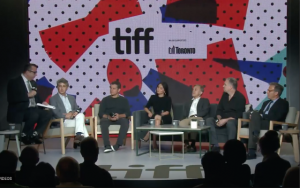
Susan Sarandon at the press conference I hosted for “Blackbird,” (with director Roger Michell, Sam Neill, Rainn Wilson, Sarandon and producer Sherryl Clark): The story of a terminally ill woman who chooses the date of her death brought out strong opinions. “I think it’s an individual choice, but it should be legal and controlled. The fact of the matter is, it is similar to abortion in that if you’re wealthy, you’ll always have access to it. So, it’s about making it more accessible to everyone now. I think taking on the process of letting go of your body takes a lot of thought and the medical profession has been behind for a long time. You should be able to die with dignity.”
Robbie Robertson’s voice: No question he’s a better guitarist than singer, but that speaking voice, on full display in the doc “Once Were Brothers: Robbie Robertson and the Band,” is so deep, so sonorous you’ll wish he would narrate every documentary made from now on. Also, from the same movie, rockabilly legend Ronnie Hawkins livens things up with his reminisces. “There was enough flour and sugar in that to make us sneeze biscuits,” he says of the cocaine backstage at “The Last Waltz.”
From @PostCity: With TIFF starting next week, @RichardCrouse shares his guide to some of the top flicks in #Toronto, such as @BarryJenkins’ ‘If Beale Street Could Talk’ #TIFF18
“For 10 days each September at the Toronto International Film Festival (TIFF), thousands of miles of film unspool, movie mavens push the limits of their endurance to take it all in and movie stars decorate red carpets…” Read the whole thing HERE!
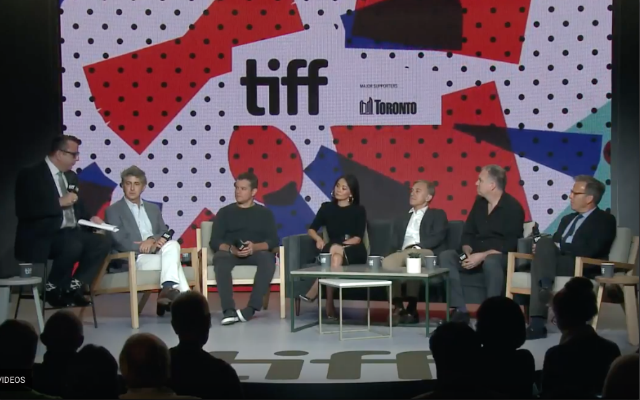
Richard hosted the TIFF press conference for “Downsizing” with director Alexander Payne, stars Matt Damon, Hong Chau, Christoph Waltz, screenwriter Jim Taylor and producer Mark Johnson.
The script by Payne and Jim Taylor opens with a Norwegian scientist making a breakthrough he thinks will save humanity: a technique that can shrink people to 5 inches (12 centimeters) tall. That means they use a tiny fraction of the resources they once did — and need to pay less, allowing people of modest means to grow instantly rich by becoming small.
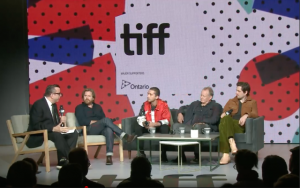
Richard hosted the press conference for the Toronto International Film Festival opening night film “Borg/McEnroe.” On the panel was director Janus Metz and stars Shia LaBeouf, Stellan Skarsgård and Sverrir Gudnason.
“It’s quite cathartic,” said LaBeouf, who plays the hotheaded John McEnroe, “watching this. I knew it when I read it, it touched me when I did it. To watch it now is something I’m very proud of, I’m very proud of the movie. I think it expresses something I feel deeply. I’m honoured to be able to have been a part of this, and to be able to share it.”
“Unless,” a new film staring Catherine Keener, is a portrait of a family in distress.
Successful author—a “book club darling”—and translator Reta Winters (Keener), her physician partner Tom (Matt Craven) and children are rocked out of their suburban complacency when daughter Norah (Hannah Gross) drops out of society to become a panhandler on the streets of Toronto.
Wrapped in a thick wool blanket, holding a sign that reads “Goodness,” Norah sits, catatonically outside of legendary discount department store Honest Ed’s. Detached and despondent, the young woman sits, quiet as the falling snow that swirls around her as her family struggles to understand why and how she ended up on the street. Is it a breakdown? A protest? A personal revolution? A reckoning of some sort?
Based on Pulitzer Prize winner Carol Shields’s final novel, she passed away in 2003, “Unless” isn’t driven by plot but by Norah’s unhappiness and her family’s reaction to it. Some flowery dialogue occasionally gets in the way—“Sometimes I think that for Norah there’s a bounteous feast going on but she has not been invited.”—but Keener’s keen intelligence and concern provides the emotional core that shapes the thin story into a compelling character study. In the novel Reta’s journey was an internal one and Keener makes it external and as cinematic as possible given the subdued nature of the film.
Although the question of why and how this happened lies at the heart of the film, director Alan Gilsenan is more interested in the effects of Norah’s decision than the decision itself. There is a conclusion, a reason, but the destination in this case is less satisfying than the journey. The trauma that triggered Norah’s inward turn is unsettling, both emotionally and visually as presented in the movie, but doesn’t provide the kind of capper a story like this needs to transcend character. It feels slightly out of balance in its final minutes as it switches focus from Reta to Norah because we realize that this isn’t the story of a woman’s decision to drop out, but the story of a family’s reckoning with the aftermath of that choice.
“I can’t understand why people don’t always say what they are thinking,” says Emory University professor Deborah E. Lipstadt. “I’m missing a certain filter. I say what I think.”
Lipstadt, a specialist in modern Jewish history, emerged into public life from academia as the subject of a 1996 lawsuit brought against her by self-taught British historian and Holocaust denier David Irving. Irving, upset she singled him out in a book as a less-than-reputable historian, launched a libel lawsuit claiming Lipstadt and her publisher were part of a worldwide conspiracy to rob him of his livelihood.
Donations from benefactors like Steven Spielberg paid for the gruelling eight-week, £3,000,000 trial which boiled down to one main question: Is Irving a liar and a falsifier of history or simply a historian who sees things from Hitler’s point of view? The stakes were high; if Irving won, his account of history would be given credence.
The sensational court case is chronicled in Denial, a new film starring Rachel Weisz as the outspoken academic.
“In the story of this trial and this case, a lot of very good people said to me, ‘Don’t do it,’” Lipstadt says. “A lot of people didn’t want me to do it because they thought I’d be giving him publicity. How do you fight bad people without building them up and giving them a billion dollars of free publicity?”
But the publicity helped expose Irving and other deniers, says Weisz.
“I think the more people who know that the better. Most people don’t know who David Irving is. He has his core group of followers and they’re going to be very happy about this publicity. Or not. I don’t know how they’re going to feel about this, but it is more important that people should know about it. And nobody does. It doesn’t really bother me that he’s getting publicity. It’s not good publicity.”
“I think Rachel is right,” says Lipstadt. “It’s a balance. I knew fighting him would give him publicity but it would serve a purpose.”
The British actress says capturing Lipstadt’s essence — from the heavy Queens accent to her personal boldness — was “a beautiful, delicious challenge.”
“Deborah came and hung out with me in New York,” says Weisz, “sat in my kitchen for two days straight. I filmed her on my iPhone so I would be able to look back at it. Deborah told me stories about her childhood, her parents and about the trial. It was just being able to be near her and soak up her spirit and attitude and find the places were we intersect as people. There are some (people) when you find that you think, ‘I could be this person if my life had gone differently.’ It became imaginable to me then that I could be Deborah had my life gone that way.”
Lipstadt describes watching Weisz’s performance as “an out-of-body experience,” adding that her friend, legal eagle Alan Dershowitz wrote her a note, saying, “She catches your accent but even more she captured your attitude.”
“It’s fun being you,” says Weisz. “I enjoyed it. You get to say what you think. I like it, it’s very healthy. Get it out.”
The story of two star-crossed lovers on the run from bad memories is at the heart of Two Lovers and a Bear, a new Arctic-set film from Rebelle director Kim Nguyen.
Counselling the couple is a talking polar bear, a philosophical addition to a movie that is part romance, part thriller and all icy cold isolation.
Montreal native Nguyen says the script for the film evolved over time, but many of the elements, including the talking bear came to him on a stopover at the Amsterdam airport.
“I was reading Kafka on the Shore by Haruki Murakami,” he says. “There are weird gods in the book, kind of like imperfect Greek gods with flaws. It dawned on me that I should have something like an imperfect, flawed deity in the film.”
At the same time he noticed the airport’s giant brass teddy bears and voilà, the idea of an advice-giving polar bear was born.
The bear, played by a real polar bear named Agee and voiced by acting legend Gordon Pinsent, is the most fanciful part of a film that sees Lucy and Roman, played by recent Emmy winner Tatiana Maslany and Dane DeHaan, embark on a physical and metaphysical journey to confront their troubled, violent pasts.
“I’ve seen a lot of people like that,” Nguyen says of the people he met in Nunavut, “(people) who just can’t connect with an organized, dense, compact society. They have to go up North and that’s why you meet very interesting, unique characters up there. Often it is the people who don’t cope with societal norms.”
Nguyen’s unpredictable story intensifies with every twist, finding depth as the volatile Lucy and Roman explore the vast white expanse of their home and their innermost fears.
The lead actors have some heavy lifting to do to navigate the film’s many shifts from comedy, to psychological drama and isolationist horror.
To survive the inhospitable cold of their home both must be strong willed characters but both also wear their fragility on their parka sleeves. As such, Maslany and DeHaan are perfectly cast.
“We met a lot of people,” says Nguyen. “At the beginning it wasn’t defined exactly who Lucy was going to be; where she would come from. We wanted to keep it open with the casting. Tatiana came a little later on. We didn’t even think about her. Coming off of Orphan Black the casting director said, ‘Why don’t we try her? She’s versatile. She has range.’ She was gracious enough to do a screen test. She blew us away. She was totally way up there in the truthfulness and the authenticity. She is really someone who is able to connect. Kind of like Dane.
“I discovered Dane when I saw Place Beyond the Pines. When I saw that, I was certain that Dane wasn’t a trained actor. He was so authentic I assumed he was this guy who had this one role in him. Then I learned he was a trained actor and was really impressed by his performance.”
The six-week Nunavut shoot was gruelling for all, requiring physical stamina and a trait Nguyen calls “one of the biggest, most important qualities”— fearlessness.
“Dane and Tatiana have that,” says the director. “They dive in and they are not analyzing their performance as they’re playing it.”
Based on the book by Professor of Modern Jewish History and Holocaust Studies at Emory University Deborah E. Lipstadt, the new film “Denial” chronicles a real-life court case that could have made it acceptable to deny the Holocaust.
The action in “Denial” begins with Lipstadt (Rachel Weisz) giving a lecture in support of her latest book. In the audience is David Irving (Timothy Spall), a self-taught British historian and Holocaust denier. Because Lipstadt steadfastly refuses to debate deniers, Irving, upset she singled him out in her book as a less than reputable historian, brings the argument to her. He theatrically offers a $1000 reward for any printed link between Hitler and the Final Solution.
Rebuffed, he launches a libel lawsuit claiming Lipstadt and her publisher are part of a worldwide conspiracy to rob him of his livelihood as a historian. The case, filed in England, left the burden of proof on the accused, Lipstadt. Baffled by the foreign legal system the American is led through the complicated case by Richard Rampton (Tom Wilkinson) and Anthony Julius (Andrew Scott), the solicitor who handled Lady Diana’s divorce. “We have no strategy,” says Julius, “we’re trying to box him in with the truth.”
Donations from benefactors like Steven Spielberg paid for the gruelling eight-week, £3,000,000 trial which boiled down to one main question: Is Irving a liar and a falsifier of history or simply a historian who sees things from Hitler’s point of view? The stakes are high, if Irving wins his account of history will be given credence. “The man is a liar and someone needs to say so,” Lipstadt says.
For much of its running time “Denial” is a taut court procedural—kind of like the last half of a great “Law and Order” episode—with colourful characters. Weisz, a feisty force of nature amid the more reserved Brits, holds the center of the film with a combination of grit and concern. Scott is the epitome of the stiff-upper-lipped lawyer but it is Wilkinson who shines, hiding a sharp legal mind behind a grandfatherly façade. As the villain Irving, Spall brings desperation, indignation and condescension to a man who wants respect for his opinions.
“Denial” moves along at a zippy pace, exploring the pertinent details but taking the time to add an emotional wallop with a research trip to Auschwitz. A drawn out ending slows things down a bit in an attempt to add drama to a verdict that is historical record but satisfies both as a precedent setting slice of legal history and a big screen entertainment.
The story of two star-crossed lovers on the run from bad memories is at the heart of “Two Lovers and a Bear,” a new film from “Rebelle” director Kim Nguyen. Counselling them is a talking polar bear, a philosophical addition to a movie that is part romance, part thriller and all icy cold isolation.
Set in Apex, Nunavut, just shy of the North Pole, “Two Lovers and a Bear” is the tale of Lucy (Tatiana Maslany) and Roman (Dane DeHaan), angst-ridden lovers, tormented by recollections of their abusive pasts. The mere thought of Lucy’s father inspires panic attacks and Roman finally put his violent father in the rear view mirror by fighting back and leaving home. Still the thought of it haunts him. When Lucy is accepted into a school program in the south, the pair split, only to be brought back together by tragedy. Together they embark on a journey that forces them to confront their pasts while solidifying their bond.
The emotional stakes rise throughout as Nguyen weaves together magic realism—the silky voice of the polar bear is supplied by Gordon Pinsent—romance and the hard realities of Northern life. It’s an unpredictable story that intensifies with every twist, finding depth as the volatile characters explore the vast white expanse of their home and their innermost fears.
Maslany and DeHaan are an intoxicating combination. Lucy and Roman are strong willed characters, they have to be to survive the inhospitable cold of their home, but both wear their fragility on their sleeves. Desperately in love, the couple can’t live without one another but, paradoxically, are bad for one another. That contradiction at the heart of their relationship feeds the narrative thrust of the film, binding the story’s mishmash of genres.
“Two Lovers and a Bear” covers the kind of troubled relationship we’ve seen in other indie films—two young lovers battling demons—but Nguyen’s bold use of the setting and the strong, naturalistic and soulful performances at the heart of the film make it quite unlike anything we’ve seen before.
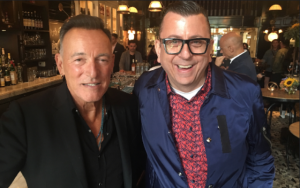 Making Bruce Springsteen laugh: I made Bruce Springsteen laugh on Thursday. We talked at a lunch for his movie “Western Stars” and I told him about my first time using a Sony Walkman. I borrowed a Walkman, used the last of my cash to buy a “Born In The USA” cassette and walked through the Eaton Centre with the thing turned up to 11. As let the music reverberated around my head I remember thinking, “This is so much easier than lugging the stereo around.” He liked the story and said, laughing, “Thanks for telling me that.” #Boss