CTV NATIONAL NEWS: 49th Toronto International Film Festival wrap up
I appear in a CTV National News report by Cristina Tenaglia on the highlights from the 49th annual Toronto International Film Festival.
Watch the whole thing HERE!
I appear in a CTV National News report by Cristina Tenaglia on the highlights from the 49th annual Toronto International Film Festival.
Watch the whole thing HERE!
Part screwball comedy, part fight for survival, “Anora” is a triumph of controlled chaos. As in his earlier films, “Tangerine,” “The Florida Project” and “Red Rocket,” director Sean Baker keenly observes his characters with empathy and emotion in stories that examine money, class, and power. Mikey Madison, best known to date as the oldest sibling on the sit com “Better Things” and being burned alive in both “Scream (5)” and “Once Upon a Time in Hollywood,” hands in a career re-defining performance as sex worker Anora a.k.a. Ani. An electric combination of tough-as-nails ferocity, self-assurance, desperation and poignant vulnerability, she is as compelling and charismatic a lead as we’ll see at the movies this year.
A story of sexual power, control and humiliation, “Babygirl” is risky and frisky with a fearless performance from Nicole Kidman.
“Better Man,” the biopic of Take That singer-turned-solo superstar Robbie Williams is a sex, drugs and British Pop story given an audacious treatment by “The Greatest Showman” director Michael Gracey. A surreal mix of “Behind the Music” and “Planet of the Apes,” it is a raw portrayal of the singer’s vulnerabilities and foibles in which he’s rendered throughout as a CGI monkey. No explanations are offered, and none are needed. Whether it’s a comment on the performing monkey nature of his work, or his ever-evolving emotional state, or whatever, it’s a startling and surprisingly effective gimmick in a wildly entertaining film.
“Conclave,” the story of the ritual to elect a new Pope, reflects a spiritual process marred by very human foibles. It’s a very timely study of the quest for power which seems even more relevant in a US election year. “The men who are dangerous are the men who want the power.”
Ron Howard’s “Eden” is a star-studded—Ana de Armas, Vanessa Kirby, Sydney Sweeney, Jude Law and Daniel Brühl— story of backstabbing, ego and survival set against the unforgiving landscape of a deserted Galápagos Island. Based on a true story, it’s a heart of darkness tale done on an operatic level.
Hugh Grant delivers a career redefining performance as the charming face of theological curiosity in “Heretic.” A two-hour doctrinal cat-and-mouse game with two Mormon missionaries (Chloe East and Sophie Thatcher), the movie digs deep, gets dark but never forgets to have fun.
As idiosyncratic movie as we’re likely to see this year, “Megalopolis” is a forty-years-in-the-making passion project from Francis Ford Coppola that brims with imagination, ambition and, unfortunately, self-indulgence. Equal parts hammy and hopeful, dense and dazzling, it’s the work of a filmmaker with nothing left to prove.
Told from the point of view of the ghost, the scares in “Presence” are muted and not particularly supernatural. The horror here is the carefully observed, callous behavior between several of the characters. It’s a stylish, visually interesting twist on a ghost story that entertains the eye but may not move the spirit.
An intense look at the chaotic ninety minutes before the first broadcast of “Saturday Night Live” on October 11, 1975, “Saturday Night” captures the anxiety, the humour and the sheer nerve it took to get the show off the ground. We know how it ends—“SNL” celebrates 50 seasons this year—but a great ensemble cast brings this love letter to show business, tenacity and Lorne Michaels to vivid life.
A revenge drama about legacy, genetic memory, social media and a cat named Potato, “Seeds” is a tense thriller that delivers its message with plenty of humor before the going gets gory. At a quick 85 minutes “Seeds” features great performances— Graham Greene, as the host of a television true crime show who speaks to Ziggy in her dreams and Goldtooth are standouts—and succeeds both as a revenge drama and an expression of Indigenous legacy and power.
“The Shrouds” revisits David Cronenberg’s go-to themes of body horror, invasive technology and paranoia in a film that promises to be a provocative and empathetic study of grief.
“The Substance” has a lot on its mind. Writer/director Coralie Fargeat infuses the story with her thoughts on youth, beauty, fame and Hollywood’s unrealistic beauty standards, and uses body horror coupled with the bonkers, Grand Guignol ending to make her points. It goes on a bit too long, but Fargeat’s gruesome vision, and the finale’s ankle-deep bloodbath, is a thing of terrible beauty.
Part rom com and part essay on what lingers after we’re gone, “We Live in Time” is a five-hankie tear-jerker fueled by the intimate and charismatic performances of its leads Florence Pugh and Andrew Garfield.
Based on Peter Brown’s award-winning, #1 New York Times bestseller of the same name, the animated “The Wild Robot” will put you in the mind of “The Iron Giant,” “E.T. the Extra-Terrestrial” and “WALL-E,” but carves out its own, unique, rewarding space. Brimming with compassion, humor and kindness, it has the makings of a classic.
A modern riff on Johann Wolfgang von Goethe’s 18th-century novella “The Sorrows of Young Werther,” “Young Werther,” takes a love-at-first-sight premise, the stuff of rom coms, and uses that as a springboard to examine self-absorbed youth, unrequited love, rejection and the true nature of love.
I sit in with NewsTalk 1010’s Jim Richards to talk about attending a screening of “The Apprentice,” then controversial film based on the early life of Donald Trump.
Listen to the whole thing HERE! (Starts at 31:20)
I joined BNN Bloomberg to talk about the opening night of TIFF and what to watch at the fest.
Watch the whole thing HERE!
I chose the Toronto International Film Festival movie I am most excited to see for Toronto Star film critic Peter Howell’s annual TIFF round-up.
“‘The Shrouds’ revisits David Cronenberg’s go-to themes of body horror, invasive technology and paranoia in a film that promises to be a provocative and empathetic study of grief.” WILD CARD: “The Last Showgirl”
Read the whole list HERE!
 Watch Andria Case’s CTV News at 6 report on the Hazelton Hotel’s unveiling of the state-of-the-art screening room as the Norman Jewison Cinema in celebration of the iconic Canadian filmmaker.
Watch the whole thing HERE!
Read about the event HERE!
Here’s my contribution to the Toronto Star’s Annual Chasing the Buzz poll which polls critics and taste makers on the most anticipated films at the fest!
“Perfect Days is a contemplative movie that examines the simple pleasures in life. Music, literature and nature are showcased, but this poetic, profound film celebrates finding contentment in all aspects of life.” WILD CARD: Mr. Dressup: The Magic of Make Believe
Read more picks HERE!
Reminders of real life were all around us at this year’s Toronto International Film Festival. From the digital screenings we watched at home to half empty, socially distanced screenings at venues like The Princess of Wales Theatre. But when my mind wanders back to September 2021, I won’t be thinking of having to show my proof of vaccination or the social distancing in theatres.
What will linger?
The images of Anya Taylor-Joy in “Last Night in Soho,” crooning an a cappella version of the Swingin’ Sixties anthem “Downtown,” and “Dune’s” Stellan Skarsgård doing his best impression of Marlon Brando in “Apocalypse Now,” come to mind immediately.
Those moments and others like them are the reason the movies exist. They transcend the vagaries of real life, transporting us away from a place where masks, vaccine passports are the reality.
And boy, did we need that this year.
Here a look back at some of the moments that made memories at this year’s TIFF:
“Night Raiders,” a drama from Cree-Métis filmmaker Danis Goulet, draws on the historical horrors of the Sixties Scoop and Residential Schools to create an unforgettable, dystopian scenario set in the new future. It effectively paints a somber portrait of totalitarian future, packed with foreboding and danger. The story is fictional but resonates with echoes of the ugly truths of colonization and forced assimilation. Goulet allows the viewer to make the comparisons between the real-life atrocities and the fictional elements of the story. There are no pages of exposition, just evocative images. Show me don’t tell me. The basis in truth of the underlying themes brings the story a weight often missing in the dystopian genre.
I asked Danis Goulet about having many of her characters in Night Raiders speak Cree: “It is everything to me,” she said. “My dad is a Cree language speaker. He grew up speaking Cree. He learned to speak English in school. His parents were Cree speakers. And coming down to my generation, I’m no longer a Cree speaker and there are entire universes, philosophies and poetry and beauty contained in the language. When we think of where our heritage lies, maybe some people think of museums. For me I think it is in the language. I think that richness doesn’t just offer Indigenous people something. I think if others looked closer at what the language tells us about the history of this land, they would be incredibly amazed. My dad has looked at references in the language that talk about the movement of the glaciers, so, foe me to have the Cree language on screen is everything. I’m in my own process. I go to Cree language camp to try and learn back the language and the language gives back in a way that is so healing and incredible. It is one of the greatest gifts in my life. So, the opportunity to put my dad’s first language on the screen, and the language of the Northern Communities where I come from, and my language that I lost, is the best. It’s incredible.”
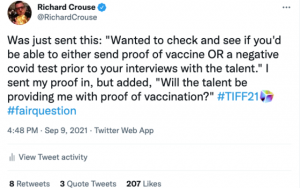 From Twitter: @RichardCrouse Was just sent this: “Wanted to check and see if you’d be able to either send proof of vaccine OR a negative covid test prior to your interviews with the talent.” I sent my proof in, but added, “Will the talent be providing me with proof of vaccination?” #TIFF21 #fairquestion 4:48 PM · Sep 9, 2021· 8 Retweets 3 Quote Tweets 206 Likes
There is no mention of COVID-19 in the Jake Gyllenhaal thriller “The Guilty.” But make no mistake, this is a pandemic movie, A remake of 2018 Danish film “Den skyldige,” it is essentially a one hander, shot on a just a handful of set with strict safety protocols in place. Gyllenhaal, as 911 operator Joe Baylor, may be socially distanced from his castmates, but his performance is anything but distant. Played out in real time, “The Guilty” builds tension as Baylor races against a ticking clock to bring the situation to a safe resolution for Emily. Director Antoine Fuqua amps up the sense of urgency, keeping his camera focused on Gyllenhaal’s feverish performance. The close-ups create a sense of claustrophobia, visually telegraphing Baylor’s feeling of helplessness and his crumbling mental state.
The sound of an audience laughing, applauding, crying, or whatever. Just being an audience. The big venues were socially distanced, and often looked empty to the eye, but when the lights went down and folks reacted to the opening speeches or the films, it didn’t matter. Roy Thomson Hall, with its 2600-person capacity, may have only had 1000 or so people in the seats, but for ninety minutes or two hours they formed a community, kindred souls brought together after a long break, and it was uplifting to hear their reactions.
“Flee” is a rarity, an animated documentary. A mix of personal and modern world history, it is a heartfelt look at the true, hidden story of the harrowing life journey of a gay refugee from Afghanistan. Except for a few minutes here and there of archival news footage, “Flee” uses animation to tell the story but this ain’t the “Looney Tunes.” Rasmussen used the animation to protect Amin’s identity, but like other serious-minded animated films like “Persepolis” and “Waltz with Bashir,” the impressionistic presentation enhances the telling of the tale. The styles of Rasmussen’s animation change to reflect and effectively bring the various stages of Amin’s journey to vivid life. It is suspenseful, heartbreaking and often poetic.
I asked “The Survivor” star Vicky Krieps about working opposite Ben Foster: “The first day I came [on set] I was very intimidated,” she said. “I wouldn’t say scared, but it felt like a wall to me. It began like this. There was no small talk. There was no, ‘How are you?’ He was already in character and it was very clear. I thought, ‘OK, I have to play his wife.’ And then, something really interesting happened. I like having a challenge and this felt like a challenge. So, I needed to find a way [to relate to him] because I knew I was going to be his wife. How do I do that? Imagine it as a wall, but then in the wall there are eyes. I used those eyes and I felt like I could open a window, and inside of those eyes was a horizon where I could go. I liked to say to Ben, ‘And then we would dance.’ Sometimes I wrote to him and said, ‘It was nice dancing today.’”
“Last Night in Soho,” from director Edgar Wright, is a love letter to London’s Swingin’ Sixties by way of Italian Giallo. Surreal and vibrant, and more than a little bit silly, its enjoyable for those with a taste for both Petula Clarke and murder. It begins with verve, painting a picture of a time and place that is irresistible. A mosaic of music, fashion and evocative set decoration, the first hour brings inventive world building and stunning imagery. Wright pulls out all the stops, making visual connections between his film and the movies of the era he’s portraying and even including sixties British icons Rigg, Tushingham and Stamp in the cast.
I asked “Dune” star Rebecca Ferguson why she said reading Frank Herbert’s novel was like doing a crossword puzzle: “Sometimes I wonder what comes out of my mouth,” she said. “My mother and many of my friends sit and do crosswords, but I have never been in that world. There is a way of thinking around it. It’s logical, mathematical. You need to be able to see rhythms. Whatever it is. Reading “Dune” was quite dense and I think for people who are immersed into the world of science fiction, they understand worlds and Catharism and this planet and that planet. It is just another picture, which, not to stupefy myself, I am intelligent enough to understand it, but there is a rhythm. I think it is me highlighting the fact that people who live and breathe science fiction, they get it at another level.”
“Dune,” the latest cinematic take on the Frank Herbert 1965 classic, now playing in theatres, is part one of the planned two-part series. “Dune” is big and beautiful, with plentiful action and a really charismatic performance from Jason Momoa as swordmaster Duncan Idaho. It is unquestionably well made, with thought provoking themes of exploitation of Indigenous peoples, environmentalism and colonialism.
As the Toronto International Film Festival winds down here’s a look back at some of the highlights of the last few days.
NOT URBAN COWBOY: Despite the similarities in name “Concrete Cowboy,” the new drama starring Idris Elba and Caleb McLaughlin of “Stranger Things” as father and son, has nothing to do with “Urban Cowboy,” the 1980 John Travolta cheese fest. This is a deeply felt, if slightly predictable coming-of-age story set against the backdrop of the urban cowboy subculture of north Philadelphia. Loosely based on the book “Ghetto Cowboy” by Greg Neri, “Concrete Cowboy” is a western but told from a different point of view than we usually see. Director Ricky Staub does a commendable job at building the world Harp and Cole inhabit. Their way of life is an anachronism in the big city, but the greater purpose of providing opportunities to the area’s youth is timeless.
DENZEL WASHINGTON ON CHADWICK BOSEMAN: As part of a virtual talk during the TIFF “In Conversation” series, Washington (who was chatting with director Barry Levinson) spoke eloquently about the passing of the “Black Panther” star. “Who knew he didn’t have much life left? He didn’t get cheated. We did. I pray for his poor wife and his family. They got cheated, but he lived a full life.”
WAHLBERG’S JOURNEY in “GOOD JOE BELL”: Mark Wahlberg is the good man of the title, Joe Bell, husband to Lola (Connie Britton), father to sons Joseph (Maxwell Jenkins) and Jadin (Reid Miller), a young gay man who took his own life after repeated bullying from the jocks at his high school. Unable to resolve his feelings, Joe hits the road, vowing to walk from La Grande, Oregon to New York City, the city of Jadin’s dreams. It’s a time of solitude for Joe to wrestle with his own complicity in his son’s death and make stops along the way to mumble his way through halting speeches about bullying at local high schools. Written by the “Brokeback Mountain” screenwriting team of Diana Ossana and Larry McMurtry, “Good Joe Bell” has its heart in the right place but makes missteps along Joe’s journey.
WORST FATHER EVER: Darth Vader may be the cosmically worst cinematic father in the universe but down on earth Willis, as played by Lance Henriksen in the new film “Falling,” gives the “Star Wars” villain a run for his money. Writer, director and star Viggo Mortensen found inspiration for the story after caring for his real-life father in his declining years. Mortensen plays John, husband of Eric (Terry Chen), son of Willis. He’s ex-Air Force, now working as a commercial pilot based in Los Angeles. It’s a long way from the rural New York farm where he was raised and his father still resides. Willis isn’t doing well. Dementia has robbed him of the ability to live alone in the rambling old farmhouse he’s inhabited for decades. Hoping to make his father’s life easier, John brings him to California with an eye toward making it easier to care for him. Trouble is, Willis’ disease has made him the definition of cantankerous. “Falling” gives genre legend Henriksen his meatiest role in years. He is the dominant and dominating character, a man who makes Archie Bunker look like Justin Trudeau.
SCORSESE AT THE TIFF TRIBUTE AWARDS: Kicking off the virtual fundraiser, aired on CTV, Martin Scorsese was impassioned as he spoke about the importance of film festivals. “It’s becoming sadly common to see cinema marginalized and devalued, and in this situation, categorized sort of as a form of comfort food, so to celebrate its very existence is all the more important and necessary. We can never remind people enough that this remarkable art form has always been and always will be much more than a diversion.”
A PICTURE IS WORTH 1000 WORDS: As Chief Official White House Photographer for two US Presidents, Pete Souza had an up-close-and-personal look at the hallways of power and the men who walked them. “The Way I See It,” captures a detailed behind-the-scenes profile of power and the responsibility that comes along with the office. “The Way I See It” is Souza’s story but the larger picture it paints is one of the importance of photography. If a picture is worth a thousand words this movie speaks volumes. Souza’s photos capture the hope and empathy that characterized the Obama years in stark contrast to the anxiety that surrounds the current election season. The photos tell the tale, for now and posterity.