Like Wrigley’s “Double your pleasure! Double your fun!” gum, this weekend’s movie Legend is two Tom Hardys in one. He plays the dual roles of Britain’s most notorious gangsters, Ronnie and Reginald Kray, identical twins and violent thugs who ruled London’s underworld during the 1950s and 1960s.
Previously real-life siblings Martin and Gary Kemp of ’80s new wave band Spandau Ballet impersonated the brothers in the 1990 film The Krays, but these days special effects allow Hardy to play both brothers. “The movie’s a testament to the Krays’ ability to get away with everything, for a while, anyway,” wrote Ty Burr in the Boston Globe. “But it’s better evidence of Tom Hardy’s ability to do just about anything.”
Already this year we’ve seen the talented actor in the Mad Max reboot Fury Road, the musical London Road and the crime thriller Child 44. Soon he’ll play opposite Leonardo DiCaprio in The Revenant and is currently shooting Taboo, a new BBC mini series scheduled to air next year.
He’s also made waves as The Dark Knight Rises’ brooding hulk Bane and dream-dancer Eames in the megahit Inception.
In between these box office busters he’s appeared in smaller, edgier films that deserve a look. Here are some of the other films that have helped Tom Hardy become legend.
Hillbilly Hardy:
Lawless takes place during Prohibition. The bootlegging business is booming, run by hillbillies who’ll sell to anyone with a buck and a thirst. The most notorious are the Bondurant family; headed by Forrest (Hardy) who engages in a knock down, drag out moonshine war with a corrupt lawman played by Guy Pearce. Hardy leads the cast as a soft-spoken thug with a brainy bent. “It’s not the violence that sets men apart,” he says, “it is the distance he is prepared to go.”
When he isn’t waxing philosophical he’s busy earning most of the film’s few laughs. It’s a natural, unaffected performance that really shows what he can do without a mask strapped to his face.
Solo Hardy:
In these days of maximalist moviemaking Locke goes the opposite way, trimming the movie down to one claustrophobic setting and a single on-screen actor. Locke is the first movie in recent memory that would probably work as well as a radio drama as it does a film. Hardy is Ivan Locke, a straight arrow construction foreman determined to be at the birth of his child. In his car, he’s battling traffic for the hour-and-a-half drive to London and the mother-to-be’s hospital. Trouble is, the child is the result of a lonely one-night stand and he’s a married man.
The entire film takes place in the front seat of Locke’s car, in real time, as he drives the M1. We see through the windshield, into the backseat and the display screen of car phone and GPS. Most of all we see Hardy’s face, which, even though obscured by a beard, still allows his charisma to ooze through. His face is the engine of the film, his talent the driver.
Hardheaded Hardy:
In the Drop, Hardy he plays Bob Saginowski, a mild mannered bartender at a Brooklyn neighbourhood pub owned by the Chechnyan mafia. Like many of the borough’s bars, Marv’s is sometimes used as a “drop,” a place where gangsters secretly hide money until it is collected by their crime bosses.
As Bob, Hardy is a cypher; kind to dogs, shy and lovesick, he is an average neighbourhood guy. Except in this neighbourhood average guys have pasts, and Hardy does a nice job of playing a man who is trying to move on while the past tries to stop him in his tracks.
In “Legend,” a new true crime drama about Britain’s most notorious gangsters, Tom Hardy plays the dual roles of Ronnie and Reginald Kray. Identical twins, the violent thugs ruled London’s underworld during the 1950s and 1960s and became celebrities of a sort, even being photographed by David Bailey and featured on television. Question is, will Hardy’s mirror imaging of the guys be like Wrigley’s “Double your pleasure! Double your fun!” gum or too much of a good thing?
“Legend” begins with voiceover from Reggie’s wife Frances Shea (Emily Browning). “London in the 1960s,” she says. “Everyone has a story about the Krays. Walk into any pub and everyone had a lie about them.” The film strings those romanticizes those stories in a genre-friendly tale of two men on the rise through London’s underworld.
Reggie is a slickster, a thug with a soft spot for Frances and the prestige of owning nightclubs. Ron is unpredictable, a psychopath prone to beating people with a hammer. The brothers are a unit, but two very different cogs of the same wheel. Reggie is straight, Ron is gay, openly so, which in London’s 1960s underworld was an enlightened stance. Reggie tried to work within the system; Ron tried to dismantle it. The thing that bound them was blood, theirs and that of their victims. “My loyalty to my brother is how I measure myself,” says Reggie.
Told from Frances’s point of view, the movie paints a vivid picture of her relationship with Reggie—he sweet talks her with, “The center of the earth can be anywhere you’d like… even the east end of London.”—and Swingin’ London with nightclubs and violent scenes that play like Scorsese with an English accent. On the personal side of the story the downside to being married to a gangster with a blood-is-thicker-than-water connection to his volatile brother quickly becomes apparent and brings the story to a film noir conclusion.
Written and directed by “LA Confidential” and “Mystic River” screenwriter Brian Helgeland “Legend” is a companion piece to the 1990 biopic “The Krays,” which starred actual twins, Spandau Ballet’s Martin and Gary Kemp as Reggie and Ron. The new film is less gritty—there is nothing that comes close to the brutal horror of Gary Kemp using a sword to give a stranger a gruesome “permanent smile”—choosing instead to play up the glamour of the period and the legend of London’s gangland.
It’s a less sensational portrait of the brothers but just as gimmicky in its own way. Special effects allow Hardy to play both brothers and while his performances are frequently impressive, it often feels like a trick to distract from an underwritten story. He effortlessly nails Reggie’s toxic mix of charm and brutality but as Ron seems to be trying too hard. Pulling faces that wouldn’t be out of place in “Reefer Madness,” Hardy strains to perform through facial prosthetics, occasionally to unintended comic effect.
“Legend” is aptly titled. More Kray Bros lore than nuance, it provides a glossy but glossed over look at the violent men behind the bespoke suits.
George Miller has made pigs talk and penguins tap dance. He’s been a doctor and a film director. Among the bold faced names on his resume are the titles Babe: A Pig in the City, The Witches of Eastwood, Happy Feet 1 and 2 and Lorenzo’s Oil. One name, however, looms larger than the rest.
Mad Max. Over the course of three films—Mad Max, Mad Max 2: The Road Warrior and Beyond Thunderdome—he introduced the world to post apocalyptic warrior Max Rockatansky, made Mel Gibson a superstar, defined dystopian cinema for a generation or two and created the phrase, “Two men enter, one man leaves.”
This weekend, thirty years after the release of the last Mad Max movie, Miller revisits the character in Mad Max: Fury Road, a reboot starring Tom Hardy and Charlize Theron.
The seventy-year-old director, who raised money to make the first film by working as an Emergency Room Doctor, says the goal of the new movie was to make it “uniquely familiar.”
After years of “following the CG evolution,” using computer generated images to create beautiful animated films, he was keen to go back to “old school” filmmaking “with real cars and real people and real desert.” That means, unlike the Avengers and their ilk, respecting the laws of physics by using practical effects and keeping the action earthbound. In other words, in a call back to the original films, when a car blows up it doesn’t rocket into space. Instead it explodes spectacularly but organically. The wild action you see in Fury Road are actual stunts performed by stunt men and women and not generated by a clever computer operator in a studio.
“It was like going back to your old home town and looking at it anew,” he says.
Miller reveals he originally created Max’s wasteland world while practising medicine.
“I worked for two and half years in a big city hospital. I stayed registered right up past Mad Max 2: Road Warrior. I never even thought there’d be a career. I stayed as a doctor on the first Mad Max because we kept running out of money in postproduction. Then I stayed through to the second Mad Max because if you are doing stunts you are obliged to have a doctor on set. There weren’t big budgets so I ended up running a clinic during lunch time tending to cuts, sunburns, scrapes and all that.”
His two careers have much in common, he says, adding he was “was privileged with a unique point of view as a doctor.”
“I don’t think I’d be the filmmaker I am unless I had that medical education, in two very direct ways. Both of them have a lot of problem solving in there. But the most important way is that as a doctor you are looking at people in extremis from many points of view. You look inside of people. You see people during birth and death and so on. Through microscopes; a lens. So you’re looking from many, many points of view. That’s exactly what you do in cinema. Huge wide shots with massive crowds or you’re looking right down inside someone’s brain, someone’s head.”
As for plans to make another Mad Max right away, he says, “That’s a bit like asking a woman who’s just given birth if she’s going to have another baby.”
The ghostly War Boys of “Mad Max: Fury Road” have a catchy mantra they recite as they go into battle. “I live. I die. I live again!” In some ways it could be the refrain for the series. Begun as a down-and-dirty punk rock vision of a post-apocalyptic Australia, the 1979 no-budget movie made a star out of Mel Gibson and spawned a mini-franchise of two more films, “The Road Warrior” and “Beyond Thunderdome.”
The George Miller films lived, died and now live again courtesy of “Mad Max: Fury Road,” an out-of-control reboot that recreates Max Rockatansky’s dystopian world and then races like hell through it, laying rubber all the way.
Set in an arid, inhospitable world where a snack of raw lizard constitutes a meal, Max (Tom Hardy) is a man who has lost everything, Haunted by “those he could not protect” he is now “a man reduced to a single instinct—survival.” Captured by henchmen of Immortan Joe (Hugh Keays-Byrne, who played Toecutter in the original “Mad Max”), a despot who hoards precious natural resources and only sparingly shares water with his subjects—Don’t take too much water, he says, you will only come to resent it when it isn’t there.—Max is turned into a blood bank for an ailing war boy named Nux (Nicholas Hoult). Subjected to a life of confinement and drained of his own natural resources, Max sees a chance for freedom when Nux and others do battle against Imperator Furiosa (Charlize Theron), a former warrior turned rogue. She’s driving the imposing War Rig—imagine a Monster Truck with an attitude—across the wasteland. With her are Immortan Joe’s five wives—Splendid (Rosie Huntington-Whiteley), Capable (Riley Keough), Toast (Zoë Kravitz), The Dag (Abbey Lee Kershaw) and Fragile (Courtney Eaton)—a natural resource he desperately wants back. Max and Furiosa form an uncomfortable alliance to battle the forces of evil and make it across the desert to Furiosa’s childhood home, a green oasis.
It’s been thirty years since there was a new “Mad Max” movie but “Fury Road” was worth the wait. The years have not stilled Miller’s restless camera or his outrageous way with steampunk influenced design or character names. If Imperator Furiosa isn’t the best character name of the year, I don’t know what is. Her title, however, might as well have been Mad Maxine as she is more the focus of the story than the titular character.
It is a chase movie where characters chase immortality, a new life in a better place, love and one another across a vivid landscape. Gone are the grey tones of dystopian movies like “The Road.” In its place is a dusty but vibrant backdrop that frames the non-stop action. Miller keeps the pedal to the metal but unlike the recent “Avengers: Age of Ultron,” which had a similar angle of attack, he keeps the action earthbound. The laws of physics are respected—when a car blows up it doesn’t rocket into space for instance—by the director’s use of practical effects. Most everything you see on screen are actual stunts performed by real people and not generated by a clever computer operator in a studio later on. The organic nature of most of (but not quite all) the visuals gives the movie extra torque, adding a sense of danger and realism (no matter how unreal the situation) to the large set pieces that make up the bulk of the film.
Hardy pulls his weight as Max. His powerful physicality mixed with a haunted look—maybe we should call him Passive Aggressive Max—and gearbox permanently shifted to survival makes him an imposing center of the film, but it is Theron who dominates.
As Furiosa she lives up to her name as a force to be reckoned with. She’s a one-armed bandit (literally) who not only provides much of the action in the film, but its heart as well.
The real star, however, is Miller. Thirty years after he last played in Mad Max’s world he revisits it with a film that doesn’t feel like a sequel or a reboot, but a fresh look at an familiar character. His off-the-wall sensibility and demented Hot Wheels style designs give the movie a look and feel that no other director could replicate.
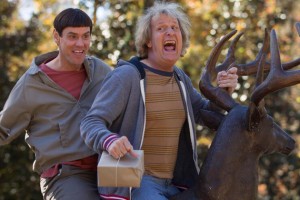
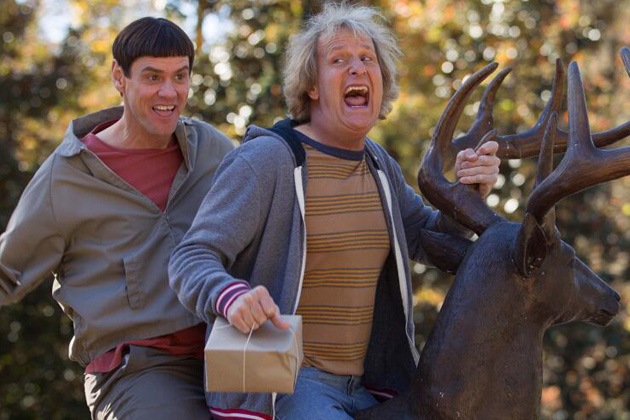
Twenty years ago Roger Ebert wrote that a moment in Dumb and Dumber, “made me laugh so loudly I embarrassed myself.”
The movie, starring Jim Carrey and Jeff Daniels as the chicken-brained Lloyd and Harry, made 250 million dollars at the box office and seemed likely to spawn a sequel but nothing happened for almost twenty years. There was a prequel, Dumb and Dumberer: When Harry Met Lloyd, but it was a Carrey-and-Daniel-less exercise in futility I called, “one of the least funny and ineptly made movies to ever play at your local multi-plex,” on its 2003 release.
So why did it take 19 years and 333 days to release a Dumb and Dumber follow-up? Carrey says he wasn’t into doing sequels but softened because everyone kept hounding him, he joked, “even dead people.”
Fans had to wait ages for Dumb and Dumber’s return, but two decades is a mere drop in the bucket when compared to the gap between the 1942 Disney classic Bambi and it’s sequel Bambi II. A ten-year-old who saw the original would have been old enough to send their grandkids to get popcorn refills when the sequel hit theatres overseas (it went direct to DVD in North America) almost sixty-four years later.
Thirty years after Alfred Hitchcock made seagulls menacing in The Birds a made-for television-movie called The Birds II: Land’s End revisited the killer avian story. Tippi Hedren, star of the original, signed on and it was shot in the house from the first film, but that’s where the similarities between the two end. The New York Times called the film “feeble,” and Hedren said, “It’s absolutely horrible, it embarrasses me horribly.”
29 years and 343 days after 1968’s The Odd Couple hit the big screen, writer Neil Simon and stars Jack Lemmon and Walter Matthau reunited for The Odd Couple II. “We always had bad chemistry,” says Oscar Madison (Matthau). “We mix like oil and frozen yogurt.” It marked the last starring roles for each of its leads and the final collaboration between Lemmon and Matthau after making ten movies together.
These days Hollywood seems obsessed with sequels and next year will be no different. Mad Max: Fury Road, starring Tom Hardy in the role that made Mel Gibson famous, returns thirty years after Mad Max Beyond Thunderdome and Jurassic World revisits Jurassic Park III thirteen years later. The biggest sequel news of the year—maybe of the decade—is the December 2015 release of Star Wars: The Force Awakens. In the official Starr Wars chronology the new film follows 1983’s Return of the Jedi after a space of 32 years and 207 days.
“The Drop,” the new film from the pen of “Mystic River” writer Dennis Lehane, presents itself as a Brooklyn-based crime drama, but is, at its heart, the story of a boy and his dog.
Tom “Man of a Thousand Voices” Hardy plays Bob Saginowski, a mild mannered bartender at Cousin Marv’s a Brooklyn neighborhood pub owned by the Chechnyan mafia. Like many of the borough’s bars, Marv’s is sometimes used as a “drop,” a place where gangsters secretly hide money until it is collected by their crime bosses. One night after work Bob hears a dog whimpering from inside a garbage can. Lifting the lid, he finds a beaten pit bull puppy. He adopts the dog and romances Nadia, (Noomi Rapace), the woman who helped him rescue the animal, but soon a robbery, a scheme by his boss Marv (James Gandolfini) and the dog’s former owner (Matthias Schoenaerts) force Bob to show his true colors.
This is a boy-and-his-dog story, but it ain’t “Old Yeller.” Sure there are gun shots and a cute dog, but there is also a slow unveiling of the clues, red herrings and characters with shady pasts.
As Bob, Hardy is a cypher; kind to dogs, shy and lovesick, he is an average neighborhood guy. Except in this neighborhood average guys have pasts, and Hardy does a nice job of playing a guy who is trying to move on while the past tries to stop him in his tracks.
Gandolfini, in his final role, plays to type as the Tony Soprano-Lite bar owner and while it is a part he could play in his sleep, there is something comforting about seeing him, one last time, as a conflicted tough guy.
Then there is the dog (very cute), the one character that doesn’t seem to have a nefarious past.
“The Drop” is a slice of life, a slickly made look at the underbelly of crime, relationships and dog rearing. Nice performances make up for some plot idiosyncrasies and the cute dog earns some goodwill for a story that doesn’t so much comment on the condition of its characters as it does reveal it.
In these days of maximalist moviemaking the new Tom Hardy film goes the opposite way, trimming the movie down to one claustrophobic setting and a single on screen actor. “Locke” is the first movie in recent memory that would probably work as well as a radio drama than it does a film.
Ivan Locke (Hardy) is a straight arrow construction foreman on a mission. “I will do what needs to be done,” he says, “whether they love me or hate me.”
The son of an absent father, he is determined to be at the birth of his child. In his car, he’s battling traffic for the hour-and-a-half drive to London and the mother-to-be’s hospital. Trouble is, the child is the result of a lonely one-night stand and he’s a married man.
Compounding his troubles is the timing of the birth. It is the eve of the biggest cement pour in European history, and he’s chosen his duty as a new dad over his loyalty to the construction company he’s worked at for nine years. Over the course of two hours and dozens of car phone conversations, his life disintegrates, but his resolve does not.
A review like this lends itself to many, many puns. “Locke” is a vehicle for Tom Hardy’s bravura performance. He face is the engine of the film, his talent the driver.
Now that we have that out of the way, let’s look at the film.
The entire film takes place in the front seat of Locke’s car, in real time, as he drives the M1. We see through the windshield, into the backseat and the display screen of car phone and GPS. Most of all we see Hardy’s face, which, even though obscured by a beard, still allows his charisma to ooze through. That’s a good thing because it is the actor—not the character or the situation—that makes “Locke” interesting.
It’s a character piece about a man who has learned what he doesn’t want to be; who is determined to do the right thing, “to be solid,” as he says. He’s an admirable man who has made mistakes, and Hardy pulls the drama out of the phone calls with his wife, his kids and soon-to-be-ex-boss. The situations individually aren’t that compelling, but placed side-by-side and filtered through Hardy, they become, if not exactly riveting—how riveting can extended conversations about cement pouring be?—at least engaging.
The set-up doesn’t limit Hardy as much as it hinders the story from truly taking off, from evolving into something more meaningful than watching a man deal with some serious life problems while trying not to get a speeding ticket. There are heightened emotions throughout, but as high as Hardy soars, the film grounds him with a gimmicky idea that keeps him car bound.
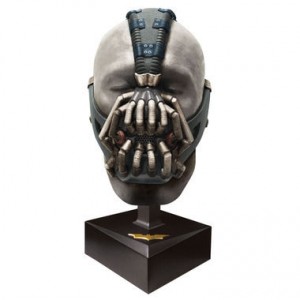
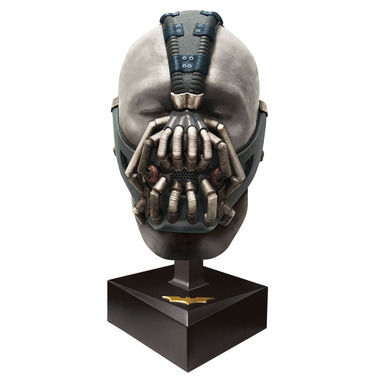
What says Christmas more than wearing a mask and grumbling, “I will feed its people hope to poison their souls.”
From Skymall.com comes the Bane Special Edition Mask as seen in “The Dark Knight Rises.”
Here’s the info from the website: Full size display mask replica as featured in Batman: The Dark Knight Rises. Measures 21″ tall. Pedestal display included.
Conventional Hollywood wisdom these days has it that audiences only want to see remakes, retreads and rehashes of old ideas. This summer has seen a seemingly endless parade of movies with the number 2 in the title and films based on 80s TV shows. Some have made money some have not, but every once and a while a movie comes along that proves Hollywood wrong. Last December “Avatar” showed that audiences would flock to a movie that wasn’t based on a videogame, existing novel or television show. It broke every box office record going and yet since then there has been a stream of derivative films clogging up the multiplex. Until now. Christopher Nolan’s “Inception” is a startlingly original film.
Set in a world where technology can invade people’s dreams, “Inception” stars Leonardo DiCaprio as Dom Cobb, the leader of a corporate espionage team who specialize in stealing valuable secrets from within people’s subconscious for profit. Cobb is an international fugitive tormented by dreams of his late wife (Marion Cotillard) who sees a way out of his personal nightmare if he takes on one last job offered to him by Saito (Ken Watanabe), a powerful businessman who can arrange for Cobb to skip past immigration and get back into the United States. All Cobb has to do is perform an “inception;” plant a thought in the mind of Robert Fischer (Cillian Murphy) CEO of a global corporation. (One writer has called it “the Great Brain Robbery.) Cobb and his team—Arthur (Joseph Gordon-Levitt), Eames (Tom Hardy), Yusuf (Dileep Rao) and Ariadne (Ellen Page), an architect who becomes Cobb’s new dream weaver—set out to implant the idea of dissolving his multibillion-dollar business into Fischer’s dreams.
“Inception” is the most innovative sci fi film to come out of Hollywood since “The Matrix” way back in 1999. It’s a movie that takes ideas very seriously—ideas drive the plot—and, as a result, takes its audience seriously. It never talks down to the crowd and in return demands viewers to pay attention. For those who do there are many rewards, and for those who aren’t willing to get drawn into the surreal story there are still many pleasures. That’s how finely crafted this movie is.
“Dark Knight” director Christopher Nolan (who also wrote the script) proves he can blow the doors off with the action—Joseph Gordon-Levitt’s MC Eischeresque gravity defying fight scene is a mind blower—and also handle the cerebral stuff.
He creates and juggles several worlds—dreams within dreams, worlds within worlds—until it becomes difficult to tell what is real and what isn’t. Each of these worlds comes complete with their own rules—five minutes in real life equals one hour in dream time, for instance—and is populated with well rounded, complex characters. The visuals are very cool—check out the streets that defy physics and curl over on top of one another—but amazing effects don’t mean much if the people interacting with them aren’t interesting. Nolan has put a great deal of effort into the look of the movie and its ideas but he never forgets the characters, who are the film’s single biggest asset.
Like the very best sci fi “Inception” is thoughtful, intelligent, audacious and humanistic. It’s also one of the year’s best films of any genre.