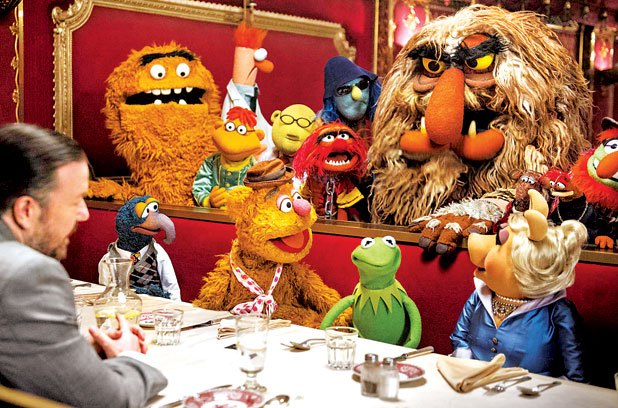
When The Muppet Movie was released in 1979 the Muppet Show Fan Club pointed out the differences between the movie and the puppet’s popular television show.
“If you think it’s a film version of The Muppet Show, you’re in for a surprise.
For one thing, it doesn’t take place in the theatre. The Muppet Movie is set in the real world — it’s like waiting in line at a gas station and looking up to find Fozzie and Kermit driving the next car over.”
In the subsequent seven theatrical Muppet movies that magic has been maintained, but the methods have changed over the years. In 2011’s The Muppet Movie all the puppets were real, but the way they were filmed changed. To give the puppets a full range of movement the puppeteers — or Muppeteers as they prefer to be called — were often in full view of the camera and digitally removed in post production.
“We removed the puppeteers later,” said visual effects artist Max Ivins, “so it gave the puppeteers a lot more freedom in that they didn’t have to hide from the camera to do everything.” It’s a technique used in Muppets Most Wanted, which sees the furry and felt puppets get into trouble on a world tour when it turns out that Kermit’s doppelgänger is the world’s number one criminal. Co-starring with the Muppets is Ricky Gervais, Ty Burrell and Tina Fey. In the years before computer generated imagery, however, Muppeteers hidden from view manipulated all the puppets. And it wasn’t always so comfortable.
Everyone remembers Kermit sitting on a log, playing his banjo, in the middle of a swamp in The Muppet Movie, but did you know that Jim Henson, Kermit’s creator and operator until 1990, was under water for the five days it took to shoot the scene?
According to the Muppet Fan Club he was wedged into a metal tube “under the water, under the log, under the Frog” while hooked up with an air hose, a monitor and a rubber sleeve which allowed him to manipulate the puppet.
Frank Oz was also submerged for Miss Piggy’s water ballet scene in The Great Muppet Caper. “I was under the water for a week,” he says. “I had three days of scuba training and then down I went.” Finally, almost every Muppet movie features Kermit riding a bicycle. How did they do it in the early days? Director James Frawley jokes, “I put him on a three-wheeler until he got his balance, and then I put him on the two-wheeler.”
In fact, the effect was achieved by intercutting long shots using a Kermit marionette and close-ups with a hand puppet operated by Henson who rode along with the bike on a low-rolling dolly.
1. Admission: Tina Fey is Portia Nathan, a mildly compulsive Princeton admissions officer—they jokingly call her their “golden retriever” because of her record of recruiting a-plus students—who leads a quiet, ordered life with professor Mark (Michael Sheen). They share a love of poetry, hatred of kids and not much else. Her well ordered life is thrown into disarray when John Pressman (Rudd), a free-spirited former classmate and now teacher at an alternative school, introduces her to Jeremiah Balakian (Nat Wolff), a brilliant young man who may be the child she gave up for adoption seventeen years ago. “Admission” is familiar enough to not jar the sensibilities of undemanding rom com fans, but there is more here than immediately meets the eye.
2. The Bling Ring: Based on actual events, “The Bling Ring” centers around a group of narcissistic Los Angeles area teenagers, Rebecca (Katie Chang), Marc (Israel Broussard), Nicki (Emma Watson), Sam (Taissa Fermiga) and Chloe (Claire Julien).
Their modus operandi? They track the comings and goings of their favorite celebs on via internet. While one-named millennial stars like Paris, Lindsay, Megan or Audrina are out on the town or out of town completely, the Ring “go shopping,” breaking into their homes and help themselves to jewels, designer clothes and loose cash. More than that, they live vicariously through the lives of the rich and famous folks they’re burgling.
“The Bling Ring” plays like a “Law & Order” episode of “The Hills.” The crime spree is device that keeps the story moving forward, but the fascinating thing is the portrait of these self-absorbed kids who aspire to hosting reality shows or becoming a “lifestyle brand” as a career. They want fame and money, but are so tied up with the idea of fame and money they are blind to virtually everything else.
“The Bling Ring” is a fascinating art-house glimpse of fame found, just not the fame the thieving teens sought. They are the robbers TMZ made famous, a group of kids who redefined narcissism in an already narcissistic town.
3. The East: Britt Marling stars as corporate spy Jane Owen, code name Sarah. Her latest job involves going deep undercover to infiltrate a shadowy group of eco-terrorists called The East. The collective—think real life activists Anonymous—run by the charismatic anarchist Benji (Alexander Skarsgård), is on the eve of their biggest demonstration yet, an act of sabotage that will make headlines and make a very public statement of their anti-corporate stance.
Sarah is accepted by the group, save for the truculent Izzy (Ellen Page), and begins to develop Stockholm syndrome. Or does she?
It’s a morally complex movie, with Sarah at the center of the ethical hurricane as she starts to question her role as both a spy and a would-be member of the radical group. She weighs the morality of both sides and… well, go see the movie.
“The East” deliberately paints shades of grey into the story, allowing for good and bad, evil and sympathetic characters on both sides. It may be too nuanced for folks who like their spy stories to take sides, but Sarah, as the source of the plot’s push-and-pull, is too complex a creation to play it straight. Marling brings strength and fighting spirit to Sarah in a performance that could finally make her a star.
4. The Iceman: Based on “The Iceman: The True Story of a Cold-Blooded Killer” by crime writer Anthony Bruno the movie begins on Kuklinski’s first date with his wife to be Deborah (Winona Ryder). He’s quiet and reserved, but charming and she is won over by his charisma. They marry, have kids and lead a normal life. At least at home. Deborah had no idea her mild mannered husband was an expert assassin, who paid for the kid’s private school and her jewels by slicing throats, shooting and choking the enemies of his boss Roy DeMeo (Ray Liotta).
Kuklinski was dubbed the Iceman for two reasons. When he was arrested police found a stash of bodies he had frozen to obscure time of death and because of his icy demeanor. It’s a role Shannon was born to play. From certain angles he looks like an everyman, the kind of guy who goes home at night to his wife and two kids. From other angles he’s menacing, the kind of guy you don’t want to meet in a dark alley.
Shannon is cooler than Mr. Freeze as the title character in “The Iceman,” and he’s joined by Chris Evans in a career making performance as a ice cream truck driving killer, Liotta in mobster mode—between Shannon and Liotta it’s a showdown of the steely stares—the welcome return of Wynonna Ryder and David Schwimmer playing against type as a slimy mafia enforcer.
5. The Last Stand: Near the beginning of the movie the head lawman of the sleepy border town of Summerton Junction, Sheriff Ray Owens (Arnold Schwarzenegger), says, “Should be a quiet weekend.” Of course whenever Arnold, or any eighties action star says, “Should be a quiet weekend,” you know all hell is about to break loose. And break loose it does.
In a parallel story ruthless drug lord Gabriel Cortez (Eduardo Noriega) stages an elaborate escape and heads for the Mexican border, which just happens to lie outside Arnold’s… er… Owens’s town. As Cortez speeds toward the border he has a quick cell phone call with Owens. “Do you wanna play?,” he yells. “Let’s play!” And play they do… with big guns.
Schwarzenegger is moving noticeably slower these days—How are you Sheriff? “Old,” he says.—but his comic timing is still there and no one else can battle through this kind of cheesefest and emerge with his action cred intact.
“The Last Stand” is not a movie to be taken seriously, but it wasn’t made to be taken seriously. Why else would cult director Jee-woon Kim cast Johnny Knoxville?
6. The Lone Ranger: Set against a backdrop of corruption during the building of the railway’s westward expansion through Native American territory, this is the origin story of how attorney John Reid (Armie Hammer), a law and order man who doesn’t believe in vengeance, met Tonto (Johnny Depp) and became the Wild West’s masked crusader.
The unlikely pair are brought together by their mutual enmity toward Butch Cavendish (William Fichtner), a cannibalistic outlaw who Reid wants to bring to justice and Tonto wants dead. That pursuit uncovers massive corruption during the building of the railway’s westward expansion through Native American territory beginning with a conspiracy to start a war between the US Calvary and the Comanche Nation.
“The Lone Ranger” is state of the art nouveau Western, complete with circling vultures, unspoiled landscapes, gruff, unshaven men and even a beer drinking horse. Surprisingly nimble footed for a two-and-a-half hour epic, it is unexpectedly funny but more violent than your typical summer tent pole flick.
7. Pacific Rim: Director Guillermo Del Toro has made an end-of-the-world scenario fun.
In the world he creates in “Pacific Rim” the planet is threatened with destruction by Kaijus, colossal beasts with an appetite for destruction. Coming to our world through a breach in a portal beneath the Pacific Ocean, the earth is losing the war against these beasts. The main of line of defense, giant robots called Jaegers—operated by pilots who mind meld with the metal behemoths; the deeper the connection, the better they fight—are being decommissioned in favor of a giant wall. “Kaijus are evolving,” says one military man, “and we’re losing Jaegers faster than we can build them.”
In the months before the machines are made obsolete a driven colonel, Stacker Pentecost (Idris Alba), assembles a crack team of Jaeger pilots—including burned out former pilot Raleigh Becket (Charlie “Sons of Anarchy” Hunnam) and talented but untested trainee Mako Mori (Rinko Kikuchi) to launch one last attack to close the portal and save the planet.
Del Toro has supersized a Godzilla story, adding in 50s b-movie tropes with state of the art sci fi to create something fresh. It’s a thrill ride from the beginning, a giant action movie that doesn’t just rely on a cool premise.
In other words, “Battleship” this ain’t.
8. Pain and Gain: Near the beginning a voiceover says, “Unfortunately, this is based on a true story.” It’s the real-life tale of three Miami-based body builders (Mark Wahlberg, Dwayne Johnson, and Anthony Mackie) chasing the American Dream. Pumped up and steroid crazy they abduct a prominent local businessman (Tony Shalhoub). They beat and torture the self-made millionaire until he signs over all his wealth—houses, cars, boats and money. The story eventually becomes so outlandish Bay flashes up a graphic in the last half hour reminding us that this is “still a true story.”
This is a seriously weird movie. It’s Bay working with a tiny—for him—budget of just $26 million. The guy has made commercials that cost more than that, but has delivered the darkest comedy—imagine if the Coen Brothers did gruesome slapstick—to come down the pike in a while.
9. Rush: When we first meet Niki Lauda (Daniel Brühl) and James Hunt (Chris Hemsworth) they are third stringers, talented Formula 3 drivers desperate for a chance to move up to the big show. Lauda makes a financial deal that lands him on Team Ferrari while Hunt uses tenacity, charm and a touch of desperation to grab a spot with the McLaren team.
Bad blood flows between the two, stemming back to an incident when Hunt edged Lauda off the track the first time they faced off against one another. That rivalry spills over from the track as the two engage in name-calling and spar in the press.
In the 1976 season Lauda seems unstoppable, a sure bet to reclaim his World Champion title. Then tragedy strikes as Lauda is badly burned in a fiery crash. During his recuperation Hunt rises in the ranks, leading to a showdown, just 50 days after Lauda’s accident, for the World Championship at the Japan Grand Prix.
“Rush” is more than “Rocky” on four wheels, it’s an exhilarating, stylish film with pedal-to-the-metal verve.
10. The Sapphires: The year is 1968. Dave Lovelace is an English (Chris O’Dowd) piano player with a love for Otis Redding and booze. While hosting a talent show in remote Australia hosting he discovers three sisters, Cynthia (Miranda Tapsekll), Gail (Deborah Mailman), Julie (Jessica Mauboy), with amazing voices but a tired country and western style repertoire. Adding cousin Kay (Shari Sebbens) as background singer and dance captain, he molds them into the Australian Supremes and gets them their first gigs—in Vietnam singing for the troops.
“The Sapphires” is a feel good movie that succeeds despite the cliché story. It’s based—one imagines very loosely based—on a true story, but make no mistake, this is a Hollywood-ized (filtered through an Australian sensibility) version of the tale.
Authenticity aside, it’s the performances and the music that make “The Sapphires” worth a look. We first noticed O’Dowd on this side of the Atlantic as the charming love interest in “Bridesmaids.” He brings it again in “The Sapphires,” mixing roguish appeal with bang on comic timing.
“The Sapphires” is a slight, but entertaining take on the effect of music to change people’s lives.
11. The To Do List: High school valedictorian Brandy Klark (Aubrey Plaza) is an overachiever. She’s the publisher of her own magazine, Women With a Y, a straight A student with a full scholarship to Georgetown University and has a Perfect Attendance certificate proudly hanging on her wall.
She’s also a virgin, a status she hopes to change soon with the help of Rusty Waters (Scott Porter), a college surfer stud with a perfect smile. Attacking her new project with the gusto that won her accolades in school, she gets the advice of friends and family (Christopher Mintz-Plasse, Alia Shawkat, Sarah Steele and Rachel Bilson) and makes up a “to do” list, applying the same zeal that made her a mathlete to losing her virginity.
Telling the story from a female point of view is a nice turnaround from the usual boycentric sex comedy story.
“The To Do List” is endearingly off-kilter, a different take on the “Porky’s” style of sexual coming-of-age stories usually that are usually headlined by the male members of the cast. I wish it was a bit shorter—did they really need 100 minutes to tell this story?—and a bit funnier, but for anyone who came of age just as The New Kids on the Block were calling it quits (for the first time) there is much to enjoy here.
12. Warm Bodies: Nicholas Hoult plays R (pronounced “arrgghhgghh”), an existential zombie who wants more out of life… or death, or whatever it is you call his current state. “Why can’t I connect with people?” he wonders in the narration. “Why is my posture so bad? Of yeah, I’m dead.” There’s been a plague of some sort which has left him and most of the population hungry for brains, while the sole human survivors live behind a giant wall.
Zombies and humans alike are terrified of the Bonies—evolved zombies who’ll eat anything with a heartbeat. “So will I,” says R, “but at least I’m conflicted about it.”
On a feeding trip R encounters a team of humans on the search for supplies. One zombie attack later he has eaten the brains of Perry (Dave Franco). When he gets a glimpse of Perry’s girlfriend Julie (Teresa Palmer) he loses his appetite. Perry’s memories come flooding into R’s zombie brain and he begins to feel something he hasn’t felt for a long time—human emotions.
It’s “Walking Dead” meets “Romeo and Juliet” with a twist—it just might be that love and hope can still set hearts a flutter, even ones that haven’t beaten in a while.
Any movie with the line, “I know it’s really hard to meet guys now… in the apocalypse and everything,” is OK by me.
13. You’re Next: On the occasion of their parents 35th wedding anniversary the Davidson kids and assorted wives, girl and boy friends gather at a remote Tudor mansion—is there any other type in these kinds of movies?—to enjoy dinner and one another, but instead end up in a fight for their lives. Only one of the guests, Erin (Sharni Vinson), has the know-how to protect herself, but will it be enough?
It’s hard to discuss “You’re Next,” which had its world premiere at the 2011 Toronto International Film Festival Midnight Madness program, without giving away a major plot twist, but I will say there is a Manson Family aspect to the story that really creeped me out. That plus the anxiety-inducing John Carpenter style score throbbing in the background and the “moist” sound effects accompanying the wet work. It’s all effective but it is the idea behind the movie that is truly disturbing.
There is a rawness to the filmmaking—and let’s just say that there are no future Meryl Streeps in the cast—that although there is very little actual gore, is chilling.
I don’t know what it says about my mental make-up, but I really liked “You’re Next.” It’s disturbing, violent and without any redeeming social value, but I enjoyed sitting in the theatre with my hands over my eyes, afraid of what I might see next. I’m not usually a fan of head trauma, but from what I saw as I peeked through my fingers, it works well.
Jerry Lewis didn’t find Lucille Ball amusing. Not only that but the man who, ironically as it turns out, made a career of spastically yelling, “Laaa-dy!” at every opportunity says he doesn’t “like any female comedians.” Doesn’t find them funny
Jerry meet Tina Fey.
Jerry meet Kristen Wiig.
Jerry meet… I could go on but I think the point I’m making is that old Jerry is about as right about this as he is funny. Which is to say, not so much.
This summer has seen the release of two movies headlined by women and aimed at the funny bone. Bridesmaids and Bad Teacher, which premiers this weekend, both take the tried and true recipe of mixing vulgar jokes with sentimentality and heart—the boys have been doing it for years in movies like The Forty Year Old Virgin and Knocked Up—and folds in female characters that are used as more than set decoration.
Women have yukked it up on the small screen since the beginning of the medium. The aforementioned Ball gave way to Marlo Thomas, Betty White, Cloris Leachman, Sarah Silverman and others, but on the big screen women have often been simply regarded as an attractive foil for the male star or given what Modern Family’s Julie Bowen calls the “finger shaking role.”
Women frequently headline big screen romantic comedies, but there is a reason why the word romantic comes first in the genre description. Sure Kathryn Hiegl or Kristen Bell will be allowed to do a pratfall or two in movies like 27 Dresses or When in Rome, but when it comes right down to it are there to deliver the romance and leave the chuckle-grabbing to their costars.
It’s rare to see comedic women front and center in the movies, but Bridesmaids had six of them and is already a hit and depending on the audience appetite for Cameron Diaz’s return to her There’s Something About Mary-esque comedic roots, Bad Teacher might usher in an era of funny female flicks that rely on chuckles and not C cups.
In an article called Why Women Aren’t Funny Christopher Hitchens wrote “women do not find their own physical decay and absurdity to be so riotously amusing.” I would suggest Mr. Hitchens have a look at the food poisoning scene in Bridesmaids and rethink his position.
I would also suggest everyone take a gander at Lake Bell, an actress who shares initials and comedic style with Lucille Ball, and who never fails to make me laugh, which is more than I can say about Jerry Lewis.
Stranded-in-big-bad-New-York-City movies are nothing new. Jack Lemon and Sandy Dennis endured everything from exploding manhole covers to muggings in 1970’s “The Out of Towners” and in “After Hours” Griffin Dunne got sucked into the vortex known as Soho for one very long, weird night. Nope, the idea of average people getting in over their heads in the Big Apple has been done before, and done better than it is in “Date Night,” but this movie isn’t about the plot, it’s about the likeability of its two stars Tina Fey and Steve Carell.
Fey and Carell are Claire and Phil, a bored married couple from Teaneck, New Jersey looking to spice up their dull date nights with a fancy outing in Manhattan. It starts off promisingly. They can’t get a table at the hottest place in town, but when another couple doesn’t show up for their reservation Phil assumes their name, The Tripplehorns, and grabs the table. Dinner is great—wine is flowing, the truffle topped risotto is delicious, Will.i.am is at the next table—until two thugs (Jimmi Simpson, Common) come calling for the real Tripplehorns. Seems the other couple are blackmailers in possession of a flash drive that local mafia bigwig (Ray Liotta) desperately wants back. The case of mistaken identity sets them on a collision course with a notably shirtless security expert (Mark Wahlberg), crooked cops and wild car chases.
“Date Night” wouldn’t be as enjoyable as it is—and it really is fun—without the two leads. Fey and Carell breathe life into a hackneyed situation, bringing not only the previously mentioned likeability, but also great chemistry and a way with a line—and an adlib—that really works. Without them “Date Night” would be a silly exercise in action – comedy, like the lackluster “The Bounty Hunter” from a few weeks ago. With them it is a romp, which while predictable, has real, deep genuine laughs.
They are aided by a good supporting cast, most of which aren’t going for laughs. Liotta brings his usual tough guy swagger, “Benjamin Button” Oscar nominee Taraji P. Henson is solid, if not a little dull as a detective who takes just a bit too long to realize that something sinister is afoot and Jimmi Simpson and Common are suitably sleazy as dirty cops, but it is the comedy supporting roles that shine.
Wahlberg mixes humor and sculpted abs in a memorable turn as a helpful—and terminally topless—security expert and the pairing of James Franco and Mila Kunis throws off some comedy sparks in their brief scene as the elusive Tripplehorns.
“Date Night” isn’t the most original comedy we’ve seen this year, but it is the best cast one.
Tina Fey regularly appears on the Forbes’ annual Celebrity 100 list of the most powerful celebrities. She’s made the Entertainment Weekly roll call of Entertainers of the Year and Time called her one of the most influential people in the world.
Did I mention she’s also really funny?
For nine years on Saturday Night Live she worked behind the scenes—as the show’s first female head writer—and on camera as the anchor of Weekend Update. “She might be the best Weekend Update anchor who ever did it,” said Dennis Miller. “She writes the funniest jokes”
Then came 30 Rock, the medium-rated but critically adored sit com, a best selling book and a celebrated impersonation of Sarah Palin that even got the thumbs up from the ex-Governor.
This weekend she’s on the big screen in Admission, a comedy co-starring Paul Rudd. She plays a Princeton admissions officer who thinks one of her new recruits is the son she gave up for adoption years ago.
Fey made her film debut a decade ago in the quirky comedy Martin & Orloff as part of an ensemble cast that included SNLers Amy Poehler and Rachel Dratch.
That movie didn’t garner much attention, and her role of “Southern Woman” even less, but in 2004 she shortened the unwieldy title Queen Bees and Wannabes: Helping Your Daughters Survive Cliques, Gossip, Boyfriends, and Other Realities of Adolescence to Mean Girls. The story of high school in-groups was a hit and launched the careers of Rachel McAdams and Amanda Seyfried.
She co-starred in Mean Girls as math teacher Ms. Norbury and made on-screen appearances as “Front Desk Girl” in Beer League but got her name over the title in Baby Mama.
She played Kate, a single thirty-seven year old businesswoman so desperate to have a baby she hires Angie, an inappropriate South Philly wild child (Amy Poehler) to be her surrogate.
Next was the “stranded-in-big-bad-New-York-City” movie Date Night opposite Steve Carell. The movie wouldn’t be as enjoyable as it is without the two leads. Fey and Carell breathe life into a hackneyed situation, bringing not only likeability, but also great chemistry and a way with a line that really works.
In the animated Megamind she voiced intrepid girl reporter Roxanne Ritchi, kidnapped by the master of all villainy Megamind (voice of Will Ferrell) and next year she stars with Ricky Gervais in The Muppets… Again!
If you’ve only ever seen New York projected onto a screen it’s understandable that you may have a skewed idea of what the city is all about. Charles Bronson made a career of showing the city’s down, dirty and dangerous side in the Death Wish films, and The Warriors didn’t exactly earn high marks from the NYC Tourist Bureau.
Even comedies frequently paint the Big Apple as a scary place. Sure, romantic comedies make the city look great, but there is a tradition of setting hapless comedic characters loose in Gotham with predictably chaotic—for instance, see After Hours, a Kafkesque Martin Scorsese trip through the mean streets of NYC—though funny results.
This weekend’s Date Night sees two of television’s funniest actors, Tina Fey and Steve Carell, as an average married couple who get pulled into New York’s seedy underbelly after a case of mistaken identity.
It’s a funny premise that breathes the same air as another 40-year-old film. Neil Simon originally planned to write the story of Gwen and George (Sandy Dennis and Jack Lemmon), an Ohio couple who experience the worst of NYC life, as a chapter in his Broadway play Plaza Suite, but as the tale grew to include a series of calamities—exploding manhole covers! Cuban protesters!—the playwright realized he needed a larger canvas and wrote it directly for the screen. The Out-of-Towners (later remade starring Goldie Hawn and Steve Martin) set the template for the indignant, put-upon NYC tourist comedy. In this story even the police sympathize with—and maybe even envy—the unlucky day-trippers.
“You folks live out of town?” asks Officer Meyers.
“Oh yes,” replies Gwen.
“You’re lucky,” says the cop.
Gwen and George can’t even catch a break when they flee the city. On the plane home they get hijacked to Cuba.
King Shadov, an exiled king played by Charlie Chaplin in A King in New York has better luck, but just barely. Shot in 1957 but not released until 1973 because of its rapier jabs at American culture, the film follows a monarch who arrives in NYC only to discover his bank accounts have been drained. Broke and on unfamiliar terrain, he clashes with the American way-of-life, denouncing rock and roll, CinemaScope and Joseph McCarthy’s communist hunt. It’s one of Chaplin’s best—although lesser known— films and would make a great double feature with Date Night.
Baby Mama is a great example of a formulaic comedy almost saved by a very likeable cast.
SNLers Tina Fey and Amy Poehler headline the story of Kate (Fey), a single, infertile—she’s told she only has a million-to-one chance of getting pregnant—thirty-seven year old businesswoman so desperate to have a baby she hires Angie, an inappropriate South Philly wild child (Poehler) to be her surrogate.
When Angie’s and her boyfriend split she lands on Kate’s doorstep looking for a place to stay. Kate welcomes her into her newly baby proofed luxury apartment and tries to smooth out some of Angie’s rough edges—no more hair dye or Red Bull—in an attempt to turn her into the perfect expectant mom.
Baby Mama is well cast with Fey, Poehler, love interest Greg Kinnear and comic relief Steve Martin handing in admirable performances, but you just have to wonder what they could have done if they had been given a script equal to their talents. They squeeze out whatever humor and heart there is to be had here, but the laughs are scarce and the situations so predictable—Poehler and Fey sing Girls Just Wanna Have Fun… big surprise!—so clichéd that by the end the main feeling I was left with was disappointment because of the movie held so much promise and delivered so little.
Baby Mama isn’t a complete waste of time, Poehler has some inspired moments, but it is a big waste of a talented cast.
“30 Rock,” the beloved but low rated comedy is gone now, having passed on to the great boob tube in the sky, but Tina Fey fans can get their fix of her trademarked brand of witty and wise humor in “Admission,” a “mom com” co-starring Paul Rudd.
Fey is Portia Nathan, a mildly compulsive Princeton admissions officer—they jokingly call her their “golden retriever” because of her record of recruiting a-plus students—who leads a quiet, ordered life with professor Mark (Michael Sheen). They share a love of poetry, hatred of kids and not much else. Her well ordered life is thrown into disarray when John Pressman (Rudd), a free-spirited former classmate and now teacher at an alternative school, introduces her to Jeremiah Balakian (Nat Wolff), a brilliant young man who may be the child she gave up for adoption seventeen years ago.
Fey didn’t write “Admission,” but it is firmly in her wheelhouse. Like “30 Rock” before it, “Admission” takes a recognizable style and subverts it with smarts. It’s a female driven romantic comedy, but there isn’t a rom com clichés in sight. Instead there are René Descartes jokes and Bella Abzug sight gags, but what else, exactly, did you expect in a movie set at Princeton?
But it also more than that. It’s a big studio comedy—the first half-hour is hysterical and then it evens out, although Lily Tomlin as Portia’s militant mom is hilarious throughout—that has all the laughs but none of the vulgarity (unless you’re offended by the line, “You’re not the only one who smells of cow placenta”) of the recent Hollywood amusements.
Fey fans will remember “Baby Mama” and the late season “30 Rock” motherhood storyline, so Portia’s maternal development completes the trilogy of motherhood movies, except, that like in those other stories, not everything works out exactly as planned.
As a recruiter Portia uses the line, “What’s the secret to getting in? I can’t tell you—you have to find out for yourself,” in her pitch to students. Those words also echo her character arc—she must find independence to find herself. That’s a heady concept for a rom com and pretty much the opposite of every romantic comedy plotline every written.
There she goes again subverting the genre.
“Admission” is familiar enough to not jar the sensibilities of undemanding rom com fans, but there is more here than immediately meets the eye.
 By Richard Crouse – In Focus Metro Canada