Toronto Star: Warren Beatty remains precise and in control about all things
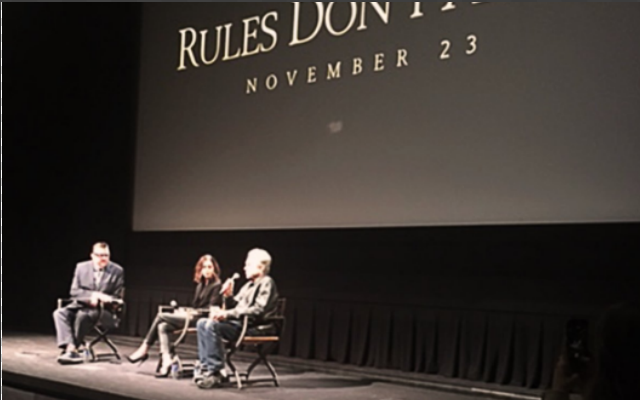
 Richard is mentioned in the Toronto Star article “Warren Beatty remains precise and in control about all things, especially sex” by Peter Howell. Read the whole thing HERE!
Richard is mentioned in the Toronto Star article “Warren Beatty remains precise and in control about all things, especially sex” by Peter Howell. Read the whole thing HERE!
If you believe a new animated movie from Minions main man Chris Renaud (with co-director Yarrow Cheney), drinking from the toilet, chewing up furniture and napping are not the only things pets do when their owners are gone.
Max (voice of Louis C.K.), a brown-and-white Jack Russell Terrier has a great life with his human Katie (Ellie Kemper). They live together in a nice New York apartment and pass the time taking walks and playing. At first there’s only one problem, “Pretty much every day she leaves.”
While Katie is at work Max misses her but fills the endless hours hanging out with the other pets in his complex. There’s Buddy the dachshund (Hannibal Buress) who uses a Mixmaster as a back scratch, an obese tabby named Chloe (Lake Bell) who regularly empties the fridge and a poodle who rocks out to death metal when her opera-loving roommate is out of the house.
When Katie brings home Duke (Eric Stonestreet), a big slobbering beast of a dog and “brother” for Max, the Jack Russell’s life, errr, ahhh, goes to the dogs. The ensuing battle for alpha dog supremacy brings on canine confusion as it spills out of the apartment and onto the street. Max and Duke must now contend with dogcatchers and the human-hating Flushed Pets gang—Liberation Forever! Domestication Never!—while Gidget (Jenny Slate), a white Pomeranian with the hots for Max, launches a rescue mission.
Animal slapstick has done well this year. First “Zootopia” gave us a menagerie of messages and laughs and now “The Secret Life of Pets” strolls along. Funny and charming, it isn’t as rich in subtext as “Zootopia,” but what it lacks in meaningful moralizing it makes up for in silly fun. It’s as deep as a dog’s dish, but it is, one might say, doggone funny.
Renaud brings the kind of bizarro humour that made the Minions a hit—the facial expressions of the pets are often as funny as their dialogue and there is a surreal musical number with edible singing sausages—to “Secret Life.” That, with a healthy mix of slapstick keeps the pace up for the younger kids. Older folks should get a kick out of the stereotypes, how the movie plays into them—“I’m your friend,” purrs Chloe, “and as your friend I don’t care about you or your problems.”—and against them—ie Kevin Hart as Snowball, the adorable but vicious bunny.
To bulk up “The Secret Life of Pets” short running time a new short, “Mower Minions,” is tacked on the front. As the strange yellow jellybeans try and make money to buy a new blender the age-old question, Do minions have tiny tattooed bums?, is finally answered probably to the delight of the kids everywhere.
Unless the movie is called “Planet of the Apes” its faint praise to say the monkey is the best thing about a picture. Such is the case with “Night at the Museum: Secret of the Tomb,” the third outing in the popular Ben Stiller kid’s franchise. Crystal the Monkey as Dexter a Capuchin monkey, gets the most laughs and is the only member of the top-of-the-line cast who doesn’t feel like they’re only in it for the big holiday movie paycheque.
On the third visit to the New York Natural History Museum we discover the Tablet of Ahkmenrah, the magical Egyptian plaque that gives its life force to the museum’s statues, allowing them to come to life after the sun goes down, is losing its power. Soon the tablet will die and so will animated exhibits Theodore Roosevelt (Robin Williams in one of his last movies), miniature men Jedediah and Octavius (Owen Wilson and Steve Coogan), and a Neanderthal named Laa (Ben Stiller). To save them night guard Larry Daley (Ben Stiller again) travels to the British Museum to find the secret to restoring the artifact’s power.
“Night at the Museum: Secret of the Tomb” beats the original premise into submission, blowing up the idea of a secret nightlife at the museum into the best example this year of how franchise filmmaking can go horribly wrong. Like the dimming tablet that slows down the wax exhibits, this movie sucks the life out of once interesting characters, placing them in a plot that is essentially an excuse to showcase more characters (like Dan Stevens as Sir Lancelot and a surprising and rather charming cameo from a very big star) and bigger special effects than in parts one and two.
There’s plenty of kid friendly slapstick and computer generated effects but a short action scene inside M. C. Escher’s topsy turvy staircase painting shows more imagination than the rest of the movie’s big set pieces put together.
It all feels old hat and despite the nostalgic rush of seeing the late Mickey Rooney and Robin Williams on the big screen, it’s less exciting to see Sir Ben Kingsley as Ahkmenrah’s father delivering bad double entendres like, “I am a pharaoh. Kiss my staff.” Andrea Martin has a fun blink-and-you’ll-miss-it cameo and the above mentioned cameo will raise a laugh, but as I left the theatre I couldn’t help but think my feelings about the film were best summed up by a line Octavius speaks just after a monkey urinates on him. “We must never speak of what happened here.”
Four years ago a restaurant tour by two British comedians resulted in one of the most charming films of 2010. “The Trip” was an improvised journey not just through Northern England’s culinary scene but through the psyches of Steve Coogan and Rob Brydon as they comment on life, usually while doing spot-on Michael Caine impressions.
The Michael “You were only supposed to blow the bloody doors off!” Caine impressions are back in full force in “The Trip to Italy,” as are the laughs and the self-aware conversations.
This time around Coogan and Brydon rent a Mini Cooper and retrace the steps of the Byron and the other Romantic poets’ grand tour of Italy set to the music of Alanis Morissette’s “Jagged Little Pill.” They eat, banter and take in the view from Liguria to Capri. Between a hysterical re-imagining of the dialogue from “The Dark Knight Rises”—“I can Hardy understand what Tom’s saying.”—and a one-sided conversation with a preserved corpse in Pompeii, is a study on everything from fatherhood to fame to faithfulness.
Director Michael Winterbottom luxuriates in the chemistry between the two men. They are naturals, an intellectual version of The Two Ronnies, who riff on everything from pop culture hot buttons like Batman and pop music to the carnal exploits of Lord Byron. Their interplay is the key to keeping the rambling narrative on track and it is enough. They are the film’s glue and the sheer joy of watching them spar prevents the film from dipping into self-indulgence. That, and the gorgeous scenery.
“The Trip to Italy” is a riotous comedy that finds time for self-reflection, Roger Moore impressions and the timeless Alanis Morissette vs Avril Lavigne debate and it is intimate and infectious.
We first meet Philomena (Dame Judy Dench) on the fiftieth birthday of the son she never got to know. Born out of wedlock in 1950s Ireland, her boy was whisked away from the Magdalene Laundries where they lived, adopted by an American couple she never met.
Her story finds its way to Martin Sixsmith (Steve Coogan, who co-wrote the script with Jeff Pope), a jaded journalist who thinks human-interest stories are for “weak-minded, vulgar people.” He’d rather be writing about Russian history but Philomena’s story is too good to be ignored.
This odd couple approaches the story from opposite sides. Philomena motives are simple and human. “I’d like to know if Anthony Lee ever thought of me,” she says. “I thought of him everyday.”
Martin, however, is angry. He’s a lapsed Catholic who thinks the church’s actions were unconscionable. He’s also looking to uncover the sensational aspects of the story.
“It was a beach birth and they wouldn’t give her drugs for her pain,” says Philomena’s daughter.
“Excellent,” he says, before catching himself. “For the story.”
The journey leads them to Washington, DC and the truth about the son she never knew.
Based on the book “The Lost Child Of Philomena Lee” by the real-life Sixsmith, the story isn’t really about the Church or the issues surrounding the Magdalene Laundries.
“I don’t want to cause any fuss or blame the church in any way,” says Philomena. “I just want to know he is all right.”
Instead it’s a relationship film. Or make that relationships film. It’s about the connection that could have been between mother and son and the mismatched pairing of the kindhearted Irish nurse and the hard-shelled journalist.
It carefully treads a line between touching and humourous, building a story of heartache and loss without ever being maudlin. Dench conveys Philomena’s obvious pain through subtle looks and faraway looks, while Martin’s sarcasm is never far beneath the surface but they also share many funny moments.
Her long winded plot recitations of her romance novels feel endless, almost as bad as when someone starts a conversation with, “I had the weirdest dream last night,” but her enthusiastic retellings of them help endear Philomena to Martin and the audience. It’s within these moments that the movie’s real heart reveals itself.
“Philomena” transcends its roots as a class study, becoming instead a poignant and funny story of forgiveness and the true nature of love.
In Man and Superman G.B. Shaw wrote, “He who can, does. He who cannot, teaches.” He very well may have been describing Dana Marschz, a hapless drama teacher played by Steve Coogan in the new satire Hamlet 2. Marschz has an unpronounceable name, an undistinguished acting résumé that includes extra work in an Al Jazeera M.O.W., herpes commercials and a stint as Robin Williams’s stand-in on the Patch Adams set. A self admitted “little boy from a dairy farm in Manitoba who can’t act very well,” he leaves the “glamour” of being an unemployed actor in Hollywood and lands in Tucson, Arizona as a drama teacher.
When we first meet Dana he’s directing the latest in his series of stage adaptations of famous films. In short order his production of Erin Brockovich, featuring his only two drama students, earns a savage review from the school’s teenage drama critic, his class balloons in size when he inherits a group of uninterested kids looking for a quick and easy credit and he is told his drama program will be shut down next semester.
To save the program and his job he decides to stage an original work—Hamlet 2—instead of going with his original plan of a musical version of the Keanu Reeves romance The Lake House. It’s an outrageous show featuring bi-sexual characters, a time machine, Satan French-kissing the President of the United States and a musical number called Rock Me Sexy Jesus. Deemed unacceptable by the school and the community Marschz and his students, with the help of a ACLU lawyer, stage the show off school property in a last ditch attempt to make money and keep drama alive in the school.
An irreverent satire of Middle American mores Hamlet 2 starts off strong but runs out of steam in the protracted midsection of the film. Much of the blame lies with Coogan, who creates a character more suited to a skit than a full-length feature. His Dana “my life is a parody of a tragedy” Marschz is a mass of insecurity and self loathing; a man so socially inept he makes Steve Carell’s Michael Scott of The Office seem well adjusted. Audiences have embraced the Scott character, I think, because despite his foibles he seems like a decent guy underneath it all. He has the dollop of humanity that Coogan’s character lacks, and that is the downfall of Hamlet 2.
Coogan gets laughs early on as his unlucky character goes from one personal disaster to another, but the act soon grows tired. If he had taken the time to make Dana more human and less a pure comedy construct we might actually care about what happens to him. As it is he’s someone you wouldn’t want to stand in line with at Starbucks, let alone spend ninety-minutes watching on screen.
Ditto the rest of the cast. Catherine Keener, a supremely talented actress, hands in a flat and unfunny performance; David Arquette is mostly mute, required to do little more than pull faces while the rest of the juvenile cast are standard high school hard cases who eventually warm up to their teacher’s unusual ways. Think To Sir With Love without the switchblades.
More fun is Elizabeth Shue who plays herself in a through-the-looking-glass take on her real career and Amy Poehler as an anti-Semitic ACLU lawyer.
Hamlet 2’s twisted underdog story has some inspired moments and is well intentioned in its sly support of arts in schools and free speech, but is too obvious in it approach to truly have much impact.
Paul Raymond became Britain’s richest man by selling sex. As played by Steve Coogan, he’s the impresario behind a series of sexy shows and nightclubs in London’s Soho District; a flamboyant representation of Swingin’ England. The movie examines his business interests—Live! Nude! Girls!—and family connections—great performances from Imogen Poots as his doomed daughter Debbie and Tamsin Egerton as the beautiful mistress who broke his heart—but never rings true. The nudity is certainly real, the drug taking is destructive and feels authentic, but the tragedy of the pornographic “King Leer” story is that it doesn’t feel tragic enough.
The Factory Records scene, born in Manchester, England and home to acts like Joy Division and The Happy Mondays was one of the most vibrant musical movements of the 70s and 80s. English director Michael Winterbottom has documented the rise and fall of the label and its founder Tony Wilson in an interesting, but not entirely successful way in 24 Hour Party People. The film attempts to cover the years 1976 to the early 90s, the birth of punk rock to the waning moments of acid jazz but is too ambitious in its scope. Names and dates are glossed over, and while you get a sense of excitement you’re frequently left wondering what is so exciting. The film takes piercing the fourth wall to a whole new level as Steve Coogan, the English comic who plays Wilson, frequently addresses the camera with asides. “You’ll see more of that scene on the DVD,” he says at one point. Those who aren’t familiar with the Factory Records scene won’t learn much, and those who are won’t learn anything they didn’t already know. I left the theatre with the nagging feeling that this material might have been better served in documentary style, something like Julien Temple’s look at the career and influence of The Sex Pistols The Filth and the Fury.