I’m glad I saw the first “Hunger Games” movie because I’m not sure if I would have a clue as to what was going on if I didn’t have that background. I may have been taken in by the beautiful art direction, or Jennifer Lawrence’s intense performance, but I don’t think I would have been able to connect all the dots. Plot points become more obvious in the second hour, but for non-Hungerites it might be confusing.
If you haven’t seen the first movie, or read one of the 26 million copies of the book that are currently in print, here’s a glossary of terms to get you up to speed.
Katniss Everdeen: Sixteen year-old protagonist and citizen of District 12, a poor mining area in the dystopian nation of Panem.
Peeta Mellark: A baker’s son, who, according to Wikipedia has “extensive strength and cake decorating skills that contributed to the art of camouflage.”
Both are “tributes” chosen from the young people of District 12 and forced to participate in an annual Hunger Games, The Hunger Games, an annual televised event in which one teenaged boy and girl from each districts surrounding the Capitol are chosen by lottery to fight to the death until only one remains.
There’s more, but you’ll figure it out.
In the new film combatants and sweethearts Katniss (Jennifer Lawrence) and Peeta (Josh Hutcherson) have returned from the 74th Annual Hunger Games victorious to become the toast of the nation. While on a Victory Tour to Panem’s various downtrodden districts, revolution is in the air. They see Katniss as a symbol of freedom, which, of course, doesn’t sit well with President Snow (Donald Sutherland), the country’s autocratic leader. To quell the revolution he and his head gamesmaker (Philip Seymour Hoffman) devise the trickiest Hunger Games yet, the Quarter Quell that will pit former winners against one another in the battle to the death. If Snow gets his way Katniss will be killed and the revolution squashed.
“Hunger Games: Catching Fire” is a better movie than the first installment.
Set decorated and costumed (as played by Elizabeth Banks, District 12 minder Effie Trinket has the most elaborate futurist art deco costumes since “Metropolis”) to within an inch of its life, but has nonetheless has a gritty edge. It doesn’t feel like a budget big franchise movie and that’s a good thing,
Visually as well as thematically it has more edge than any of the recent Marvel movies. And it skirts around the thing that upset many people about the first movie—the idea of kids killing kids—by setting the action between former victors ranging in age from 20s to 70s.
It creates a world with it’s own rules, style and customs and does so convincingly. In part it’s comprised of things we’ve seen before in everything from the human sacrifices of Greek Mythology to reality television to stories of government corruption on the news, but author Suzanne Collins and director Francis “I Am legend” Lawrence tie it together to create something new.
In many ways it breaks the mold of what we expect from a young adult a blockbuster. The focus is on the characters and the underpinning of romance that snakes throughout the story. The action sequences are few and far between and it takes almost an hour before any of Katniss’s trademark bow-and-arrow dexterity comes into play. (Silly complaint: the number of arrows in her quiver changes from shot to shot! Just when you think she’s out, arrows magically appear.)
Sure there’s poison fog, angry animals and vicious victors but it’s about survival and relationships not the wholesale slaughter of the characters. It’s grim, shot in hues of grey with a perpetually overcast sky, which lends it a classic feel, more like 1970s sci fi than the brightly couloured eye catchers Hollywood makes these days.
“Hunger Games: Catching Fire” has a who’s who of a cast—Woody Harrelson, Lenny Kravitz, Jeffrey Wright, Stanley Tucci, Jena Malone, Brit heartthrob Sam Claflin and Amanda Plummer—who all perform well, lending some gravitas to the story, but it is carried by Lawrence whose vision for Katniss is as straight as an arrow.
Is Stanley Tucci the busiest actor in Hollywood? This year alone added five movies to his IMDB page with five more in the pipeline for 2014.
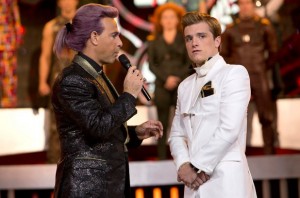
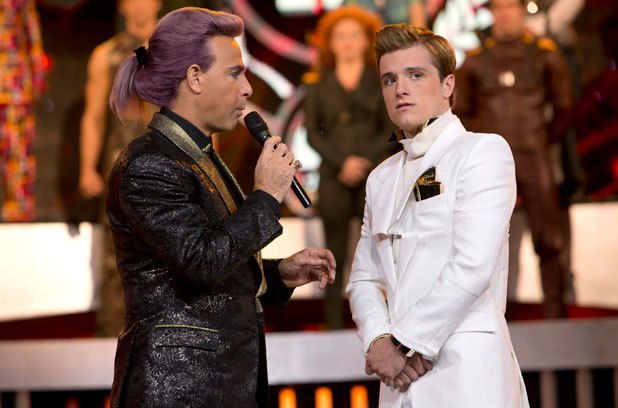
This weekend in Hunger Games: Catching Fire, he plays Caesar Flickerman, the elaborately coiffured host of The Hunger Games television broadcasts. Despite being disguised with wild wigs, fake teeth and plenty of bronzer, it is unmistakably Tucci, one of the most interesting actors working today.
He made his big screen debut in the 1985 gangster comedy Prizzi’s Honor followed by several years of dues-paying stage work and movie roles like Second Dock Worker in Who’s That Girl before landing recurring spots on Miami Vice and Wiseguy.
A succession of supporting roles lead to the one-two punch that made him a name actor. Producer Steven Bochco’s television drama Murder One cast Tucci as Richard Cross, a Machiavellian multi-millionaire accused of the strangulation of a 15-year-old girl.
The following year a much different part earned him an Independent Spirit Award nomination for best actor. In The Big Night he plays Secondo, owner of an Italian restaurant called Paradise. The place is slowly going broke but may get a boost from a visit by singer Louis Prima. If Prima shows up the restaurant will have a big night and be saved from bankruptcy.
It’s not only one of the greatest food movies ever made — you’ll want to go for risotto afterward — but it also features what Rolling Stone’s Peter Travers called “an unforgettable acting duet” between Tucci and Tony Shalhoub, who plays his temperamental chef brother, “that is as richly authentic as the food.”
Since then Tucci has played everything from villains — strangling a Supreme Court justice in The Pelican Brief — to a flamboyant nightclub manager in Burlesque, to the God of wine Dyonisius in Percy Jackson: Sea of Monsters to Puck in A Midsummer Night’s Dream. Opposite just Meryl Streep alone he’s played everything from a gay art director in The Devil Wears Prada to Julia Child’s loving diplomat husband Paul in Julie & Julia.
In 2010 he received his first (but probably not last) Oscar nomination for his work in The Lovely Bones. He played the murderous Mr. Harvey, all twitchy movements and squeaky voice; he was Norman Bates without the overbearing mom.
“I don’t like to watch things about serial killers or kids getting hurt,” he said, “but this was something beyond that. It was an exploration of loss and hope.”
The first time most of us noticed Emily Blunt she was “’on-the-edge of sickness thin.” To play the role of Emily Chalton, the prickly first assistant to the editor in The Devil Wears Prada, Blunt had to drop pounds from her already slight frame. “It wasn’t like doughnuts were snatched out of my hand,” says the 5′ 7½” actress, but she was encouraged to slim down. So much so she would occasionally cry from hunger during the shoot. Luckily, though rake thin, she still had the energy to steal the movie from her more seasoned co-stars, Meryl Streep and Stanley Tucci.
Although the character fell directly into the love-to-hate-her category, audiences found Blunt irresistible. Her mix of vulnerability and fork-tongued charm—crowned by crystal clear blue eyes and a face anchored with a cleft chin that would make Kirk Douglas envious—earned the title Best Female Scene-Stealer from Entertainment Weekly and nominations for everything from a Teen Choice Award to a Golden Globe.
The kudos and notoriety that followed her Prada performance on this side of the Atlantic were simply an echo of her much-admired, though lesser seen work, in the UK.
After dabbling in drama at age 12 to help conquer a stutter she made her professional stage debut while still in school. From there it was a short leap to the small screen and praised performances in British television period pieces. It was, however, only when she left the lace-bonnets behind and took on a role in the critically-acclaimed My Summer of Love that she really made a splash. The story of a teenage infatuation between Mona (Nathalie Press) and the manipulative and cynical Tamsin (Blunt) earned both Press and Blunt equal shares in an Evening Standard British Film Award for Most Promising Newcomer.
When asked why she is so often cast as bad girls like Tasmin she says, “I have sly eyes. When I was in school they always said, ‘Emily can never be elected Head Girl because you never know what she’s thinking.’” Just don‘t ask her to further explain her acting method. “I think it’s embarrassing to hear people talk about their process because you always sound wanky,” she says bluntly.
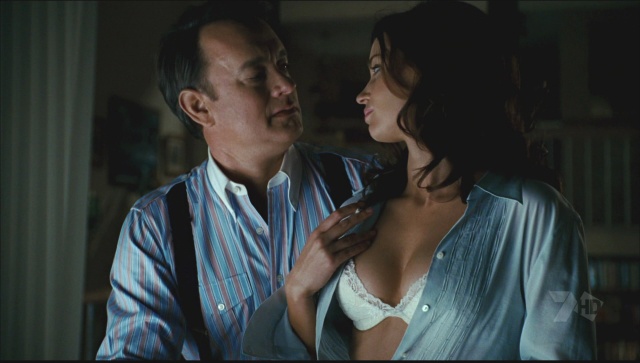
We can say that she has an enigmatic quality which has served her well in supporting parts as diverse as a gawky, uptight French teacher in The Jane Austen Book Club, an oversexed young women opposite Tom Hanks in Charlie Wilson’s War and as a babysitter in Dan in Real Life, all movies she says, that share “a very human heartbeat.”
Even when she appears in something less than Oscar worthy, take the 2005 miniseries Empire, for instance, a project she dismisses as “the sad little brother of Rome,” she still stands out, giving her characters both subtlety and complexity. She’s not a flashy actor; often she expresses an idea with a simple lift of an eyebrow or an understated movement, a trait she shares with her acting idol Cate Blanchett.
While she says “I want to do my own thing and not emulate anyone else,” she calls Blanchett’s chameleon-like ability to disappear into a variety of roles very brave.
The disappearing act is a trick Blunt seems to have picked up from Blanchett. Following a bravura turn in the offbeat comedy Sunshine Cleaning, and the now obligatory for stars-on-the-rise Simpson’s cameo, she took on, and disappeared into, the most challenging role of her career to date. In The Young Victoria Blunt returned to the period roles that defined the early part of her career, playing Queen Victoria from headstrong teen to Queen of the Realm to love sick widow.
“I definitely made a real play for the part because I knew it would be one of those roles that people would hound because it was so rare and so well written,” she says. “It’s hard to find a film that is shouldered by a woman about a girl like that who is so remarkable and so complex. I went in and met them and said, ‘I love it. I’m very aware that a lot of other people do as well but I’d like you to give me a chance.”
Since then she’s worked nonstop, in movies both big—like this month’s mega budget Gulliver’s Travels—and small—a 10 minute short named Curiosity, shot on a budget of £2,000. Mixed into that eclectic stew is The Wolfman, a reimagining of the 1941 Lon Chaney classic which airs on TMN and Movie Central this month. Blunt says she took the role for two reasons. First to work with co-stars Anthony Hopkins and Benicio Del Toro and secondly because her character Gwen is “the girl in a werewolf film, and that’s cool.”
One more very cool job in Emily Blunt’s white-hot career.
“Jack the Giant Slayer” is what used to be called a “ripping good yarn.” It’s got all the ingredients of classic fairy tales—a pretty princess, heroics galore, a dash of romance and loads of giant slaying! It’s also a change from the usual Hollywood fairy tale retellings in that it remains fairly true to the source—there’s no Snow White and the Huntsman style ennui here—but what starts out as a family friendly romp turns much darker near the end and might freak-out younger Jack and the Beanstock fans.
The classic “Jack and the Beanstock” is given an epic twist by director Bryan “X-Men” Singer. Synopsis: The action in this epic retelling of Jack and the Beanstalk begins when the king’s advisor Roderick (Stanley Tucci) hatches a plot to steal an enchanted crown and the six magic beans that hold to key to opening a gateway between earth and Gantua, the land of the giants. Enter poor farmer Jack (Nicholas Hoult) who becomes involved when he unwittingly sows a seed that sprouts a giant beanstalk, literally shooting the princess Isabelle (Eleanor Tomlinson) skyward into the humungous hands of the giants. Determined to rescue her Jack battles the goliaths, wins the respect of the king and the love of a princess.
Like “Clash of the Titans” this is a large-scale computer generated epic, but “Jack” is far more successful in creating a world for the characters to live in. Both are CGI-a-Ramas with wild creatures, like two headed giants, big action set pieces and relatively simple stories of good versus evil but “Clash” is much more reliant on it’s computer creatures. “Jack” wants you to like its characters, whereas “Clash” wants you to forget about the humans and focus on the digital creations. Also, in a battle between “Clash’s” Kraken and this movie’s giants, I’d bet on the giants.
The beanstock certainly takes top billing, but it’s fun to see Ewen Bremner—Spud from “Trainspotting”—in a juicy villain role, backing up an evil Tucci, who seems to be having fun here.
It’s a large-scale English pantomime without the songs—there’s slapstick, elaborate costumes and you’re supposed to boo at the bad guys and cheer for the heroes. It won’t become a staple in my Blu Ray collection, but I enjoyed watching the giant chef prepare pigs-in-a-blanket with live pigs!
If the latest film from “Lord of the Rings” director Peter Jackson is to be believed the afterlife looks a lot like a Pink Floyd album cover from the late 1970s. In “The Lovely Bones,” a loose adaptation of the bestselling book by Alice Sebold, he goes heavy on the computer generated imagery to create a slick looking world, which despite the best efforts of the cast, is almost bereft of emotion.
In case you’re not a member of Oprah’s book club, who chose “The Lovely Bones” and propelled it up the best seller charts like a rocket, it is the story of Susie Salmon (“like the fish”) a 14 year old girl murdered in suburban Pennsylvania in 1973. Susie, however, didn’t go quietly into the long goodnight. From a place somewhere between Heaven and Earth she watches over her distraught family and tries to guide them through their time of despair.
Some of the now controversial CGI—early trade reviews called the film indulgent and “evocative of “The Sound of Music” or “The Wizard of Oz” one moment, “The Little Prince” or “Teletubbies” the next”—is quite beautiful and some of it is overkill. When Susie is making her arrival in “her heaven” it is a beautiful representation of a spirit floating away. Hugh shots of her never-to-be boyfriend Ray, reflected in a body of water that separates them and Ray again on a gazebo, surrounded by an undulating landscape, are a bit heavy handed. Jackson is the real deal, a skilled filmmaker and visualist, but he has to learn to trust the story and not let the technology do the talking.
Performance wise Jackson has cast well and gets good, solid work from his actors, particularly Rachel Weisz as the grieving mother, Susan Sarandon as the boozy grandmother and Rose McIver as the spunky sister Lindsey but it is the two central roles that the whole movie hinges on.
As the murderous Mr. Harvey Stanley Tucci is creepy; all twitchy movements and squeaky voiced. He’s Norman Bates without the overbearing Mom and wonderfully cast. Tucci, it appears can do anything. Earlier this year he played Julia Child’s loving diplomat husband in “Julie & Julia” and held his own opposite Meryl Streep. Now he’s the creepiest bad guy this year since Hans Landa drank a glass of milk with a French farmer in “Inglourious Basterds.”
At the heart of the film, however, is an arresting central performance by Saoirse Ronan as Susie, the little girl who never got to kiss a boy or see her fifteenth birthday. Her luminous presence gives the film whatever soul it has and her generous screen presence is a good tonic for the effects heavy scenes she plays in the “in between,” the blue horizon between heaven and earth.
“The Lovely Bones” should have been a better movie. It’s not terrible, mind you; it just doesn’t push the emotional buttons that a story about the murder of a young person should. Jackson is still in epic “LOTR” mode, taking a small, intimate movie and needlessly cluttering it up with bigger than life images that get in the way of the feeling of the piece.
On a scale of 1 to Ridiculous, “Burlesque,” the new film starring dueling pop divas Cher and Christina Aguilera, it’s Rip Taylor. A glittery mix of “All About Eve,” “Striptease” and “42nd Street” it is for people who didn’t find “Priscilla Queen of the Desert” campy enough.
Xtina plays Allie, a small girl with a giant voice who leaves her Podunk Iowa town to find fame and fortune in Los Angeles. Then, in an explosion of glitter and cone bras, she lands a job as a waitress at Burlesque, a place with no windows, but the “Best View on the Sunset Strip.” It’s an old school burlesque house, seemingly inhabited by the spirit of Bob Fosse, on the verge of bankruptcy, currently being run into the ground by Tess (Cher) and Sean (Stanley Tucci). Christina, and her highly articulated vocalizing come along just in time to save the club, romance a handsome bartender (Cam Gigandet) and a multimillionaire (Eric Dane) and alienate the club’s reigning diva.
“Burlesque,” is essentially a vehicle for Christina’s vocal acrobatics. It hangs a recycled show biz story—girl from the sticks becomes a star in Los Angeles—on the elastic voice talents of its star. Less than five minutes into the story she’s on a stage bellowing a multi-octave cover of the Etta James classic “Something’s Got a Hold on Me.” If that sends a shiver down your spine, then “Burlesque” is for you. If not, it’s going to be a long two hours.
Only Cher and Stanley Tucci seem to understand what kind of movie this is. Only Cher could intone a line about helping a dancer when she was drunk and sick, throwing up “everything but your memories,” and walk away with her career intact. Ditto Tucci. He’s slumming here, but he sparks with Cher and seems to be having fun.
Which brings us to Aguilera. She can gyrate like nobody’s business and looks fetching in a sparkly bowler hat, but as energetic as the performance is it never rises above the level of a gifted amateur.
“Burlesque” isn’t trashy enough—remember “Showgirls”?—to be truly memorable. It has no story arc, no dramatic tension, just a lot of bump-and-grind. That’ll be enough for people with a taste for camp but like the art form it is named after the movie is all tease and no follow through.