Way back when Rick Astley was one of the biggest stars in the world Shane Black wrote the classic L.A.P.D. buddy action comedy “Lethal Weapon.” A mix of chemistry and quips it set the template, for better and for worse, for a generation of cop buddy flicks. Black is back, breathing the same air, as co-writer and director of “The Nice Guys,” a hardboiled comedy that places Russell Crowe and Ryan Gosling amid the mayhem.
Set in smoggy 1970s era Los Angeles, the story revolves around an odd couple brought together by circumstance. Jackson Healy (Crowe) is the muscle. He’s a brass-knuckled enforcer who makes his money through intimidation and violence. Holland Marsh (Gosling) is a drunken private investigator so desperate he specializes in doing missing persons cases for dementia patients who have forgotten their loved ones are dead, not missing. He’s so inept even his own thirteen-year-old daughter, Holly (Angourie Rice), refers to him as the world’s worst detective.
They are thrown together when March is hired to find Amelia (Margaret Qualley) but she hires Healy to get rid of the creep she thinks is a stalker. An uneasy alliance leads them head on into a wacky web of sleaze, corruption and catalytic converters. There’s a load more plot, but the point here isn’t the story as much as it is the journey it takes its characters on.
By rights “The Nice Guys” should be called “The Nice Guys and a Girl” because the teenage Angourie Rice is a key player. She’s an adolescent sidekick who, unlike Black’s child hanger-on in “Iron Man 3,” doesn’t have a precocious bone in her body. She’s funny, lends some heart to the cynicism on display and nearly steals the movie from the leads.
Nearly, but not completely. Crowe and Gosling bring seedy charm to their roles. They’re part “Freebie and the Bean,” part Abbott and Costello. Each hand in loose performances in a film that is unafraid to spend time listening to its leads bantering back and forth. Gosling excels with physical bits—trying to maintain his modesty in a bathroom stall scene is pure slapstick—while Crowe is more menacing but with solid comic timing.
Black’s way with a visual gag is also used to ample effect. An elevator scene that made me laugh in the trailers is played out with precision, escalating the laughs as the violence increases.
“The Nice Guys” is funny and even thrilling by times, but its greatest trick is to make you fall on side with these two not-always-so-nice-guys. They are neither particularly heroic nor gifted. Instead they are everymen looking for redemption and a fast paycheque. The ending sets things up for a sequel and that’s OK. I’d like to spend more time with these nice guys and girl.
In the Heart of the Sea features less of Chris Hemsworth than we’ve seen on screen before. He’s in virtually every scene, but for much of the film the usually bulked up Thor star is set adrift in a raft, starving and physically much less imposing than usual.
The movie is an old-fashioned whale of a tale. Literally.
Based on the true story said to have inspired Moby Dick, it’s about whalers battling not only repeated assaults from the one whale who fought back, but also malnourishment and dehydration.
At sea for three months in tiny whaleboats the men are pushed to the edge of sanity, taking drastic steps to survive.
To convincingly play a starving sailor Hemsworth trimmed 33 pounds off his already toned 6’2 3/4” frame.
“My crazy diet would make you pass out from exhaustion,” he said. At certain points he was eating just 500 or 600 calories — that’s less than a combo lunch meal at most fast-food places — in the form of a boiled egg, two crackers and a celery stick a day.
Hemsworth and his underfed cast mates passed away the time with conversations “about our favourite foods and what we would eat when we finished the film.”
The actor says losing that amount of weight isn’t something he’d like to do again, but adds, “by those final sequences when we were supposed to be exhausted and emotional. We were feeling that way off screen too, so it helped.”
Dramatic weight loss isn’t new — actors have been yo-yo dieting for roles for years — but doctors say rapid body mass reduction can lead to malnutrition, maladies like gallstones and worse. In other words, as Christian Bale who dumped 60 pounds for his role in The Machinist says, “It ain’t great for your health.”
Still, actors take on dramatic diets to aid in their dramatic work. Anne Hathaway dropped 25 pounds by food deprivation and exercise to make Les Miserables while Matthew McConaughey survived eating only Diet Coke, egg whites and a piece of chicken a day to play AIDS patient Ron Woodroof in Dallas Buyers Club. According to The Playlist he stopped dieting when “people stopped asking if he was all right and started suggesting he seek help.”
Just as common are actors who gain weight. Russell Crowe gained 63 pounds to play a CIA bigwig in Body of Lies, George Clooney gained 35 pounds for Syriana and Renee Zellweger gained 30 pounds for Bridget Jones’s Diary, lost it, only to regain it for the sequel.
Jared Leto who lost 40 pounds to play Rayon in Dallas Buyer’s Club, gained 67 pounds for the film Chapter 27 by drinking melted pints of chocolate Haagen Dazs ice cream mixed with olive oil and soy sauce “to get me bloated even more.”
Why do actors alter their bodies? Some call it dedication while cynics suggest it’s an easy Oscar. Physical transformations (plus acting talent) brought Robert DeNiro, Charlize Theron and McConaughey to the winner’s circle.
But some actors have sworn off manipulating their weight. Jim Carrey turned down a role in the Three Stooges biopic that would have required him to gain 40 to 50 pounds and Tom Hanks blames gaining and losing weight for roles with him developing Type 2 diabetes.
“I’ve talked to a number of actors who have gained weight for roles and — just out of the sheer physical toll on one’s knees and shoulders — no-one wants to do it again,” he told the BBC.
What would you do if Robert De Niro cut short your conversation with a quick, “I’m not doing this, darling,” and exited? If you’re Radio Times journalist Emma Brockes you write about it and watch your article go viral.
As unpleasant as the encounter may have been — he objected to the “negative inference” of her questions, she called him condescending — it did exactly what it was meant to do, generate buzz for De Niro’s upcoming film The Intern.
Who won? I’ll give the edge to Brockes who, when faced with a bad situation, turned De Niro’s lemons into lemonade and earned just as much press as the touchy actor.
De Niro took some blowback for his behaviour. Daily Mail columnist Piers Morgan wrote, “If I’d been her, I’d have slapped him ’round his smug little chops,” adding the Goodfellas star is “renowned as the rudest, most difficult and frankly obnoxious star to interview, possibly in the history of planet Earth.”
I think Morgan overstates his case. De Niro isn’t the worst — anyone who has ever done a movie junket knows Tommy Lee Jones is the crankiest, most soul destroying interview ever — he’s just a reticent interview, who, according to director Nancy Myers, doesn’t want “to expose himself all the time.”
De Niro isn’t alone in the chat-and-dash sweepstakes. Robert Downey Jr. and Quentin Tarantino bolted on Krishnan Guru-Murthy with the Avengers: Age of Ultron actor later calling the Channel 4 news presenter a “syphilitic parasite.” Robert Pattinson, Naomi Campbell and Russell Crowe have also done runners on the press.
So why submit to promotional interviews at all? Contractual obligation has much to do with it, but beyond that, they’re good for the movie. Daniel Radcliffe, star of Harry Potter, Horns and the upcoming Victor Frankenstein, once told me no matter how famous the actor, anyone who doesn’t get out and pump their film up to the press is making a huge mistake.
As a result everyone does them and while it’s easy to look at De Niro or Downey as spoiled brats, I’m surprised walkouts don’t happen more often.
It must get brutally dull answering the same questions over and over, particularly when they are of the “Of all your leading ladies who was the best kisser?” variety.
How bad can it get in the interview suites?
Once a talking head proudly told me she wrote new lyrics for Beyoncé’s hit song Survivor… “My name’s Beyoncé/ I’m in Goldmember/ You’re watching blah blah on blah blah blah…” and asked the superstar to sing them as a promo for her television station. If I were Beyoncé I would have exited stage left without a song on my lips.
I remember one “reporter” asking George Lucas “whether Dark Vader was a good guy or a bad guy.” If I were Lucas I would have hitched a Millennium Falcon ride out of there.
Recently I heard Tom Cruise try and answer the question, “What kind of stunt would you do to impress a girl?” If I were Cruise I would have grabbed the side of the nearest plane and jetted out of there.
As for De Niro, Brockes graciously says she has sympathy for him “because nobody wants to be there for these choreographed junket interviews.”
De Niro wasn’t quite as kind, but at least he called her “darling” and not “syphilitic parasite.”
In his directorial debut Russell Crowe wasn’t content to simply make one movie. Instead he made “The Water Diviner,” an all-encompassing film that is a war story, a family drama, a road movie, a romance, an ode to tolerance and the tale of a man with mystical powers.
Crowe sets the backdrop for the story with an opening scene detailing one of the great Allied disasters of World War One, the Battle of Gallipoli. In a standoff between the Turkish Army, led by Major Hasan (Yilmaz Erdogan) and the ANZACS (Australian and New Zealand Army Corps) horrific loss of life led to the Australian Army retreating, leaving behind many fallen comrades.
Cut to the Australian out back. Joshua Connor (Crowe) is a burly farmer with a gift for finding water in the arid countryside. His wife is a broken woman, devastated at the loss of their three sons, all killed in combat at Gallipoli. She switches between blaming Joshua for allowing them to go to war and pretending they are still alive. When her grief becomes too much, he makes her a promise, “I’ll find them, love,” he says, “I’ll find them and bring them back to you.”
Next stop, Constantinople. Connor travels to the exotic Turkish land to find the remains of his sons, bring them back to Australia and bury them in home soil. There he meets hotelier Ayshe (Olga Kurylenko) and her precocious son Orhan (Dylan Georgiades). Romance brews, war between the Greeks and the Turks heats up, and honour is tested as this fish-out-of-water makes his way through the Ottoman Empire.
There is much to like in “The Water Diviner.” Andrew “Lord of the Rings” Lesnie’s cinematography is handsome and effective throughout, particularly in the war scenes. The storytelling is clear and concise and doesn’t glorify war or demonize the Turkish Army and there are nice performances throughout. Young Georgiades is a spark plug and Erdogan is the epitome of grace under fire and dignity. Crowe brings low key determination tempered by stoicism while Kurylenko, who is usually treated as part of the set decoration, is soulful in her portrayal of a war widow who has a hard time accepting that her husband isn’t coming back from the battlefield.
As good as Crowe and Kurylenko are it’s their relationship that brings the melodrama to a movie that doesn’t need a love story to keep our attention. The goo-goo eyes on display bring to mind “A Good Year,” Crowe’s ill-advised attempt at adding rom com stardom to his resume. It feels out-of-place and unnecessary in a movie that already hits many organic emotional highs in the story of a father searching for his dead sons.
“The Water Diviner” is a sweeping historical drama about one man; a personal story set against a huge backdrop that studies a father’s sorrow and a nation’s tribulations.
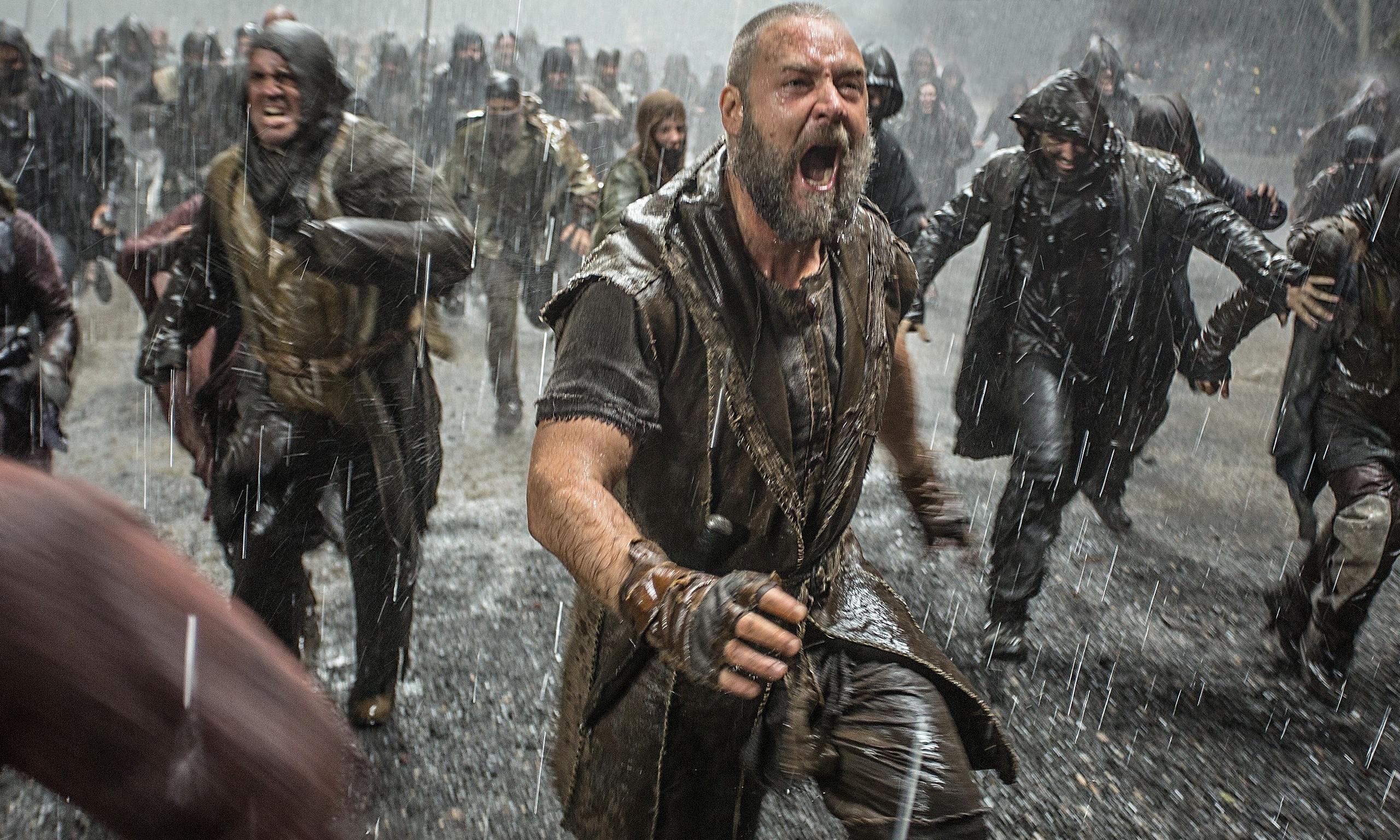
“Noah” is not your father’s biblical movie. It’s an art house epic that filters the story through director Darren “Black Swan” Aronofsky’s impressionistic style.
The best way I can describe “Noah” is emotionally ambitious. It takes a familiar tale and shines a new light on it by highlighting Noah’s spiritual quandary. In the film—which takes liberties with the biblical story—he’s a vegan prophet who grapples with doing God’s will while balancing the needs of all of humanity, particularly his family. The meaning of faith and the consequences of adhering to that faith are the film’s main thrust, but as interesting as that is, the movie feels like one thing when it is addressing the spiritual and quite another—possibly a “Lord of the Rings” flick—when it is in action movie mode.
The movie starts at the beginning. Literally.
After a quick recap of Old Testament highlights—the Creation, Adam and Eve in the Garden of Eden and Cain vs Abel—we meet Noah, the last descendent of Adam and Eve’s good hearted son Seth. The world he lives in is a dangerous place, ruled by Cain’s bloodthirsty bloodline but Noah (Russell Crowe) and family (Jennifer Connelly, Douglas Booth, Emma Watson, Logan Lerman and Leo McHugh Carroll) live peacefully as nature loving, proto hippies. That is, until Noah has a disturbing apocalyptic dream. Consulting with his grandfather Methuselah (Anthony Hopkins) he determines The Creator wants him to build an ark and laden it with two of every creature on earth in advance of a great flood that will destroy mankind and the violence they perpetrate. It’s ultimate Mulligan—a do over for the planet—but Noah will have to make some troubling decisions to fulfill God’s will.
Some may criticize the movie for not being reverent enough, but Aronofsky treats the story as a living breathing thing and not an artifact from another time. The addition of a spectacular creation of the world sequence, as narrated by Noah, may annoy Creationists, but is a moving and beautiful retelling of the biblical story.
Aronofsky may play fast and loose with Noah’s story, but underlines the spirituality that is at the very heart of the tale as evidenced by the Seven Days of Creation scene.
He’s also aided by a terrific performance from Crowe.
Crowe’s been in a bit of a slump in recent years. The dangerous, complex actor of movies like “Gladiator” and “A Beautiful Mind” seemed to have taken a backseat to the performer who thought making “The Man with the Iron Fists” was a good idea. “Noah” is a nice reminder of Crowe’s delicate mix of fearsome masculinity and subtle sensitivity and his tortured performance hits Noah’s zealotry square on the head.
But having said that, Aronofsky moves in mysterious ways. He shot the epic almost entirely in close up and the flood scene could have used a bit more Cecil B. DeMille. Aronofsky means this to be a personal story of a man with the weight of the world on his shoulders, but it is still an end of the world movie. Despite the occasional Peter Jackson flourish—like the stone giants The Watchers and sweeping crane shots—“Noah” doesn’t feel as big as it should. It has big ideas, but the expected sweeping visuals aren’t there.
“Noah” is a thought-provoking take on a familiar story that will keep you guessing until the end credits roll.
According to Genesis God said to Noah, “I am going to put an end to all people, for the earth is filled with violence because of them.”
Noah, a righteous man, was commanded to build an ark and stock it with “two of every kind of bird, of every kind of animal and of every kind of creature that moves along the ground will come to you to be kept alive.”
For forty days and forty nights Noah, his family and precious cargo withstood a flood so severe it submerged the tops of mountains until “every living thing on the face of the earth was wiped out.”
Once the flooding stopped and the Earth dried, God commanded Noah to come out of the ark and release the animals, “so they can multiply on the earth and be fruitful and increase in number on it.”
The story of Noah’s Ark and the flood is one of mankind’s most famous tales and Hollywood has retold it a number of times.
This weekend Russell Crowe plays the title role in Noah, co-starring with Jennifer Connelly, Anthony Hopkins and Emma Watson. Director Darren Aronofsky says he has been obsessed with the story since he was thirteen, calling it “the first apocalypse story.” Nonetheless, he has added his own spin to the tale.
“When we first started working on the project, we were very clear not to have sandals and robes and long white beards,” he told Rolling Stone. “The first thing I said to Russell Crowe was, ‘I’ll never shoot you on a houseboat with two giraffes standing behind you.’”
More traditional are two Disney short films. Father Noah’s Ark is a 1933 “Silly Symphony” for children that tells the narrative in song. Lively animation shows how the animals may have helped build the ship and why skunks almost didn’t make it on board.
In 1959 Disney released the twenty-minute Noah’s Ark, their first stop motion animated film. A jazzy score accompanies equally jazzy animation as pencils, pipe cleaners and other household items are inventively used to create the animals.
Shooting the flood scene in the 1928 version of Noah’s Ark endangered the life of a future Hollywood icon. John Wayne was a swimmer in the famous scene, and emerged unhurt, but other weren’t so lucky. Three extras drowned and a dozen others suffered broken limbs.
Finally, a 1977 documentary claims to shed some light on the real story. In Search of Noah’s Ark is an investigation into the speculation that Turkey’s Mt. Ararat in is the landing place of Noah’s Ark. “This may be the most incredible film you will ever see,” says narrator Brad Crandall, “but the facts that will be presented are true.”
I am not a cold-hearted man. I like love stories as much as anyone and, as a fan of Say Anything, almost well up whenever I hear Peter Gabriel’s “In Your Eyes,” but the sledgehammer romance of “Winter’s Tale” left me feeling bruised rather than buoyed. What is meant to be an uplifting experience about the power of love and the triumph of good over evil felt more like being strapped to a chair and force-fed all nine seasons of “Touched by an Angel.”
Based on the best-selling novel of the same name by Mark Helprin and brought to the screen by Oscar winning writer-turned-director Akiva Goldsman the story begins when Peter Lake (Colin Farrell), a turn-of-the-last century burglar, comes across the love of his life while robbing a mansion he thought was empty.
Beverly Penn (Downton Abbey’s Jessica Brown Findlay) the beautiful-but-doomed daughter of a wealthy newspaper tycoon, is a precocious and philosophical young woman with just months to live. He wants to save her, but first he must save himself from demonic crime lord Pearly Soames (Russell Crowe), a brutal man who wants Lake dead. Then, in a twist suggested by the Brothers Grimm, he finds himself thrust one hundred years into the future with only the faded memory of Beverly and a white guardian angel horse as company.
The opening narration let’s us know that “magic is everywhere around us.” I just wish that some of that magic had spilled into the screenplay. The movie’s mix of metaphysical romance, magic realism and demonic revenge is a strange stew that worked well in the novel but seems to have lost something in the translation to the screen. In other words, perhaps the sight of Colin Farrell flying above New York on a winged Pegasus is best left in the mind’s eye.
As silly as the movie is, and make no mistake, this is what I like to call an S.D.M.—Silly Damn Movie—Farrell and Findlay manage to bring the romantic side of the tale alive. Their first meeting, over a cup of tea, is simple, effective and bristles with sexual tension. The love story, although a bit starry-eyed, works until the magic realism takes over and the story becomes loopier and loopier. By the time the words, “Is it possible to love someone so much they can’t die?” spill from Farrell’s lips all is lost, and that’s not even an hour into the story.
Putting aside the enchanted horses and dime store spirituality for a moment, the story often requires leaps of faith that would have even terrified Evel Knievel. This is the kind of movie where mothers willingly hand over their sick children to scruffy looking strangers on the promise of a miracle. It’s the kind of movie where people accept outlandish events with a tossed off phrase like, “How’s that even possible?” It’s the kind of sloppily plotted movie that involves a level of suspension of disbelieve so off-the-charts it’s almost in outer space.
“Winter’s Tale” is a frustrating movie. It overly complicates a boy-from-the-wrong- side-of-the-tracks-meets-rich-girl story with a bunch of hocus pocus that wastes some good work from Farrell, Findlay and Russell Crowe.
If the number 24601 brings a tear to your eye then you can likely skip past the synopsis paragraphs in this review as you probably already know the epic story of “Les Misérables.” For the uninitiated, however, what follows is the sad and tragic tale of obsession, love and redemption, now an all singing (but no dancing) operetta from “The King’s Speech” director Tom Hooper.
Based on the mega-musical that brought Victor Hugo’s 1862 French novel to Broadway, the film is a faithful adaptation of the show that inspired gallons of tears on the Great White Way.
Hugh Jackman is Jean Valjean, a French national imprisoned for two decades for the crime of stealing a loaf of bread to feed a starving child. Once released he breaks parole, flees, makes a new life for himself and searches for redemption. Searching for him is police Inspector Javert (Russell Crowe), who refers to Valjean by his ID number, 24601. Their cat and mouse game spans two decades culminating in the 1832 June Rebellion in Paris.
Wringing extra emotional from the melodramatic tale is a side story concerning Fantine (Anne Hathaway), ill-fated factory worker (her story is one of the main reasons this is called the “Miserables”) and mother of an illegitimate child, Cosette (played by Isabelle Allen as a child, Amanda Seyfried as an adult). Forced into prostitution, she entrusts the care of her daughter to Valjean.
After the royal bollocking Joel Schumacher gave “The Phantom of the Opera” a few years ago the future of poperas on the big screen looked bleak. Sure “Chicago” hit some of the right notes, but apart from lighter fare like “Mama Mia” big time musicals have been few and far between at the movies.
Add to that the reputation of “Les Misérables.” It’s not only an emotional epic, combining a stew of audience grabbers like forgiveness, self-sacrifice, and courage but it’s also the world’s longest-running musical. Fan expectation is high.
Director Hooper’s all-star cast (with the addition of stage vets Samantha Barks and Colm Wilkinson, who originated the role of Valjean on Broadway) is game for the challenge, and once you get past the giggles at seeing tough guy Russell Crowe warbling operatic, it works.
Jackman is a natural, with both the acting and vocal chops to play Valjean. He’s the lead, the heart of the show, but he isn’t blessed with the most interesting repertoire. His songs are occasionally repetitive but perhaps because they’re weren’t prerecorded—as is the usual practice in screen musicals—but sung live on set, Jackman ups the sentiment and could land an Oscar nod for his work.
Crowe has better songs but a different approach, less musical theatre and more Pink Floyd.
Eddie “My Week with Marilyn” Redmayne as Marius is terrific in a strong supporting role and Amanda Seyfried’s voice is almost as big as her eyes, but it is Anne Hathaway’s performance that lingers.
As Fantine she has the smallest role of the leads, but given her slim screen time makes the biggest impression. Her version of the show’s four Kleenex signature song “I Dreamed a Dream”—shot in one take—is a microcosm of the entire show. It’s raw in its passion, hits on themes of life, death and disappointment echoed by the other characters and yes, it’s a little bit showy. Hathaway nails it and kind of blows everybody else away in the process.
“Les Misérables” succeeds by playing it straight. Hooper highlights the star power but underplays everything else. The film looks sumptuous, but wisely avoids the flamboyant approach that sunk “Nine” and “The Phantom of the Opera.”
In a twelfth century twist on a modern saying, the only two things you can count on in “Robin Hood,” the handsome new retelling of the age old tale from director Ridley Scott, are taxes and treachery.
Set in the waning days of Richard the Lion Heart’s (Danny Huston) ten year long Crusade, the origin story of how Robin Longstride (Russell Crowe) became Robin Hood, really picks up when Robin promises one of the king’s knights, Sir Robert Loxley (Douglas Hodge), that he will deliver a sword to Robert’s father, Sir Walter Loxley (Max Von Sydow), in Nottingham. Meanwhile, Richard’s ridiculous brother Prince John (Oscar Isaac) ignores his trusted advisors, his chancellor William Marshall (William Hurt) and his mother Eleanor of Aquitaine (Eileen Atkins) and imposes crippling taxes on his subjects. Egging him on is the duplicitous Godfrey (Mark Strong), a traitor who is secretly trying to start a civil war and help France invade the country. Back in Nottingham, Robin delivers the sword, meets Lady Marion (Cate Blanchett), helps save England from the French and for his trouble is declared an outlaw by King John.
The new “Robin Hood” isn’t the bright Technicolor tale of the famous Errol Flynn version. Scott’s vision of the story is dark, thematically and visually. It’s a raw boned and bloody story of greed, unfettered ambition and treachery with a complex plot that touches on some very modern issues like taxes, too much government and one that might make the people of Arizona happy—unwanted immigration. It’s a mostly historically correct representation of the time and the Robin Hood legend, but Scott has added in an unbelievable plot twist involving Robin’s father and a coincidence that stretches credulity to the breaking point. It seems so out-of-place and glaringly silly I’m sure the writers of the campy cartoon series “Rocket Robin Hood” would have rejected the idea as being too outlandish.
Despite that lapse in judgment, the movie works. Fans of “Gladiator” will feel a sense of déjà vu—the only thing separating the two movies is the time period and Richard Harris and Oliver Reed, and they’re both dead. Scott and Crowe have returned to the winning formula of historical drama mixed with strong characters and lots of crazy action.
At the center of it all is Crowe, possibly the only Hollywood a-lister he-man enough to pull off “Robin Hood’s” combo of raging machismo, honor and emotional intensity. Physically he doesn’t look like he spends much time at the gym, instead it seems like he earned those muscles the old fashioned way—by swinging a sword. Equally strong is Blanchett in a role that could be redubbed, Maid Marion, Warrior Princess. She defines twelfth century girl power and, as one of only three female characters, cuts through the thick cloud of testosterone that hangs over the movie like a cloud. The supporting cast, including Mark Strong—in what is now becoming his trademark bad guy routine—Max Von Sydow, William Hurt, Danny Huston and Canadian Kevin Durand as the ironically named Little John, add much to the overall effect.
“Robin Hood” is a new take on an old story; it’s entertaining, occasionally funny and as epic a film as we’re likely to see this summer.