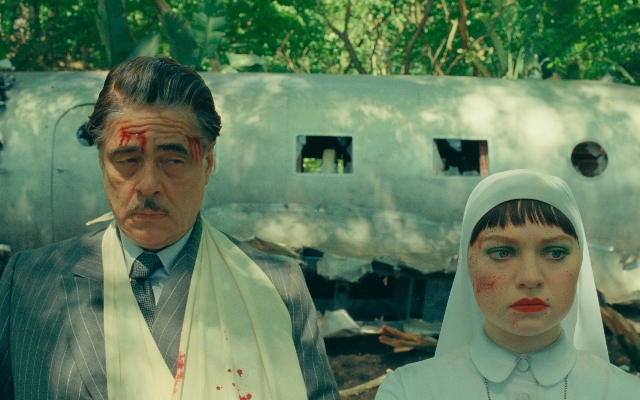
SYNOPSIS: In “The Phoenician Scheme,” a new Wes Anderson film now playing in theatres, Benicio del Toro is Zsa-zsa Korda, a shady businessman who made his fortune through “unholy mischief.” On the verge of a new venture, he finds himself in the crosshairs, literally, of tycoons, foreign terrorists and determined assassins. “Why do you need to keep assassinating me all the time?” he asks.
CAST: Benicio del Toro, Mia Threapleton, Michael Cera, Riz Ahmed, Tom Hanks, Bryan Cranston, Mathieu Amalric, Richard Ayoade, Jeffrey Wright, Scarlett Johansson, Benedict Cumberbatch, Rupert Friend, Imad Mardnli and Hope Davis. Directed by Wes Anderson.
REVIEW: There was a time when I loved Wes Anderson’s movies. His holy trinity, “Bottle Rocket,” “Rushmore,” and “The Royal Tenenbaums,” were all unconventional gems; movies with a singular point-of-view that examined the lives of misfits and oddballs.
Then I stopped loving and stared merely liking Anderson’s movies as his signature whimsical style began to squeeze the life out of his stories of self-discovery and community. Still, his stop-motion “Fantastic Mr. Fox,” for example, was mannered but also hilarious and poignant.
These days, I long for the days of the relative restraint of “The Darjeeling Limited” and “Moonrise Kingdom.” Perhaps it’s a case of familiarity breeding contempt (although think that is too harsh a word), but to me Anderson’s films have lost the humanity of his earlier work. They still cover much of the same thematic ground, commenting on family dysfunction, failure and redemption, but they now feel as though they arrive covered in bubble wrap like precious museum pieces.
Such is the case with his latest, “The Phoenician Scheme,” a stylish story of big money, attempted assassinations and family, it features a topflight cast, who all seem to be having a swell time slotting themselves into Anderson’s carefully crafted, artisanal film. But there is an air of artificiality that settles over the movie like a shroud which sucks way much of the emotional depth.
“The Phoenician Scheme” is pretty, occasionally amusing and the commitment to deadpan performances is unparalleled, but even though I’ll watch anything with Benicio del Toro, it is more concerned with style than substance. As a result, its well-worn take on the evils of capitalism, as personified by del Toro, feels academic rather than authentic.
SYNOPSIS: In “Companion,” a darkly comedic sci-fi thriller starring Sophie Thatcher and Jack Quaid, and now playing in theatres, a weekend get-a-way at a billionaire’s palatial home takes a turn when the host is killed.
CAST: Sophie Thatcher, Jack Quaid, Lukas Gage, Megan Suri, Harvey Guillén and Rupert Friend. Directed by Drew Hancock.
REVIEW: (CAREFUL! MILD SPOILERS AHEAD) “Companion” is a fast paced, entertaining thriller that tackles big subjects like power structures, misogyny and our relationship with technology.
I’m keeping the synopsis and review vague as to not give away the film’s secrets. The pleasure of “Companion” is in its reveals, the way it invites the viewer in, and then subverts expectations.
Writer/director Drew Hancock sets the off-kilter tone off the top, staging a love-at-first sight meet cute between Iris (Sophie Thatcher) and Josh (Jack Quaid) as Iris narrates, “There have been two moments in my life when I was happiest. The first was the day I met Josh. And the second, the day I killed him.” It’s a delicious film noir flourish that hints us at the darkness to come in an intriguing manner.
Without giving too much away, I can say that there is more (or less, depending on how you look at it) to Josh than you might think at first glance. Hidden under his boyish charm is a conniving misogynist, incapable of deep feelings who feels the world owes him a debt. Quaid, who inherited his famous father Dennis’s toothy grin, gleefully goes from hero to zero, slowly revealing the cruelty that simmers inside.
The less you know about Iris the better. Just know that Thatcher, who impressed as a Mormon missionary in last year’s “Heretic,” is given the freedom to showcase many sides of her talent. From rom com princess to otherworldly femme fatale to action star, she does it all in a variety of languages and accents, and she’s a blast.
At its wizened heart “Companion” is a movie about (CAREFUL! SPOILERISH COMMENTS AHEAD) technology. But unlike “Westworld,” which mined similar territory, it’s not a technology gone wild movie, it’s about how tech can be manipulated by humans to do their bidding. (FINAL WARNING! STOP READING NOW!) “You programmed me to murder someone Josh,” says Iris. “It’s really hard to come back after that.”
“Companion” breathes the same air as shows like “Black Mirror” and “The Twilight Zone,” blending social commentary with genuine thrills and lots of dark humor.
For better and for worse, there is nothing quite like a Wes Anderson film. The director’s unique production design is all over his new sci fi comedy “Asteroid City,” but with this film it is clear that whimsy has finally replaced storytelling on his to do list.
This is a twisty-turny one. Like a set of nesting dolls, it’s a film, within a play, within a show hosted by a Rod Sterling-esque talking head (Bryan Cranston), within a teleplay written by playwright Conrad Earp (Edward Norton).
The bulk of the “action” takes place in Asteroid City, a remote New Mexico desert town—population 87—where Steve Carell’s motel manager hosts a Junior Stargazer convention. Gifted kids and their parents from all over the state convene to showcase their incredible, and often outlandish, inventions.
It’s an interesting group that includes recently widowed war photographer Augie Steenbeck (Jason Schwartzman), father to “brainiac” Woodrow (Jake Ryan) and son-in-law to Stanley (Tom Hanks), movie star Midge Campbell (Scarlett Johansson) and the rough-n-tumble J.J. Kellogg (Liev Schreiber). Along for the ride are singing cowboy Montana (Rupert Friend), teacher June (Maya Hawke), Dr. Hickenlooper (Tilda Swinton) a scientist from the local observatory and the fast-talking Junior Stargazer awards judge, General Grif Gibson (Jeffrey Wright).
When the convention is interrupted by a visiting alien, the whole thing is locked down for a mandatory government quarantine.
Despite the quirky tone and Anderson’s trademarked stylistic choices, “Asteroid City” is a serious film, albeit one laced with a healthy dose of absurdism. A study in how people deal with grief, and the true nature of love, Anderson’s characters experience existential dilemmas, angst born of loss and dissatisfaction. Threats are posed by nuclear bombs and life from other planets unexpectedly dropping by to say hello and children wonder aloud what happens when we die. A shroud of melancholic anxiety hangs over the film, like a shroud, but Anderson’s staging of the film, the meta story within a story structure, obscures the movie’s deeper meanings under layers of style.
The cast, particularly Johansson and Hanks, bring focus to Anderson’s unfocussed story, and Carell, Cranston and briefly Goldblum are having fun, but it sometimes feels the surfeit of characters are there more to decorate the screen than to forward the story.
“Asteroid City” may delight long-time fans, but casual moviegoers or newcomers to the director’s oeuvre may find the film’s mannered obtuseness off kilter and off putting.
The Daily Telegraph calls writer/director Armando Iannucci “the hardman of political satire.” As the creator of sardonic films and TV shows like “In the Loop” and “Veep” he’s a vitally caustic comic presence.
As the film begins it’s 1953 and Joseph Stalin (Adrian McLoughlin), the second leader of the Soviet Union, is alive and well. Under his watch death squads are rounding up his enemies, executions are common and the mere mention of his name strikes fear into the hearts of the people. The Central Committee, surround him. There’s the scheming Nikita Khrushchev (Steve Buscemi), the pompous Georgy Malenkov (Jeffrey Tambor), Old Bolshevik Vyacheslav Molotov (Michael Palin) and secret police chief Lavrentiy Beria (Simon Russell Beale). When he suffers a stroke everything changes as his inner circle engage in a power struggle that will determine not only their futures but also the future of the Soviet Union.
The idea of chaos in the halls of power, though set sixty-five years in the past, feels almost ripped from the headlines. With jet black humour “The Death of Stalin” supercharges the farcical elements of a very dark time in history. With the cast using their natural accents—no one here tries to sound Russian—it feels surreal, like Monty Python gone amok. There’s doublespeak, jealousy and sight gags galore as this band of yes-men bumble around in an attempt to seize the Kremlin in the days following their leader’s passing.
Iannucci avoids the danger of trivializing the very real-life tragedy of the story—you hear gunshots off screen for much of the first half of the film—by not glorifying the villains. He takes a sharp knife to the reputations of Stalin, Khrushchev et al, portraying all of them as spoiled incompetents capable only of looking out for number one. In this historical context that approach works to show how absolute power corrupts absolutely.
“The Death of Stalin” is an audacious reimagining of history. Strong comic performances are highlighted in a film that is both frightening and funny at the same time.
“Hitman: Agent 47” is about murder, mayhem, car chases and bullets but really, at the core of its dark little heart, it’s about family.
Based on the videogame series of the same name, the story begins in 1967 with the establishment of a top-secret government program to create the perfect killing machine agents with no fear, no remorse or humanity.
Cut to many years later.
A trio of three people are on the hunt. Katia (Hannah Ware) is searching for a man she sees in haunting, strange visions, while the genetically modified Agent 47 (“Homeland’s” Rupert Friend) and John Smith (Zachary Quinto) are looking for Katia. As it turns out, all are interested in the same end game, locating the father of the Agent program, Dr. Litvenko (Ciarán Hinds in a paycheque role). As their paths and allegiances crisscross the trio fight their way through a convoluted plot to contribute to cinema’s body count and come to a bloody climax
“Hitman: Agent 47” has all the assets you expect from a videogame movie. It’s the kind of film where the “hero” fights against seemingly insurmountable odds and walks away without breaking a sweat. It’s also the kind of movie where it is not enough for someone to get shot, they must also fall from a great height hitting things on the way down. There is stylized action and bad guys with sub dermal body armour.
Unfortunately there’s also enough bad dialogue for any two Ed Wood Jr. movies—it’s the kind of movie were people say, “What the bleep is happening?” as an excuse to forward the story with exposition—a non-twist—(BLAZINGLY OBVIOUS SPOILER) Litvenko is Katia’s father! OMG!—and a main character that makes Jason Voorhees seem like a barrel of laughs.
The whole idea of Agent 47 is that he’s a cipher, a relentless and lethal killer—imagine a human Terminator without the accent or bulging muscles and you get the idea—and the ironically named Friend pulls that off, but that is a big part of the problem here. It’s difficult to build a movie around a personality-free title character. It’s been done—think anything starring Taylor Lautner—but first time director Aleksander Bach doesn’t have the chops to keep a movie based on a blank slate interesting. “Hitman: Agent 47” has a few stylish moments and some big action scenes, but not enough to add enough personality to push this dull affair over the top.
The world’s oldest profession has experienced an on screen revival of late. Steven Soderbergh’s film The Girlfriend Experience is a thoroughly modern look at the life of an escort while Cheri, the new film from Stephen Frears (of Dangerous Liaisons and The Queen fame) is a decidedly old fashioned take on the life of a lady of the night. Based on a 1920 novel by French author Colette it tells the story of the end of a six-year affair between a retired courtesan, Léa de Lonval (Michelle Pfeiffer), and an ostentatious young man, Fred ‘Chéri’ Peloux (Rupert Friend). When the relationship is over each must learn to go on with their lives. “Living with someone for six years is like following your husband to the colonies,” says Léa. “When you come back you’ve forgotten how to act and what to wear.”
The two films share a theme, the notion of what happens when people who sell themselves actually fall in love, but while Soderbergh’s take on the situation is up-to-the-minute with its references to Obama and the market meltdown Frears has taken a different path. His movie is not only set in the 1900s, but it feels like it was made in the 1900s; it feels old fashioned and staid.
The film is beautifully appointed—the sets, clothes and period details are bang on—but the acting style is stiff (with the exception of Kathy Bates, the only live wire in the cast), and the language a touch too courtly. For a movie about a courtesan it’s a bit too mannered.
The film has lots of problems. Firstly it breaks a cardinal rule of movie making: show me don’t tell me. A narrator (the voice of director Frears) pops up now and again to clumsily fill in the details sadly lacking in the film’s storytelling. When a narrator is needed to keep the momentum moving forward something is amiss.
Secondly affairs of the heart are unpredictable things, but Léa and Chéri are so self absorbed that their dangerous liaison never comes across as interesting. Their emotions are on the surface with no real depth. It was a repressed time but the film presents it and its characters as vapid rather than simply reserved.
If the story was more interesting those faults could be forgiven but the real killer here, the thing that drags the whole movie down is the casting of Rupert Friend as Chéri. There is love sick. There’s morose and then there is whatever Friend is trying to convey here. He turns Chéri into such a doleful wet rag it’s hard to imagine that anyone would want to spend a minute in the same room with him, let alone surrender their heart.
Pfeiffer fares better, wringing some emotion from the affected script and bringing sophistication to the character but is undone by an underwritten story.
Cheri is a minor work from a major filmmaker and talented cast.
 SYNOPSIS: In “The Phoenician Scheme,” a new Wes Anderson film now playing in theatres, Benicio del Toro is Zsa-zsa Korda, a shady businessman who made his fortune through “unholy mischief.” On the verge of a new venture, he finds himself in the crosshairs, literally, of tycoons, foreign terrorists and determined assassins. “Why do you need to keep assassinating me all the time?” he asks.