What would you do if Robert De Niro cut short your conversation with a quick, “I’m not doing this, darling,” and exited? If you’re Radio Times journalist Emma Brockes you write about it and watch your article go viral.
As unpleasant as the encounter may have been — he objected to the “negative inference” of her questions, she called him condescending — it did exactly what it was meant to do, generate buzz for De Niro’s upcoming film The Intern.
Who won? I’ll give the edge to Brockes who, when faced with a bad situation, turned De Niro’s lemons into lemonade and earned just as much press as the touchy actor.
De Niro took some blowback for his behaviour. Daily Mail columnist Piers Morgan wrote, “If I’d been her, I’d have slapped him ’round his smug little chops,” adding the Goodfellas star is “renowned as the rudest, most difficult and frankly obnoxious star to interview, possibly in the history of planet Earth.”
I think Morgan overstates his case. De Niro isn’t the worst — anyone who has ever done a movie junket knows Tommy Lee Jones is the crankiest, most soul destroying interview ever — he’s just a reticent interview, who, according to director Nancy Myers, doesn’t want “to expose himself all the time.”
De Niro isn’t alone in the chat-and-dash sweepstakes. Robert Downey Jr. and Quentin Tarantino bolted on Krishnan Guru-Murthy with the Avengers: Age of Ultron actor later calling the Channel 4 news presenter a “syphilitic parasite.” Robert Pattinson, Naomi Campbell and Russell Crowe have also done runners on the press.
So why submit to promotional interviews at all? Contractual obligation has much to do with it, but beyond that, they’re good for the movie. Daniel Radcliffe, star of Harry Potter, Horns and the upcoming Victor Frankenstein, once told me no matter how famous the actor, anyone who doesn’t get out and pump their film up to the press is making a huge mistake.
As a result everyone does them and while it’s easy to look at De Niro or Downey as spoiled brats, I’m surprised walkouts don’t happen more often.
It must get brutally dull answering the same questions over and over, particularly when they are of the “Of all your leading ladies who was the best kisser?” variety.
How bad can it get in the interview suites?
Once a talking head proudly told me she wrote new lyrics for Beyoncé’s hit song Survivor… “My name’s Beyoncé/ I’m in Goldmember/ You’re watching blah blah on blah blah blah…” and asked the superstar to sing them as a promo for her television station. If I were Beyoncé I would have exited stage left without a song on my lips.
I remember one “reporter” asking George Lucas “whether Dark Vader was a good guy or a bad guy.” If I were Lucas I would have hitched a Millennium Falcon ride out of there.
Recently I heard Tom Cruise try and answer the question, “What kind of stunt would you do to impress a girl?” If I were Cruise I would have grabbed the side of the nearest plane and jetted out of there.
As for De Niro, Brockes graciously says she has sympathy for him “because nobody wants to be there for these choreographed junket interviews.”
De Niro wasn’t quite as kind, but at least he called her “darling” and not “syphilitic parasite.”
“If you had told the ten-year-old me that I would be doing what I’m doing now my head would have exploded,” says Peyton Reed, director of the latest Marvel superhero movie Ant-Man.
The director, best known for making comedies like Yes Man and The Break Up, says he grew up obsessed with comics and movies.
“I read comics and got a Super 8 film camera when I was thirteen and started shooting film from a young age. My after school life was divided up between my jobs. I had a paper route and I mowed lawns to make money to buy comic books and buy Super 8 film to shoot movies.”
Marvel comics played a major part in his comic book consumption.
“The thing I loved about Marvel was Stan Lee’s storytelling techniques and his editorial attitude. Those Marvel comics had a clear sensibility. They were really of the moment and had this attitude that was equal parts cocky and self-effacing. I loved it. They created these heroes who all had real world problems. Spider-Man was Spider-Man, but he could never get the girl in high school and he had to figure out how to make enough money to pay his rent.
“I actually told Stan Lee this when he did his cameo in our movie. I said I grew up reading the comics and my mom was an English teacher and I became an English major and I learned so many vocabulary words form Marvel comics. He wrote in this very flowery style. If someone was disappearing into the microverse he’d write, ‘Slowly and inexorably he disappeared into the ether.’ I’d run to the dictionary. What does inexorably mean? What is ether? It was hugely educational for me.”
Reed admits his small-but-mighty superhero, Ant-Man, played by Paul Rudd, has “really absurd powers.” His ability to shrink and control ants don’t seem as impressive as Thor’s Hammer or Hulk’s rage but, Reed says, “there is an inherent comedic component to the idea of Ant-Man which we also really embraced.
“I think one of the biggest things that helped was having Paul Rudd at the center of it because Paul manages to do something in this movie that I think is really interesting. He really does relate to these weird situations in the same way you or I would. He definitely acknowledges the absurdity of the situation but then goes ahead and fully commits to that situation.”
At the end of the year don’t be surprised to see ”Ant-Man,” the latest Marvel superhero franchise starter, take the top spot on the Canadian Entomologist Magazine’s Top Films of the Year but numbers 2 through 10 as well. It not only features a man who can shrink to the size of an insect, but a supporting cast featuring colony after colony of ants. Bugheads are going to love it, and I suspect, so will fans of the Marvel Universe.
The origin story of “Ant-Man” begins with Dr. Hank Pym (Michael Douglas). He’s not a mad scientist, but he’s certainly angry. At the height of the Cold War his creation, the Pym Particle, was a breakthrough but he refused to allow its miniaturization properties to be used as a weapon. “As long as I am alive,” he says, “nobody will ever get the formula!”
Cut to present day. Pym’s Particle is still a secret from everyone, including his daughter Hope (Evangeline Lilly) and former protégé Darren Cross (“The Strain’s” Corey Stoll). Cross is now in charge of Pym’s company and has worked to develop the technology with an eye toward selling it to the highest bidder, a.k.a., HYDRA.
In the hopes of stopping Cross, Pym and his daughter recruit cat burglar Scott Lang (Paul Rudd) to don the incredible shrinking ant suit and use his particular set of skills to break into Cross’s laboratory and destroy the miniaturization technology. If he is successful he can save the world, if he isn’t, he will be crushed like a bug underfoot.
Surely the silliest, and most definitely the smallest of all Marvel superheroes “Ant-Man” nonetheless has the same sort of swagger as the first “Iron Man” movie. It’s an origin story that uses humour to smooth over some of the rough bits of exposition. For instance, it’s self aware enough to follow a revelation of Pym’s complicated plan with a throwaway line from Rudd. “That sounds like a job for the Avengers.” It gets a laugh and stops the film from taking itself far too seriously.
As Lang Rudd has the same off-the-cuff charm that Downey brought to Tony Stark and the movie is the better for it. To pull off the story of a man who flies on the back of winged ants and is small enough to get sucked up by a vacuum cleaner you need someone with a spring in his step and a permanent wink and Rudd has both, finding just the right tone in scene after scene to make this work.
Michael Peña brings full on comic relief as Lang’s motor-mouthed friend, Lily adds strength to a character who could be spun off to her own franchise and Douglas has old school gravitas to burn, but make no mistake, this is Rudd’s movie, whether he is running through the grass with a herd of ants or slyly trying to seduce Hope.
Entomophobics may have nightmares following the film, with memories of a dog-sized ant scurrying around their dreams, but for the rest of us, “Ant-Man” is a fun, larger than life summer diversion.
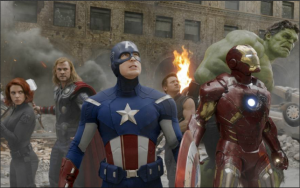
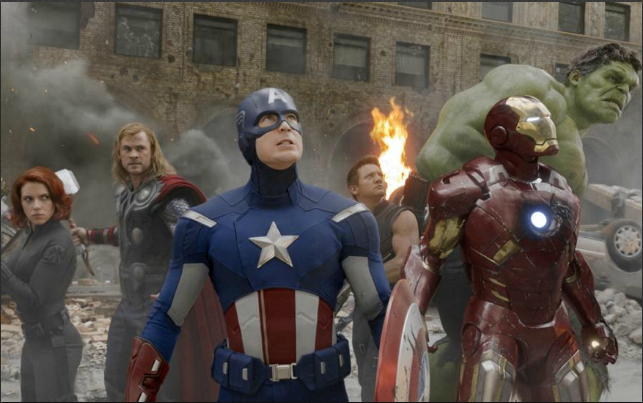
It’s not a spoiler to let you know the Avengers save the world in The Age of Ultron. The spectacular six have rescued the planet before and, no doubt, will save it again in future. In superhero movies the globe is always on the eve of destruction.
The original movie, 2012’s The Avengers, saw the team protect the planet from Thor’s evil brother Loki while in Superman II the Man of Steel battles three Kryptonian criminals set to obliterate our orb. A baddie named M tries to wage world war in The League Of Extraordinary Gentlemen and recently the Fantastic Four prevented a giant cosmic entity called Galactus from gobbling up the earth.
“I see a suit of armour around the world,” says Tony Stark in Age of Ultron. “Peace in our time, imagine that.”
The movies get bigger every time out and with thirty more superhero flicks scheduled for the five years—including Deadpool, Doctor Strange and Gambit—the mind reels at the ways villains might endanger our world. It sounds entertaining but haven’t we’ve already been there? Where do you go from the threat of total annihilation?
Diminishing returns in terms of audience reaction, that’s where. We all know The Avengers will pull out all the stops to save the earth. Buildings will crumble, trucks will go airborne and giant cracks will appear where city streets used to be but by the end credits you know everyone will emerge relatively unscathed, with the bad people vanquished and the good guys grinning from ear to ear. Viewers are left with CGI fatigue, but dammit a catastrophe was averted. Again.
But we’ve been there, done that. Why not freshen things up and turn back the hands of the doomsday clock a few minutes to create tension in the form of different kinds of situations? It sounds counter intuitive—bigger is always better, right?— but imagine Captain America going mano a mano with Kim Jong-un or Iron Man shrinking down to the size of a microbe to battle cancer from the inside à la Fantastic Voyage.
The real world is a very complicated place. Every day the news delivers more bad information than all the tragedies of Aeschylus and Sophocles combined. Stories of beheadings, terrorism and all manner of terrible behaviour flood the airwaves aching to be corrected by some sort of superhero. How great would it be to see warrior princess of the Amazons Wonder Woman unleash the Lasso of Truth on the Canadian Senate or weather maven Storm get all medieval on climate change?
An injection of real world issues might not make for big box office, but it certainly would infuse the movies with a sense of unpredictability—just like real life events. Real life is messy and volatile and that’s what keeps it interesting.
I understand one of the reasons we go to movies like The Avengers: Age of Ultron is to see things we’ll never witness in real life, but it’s hard not to agree with Hawkeye (Jeremy Renner) when he says, “We’re fighting an army of robots and I have a bow and arrow—it makes no sense!” These movies try to dazzle our eyes—and they do!— but bringing them down to earth, literally, might help us engage our brains as well.
“Can we hold them?” asks evil scientist Baron Wolfgang von Strucker (Thomas Kretschmann) as a team of superheroes tear up his supposedly impenetrable HYDRA lair.
“They’re the Avengers,” comes the reply. The only thing missing is the “Duh!” at the beginning of the sentence.
Not only does the exchange answer the question of every film producer who has a movie opening opposite “Avengers: Age of Ultron” this weekend but it also sets a loose, funny tone for the film.
Twenty seconds into the movie we’re already engaged in a wild action scene that puts them in possession of an ancient gem containing artificial intelligence. Tony Stark (Robert Downey Jr.) and Bruce Banner (Mark Ruffalo) intend to use the technology to build a peacekeeping army—“I see a suit of armour around the world,” says Stark. “Peace in our time, imagine that.”—but the plan backfires and instead of creating a global peace initiative they create a robot monster named Ultron (voice of James Spader). “I really miss the days when the weirdest thing science created was me,” says Captain America (Chris Evans). Hell-bent on improving the world by exterminating humanity, Ultron says, “When the dust settles the only things left will be metal.”
Cue the metalocalypse.
While many superhero movies have chosen a dark road—think Christopher Nolan’s ennui ridden “Batman” movies or the dour looking “Batman v Superman: Dawn of Justice”—director Joss Whedon delivers action with a grin. There’s always time for a quip in “Age of Ultron.” The wisecracks are the glue that hold the film together, acting as a bridge between the battle scenes.
Stark is his old cocky self with none of the insecurity of the emo “Iron Man 3” in sight. Gone is the introspection of “Winter Solider.” Sure, Banner is still tormented by his Hulk alter ego—but let’s be honest, if you take away his torment, you take away his character—but nonetheless finds time to do a faceplant into Scarlett Johansson’s chest and Black Widow (Johansson) shows more of her feminine side than ever before, but the film is less interested in the characters than how carnage the characters can cause.
There are action scenes galore. If all you want are trucks flying through the air, buildings crumbling and Iron Man assembling and disassembling, look no further. It’s a smorgasbord of skirmishes, a constant barrage of action scenes, many of which appear in a blur, just glints of metal and flashes of colour. These sequences are stuffed to bursting with an overload of CGI that becomes less interesting the more you watch.
One of the reasons we go to the movies like “Avengers: Age of Ultron” is to see things we’ll never see in real life, but it’s hard not to agree with Hawkeye (Jeremy Renner) when he says, “We’re fighting an army of robots and I have a bow and arrow—it makes no sense!” Whedon has tried to dazzle our eyes—and he does!— but has forgotten about engaging our brains.
Interviewers love talking with Robert Downey Jr., not just because he’s one of the biggest movie stars in the world, but also because he’s a one-man quote machine.
Walking into a room full of Canadian reporters to chat up his latest film, The Judge, he’s wearing a festooned shirt — and that is the only word that can be used to describe his flamboyant sartorial choice — with a pattern that resembled a bisected tree trunk. More intriguingly he carried a small green, nondescript box.
Asked what was inside he said, “I have distilled socialism in this box. It wasn’t easy. I’m bringing it back to America.”
And the quotes kept coming.
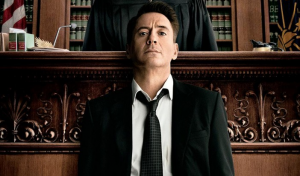
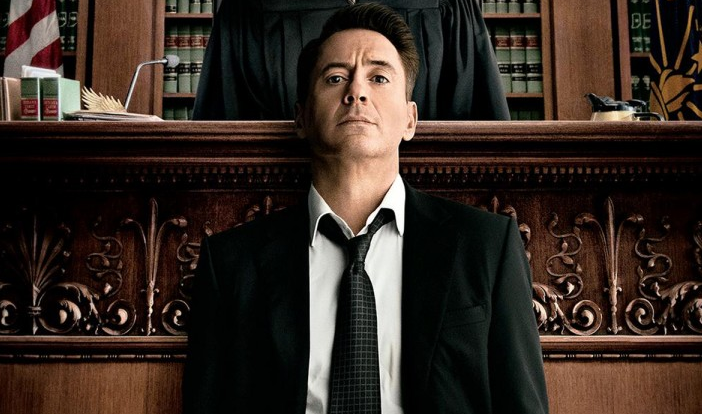
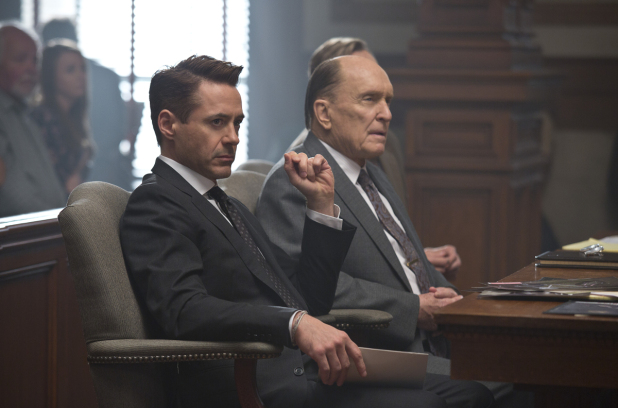
The Judge is a family drama about Hank, a hotshot, big-city lawyer who returns to his hometown for his mother’s funeral. He’s been estranged from his father, Judge Joseph Palmer (Robert Duvall), for years — “He’s dead to me” — but is forced to re-examine everything he knows about his dad when the judge is accused of murder.
Downey says, “I found myself crying all the time,” (great quote No. 2 for those keeping track) during filming, but not because he was reflecting back on his own life. “I got caught up in the reality the movie expresses,” he says. “Hank’s mom’s funeral is every funeral and Hank’s cut-off with his dad is every cut-off that anyone has ever had. It’s not even particularly a father-son story because the judge could have been the mom. I just think about these family dynamics and they light up constellations that are very emotional” (great quote No. 3!).
He describes shooting the movie as a “weird game of Sudoku” (great quote No. 4) in terms of making sure the emotional moments didn’t stack up against one another, blunting their impact.
“You can’t just play 120 catharses in a row,” he says. “I hate it when I see that in movies. It’s like, ‘All right, is everyone always crying in real life?’”
The first step in finding the character meant not allowing his Hollywood persona to bleed into Hank. “That was the first thing I had to smash,” he says.
“Hank is really observing this situation that’s happening around him and to him and he becomes this person who has to go through this terrible and wonderful crucible. It was really just about doing less and less and less and less and I like being busy. I like to talk and I like to be active and all that stuff, so sometimes I felt like I was literally just sitting on my hands.”
He leaves us with one last great quote that sums up his emotional response to the film. “It kicks me in the stomach in the nicest way.”
You get value for your money in Robert Downey’s Jr’s new film “The Judge.” Stepping away from the superhero movies that made him a household name, he stars in a film with so many story shards and plot derivations you need a scorecard to keep up.
It’s a legal drama. No, it’s a manboy coming-of-age story. Wait! It’s also romance, a dramedy, a father-and-son tale and a mystery. The only genres missing are horror and science fiction and I suspect they will be included on the director’s cut Blu Ray.
Downey Jr is Hank Palmer, a hotshot defense lawyer. He’ll do anything to win and is proud of it. “Everybody wants Atticus Finch,” he says, “until there’s a dead hooker in the hot tub.” In court he’s Iron Man, an unstoppable force with a thick skin and a quick line. He’s the same outside of court as well, except when it comes to his father.
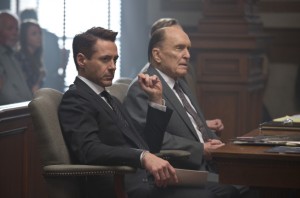
He’s been estranged from Judge Joseph Palmer (Robert Duvall) for years—“He’s dead to me.”—but is forced to see him when his mother passes away. Returning to his hometown of Carlinville, Indiana for the funeral Hank must confront the life he left behind—ex-girlfriend Samantha (Vera Farmiga), brothers Glen (Vincent D’Onofrio) and Dale (Jeremy Strong) and his cold-fish father. The quick in-and-out trip is extended, however, when the Judge is accused of murder and Hank becomes his lawyer.
“The Judge” feels like Oscar bait. It’s a long movie with a wide story arc that gives its leads ample opportunity to strut their stuff. Downey hands in a solid, if somewhat familiar performance while Duvall plays elder statesman, resurrecting the alpha male feel of “The Great Santini.” Both are used to good effect and the supporting cast keeps things humming along despite a story that pushes credulity to the limit.
The devil is in the details and when the details, no matter how small they are, verge on silly, they become a distraction.
Most of the silly stuff comes in the form of the clues Hank pieces together while forming the Judge’s defense and the trial itself. There will be no spoilers here, but suffice to say the whole thing hinges on a bit of information so implausible that it gives new meaning to the term suspension of disbelief. Trouble is, it didn’t have to be that way. There were any number of ways to establish the point in question (OK, HERE’S AMILD SPOILER ALERT: It involves chemotherapy and a cottage) without trying so hard, but that’s not the kind of film this is.
“The Judge” is the hardest working movie in show business. It’s a film that wants to check all the boxes and tries just a little too hard. Downey and Co. float above it all, however, touching down every now and again to introduce a new plot twist and deliver the occasional touching moment.
“My father’s a lot of unpleasant things. A murderer’s not one of them.”
That’s how Robert Downey Jr. describes his father, the titular character in this weekend’s legal thriller The Judge. Robert Duvall plays the irascible old judge, who, when accused of vehicular manslaughter, must reluctantly rely on his estranged lawyer son for a defence in court. While he’s on the bench, he’s a no-nonsense justice who doles out old-fashioned common sense along with his judgments. In one case, he makes a deadbeat dad hand over his brand-new truck to his ex-wife, joining a long list of movie magistrates who have meted out law and order on the big screen.
Remember Fred Gwynne as My Cousin Vinny’s Judge Chamberlain Haller —his classic question, “What is a yoot?” may be one of the most famous movie lines delivered from the bench — but how about Judge Doom, the much feared judge of Toontown? As played by Christopher Lloyd in Who Framed Roger Rabbit, he presides over a town of cartoon characters, punishing lawbreakers with the dreaded Dip, a bubbling vat of turpentine, acetone and benzene that “erases” them. His mission is to pin the murder of Marvin Acme on Roger Rabbit. “I’ll catch the rabbit, I’ll try him, convict him and execute him!”
Everyone has heard the term “judge, jury and executioner,” but Judge Dredd adds one more title, police officer. Set in 2080, this Sylvester Stallone movie sees the justice system boiled down to Street Judges who enforce the laws and dole out instant justice. When Joseph Dredd is convicted for a crime he didn’t commit, he must prove his innocence. “The evidence has been falsified! It’s impossible! I never broke the law, I AM THE LAW!”
Finally, a more conventional judge is seen in Anatomy of a Murder, the 1959 Otto Preminger film about an army lieutenant accused of murdering a bartender who attacked his wife. The all-star cast — defence attorney James Stewart, George C. Scott as the prosecutor, Ben Gazzara and Lee Remick as the defendant and his wife — was presided over by real-life lawyer Joseph N. Welch as Judge Weaver. Welch made several pictures, but is best remembered as the attorney who represented the Army in the McCarthy hearings and scolded the Communist-hunting senator with the famous words, “Have you no sense of decency, sir?” when he verbally attacked a member of Welch’s law firm.
The Toronto International Film Festival premieres some of the best movies across the globe and attracts some of the biggest names in Hollywood. This year is certainly no exception with expected appearances from Reese Witherspoon, Robert Downey Jr., Kristen Wiig, Bill Murray and more.
Each year we get the inside scoop on the hottest TIFF movie premieres from renowned Canadian critic Richard Crouse, an expert in what films to see…and what films to skip…