Reminders of real life were all around us at this year’s Toronto International Film Festival. From the digital screenings we watched at home to half empty, socially distanced screenings at venues like The Princess of Wales Theatre. But when my mind wanders back to September 2021, I won’t be thinking of having to show my proof of vaccination or the social distancing in theatres.
What will linger?
The images of Anya Taylor-Joy in “Last Night in Soho,” crooning an a cappella version of the Swingin’ Sixties anthem “Downtown,” and “Dune’s” Stellan Skarsgård doing his best impression of Marlon Brando in “Apocalypse Now,” come to mind immediately.
Those moments and others like them are the reason the movies exist. They transcend the vagaries of real life, transporting us away from a place where masks, vaccine passports are the reality.
And boy, did we need that this year.
Here a look back at some of the moments that made memories at this year’s TIFF:
“Night Raiders,” a drama from Cree-Métis filmmaker Danis Goulet, draws on the historical horrors of the Sixties Scoop and Residential Schools to create an unforgettable, dystopian scenario set in the new future. It effectively paints a somber portrait of totalitarian future, packed with foreboding and danger. The story is fictional but resonates with echoes of the ugly truths of colonization and forced assimilation. Goulet allows the viewer to make the comparisons between the real-life atrocities and the fictional elements of the story. There are no pages of exposition, just evocative images. Show me don’t tell me. The basis in truth of the underlying themes brings the story a weight often missing in the dystopian genre.
I asked Danis Goulet about having many of her characters in Night Raiders speak Cree: “It is everything to me,” she said. “My dad is a Cree language speaker. He grew up speaking Cree. He learned to speak English in school. His parents were Cree speakers. And coming down to my generation, I’m no longer a Cree speaker and there are entire universes, philosophies and poetry and beauty contained in the language. When we think of where our heritage lies, maybe some people think of museums. For me I think it is in the language. I think that richness doesn’t just offer Indigenous people something. I think if others looked closer at what the language tells us about the history of this land, they would be incredibly amazed. My dad has looked at references in the language that talk about the movement of the glaciers, so, foe me to have the Cree language on screen is everything. I’m in my own process. I go to Cree language camp to try and learn back the language and the language gives back in a way that is so healing and incredible. It is one of the greatest gifts in my life. So, the opportunity to put my dad’s first language on the screen, and the language of the Northern Communities where I come from, and my language that I lost, is the best. It’s incredible.”
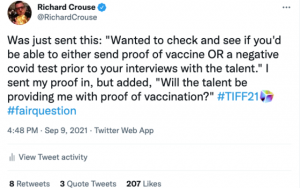
From Twitter: @RichardCrouse Was just sent this: “Wanted to check and see if you’d be able to either send proof of vaccine OR a negative covid test prior to your interviews with the talent.” I sent my proof in, but added, “Will the talent be providing me with proof of vaccination?” #TIFF21 #fairquestion 4:48 PM · Sep 9, 2021· 8 Retweets 3 Quote Tweets 206 Likes
There is no mention of COVID-19 in the Jake Gyllenhaal thriller “The Guilty.” But make no mistake, this is a pandemic movie, A remake of 2018 Danish film “Den skyldige,” it is essentially a one hander, shot on a just a handful of set with strict safety protocols in place. Gyllenhaal, as 911 operator Joe Baylor, may be socially distanced from his castmates, but his performance is anything but distant. Played out in real time, “The Guilty” builds tension as Baylor races against a ticking clock to bring the situation to a safe resolution for Emily. Director Antoine Fuqua amps up the sense of urgency, keeping his camera focused on Gyllenhaal’s feverish performance. The close-ups create a sense of claustrophobia, visually telegraphing Baylor’s feeling of helplessness and his crumbling mental state.
The sound of an audience laughing, applauding, crying, or whatever. Just being an audience. The big venues were socially distanced, and often looked empty to the eye, but when the lights went down and folks reacted to the opening speeches or the films, it didn’t matter. Roy Thomson Hall, with its 2600-person capacity, may have only had 1000 or so people in the seats, but for ninety minutes or two hours they formed a community, kindred souls brought together after a long break, and it was uplifting to hear their reactions.
“Flee” is a rarity, an animated documentary. A mix of personal and modern world history, it is a heartfelt look at the true, hidden story of the harrowing life journey of a gay refugee from Afghanistan. Except for a few minutes here and there of archival news footage, “Flee” uses animation to tell the story but this ain’t the “Looney Tunes.” Rasmussen used the animation to protect Amin’s identity, but like other serious-minded animated films like “Persepolis” and “Waltz with Bashir,” the impressionistic presentation enhances the telling of the tale. The styles of Rasmussen’s animation change to reflect and effectively bring the various stages of Amin’s journey to vivid life. It is suspenseful, heartbreaking and often poetic.
I asked “The Survivor” star Vicky Krieps about working opposite Ben Foster: “The first day I came [on set] I was very intimidated,” she said. “I wouldn’t say scared, but it felt like a wall to me. It began like this. There was no small talk. There was no, ‘How are you?’ He was already in character and it was very clear. I thought, ‘OK, I have to play his wife.’ And then, something really interesting happened. I like having a challenge and this felt like a challenge. So, I needed to find a way [to relate to him] because I knew I was going to be his wife. How do I do that? Imagine it as a wall, but then in the wall there are eyes. I used those eyes and I felt like I could open a window, and inside of those eyes was a horizon where I could go. I liked to say to Ben, ‘And then we would dance.’ Sometimes I wrote to him and said, ‘It was nice dancing today.’”
“Last Night in Soho,” from director Edgar Wright, is a love letter to London’s Swingin’ Sixties by way of Italian Giallo. Surreal and vibrant, and more than a little bit silly, its enjoyable for those with a taste for both Petula Clarke and murder. It begins with verve, painting a picture of a time and place that is irresistible. A mosaic of music, fashion and evocative set decoration, the first hour brings inventive world building and stunning imagery. Wright pulls out all the stops, making visual connections between his film and the movies of the era he’s portraying and even including sixties British icons Rigg, Tushingham and Stamp in the cast.
I asked “Dune” star Rebecca Ferguson why she said reading Frank Herbert’s novel was like doing a crossword puzzle: “Sometimes I wonder what comes out of my mouth,” she said. “My mother and many of my friends sit and do crosswords, but I have never been in that world. There is a way of thinking around it. It’s logical, mathematical. You need to be able to see rhythms. Whatever it is. Reading “Dune” was quite dense and I think for people who are immersed into the world of science fiction, they understand worlds and Catharism and this planet and that planet. It is just another picture, which, not to stupefy myself, I am intelligent enough to understand it, but there is a rhythm. I think it is me highlighting the fact that people who live and breathe science fiction, they get it at another level.”
“Dune,” the latest cinematic take on the Frank Herbert 1965 classic, now playing in theatres, is part one of the planned two-part series. “Dune” is big and beautiful, with plentiful action and a really charismatic performance from Jason Momoa as swordmaster Duncan Idaho. It is unquestionably well made, with thought provoking themes of exploitation of Indigenous peoples, environmentalism and colonialism.
If a movie starring Riz Ahmed about a musician sidelined by a medical condition sounds familiar, it should. Last year he was nominated for Best Actor for playing a heavy metal drummer suffering hearing loss in “Sound of Metal.” He returns to theatres this week in “Mogul Mowgli,” a rap drama that treads similar ground but with a whole new attitude.
Ahmed, who co-wrote the script with director Bassam Tariq, stars as Zaheer, a London-born rapper known as Zed to his growing number of fans. His lyrics focus on racism, Islamophobia and the issues he faced as a young British Pakistani man.
Based in New York City, he’s about to embark on a European tour. His soon-to-be-ex-girlfriend (Aiysha Hart)—she’s grown tired of their FaceTime relationship while he’s on the road—thinks he needs to get grounded, to reconnect with his family in England. “For someone who raps so much about where they’re from,” she says, “when was the last time you went home? When was the last time you actually spent time with your family?”
He returns to England, welcomed by his family, even if they disapprove of his career and choices. “I can’t give you my blessing,” says his restaurateur father Bashir (Alyy Khan), “if I don’t believe in it.”
Following a scuffle with a fan, he finds himself in the hospital, diagnosed with a degenerative autoimmune disease.
What exactly is wrong? “Your body can’t recognize itself,” his doctor says, “so it’s attacking itself.”
“If you can walk from that chair to that lift,” says his doctor pointing to the elevator ten feet away, “I’ll discharge you.” He can’t, and his treatment begins as he feels his career slip away.
“Mogul Mowgli” is anchored by a raw nerve of a performance from Ahmed. Bruised, physically and mentally, from the indignity of disease and his dreams slipping away, he vacillates between helplessness and anger, sadness and frustration. It’s powerful but most of all, human. He doesn’t play Zed simply as tragic. He’s often unlikeable, often unsympathetic. You know, human.
Often shot in searing close-up, and dotted with surreal sequences, “Mogul Mowgli” is in your face both visually and emotionally. The stark reality of Zed’s disease is tempered by dreamlike sequences that illustrate the chasm between where he came from, to as he imagined it would be to where it is today. It’s a study of cultural identity, divides in families, how illness defines relationships and masculine ambition. It occasionally bites off more than it can chew, but as uncomfortable as it can get, it is never less than compelling.
“Sound of Metal,” a new drama starring “Rogue One’s” Riz Ahmed, is a cautionary tale about getting what you wish for.
Ahmed is Ruben, a drummer in Blackgammon, a heavy metal duo fronted by his girlfriend Lou (Olivia Cooke). The pair live in an RV, criss-crossing the country on tour before going into the studio to make an album. He’s an aggressive player, part Lars Ulrich, part Chuck Biscuits, whose booming style is the sound of frustration and bellicosity manifested on stage six nights a week. At a gig in Missouri his ears ring and soon stop working. On stage and off all he hears is a muffled roar. A visit to the doctor reveals he has lost more than seventy percent of his hearing is gone and won’t come back. “Eliminate all exposure to loud noises,” he’s told. “Your first responsibility is to preserve the hearing you have left.”
As he and Lou try and plot a way forward Ruben becomes obsessed with the idea of cochlear implant surgery than accepting his hearing loss. At a cost of $40-$80,000 they are out of reach for now so in the short-term Lou takes Ruben, who has been sober for four years, to a “clean” house, run by deaf counselor Joe (Paul Raci). He’s welcome to stay but this is a solo gig. As Ruben learns how to be deaf Lou must give him space. In the coming weeks anger and dissatisfaction lead to acceptance as he learns about his new life but never lets go of the idea that implants will allow him to return to his old life. “Our main tenet is that deafness is not a handicap,” says Joe, “not something to be fixed.”
“Sound of Metal” makes you walk a mile in Ruben’s shoes. Applying immersive sound design, writer-director Darius Marder toggles between Ruben’s point-of-view and real-world sounds. The muffled sound of the world filtered through his damaged ears portray his sensory deprivation in an intense way. As his desperation and frustration grow the sound design hammers home the devastating effects of hearing loss.
In addition, Marder close captions much of the film, dropping the subtitles when Ruben is learning sign language, once again involving the audience in his learning curve.
As Ruben, Ahmed brings a nervous energy to the role. He’s always in motion, unable to find a still moment for contemplation or acceptance. As his frustration gives way to a reluctant acceptance, he brings us along for the journey, giving us insight into a person’s whose life has been blown apart.
Raci as Joe, a Vietnam vet who lost his hearing in the war emerges as a force. In real life Raci grew up with deaf parents, is a Court Certified American Sign Language interpreter, and the lead singer for a heavy metal band that performs in American Sign Language. With great warmth, tinged with firmness, he steals every scene he’s in.
“Sound of Metal” is specific in its setting but ultimately is a story of accepting the curveballs life throws at you.
“Venom,” the first film in the brand-spanking-new Sony Marvel Universe, gives us not one but two Tom Hardy performances. In a dual role the Oscar nominee plays Eddie Brock, an investigative reporter with an aw-shucks accent and the title character, an amorphous sentient alien who requires a host, usually human, to bond with for its survival. It’s kind of an anti-superhero Jekyll and Hyde situation where Ed and Venom are a hybrid, two beings in one body.
If you are still reading and processing this, you might enjoy “Venom.” If not, you’ve probably already purchased tickets for “A Star is Born.”
When we first meet Brock he’s the host of a popular television show. When he is assigned to interview genius inventor Carlton Drake (Riz Ahmed), he goes off script, asking some difficult and embarrassing questions. His rogue behaviour costs him everything, his job, his girlfriend (Michelle Williams) and his house. To get revenge he breaks into Drake’s facility with an eye toward exposing Drake’s evil doings. Instead he ends up merged with the extraterrestrial symbiote Venom, becoming a toothy creature with a tongue that would make Gene Simmons envious.
Bestowed with superhuman strength and power, he must learn how to manage his not only his new gifts but also his rage. “The way I see it we can do what we want,” Venom says to his host.
“Venom’s” advertising tagline, “The world has enough Superheroes,” refers to the titular character’s anti-hero status but could also be a comment on the surplus of comic book characters seen on screens in recent years. So, is Venom one superhero too many? Maybe, depending on your level of fandom.
Comic book heads may complain about the absence of Spider-Man, the symbiote’s original host, and other deviations from the canon. But, on the flip side, the body-horror aspect of Venom’s metamorphosis coupled with the inherent humour of Eddie and Venom’s interactions are brought to vivid life by Hardy’s commitment.
Structurally, for fans, “Venom” offers something different from the Marvel formula. By the time Hardy is flailing around in a restaurant lobster tank there will be no mistaking this for anything that came before it.
Casual viewers may not be as interested. The first half, the origin story, gloomily drags on leading up to the Eddie’s transformation. Then it’s followed by a series of darkly lit chase scenes as Drake’s baddies try and stop Venom.
The there are the women. In the “Wonder Woman” world we live in it’s a disappointment that Williams, as Eddie’s girlfriend, and Jenny Slate, as a scientist working for Drake’s Life Foundation, are underwritten, acting as placeholders more than actual characters.
“Venom” has its moments, but it’s hard to tell whether we’re laughing with or at the movie. It feels unintentionally funny, as if all the actors except for Hardy understood they were acting in a generic comic book movie. He’s a hoot, the movie isn’t.
Based on a historical novel by Canadian-born author Patrick deWitt “The Sisters Brothers” is a buddy Western that, for better and for worse, doesn’t rely on the clichés associated with buddy flicks or Westerns.
Set in 1851 Oregon, “The Sisters Brothers” tells parallel stories. First we meet the brothers, Eli (Reilly) and Charlie Sisters (Joaquin Phoenix). The pair are bounty hunters and all-round thugs for hire, currently working for a mysterious Oregon City mob boss known only as the Commodore (Rutger Hauer in a wordless cameo). “You do realize our father was stark raving mad and his foul blood runs in us,” Charlie says to his big bro. “Its why were good at what we do.” Violent and ruthless, wherever they go a heap of sorrow is left behind.
Their latest job is to meet detective John Morris (Jake Gyllenhaal) who is to hand off Hermann Kermit Warm (Riz Ahmed), a chemist-turned-gold-prospector who has developed a formula to make searching for gold a scientific rather than physical procedure. It’s a chemical mixture that, when poured in the river, lights up the gold. All you have to do is reach in and pick it up
It’s a get rich quick scheme and the Commodore desperately wants to get his hands on it. Warm’s ultimate goal is much more pure. He has visions of using the gold money to create a new society in Texas that favours nonviolence, education and true democracy. Morris the hunter becomes the hunted when Warm appeals to his better nature. Moved by warm’s plea—“The Sisters will cut off my fingers, burn my feet,” he says—Morris becomes a business partner. The big question? What will happen if and when the Sister Brothers catch up with them?
The four leads play tough guys and cowboys who spend as much time discussing their feelings as they do firing their guns. The brothers have daddy issues—he was a violent alcoholic—while Morris hated his father for any number of sins, both personal and professional.
The brothers bicker constantly. Eli, a great lummox who, at first glance seems ill suited for the job at hand and yet never hesitates to shoot an adversary in the head, is sensitive and wants to settle down. Charlie, on the other hand, is a wild card, with a hair trigger and a more limited idea as to what the future may or may not bring.
The conversations range from heartfelt to funny and are the engine that propels the action. There are shoot-outs and horses and all the other tropes of the genre but this story is actually about the guys, not their actions. A John Wayne oater this ain’t. Instead it is a movie that explores the masculine bond that lies at the heart of so may westerns but is never fully explored.
“The Sisters Brothers” is a story about family, purpose and male bonding made human by a sensitive performance from Reilly (who also produced) and his chemistry with Phoenix. It’s a buddy flick and a Western but it’s also more than the sum of its parts.
Based on the play Blackbird by Scottish playwright David Harrower, the new film Una is an uncomfortable look into an uncomfortable subject.
“In the theatre it is kind of like a verbal boxing match,” says Una’s director Benedict Andrews. “You are trapped in the same room with the two protagonists as they face each other off. There is a profound shift that happens once it becomes cinema. After living with the film for a while I think the film hurts a lot more than the play ever did.”
Rooney Mara plays the title character, a 20-something who takes action after seeing a picture of Ray, played by Ben Mendelsohn, in a magazine. The two have a past. Fifteen years earlier, when she was 13 and Ray was a middle-aged man, he seduced her, a crime he paid for with four years in prison.
Convinced his actions put her in a downward spiral, she goes to his place of work to confront him. He’s re-established himself with a new name, wife and job. She demands to know why he did what he did, and why he abandoned her when they were about to make a run for it and leave England to start a new life together.
Andrews first directed the play in November 2005 but had no interest in revisiting his previous work.
“There will continue to be fine productions of the play because it really is one of the best chamber plays of this century,” he says.
“It is rich material for actors and provocative and rich material for audiences. Neither of us wanted to make a well-made version of the play. It had to become distinct. I sometimes see them as two children coning from the same DNA. In many ways I’m trying to respect and amplify the core of the play.”
What might have been a straightforward story of a search for answers defies preconceived audience expectations with the ethical landmines Andrews and Harrower (who also wrote the script) plant along the way. In its most startling turn Una asks the audience to consider the interaction between Ray and Una, the abuser and the abused, as some kind of love story.
“This is about two people who see each other after 15 years,” he says, “the chemical charge of that meeting and their encounter is a profoundly cinematic idea. I was interested in how the camera might be able to pursue a special intimacy, the scar tissue opening up again between these two characters, and being able to microscope in on that scar tissue.”
Although the play was first performed 12 years ago, Andrews calls it “prescient” in the wake of recent events that have shone a light on sexual abuse in Hollywood.
“Part of the intelligence of the play is the way (Harrower) unpacks the moral problems of the survivor and the abuser relationship,” Andrews says.
“Thankfully that silence is breaking in journalistic and legal ways. We’ve seen that over the course of the week with the dam bursting about the systemic abuse of actresses within the Harvey Weinstein story. From my point of view it wasn’t necessarily a conscious thing although I think the play absolutely touches a raw nerve now and is part of a conversation that needs to happen about a topic that was kept in silence.”
Based on the play “Blackbird” by Scottish playwright David Harrower, “Una” is an uncomfortable look into an uncomfortable subject.
Rooney Mara is the title character, a twenty-something who takes action after seeing a picture of Ray (Ben Mendelsohn) in a magazine. The two have a past. Fifteen years earlier, when she was thirteen and Ray was a middle-aged man, he seduced her, a crime he paid for with four years in prison. “You wanted to be treated like an adult,” Ray says. “That’s what children say.”
Convinced his actions put her in a downward spiral, she goes to his place of work to confront him. He’s re-established himself with a new name, wife and job. She demands to know why he did what he did, and why he abandoned her when they were about to make a run for it and leave England to start a new life together.
What might have been a straightforward story of a search for answers defies preconceived audience expectations with the ethical landmines Harrower (who also wrote the script) plants along the way. In its most startling turn “Una” asks the audience to consider the interaction between Ray and Una, the abuser and the abused, as some kind of love story. Rooney and Mendelsohn, both very good in difficult roles, explore the thin lines the story draws between abuse and love, between right and wrong, between desire and guilt. It’s complicated and messy as Ray is forced to confront a past he’d rather subvert while Una looks for answers. “I don’t know anything about you except you abused me,” she says.
“Una” lurches headlong into controversial territory, unflinchingly presenting a painful story that offers no easy answers.
In the latest Jason Bourne movie, Matt Damon will punch, kick and spy master his way to the top of the box office charts.
His previous Bourne films, Identity, Supremacy and Ultimatum, were all hits commercially and critically.
Damon says he owes a great deal to the fictional character.
After the early success of Good Will Hunting, Saving Private Ryan and The Talented Mr. Ripley made him a star, a string of flops cooled his box office appeal.
“Right before The Bourne Identity came out,” he said, “I hadn’t been offered a movie in a year.”
Then his career was Bourne again.
“It’s incalculable how much these movies have helped my career,” he told The Telegraph. “Suddenly it put me on a short list of people who could get movies made.”
In the spirit of “one for them, one for me” for every film like The Martian or the new Jason Bourne, Damon has attached himself to smaller, riskier projects.
He lent his star power to The Good Shepherd, a low budget film directed by Robert De Niro. It’s a spy movie without the bells and whistles we’ve come to expect from our favorite undercover operatives.
There are no elaborate chase scenes a la James Bond or even the great scenery of the Bourne flicks.
In fact, the only thing The Good Sheperd shares with any of those movies is Damon, who plays Edward Wilson, one of the (fictional) founders of the CIA.
Despite mixed to good reviews — USA Today gave the film three out of four stars—and winning the Silver Bear of the prestigious Berlin International Film Festival, the movie barely earned back its production costs at the box office.
Ninety per cent of director Steven Soderbergh’s job on The Informant! was casting this mostly true tale of a highly paid executive-turned-whistleblower who helped uncover a price fixing policy that landed several executives (including himself) in jail.
It’s a tricky balancing act to find an actor who can keep the audience on-board through a tale of corporate malfeasance and personal greed, who can be likeable but is actually a liar and a thief, but Damon is the guy.
The Informant! skewed a tad too far into art house territory to be Soderbergh’s new Erin Brockovich-sized hit, but Damon’s presence kept the story of accounting, paperwork and avarice interesting. Reviews were kind but A Serious Man and The Twilight Saga: New Moon buried the film on its opening weekend.
Damon teamed with John Krasinski to produce and co-write Promised Land, a David and Goliath story that relied on the charm and likability of its cast to sell the idea that fracking is bad and the corporations who dupe cash-strapped farmers into leasing their land are evil.
It’s hard to make talk of water table pollution dramatic but Promised Land makes an attempt by giving much of the heavy lifting to Damon.
Done in by middling reviews and “sobering” box office receipts, this earnest and well-meaning movie might have been better served in documentary form.
With an Oscar on his shelf and more than 70 films on his resume Damon is philosophical about the kinds of films he chooses to make, big or small.
“If people go to those movies, then yes, that’s true, big-time success,” he says.
“Jason Bourne,” the first Matt Damon led film in the series in nine years, proves that actions speak louder than words. Damon speaks a mere twenty-five lines of dialogue as he kicks, punches and crash-boom-bangs his way through this spy thriller, letting the action do the talking.
Damon’s fourth go-round as amnesiac superspy Jason Bourne begins with him tormented by his violent past. Most of his memory is intact, but he’s eaten away by guilt for the terrible things he did as a government programmed killer. “I remember,” he says. “I remember everything.”
To get his ya-yas out he goes all Fight Club, bare-knuckling any and all contenders but he’s drawn back into the international spy game—the movie never met an exotic location it couldn’t use, whether it’s Berlin, Reykjavík, Athens, London or even Vegas—after his former-handler-turned-hacker Nicky Parsons (Julia Stiles) tells him of a collaboration between CIA director Robert Dewey (Tommy Lee Jones, whose face is one forehead wrinkle away from becoming a caricature of an old man) and Silicon Valley kingpin Aaron Kalloor (Riz Ahmed). They’re working on Edward Snowden’s worst nightmare, a new program called Ironhead, a system of full spectrum surveillance; watching everyone all the time.
Wanting Bourne out of the way Dewey uses every newfangled asset at his disposal—like state-of-the-art global surveillance—to find the agent before turning to the old ways and bringing in an assassin known as, appropriately enough, The Asset (Vincent Cassel) to take care of business. “I’m going to cut the head off this thing,” says Dewey.
Flitting about the edges of the intrigue is the CIA’s cyber ops head Heather Lee (Alicia Vikander), who helps Bourne in an effort to keep him away from The Asset’s deadly gaze. “Bringing him in is the smart move,” she says. “There’s no bringing in Bourne,” Dewey says. “He needs to be put down.”
Cue the carnage.
If nothing else “Jason Bourne” proves once and for all that you can’t keep a good man down. Shot, beaten, dropped from a tall building or whatever, he’s the Energizer Bunny of international spies. He just keeps on ticking. We expect that from Bourne and we also demand feral fighting scenes, crazy car crashes and action, action, action. Make no mistake, there’s plenty of Bourne battle and bloodshed and some of it is quite exciting but it doesn’t have the finesse of the earlier films. Director Paul Greengrass’s signature handheld you-are-here style is in place but doesn’t feel as fresh as it did in the other films. Often frenetic instead of pulse-racing, the action sequences are frequent but not as memorable as the magazine-in-the-toaster gag from “Bourne Supremacy” or “Bourne Ultimatum’s” hardcover book punch. Still, you might not make it quite to the edge of your seat, but the combo of action and intrigue will shift you out of a reclining position.
“Jason Bourne” has its moments. Damon brings a grizzled power to the role and Vikander is a welcome addition, even if her motives are sometimes are hard to understand. There are interesting messages about online personal rights versus public safety that would have been moot in 2002 when the series debuted, a labyrinthine plot occasionally weighed down with unnecessary exposition and an unhinged Vegas climax—Bourne must really hope that whatever happens in Vegas stays in Vegas—that would not be out of place in an Avengers movie. I just wish the ending felt less like an Avengers scene—with cars comically flying through the air—and more like a Bourne moment.
 From Twitter: @RichardCrouse Was just sent this: “Wanted to check and see if you’d be able to either send proof of vaccine OR a negative covid test prior to your interviews with the talent.” I sent my proof in, but added, “Will the talent be providing me with proof of vaccination?” #TIFF21 #fairquestion 4:48 PM · Sep 9, 2021· 8 Retweets 3 Quote Tweets 206 Likes
