All found footage films need to find a reason to exist, a reason why there is a camera set permanently to the on position. In the case of “Phoenix Forgotten” it’s a sister trying to make a documentary about her brother’s disappearance.
“Are you going to be filming the whole time,” asks her father.
“That’s the whole idea,” says Sophie (Florence Hartigan).
“I feel like Harrison Ford,” he laughs.
With that framework out of the way the story gets going, using the (now debunked) real life Phoenix, Arizona UFO sightings of March 13, 1997 as a backdrop for the action.
When sonic booms rocked the city Josh Bishop (Luke Spencer Roberts) didn’t buy his father’s explanation that the air force was doing a practice run overhead. Shooting some grainy footage, the teenager decides to investigate. With the help of school friends Ashley Foster (Chelsea Lopez) and Mark Abrams (Justin Matthews) and a borrowed school handy cam he sets off to into the desert filled with curiosity. The three never finish their make shift documentary. Disappearing after they left their car on the desert edge, extensive searches by a small army of law enforcement turn up no clues. Were they I they in the wrong place at the wrong time? Was it a fight over the girl? Or was it something otherworldly? “We didn’t find anything,” says a police officer involved in the search, “so who knows what happened. It’s hard to speculate.”
Twenty years later sister Sophie picks up the story, arriving in town with her ever- present camera. “What if Josh was on to something?” she says. “We always assumed he got lost or kidnapped or murdered. What if…” What if he got kidnapped by an alien? “I’m starting to sound like him,” she muses. When she finds Josh’s video camera, returned to the lost and found of the school he borrowed it from, more clues emerge.
As a genre found footage is showing it’s age. From the brilliant “Blair Witch Project” on it has been used, primarily in cheap-and-cheerful budget horror and sci fi films, to create a sense of urgency in a first person narrative. Trouble is, they’ve been done to death and their techniques don’t feel fresh anymore. At some point the screen will fill with static (check), the cast of unknowns will look panicked and confused (check), the protagonists will run, camera in hand, causing the picture to jiggle as though it was strapped to the back of a runaway horse (check), there will be Dr. Tongue-style close-ups (check) and the inevitable dropped camera freeze frame (check).
Despite the stylistic predictability “Phoenix Forgotten,” succeeds on several levels. Director Justin Barber has a nice ear for the rhythms of the character’s speech and draws good naturalistic performances from the cast of unknowns. The story doesn’t completely impress, and Barber takes way too long setting up the mystery, but the actors are engaging. He also does a nice job cutting together Sophie’s slick documentary footage with the grainy 1990s handy cam material.
“Phoenix Forgotten’s” mix of fact and fiction isn’t all that scary but Barber does whip up some intense and paranoid moments.
Alien: Covenant is the second instalment in the Alien prequel series and the sixth film in the franchise overall.
That’s a lot of facehugging and chestbursting.
Since the 1979 release of Alien, a film Roger Ebert called “an intergalactic haunted house thriller set inside a spaceship,” audiences have been fascinated with the sci fi / horror series.
The latest movie sees a new crew—including Michael Fassbender, Katherine Waterston, Billy Crudup and Danny McBride—on a mission to colonize planet Origae-6. Along the way they abandon their original course, choosing a closer, apparently inhabitable planet only to be met with terror and acid-spewing creatures.
Covenant is the third Alien movie directed by Ridley Scott. I once asked him what it was that kept him casting his eyes to the skies movie wise.
“The fantasy of space,” he said, “which is now also a reality, is a marvellous platform and a form of theatre. Honestly, almost anything goes.”
The freedom of the sci fi genre is a common theme among creators. Denis Villeneuve, whose sequel to Ridley Scott’s Blade Runner, now titled Blade Runner 2049, comes out later this year, remembers how his mind was opened by his first exposure to the genre.
“At a very young age one of my aunts came home one night and she had brought two or three big cardboard boxes filled with magazines,” says Villeneuve. “Those magazines were all about sci fi. Those boxes changed my life because the amount of poetry and creativity among the guys that were drawing those comic strips. They were very strong storytellers. They were all like mad scientists playing with our brains.”
Alien: Covenant has only been in theatres for a few hours and Scott has already announced another sequel he plans on filming in the next fourteen months.
Until that one hits theatres what other sci fi films should we have a look at?
Vincenzo Natali, the director of episodes of television’s Westworld and Orphan Black and adventurous films like Cube and Splice has some suggestions. “I could mention 2001, Star Wars and The Matrix, but we’ve all been there. I think there are some very worthy science fiction films that aren’t so well known.”
First on his list is Stalker, from master director Andrei Tarkovsky.
“It’s about a zone in Russia that may have had some kind of alien visitation and is highly classified. There are very special people called stalkers who illegally enter the zone and can take you to a place where your wishes can come true. No other movie ever made is quite like it. It is one of the most beautiful films I’ve ever seen.”
Next up is The 10th Victim, a futuristic Marcello Mastroianni movie about a deadly televised game called The Big Hunt which becomes a replacement for all conflict on Earth, but at what cost? “An Italian film made in the ’60s but way ahead of its time,” he says. “It’s a satirical comedy, absolutely brilliantly made, filled with cool futuristic Italian design and it’s really funny. I cannot recommend it enough.”
Third is the animated La Planète Sauvage. “It takes place on a planet where humans are pets for a race of large aliens. It’s a kind of a Spartacus story against the aliens. Totally outrageous and very, very ’70s.”
Alien: Covenant is the second instalment in the “Alien” prequel series and the sixth film in the franchise overall. Its director Ridley Scott’s follow-up to his 2012 film “Prometheus,” and the origin story for one of the most fearsome alien species ever, the Xenomorph.
Led by the pious first mate Christopher Oram (Billy Crudup), the colony ship Covenant hurtles trough space to planet Origae-6, an Eden that offers a chance at a new life in the first large scale colonization mission.
Laden with crew—including android Walter (Michael Fassbender), terraforming expert Daniels (Katherine Waterston), biologist Karine (Carmen Ejogo) and crewman Tennessee (Danny McBride)—2000 settlers and 1000 embryos, the spaceship is damaged by an energy surge. During repairs they intercept a mysterious radio transmission from a nearby planet that suggests better living conditions may be just around the corner. Abandoning their original course, an exploratory crew is sent down. On the ground they discover breathable air, wheat, the only survivor of the ill-fated Prometheus mission, an android named David (Fassbender again) but Daniels is concerned. “Do you hear that?” she says. “There’s nothing. No birds, no animals. Nothing. What happened here?” Of course there is life on the planet, life in the form of nasty face-hugging, chest-bursting aliens.
All great sci-fi has to have a bedrock of strong ideas but this is an “Alien” movie, can’t we have a better balance between ideas and action? Scott kicks things off, appropriately enough (given the movie’s plot) with Richard Wagner’s “Entering of the Gods into Valhalla,” a stirring number that thematically sets up the story of Xenomorphs and a search for a new promised land. There is talk of creation—Where do we come from? We can’t be random molecules thrown together by chance—how humans may have already blown their one and only shot at existence (“Why give them a second chance?”), android love and whether it is better to serve in heaven or reign in hell.
Grand ideas one and all and each seems to take on more import as they are filtered through Scott’s dark and dreary atmospherics. It’s moody, with a growing sense of what is to come, but it takes almost an hour for the first alien to burst (in rather bloody spectacular fashion) onto the screen. In that time there are loads of cool images, Scott is genetically wired to make great looking movies—witness the beautiful and delicate way the alien spores are dispatched—but the film is at its best when the slimy Xenomorphs are involved which, unfortunately, isn’t enough of the time.
From the way the crew banters to the space intrigue to the chest bursting “Alien: Covenant” feels more like a throwback to the original films than to “Prometheus.” There’s more dark humour–“How do you know you’re infected?” “You’d know by now.”—and when Scott revs up the action there are some truly horrifying moments, but because much of the crew are the equivalent of “Star Trek” redshirts the alien kills don’t have much emotional impact.
“Alien: Covenant” is well made, although Scott over shoots the climatic cat-and-mouse-game, but feels perfunctory in the scheme of things. It tries to freshen up the formula—no spoilers here but the Xenomorphs aren’t the only villains—but despite the injection of a good dose of philosophy is still essentially a “run away from the monster!!!” movie we’ve seen before and better.
As fans of Charlton Heston are well aware, Moses (Christian Bale) was a one-time Prince of Egypt raised as a brother to Pharaoh Ramses (Joel Edgerton) and exiled to the desert when his Jewish heritage was revealed. He should have perished but instead found a new life, with a wife, a son and a flock of goats.
It’s during this rather uneventful time that God speaks to Moses, commanding him to liberate his people, the Hebrew slaves, from under the tyranny of Ramses’s rule. “He has lost his mind,” says the Pharaoh. “He has found a god. His god. Not one of ours.” Moses supposes that the slaves are Egyptians and should be treated as such, with fare pay and the rights of any other citizen.
Cue the burning bush, plagues and the (almost) parting of the Red Sea.
Director Ridley Scott is the anti-Cecil B. DeMille. Like “The Ten Commandments,” “Exodus: Gods and Kings” is a huge movie with thousands of extras, two very important tablets and plagues galore. The stories are basically the same (although Scott takes liberties, making God appear as a young, tart-tongued boy) but the approaches are very different.
Scott’s film eschews all the Hollywood glam of DeMille’s biblical epic. It’s humanistic and so gritty you’ll feel like taking a bath afterwards, but not in the Nile, which is turned a lurid blood red as one of the ten plagues. Scott also makes good use of 3D, staging big screen dioramas with amazing detail, depth and even the odd spear that shoots off the screen.
The director pulls out all the stops in the large-scale action scenes and when the movie is raging it works. When he slows the pace in the more introspective scenes it flattens. Character development is one thing. Bad dialogue is another.
The eager cast is up for almost anything, but it’s unlikely that many actors, when asked, “Do you know where we are?” could keep a straight face when replying, “Yes. We are somewhere at a point on earth where there is a sea in front of us and an army behind.” Bale gives it his best, and does a noble job, but the script stymies even this fine actor from time to time.
The film’s climax—and this is NOT a spoiler—is the parting of the Red Sea sequence. Like the plague scenes—wild crocodile attacks, locusts, frogs, pustules etc—the parting is quite stunning visually, but ultimately feels a bit less than miraculous. For one thing it’s more of a wave than an actual parting, and while that may be splitting hairs, it is one of the best-known parts of the story and Scott turns it into an Irwin Allen moment.
“Exodus: Gods and Kings” does share one main thing with “The Ten Commandments” in that there is a noticeable lack of Middle Eastern faces among the cast. The days where Heston and Edward G. Robinson could pass for Egyptian slaves and Pharaohs is apparently not too far in the rearview mirror.
When we think of elves at this time of year visions of Santa’s helpers fill our heads.
The cute, industrious and diminutive creatures from the North Pole can be seen everywhere in December in Christmas TV specials, greeting cards and movies like Arthur Christmas and Santa Claus: The Movie.
One of the most famous movie elves is Buddy, played by Will Ferrell in the neo-classic Elf.
“You’re not an elf,” says Leon the Snowman. “You’re six-foot-three and had a beard since you were fifteen.”
So technically he’s not really an elf, just a human raised by elves but he has more Christmas spirit than Dasher, Dancer, Prancer, Vixen, Comet, Cupid, Donder and Blitzen put together.
This weekend, just weeks before December 25, Buddy is joined on the big screen by a very different kind of elf.
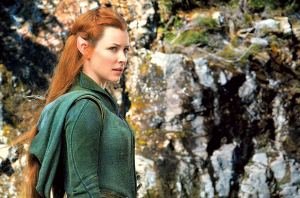
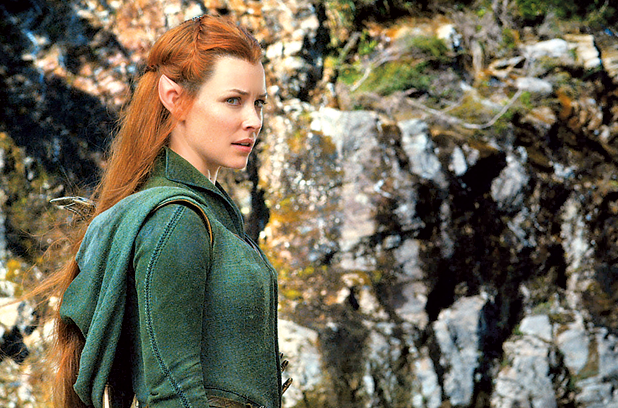
“She’s slightly reckless and totally ruthless and doesn’t hesitate to kill.” That’s how Evangeline Lilly describes the 600-year-old “she-elf” Tauriel from this weekend’s The Hobbit: The Desolation of Smaug.
The bow-and-arrow wielding character is new to the J.R.R. Tolkien movie franchise, created by director Peter Jackson and his co-writers Fran Walsh and Philippa Boyens.
“She’s our redhead,” says Boyens. “We created her for that reason. To bring that energy into the film, that feminine energy. We believe it’s completely within the spirit of Tolkien.”
Buddy and Tauriel are just two of the many kinds of movie elves.
Elves, or (Gelfling as they’re called in the flick), are the main focus of the Jim Henson film The Dark Crystal.
Dobby the House Elf was voted the No. 1 favourite magical creature in the Harry Potter series by NextMovie.com and Thor: The Dark World featured Dark Elves, an ancient race of dangerous beings whose spaceships are powered by black holes.
The cheeseball b-movie Elves features the tagline, “They’re Not Working for Santa Anymore.” Well, if not Santa, then who? Nazis, that’s who.
Finally Tom Cruise consorted with an elf named Honeythorn Gump in Legend, the Ridley Scott film The New York Times called “a slap-dash amalgam of Old Testament, King Arthur, The Lord of the Rings and any number of comic books.”
Swiss actor David Bennett played the feisty elfin sidekick who not only is the protector of the world’s last two unicorns but, along with elves Screwball, Brown Tom and Oona, helps Cruise’s character save the world from the nasty Lord of Darkness (Tim Curry).
“The Counselor” is the feel bad movie of the year.
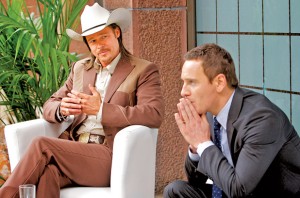
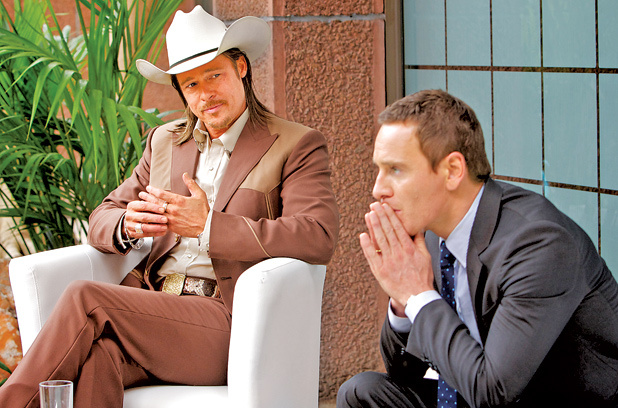
Bleak and hopeless, it’s an ice-cold crime drama that examines the reasons and consequences of crime instead of focusing on the crime itself. It’s a stylish cautionary tale about the worst of human behavior driven by greed, lust and hubris; a non-action, action movie where most of the fireworks are in McCarthy’s dialogue. Luckily actors like Javier Bardem, Brad Pitt, Rosie Perez and Michael Fassbender are there to keep the fuse lit.
In Cormac ‘No Country for Old Men’ McCarthy’s screenwriting debut he tells a gritty story about a greedy lawyer (Fassbender) in over his head after dipping his toe into the narcotics trade with charismatic drug lord Reiner (Bardem) and his sociopath girlfriend Malkina (Cameron Diaz).
When the deal, smuggling carrying 625 kilos of cocaine from Mexico to Chicago, goes south after one “we’ve got a problem” phone call, the Counselor finds his life swirling out of control.
Spiraling around this grim vortex are womanizing middle-man Westray (Pitt), prison inmate Ruth (Rosie Perez) and the counselor’s long-distance girlfriend Laura (Penélope Cruz).
In “The Counselor” director Ridley Scott mutes his usual high-octane visual sense to focus on the words.
And there’s a lot of them.
Talky to the extreme, the entire movie is built around dialogue that sounds like it flowed from the hardest boiled crime writer out there, which I guess McCarthy is now that Elmore Leonard is working from his celestial typewriter. Catch phrases abound—“You don’t know someone until you know what they want,” for example—but it is wordy. Sometimes brilliantly so, but the pacing, particularly in the first hour, will be thought of as hypnotic by some, slow by others.
Scott takes his time creating tension in every scene, which really begins to pay off in the second hour when the themes of truth or consequences really start to pay off. “If you think you can live in this world and not be part of it, you’re wrong,” the Counselor is told, just after it’s too late to change his fate.
Or the most part the acting is top notch. Fassbender’s shift from confident criminal to a man who lands himself in a world of trouble after doing a good deed gives a nakedly raw performance. As his desperation grows his defenses drop and the weight of what he did in the name of greed crushes him.
Perez and Pitt (who’s in his “Killing Them Softly” mode here) are both fine, and it’s hard to imagine anyone else describing a “gynecological” love scene between a woman and a car with as much strange gusto as Bardem. “You see something like that,” he says, “and it changes you.”
These actors bring the words to life. Unfortunately the same can’t be said for Diaz, whose cold-blooded take on the character is too detached to be truly effective.
Like “Killing Them Softly,” another thriller that relied on dialogue and ideas to provide the thrills instead of gunshots and explosions, “The Counselor” will polarize people. Some will find it a head scratcher, others will be drawn into its uncompromising look at life and death, cartel style.
Still others, like me, will be left half in, half out, wishing the film’s virtues—it’s dialogue and ideas—were propped up with just a bit more attention to plot and possibly some warmth. But the chilliness of the story and characters may be McCarthy’s point. Early on Malkina says, “I don’t think truth has a temperature,” which sums McCarthy’s ice cold look at primal, criminal behavior.
Cormac McCarthy may not be a household name around your place, unless you live with the Coen Brothers or maybe with the Pitt’s.
Literary critic Harold Bloom called the writer one of the four major American novelists of his time, and he has two all-star movies set for release, which may make his name a little more commonplace.
Later in 2013 James Franco directs, scripts and stars in Child of God, an adaptation of Cormac’s 1973 novel about, “a dispossessed, violent man whose life is a disastrous attempt to exist outside the social order.”
This weekend a star-studded cast lead by Brad Pitt, Cameron Diaz and Michael Fassbender headline The Counselor, directed by Ridley Scott.
Producer Steve Schwartz says the story of a lawyer in over his head after dipping his toe into the drug trade, “may be one of McCarthy’s most disturbing and powerful works.”
And that’s saying something about the writer who gave us a character like No Country for Old Men’s killing machine Anton Chigurh. Empire.com warned that when, “McCarthy throws “a dark character at you, it’s a safe assumption that you’re not going to be able to get them out of your head for a good, long while—if ever.”
As written by McCarthy and played by Javier Bardem, who earned an Academy Award for Best Supporting Actor for the part, Chigurh is merciless, a murderer who makes life and death decisions with the flip of a coin.
The Road—a 2007 Pulitzer Prize winner for fiction—is another disturbing McCarthy novel adapted for the big screen.
The story is simple. A man and his son (Viggo Mortenson and Kodi Smit-McPhee) try to survive in a dystopian world. Armed with only a gun and two bullets they must scavenge for food amid the ruins and protect themselves from cannibals who roam the desolate land.
The Road is a movie based on small moments set against a big backdrop. No parent will be able to forget the stark image of seeing a young boy who doesn’t know what a can of Coke is or a father teaching his son how to commit suicide.
It’s tough, no nonsense work from a writer who says he’s “not that big a fan of exotic foreign films,” especially movie with magical realism. “You know, it’s hard enough to get people to believe what you’re telling them without making it impossible,” he says. “It has to be vaguely plausible.”
Thematically “Prometheus” is about creation and destruction. As a piece of entertainment goes, however, I’m not sure Ridley Scott’s new space opera will create lasting memories. It won’t destroy the goodwill of the first couple of “Alien” films, but I don’t think it will add much to the legacy either. For me there is very little big bang in a movie that is reportedly about the most significant discovery in the history of mankind.
The basic storyline of “Alien” is in place in “Prometheus,” just don’t this movie a sequel or a prequel lest you annoy Sir. Ridley. A group of hapless space travellers go head to head with some intergalactic nasties who give hugging a bad name. But these face huggers aren’t the movie’s main draw. Led by Elizabeth Shaw (Noomi Rapace) and Charlie Holloway (Logan Marshall-Green, the expedition into the farthest corners of the universe aims to prove a connection between ancient human civilizations and extraterrestrials. They discover a link to creation and religion that is more Book of Revelation than Genesis, however.
“Prometheus” doesn’t degrade the legacy of Scott or his beloved “Alien” but it doesn’t add much to the franchise either. It’s an expertly made, but clinical study of dread and wonder which, despite the two-and-a-half-year spaceship journey, never takes flight.
It’s a slow build. Scott allows the intensity to build throughout the two hour running time, leading up to a climax that is best described in
(mild spoiler) four words: Do it yourself caesarean! It’s a memorable scene, well orchestrated by Scott, but the movie peaks there, despite the half-hour that follows.
It’s a mix of heady ideas—which are revealed in the film’s first half—the odd action sequence and dialogue that sounds left over from a bad late seventies sci film. I expected a higher level of writing from a movie that is more about ideas than action.
Having said that, I loved Michael Fassbender’s automaton space butler David 8. He’s got many of the film’s best lines and if they ever need someone to play the lead in The Peter O’Toole Story, he’s the guy.
I know it is wrong to compare movies in the same way it’s a bad idea to compare your kids to one another, but Scott has made a movie that feels like something he’s done before, just not as well. I expected more. Perhaps “Alien” set the bar too high for the director to leap over.
In a twelfth century twist on a modern saying, the only two things you can count on in “Robin Hood,” the handsome new retelling of the age old tale from director Ridley Scott, are taxes and treachery.
Set in the waning days of Richard the Lion Heart’s (Danny Huston) ten year long Crusade, the origin story of how Robin Longstride (Russell Crowe) became Robin Hood, really picks up when Robin promises one of the king’s knights, Sir Robert Loxley (Douglas Hodge), that he will deliver a sword to Robert’s father, Sir Walter Loxley (Max Von Sydow), in Nottingham. Meanwhile, Richard’s ridiculous brother Prince John (Oscar Isaac) ignores his trusted advisors, his chancellor William Marshall (William Hurt) and his mother Eleanor of Aquitaine (Eileen Atkins) and imposes crippling taxes on his subjects. Egging him on is the duplicitous Godfrey (Mark Strong), a traitor who is secretly trying to start a civil war and help France invade the country. Back in Nottingham, Robin delivers the sword, meets Lady Marion (Cate Blanchett), helps save England from the French and for his trouble is declared an outlaw by King John.
The new “Robin Hood” isn’t the bright Technicolor tale of the famous Errol Flynn version. Scott’s vision of the story is dark, thematically and visually. It’s a raw boned and bloody story of greed, unfettered ambition and treachery with a complex plot that touches on some very modern issues like taxes, too much government and one that might make the people of Arizona happy—unwanted immigration. It’s a mostly historically correct representation of the time and the Robin Hood legend, but Scott has added in an unbelievable plot twist involving Robin’s father and a coincidence that stretches credulity to the breaking point. It seems so out-of-place and glaringly silly I’m sure the writers of the campy cartoon series “Rocket Robin Hood” would have rejected the idea as being too outlandish.
Despite that lapse in judgment, the movie works. Fans of “Gladiator” will feel a sense of déjà vu—the only thing separating the two movies is the time period and Richard Harris and Oliver Reed, and they’re both dead. Scott and Crowe have returned to the winning formula of historical drama mixed with strong characters and lots of crazy action.
At the center of it all is Crowe, possibly the only Hollywood a-lister he-man enough to pull off “Robin Hood’s” combo of raging machismo, honor and emotional intensity. Physically he doesn’t look like he spends much time at the gym, instead it seems like he earned those muscles the old fashioned way—by swinging a sword. Equally strong is Blanchett in a role that could be redubbed, Maid Marion, Warrior Princess. She defines twelfth century girl power and, as one of only three female characters, cuts through the thick cloud of testosterone that hangs over the movie like a cloud. The supporting cast, including Mark Strong—in what is now becoming his trademark bad guy routine—Max Von Sydow, William Hurt, Danny Huston and Canadian Kevin Durand as the ironically named Little John, add much to the overall effect.
“Robin Hood” is a new take on an old story; it’s entertaining, occasionally funny and as epic a film as we’re likely to see this summer.