After mid-1970s success of two “midnight movies” called “El Topo” and “The Holy Mountain,” renegade director Alejandro Jodorowsky was offered the chance to make any movie he wanted. He toyed with a number of stories, including “Don Quixote,” the story of an hidalgo with lofty, but unrealistic ideas.
Instead the Chilean born Jodorowsky chose to make “Dune,” the science fiction epic by Frank Herbert. As it turns out, however, the director may have been better suited to the story of Cervantes’s impractical idealist than the maker of a giant Hollywood film.
To hear Jodorowsky tell it, his version of “Dune,” which never made it past preproduction due to budget and Hollywood’s reluctance to work with the avant-garde director, would have been more of a mystical journey than a film. He collected “spiritual warriors” like Salvador Dali (who demanded to be paid $100,000 an hour to appear as the Emperor of the Known Universe), Orson Welles (who was promised a private chef), special effects wiz Dan O’Bannon and conceptual designers Chris Foss, H.R. Giger and Jean “Moebius” Giraud, to fulfill his vision, creating an amazingly detailed storyboard of the proposed film.
The story is mostly told by the people who in the room, lead by the 84-year-old Jodorowsky. It’s a talking head doc, punctuated by preproduction art and storyboards. For movie geeks it’s an essential glimpse into the mind of a legend. For others—including fans of Frank Herbert who gets a bit of a short shrift here—it may sound like the ramblings of a madman. Which it is, but an endearing madman who values art and spirituality above all else. He was so committed to making this movie, a movie he says might have changed the very fabric of humanity, that he was prepared to die for it.
Of course, that didn’t happen. David Lynch made the movie and one of the pleasures of “Jodorowsky’s Dune” is watching the elderly director describe his delight in realizing that Lynch’s film was a bit of a disaster.
As for whether or not the director’s vision for “Dune” would have been feasible, we’ll never know. Like many lost or never made films, it feels as though the legend of the project might be more entertaining than the film itself could ever have been.
“You’re a con artist,” wrote Karina Halle in Sins & Needles. “A liar. A thief. An unredeemable soul.”
She might also have added to that colourful list really interesting movie character.
As despicable as flim flam artists may be, there is no denying they make good film subjects.
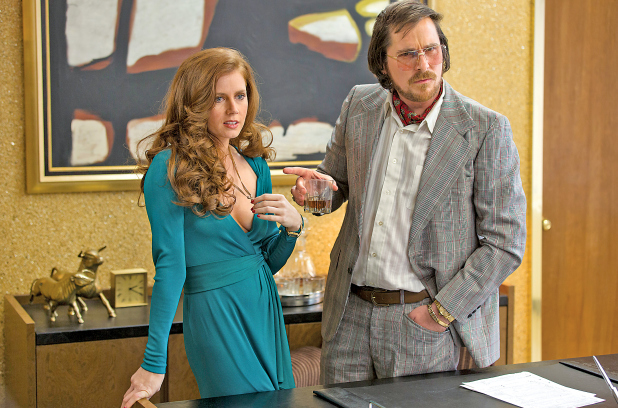
This weekend in American Hustle, Christian Bale plays Irving Rosenfeld, a con man forced to help the FBI ensnare a group of corrupt politicians in the ABSCAM sting operation.
Although American Hustle director David O. Russell says his film is a fictionalized account of events, the ABSCAM operation was headline news in the early 1980s and Hollywood took notice.
In 1982 director Louis Malle was making plans for a May start date on an ABSCAM film called Moon Over Miami starring Dan Aykroyd and John Belushi. Belushi was to play Melvin Weinberg, based on the same man as Bale’s character in American Hustle.
The movie was scuttled following Belushi’s death in March of that year.
That con man film never saw the light of day, but many others have.
Everyone knows The Sting and The Grifters, but lesser seen is David Mamet’s The Spanish Prisoner, a complicated story starring Campbell Scott as Joe Ross, a man who invents a process “to control the world market.” Concerned that he will not be properly compensated for his work he contacts Jimmy Dell (Steve Martin), a wealthy businessman who offers to help. Little does Ross know that he has just stepped into a world of deception that will change his life.
Steve Martin’s performance in The Spanish Prisoner was Oscar worthy, but it wasn’t the first time he played a confidence man on film.
In the comedy Dirty Rotten Scoundrels he starred opposite Michael Caine as a scruffy con man trying to muscle in on some high end business on the French Riviera. Caine’s suave grifter makes a bet with Martin. Whoever can con Soap Queen Janet Colgate (Glenne Headley) first will walk away with $50,000.
The movie was written for Mick Jagger and David Bowie who were looking to do a project together after the success of their Dancing in the Street video. The rock stars dropped out before cameras rolled — Bowie later said both were, “a bit tweezed that we lost out on a script that could have been reasonably good” — and replaced by Martin and Caine whose hilarious performances earned the movie a spot on Bravo’s 100 Funniest Movies list.