Have you ever heard the saying, “Be careful what you wish for because you just might get it”? It’s a fitting maxim for the new Disneyfied version of Stephen Sondheim’s musical “Into the Woods.” Of course, it is one of the themes of the show, but on another level, for the people who have long hoped to see a screen adaptation of the legendary musical, it may not be a situation of wish fulfillment.
Fans of the stage show will notice a few liberties have been taken with the show’s book. The changes are slight—for instance, the prince does not sleep with the Baker’s Wife, although they do have an encounter—but purists may feel like their beanstalk has been shaken a bit too much.
Casual fans of big screen musical theatre, however, will find a handsomely mounted reworking of the popular show, filled with the stuff of fairy tales: beautiful princesses, handsome but dimwitted princes, witches and even a giant or two.
The story is broken into two halves, a sunnier and irreverent “Once Upon a Time” first half that introduces the Baker (James Corden) and his Wife (Emily Blunt), a couple unable to have children because of a Witch’s (Meryl Streep) curse. The old crone agrees to undo the spell if the pair supply her with four items, a cow as white as milk, a cape as red as blood; hair as yellow as corn and a slipper as pure as gold.
Their search takes them into the woods and in collision (and later in collusion) with Jack (Daniel Huttlestone), later of Beanstalk fame, Little Red Riding Hood (Lilla Crawford) after the Big Bad Wolf (Johnny Depp) has swallowed her whole, Rapunzel (Mackenzie Mauzy) and Cinderella (Anna Kendrick).
The second half, the darker side of the fairy tale world, begins where the happily ever after part usually sits. When a female giant comes to the woods looking for Jack, the boy who killed her husband, the story takes a turn, teaching a lesson about wish fulfillment and responsibility for our actions.
“Into the Woods” has more to do with the original Grimm Brother Fairy Tales—the ones where evil stepmothers sawed the toes off their daughters to fit into golden slippers—than anything Disney has ever attempted before. The stereotypes are all present and accounted for, but under the prince’s brocade jackets or the Witch’s wild mauve wig, are complex characters that veer from comedic to serious to poignant, often in the same scene.
The cast is comprised of actors who can sing, warbling to Sondheim’s rich score. Standouts include “Agony,” an amusing duet between the two princes (Billy Magnussen and Chris Pine) and the Witch’s swansong “Last Midnight.”
On the downside, it feels a bit overlong and the Big Bad Wolf scene could have been renamed the Huge Unctuous Wolf, given Depp’s oily interpretation of the character.
“Into the Woods” survives the script meddling through strong staging, good performances and sheer wish fulfillment to make end up at it’s own kind of happily ever after.
I learned a great deal during my interview with Mackenzie Mauzy and Billy Magnussen. The Manhattan based performers brought me up to speed on the rite of passage for all New York actors, Rapunzel’s hair and whether or not Meryl Streep likes men in blue tights.
The pair play Rapunzel and Rapunzel’s Prince in the big screen adaptation of the legendary Broadway musical Into the Woods. The two relative new comers—she’s best known as Abigail on Forever while he made a memorable appearance on Boardwalk Empire and will soon be seen in an upcoming Steven Spielberg spy thriller—help bring fairy tales to life as part of a large ensemble that includes Johnny Depp, Emily Blunt and Meryl Streep.
Which leads me to the first thing I learned during our chat.
“Meryl’s a beast,” says Magnussen. “She’s the one who got me the job. I was in a play and she saw it and recommended to me [director] Rob [Marshall] and [producer] Mark Platt. The play was Vonya and Sonia and Marsha and Spike and I dress up as a prince because we’re going to a costume party. It’s all about the blue tights.”
“Meryl likes the blue tights,” laughs Mauzy.
Next I discovered the wig Mauzy wears in the film put her at a follicular risk.
“They used my hair and braided it into the extensions,” she says. “It was thirty feet long so I wrapped it around my arm. I had a little fake one for rehearsal but I asked to actually wear [the real one] one day so I could figure out how to be mobile. It’s a tripping hazard! We joke about how I had a really strong left bicep for a couple months.”
Then Magnussen enlightened me on a rite of passage for New York actors, “Once you get on Law and Order,” he says, “you’re really an actor.” Both have done time in the L&O trenches. Mauzy played a child killer named Carly Di Gravia—“It’s weird I remember that name,” she says.—while Magnussen says, “It was one of my first jobs. They bleached my hair white and I was a Southern male prostitute. How do you tell your mom? Hey watch this!”
Finally, one I gleaned one last pearl of knowledge from Mauzy. Apparently it’s OK to call Stephen Sondheim, legendary Into the Woods composer and eight time Tony Award winner, Steve. “Everyone calls him Steve!” she laughs. “He likes to be called Steve! It is weird. Steve Sondheim.”
At one time or another everyone has fantasized about, if not killing, then at least doing grievous bodily harm to an employer. The guys in Horrible Bosses, the 2011 comedy starring Jason Bateman, Charlie Day and Jason Sudeikis, actually tried to make their fantasies reality.
The idea of squaring off against the boss man struck a chord with a lot of people and the movie raked in more than $100 million. So the inevitable sequel, Horrible Bosses 2, hit theatres earlier this week.
They’ll have to go some ways to top the last trio of bad bosses: Jennifer Aniston as a foul-mouthed sexual predator with a bad habit of using laughing gas as foreplay; a manic boss with no scruples in the form of Kevin Spacey; and a drug-addled loser with a penchant for cocaine and masseuses who inherits a business from his papa, played by Colin Farrell, who berates his employees for coming in late after attending his dad’s and their old boss’s funeral.
“Well, maybe that excuse would have flown when my dad was here, but I’m in charge now.”
But even that terrible trio pales in comparison to the worst movie bosses of all time.
One of the worst is Working Girl’s Katharine Parker (Sigourney Weaver). Parker is two-faced, and attempts to pass off her trusted secretary Tess McGill’s (Melanie Griffith) ideas as her own. Roger Ebert said of Weaver’s performance, “From her first frame on the screen, she has to say all the right things while subtly suggesting that she may not mean any of them.”
In the end, Tess teaches her a lesson about honesty and gets Katharine fired.
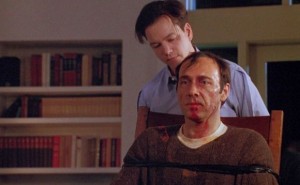
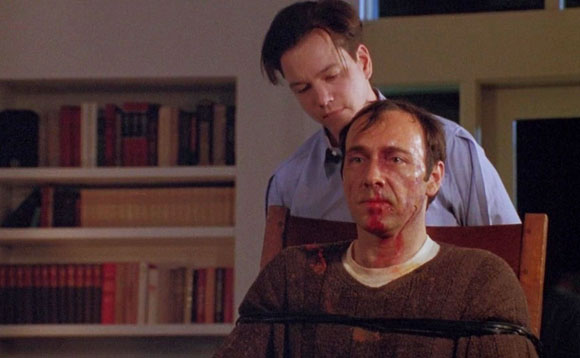
Katharine looks like a pussycat compared to Buddy Ackerman (Kevin Spacey), the tyrannical Hollywood producer in Swimming with Sharks.
“You are nothing!” he says to his new assistant Guy (Frank Whaley). “If you were in my toilet I wouldn’t bother flushing it. My bathmat means more to me than you!”
Guy finally snaps, kidnaps Buddy and tortures him. But in an unexpected twist, the extreme behaviour earns Buddy’s respect and Guy gets a promotion.
Finally, if you mix the swooping white hair and bad attitude of Cruella DeVille with the people skills of Vlad the Impaler, you will come up with Miranda Priestly, the worst boss in all of moviedom. Played by Meryl Streep in The Devil Wears Prada, Priestly is the editrix of a fictional fashion magazine called Runway who never met an assistant she couldn’t humiliate with a withering glance and a few choice words. “By all means, move at a glacial pace,” she says to newbie Andy Sachs (Anne Hathaway). “You know how that thrills me.”
A cross between an old school western and a Merrie Melodies cartoon, “The Homesman” is the latest from actor and director Tommy Lee Jones. A rough and tumble look at the harsh realities faced by women in frontier life it sheds light on a little seen aspect of life in the old west. It features a terrific performance from Hilary Swank and a spot on impression of Yosemite Sam from Jones.
Swank is Mary Bee Cuddy, a woman from New York State, now living in Loup City, Nebraska. She’s cultured, wealthy in land and know-how and unmarried. She’s well regarded in the town—one local says she’s “as good a man as many man hereabouts”—but her overtures at romance fall flat. She proposes marriage to Gam Sours (Jesse Plemons) with the caveat, “I won’t take no for an answer,” only to be rebuffed. “You’re as plain as an old tin pale,” he says, “and bossy.”
That may be so, but she has faired better than several other local women (Grace Gummer, Miranda Otto, Sonja Richter) whose fragile mental states have been pushed to the limit by the grim reality of life in Loup City. Cuddy volunteers to transport them on a five-week journey to Iowa where they can be cared for properly.
On the way she meets army deserter, coward and all round scoundrel George “Yosemite” Briggs (Jones). She saves his life and in return he reluctantly agrees to make the journey with them.
“The Homesman” starts off as one thing, a look at Cuddy’s life as it intertwines with these mentally ill women but shifts story wise and tonally with the introduction of Jones’s character. What could have been a tale of female empowerment does a u-turn, shifting the focus to Jones and his cartoonish portrayal of the hard-drinking, jig dancing Briggs. What begins as an unconventional western becomes even less conventional as Jones cuts ghastly scenes of women dumping babies into outhouse holes against more jocular dialogue.
Swank, when she is given something to do, does it extremely well and Tim Blake Nelson as an amorous cowhand is menacing and funny, which seems to be the offbeat tone Jones was searching for, but never quite finds.
Story and character wise “The Homesman” is muddier than the rough terrain it takes place on.
These days many speculative fiction films are set in dystopian cities, places ravaged by war, famine or man’s stupidity. “The Giver” goes a different way, setting the action in a utopian society where everyone is equal and no one, except for a young man named Jonas (Brenton Thwaites), questions anything.
Based on Lois Lowry’s young adult novel of the same name, “The Giver” is set in an ascetic world divided into climate-controlled communities. Climate isn’t the only thing that is tightly controlled, however. A strict set of simple rules—like “Use precise language” and “never tell a lie”—keep people in line but to make sure the citizens conform, they’re given a morning injection—the Prozac of the nation.
The docile population lives a colorless existence, where their every move is monitored and all choice has been removed because, as the Chief Elder (Meryl Streep) says, “When people have the right to choose they choose wrong every single time.”
When Jonas is chosen to be the Receiver of Memory, the recipient and keeper of all mankind’s darkest secrets and memories, he begins to realize that the world was not always monochrome, that it was once a colourful place where love—“ a word so antiquated it no longer has meaning”—and pain existed side by side with war, peace and all the other messy stuff that make humans human.
“The Giver” is George Orwell Lite, willy-nilly lifting from not only “1984,” but Ray Bradbury’s “Fahrenheit 451” and a host of young adult novels. It’s an unholy combination of dystopian themes and tropes, banged together to create a convincing, if somewhat dull world.
Shot in austere black and white, the highly controlled community is like 1950s America on film, structured, monotone in race and idealized. The conformity on display is chilling, at least the idea of it is. The film is too restrained to show us the detrimental effects of the grinding monotony of living in a place where sameness is valued above all. We’re told that the memories of the past are agonizing, “Sometimes the pain of the memories is too much,” says The Giver (Jeff Bridges)—but the flashbacks to the wild, untamed life that came before the enforced conformity aren’t as revealing as they’re meant to be. Colorful stock footage shots of people dancing, animal cruelty and other slices of life are meant to shine a light on the human condition but are, for the most part, no more provocative than anything we see on the nightly news.
They are jarring, like a screaming barker commercial for Monster Trucks interrupting an episode of “Masterpiece Theatre,” but only because they’re such a break in tone from the rest of the film. These visions may rock Jonas’s world, but they don’t make much of an impression on ours.
Also not making much of an impression is Meryl Streep in a generic villainess role. The cast’s other Oscar winner, Jeff Bridges is in full-on old codger mode, reviving his gruff voice for “True Grit” and bringing some humanity to a movie that should be teeming with it, but isn’t.
The remaining cast, even the leads, Thwaites as the young man who longs for something more in life and Odeya Rush, his love interest who has a harder time imagining a world without bland orthodoxy, aren’t given enough to do to make us root for them. Ditto supporting actors Alexander Skarsgård and Katie Holmes.
“The Giver” is a small movie with big ideas about individual freedoms, memory, traditions and customs. Important themes one and all, but they’re wrapped in a movie that does not do them justice.
And you thought your family get-togethers were weird.
Take the worst family dinner party ever, times it by infinity and you can begin to imagine the discomfort and distress at the Weston clan table. “August: Osage County,” the all star remounting of Tracey Letts’s hit Broadway play never met a disparaging remark it couldn’t place in the mouth of one of its mean-spirited diners.
The film reunites the Weston sisters, Barbara (Julia Roberts), Karen (Juliette Lewis) and Ivy (Julianne Nicholson) along with soon-to-be ex-husbands, grumpy granddaughters and secret lovers, with their pill-popping mommy dearest Violet (Meryl Streep). They come together when Dad (Sam Shepard) goes missing, but his disappearance is simply a backdrop to bring this desperate group of people together and allow them to wallow in their dysfunction.
“August: Osage County” is ram-packed with unlikeable characters played by likeable actors. There’s more baggage on display here than at any airport carousel and while it is occasionally difficult to buy in to the level of petty behavior displayed by Violet and her prey, the vindictive dialogue often does sound delicious rolling off the tongues of these actors.
A case in point is the dinner scene. It features the best example of ensemble acting on screen this year, giving everyone around the crowded table a chance to show what they can do. Chris Cooper’s rambling, extended saying-of-grace is worth the price of admission, but the powerhouse back-and-forth between Streep and Roberts is the main attraction.
Roberts hasn’t had a juicy role like this in years. Her Barbara is a bit of an enigma. She’s a jumble of mixed, complicated emotions, capable of both great kindness and compassion but seems only to express herself through tough love. When she explodes she’s letting loose a lifetime of rage stemming from her mother’s mistreatment.
When they go head-to-head it is the clash of the titans and an unforgettable scene.
Streep is shrill, and purposefully so, but it is far from a one note performances. For instance a porch swing monologue shows her mastery of the form. What could have been an interminable acting class monologue is transformed into an epic bit of storytelling with more range and character development in the five minutes it takes to play out than most movies contain in their entire running time.
“August: Osage County” sometimes feels like you’re watching “Who’s Afraid of Virginia Woolf” with all the tender parts removed. Unhappy people abound and so do inappropriate situations to the point where it becomes hard to imagine that this much dysfunction could be squeezed into one story, but director John Wells holds steady, creating a setting where this kind of behavior can thrive.
Only a misplaced smile in the film’s closing minute feels out of place. It’s an attempt at a Tinsel Town feel good moment in a film that has been uncompromising it its world view up until a final, unnecessary Hollywood touch.
Hollywood is full of hyphenates, the kind of people who introduce themselves as a model-actor-writer-waiter-personal-trainer-dog-walker.
Lately there is one Tinsel Town citizen, however, who has actually earned every word in his hyphenated title.
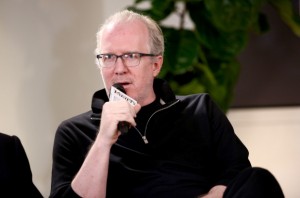
Tracy Letts is an actor-writer-producer-Pulitzer-Prize-winner who is going to have to get longer business cards if he gets any more successful. You may not recognize the name unless you pay attention to the end credits of Homeland (he plays Senator Andrew Lockhart on the popular show) or if you know who won the 2013 Tony Award for Best Actor in a Play for Who’s Afraid of Virginia Woolf?.
He’s a multi-talent with a shelf of awards, some heavyweight acting credits and a new movie screenplay on his resume.
His latest project, the script for August: Osage County, puts words into the mouths of some of the biggest stars in Hollywood. The film brings together the Weston sisters, Barbara (Julia Roberts), Karen (Juliette Lewis) and Ivy (Julianne Nicholson) with their pill-popping mommy-dearest Violet (Meryl Streep).
As a writer Letts says inspiration came from Tennessee Williams, William Faulkner and Jim Thompson, which might explain the dark vein that runs through his work.
How twisted are his plays? “Everybody in Tracy’s stories gets naked or dead,” says his mom, author Billie Letts.
Tracy jokingly says that his mother is “a liar” for saying that, pointing out that “not all of the people in my plays wind up naked or dead.”
Still there is no denying that his screenplay for Killer Joe, the 2011 Matthew McConaughey thriller, is written with what Roger Ebert called, “merciless black humor.” The story of a corrupt cop and a bad insurance claim earned critical praise even if the Women Film Critics Circle cited the film for its presentation of what they called “the worst female and male images” of the year.
According to Entertainment Weekly his script for Bug, starring Ashley Judd and Michael Shannon as a lonely woman and unhinged war veteran trapped in a bug infested Oklahoma motel room, contains an “enjoyably icky heart.”
Tracy Letts seems willing to take on any challenge to add to his hyphenate status. There’s just one thing you can’t ask him to do. “I don’t act in the stuff that I write,” he says. “I have no interest in doing that.”